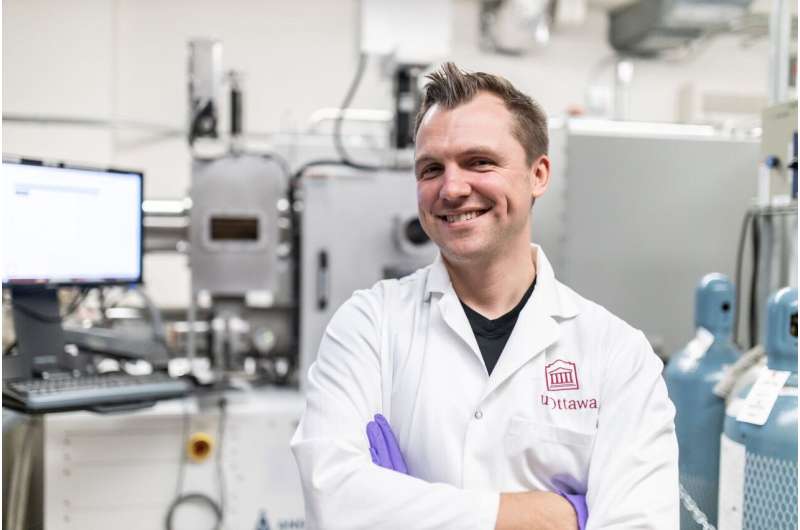
Dr. Benoît Lessard says that organic electronics are the best technology for creating wearable sensors and artificial skin. Credit: Dr. Benoît Lessard
Benoît Lessard and his team are developing carbon-based technologies which could lead to improved flexible phone displays, make robotic skin more sensitive and allow for wearable electronics that could monitor the physical health of athletes in real-time.
With the help of the Canadian Light Source (CLS) at the University of Saskatchewan (USask), a team of Canadian and international scientists have evaluated how thin film structure correlates to organic thin-film transistors performance.
Organic electronics use carbon-based molecules to create more flexible and efficient devices. The display of our smart phones is based on organic-LED technology, which uses organic molecules to emit bright light and others to respond to touch.
Lessard, the corresponding author of a recent paper published in ACS Applied Materials and Interfaces, is excited about the data his team has collected at the HXMA beamline. As Canada Research Chair in Advanced Polymer Materials and Organic Electronics and Associate Professor at the University of Ottawa in the Department of Chemical and Biological Engineering, Lessard is working on furthering the technology behind organic thin-film transistors.
To improve on this technology the team is engineering the design and processing of phthalocyanines, molecules used traditionally as dyes and pigments.
“The features that make a molecule bright and colorful are features that make them able to absorb and emit light effectively.” Lessard said. “A lot of things we want in a dye or pigment is the same thing we are looking for in your OLED display—brightly colored things that make light.”
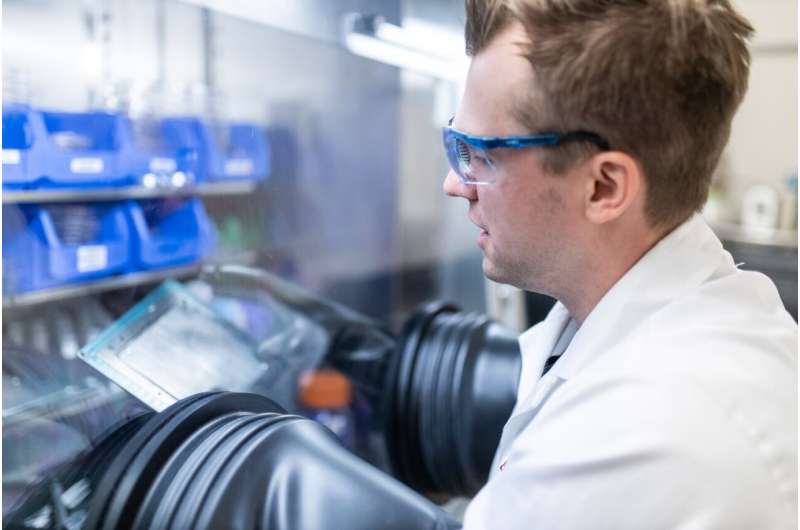
Benoît Lessard in the lab. Credit: Image courtesy Benoît Lessard.
Phthalocyanines have been used in photocopiers and similar technologies since the 1960s. Repurposing these molecules for use in organic electronics helps keep costs down and makes the manufacturing of these devices more practical, allowing for their use in many unusual applications.
“The computer we are using has a billion transistors, but if you want to have artificial skin for robotics or wearable sensors, you are going to need flexible, bendable electronics and the best way to do that is to go organic,” Lessard said.
Organic electronic technologies can be used in artificial skin for burn victims or electronic skin for robots. Organic sensors could be imbedded in athletic clothing and could send information to coaches who could observe an athlete’s hydration levels by monitoring what is lost in their sweat.
“The applications are sort of anything you can dream of,” Lessard said.
Lessard has also used this technology in the creation of sensors that detect cannabinoids, the active molecules in cannabis. He is co-founder of a spin-off company called Ekidna Sensing, which develops rapid tests for the cannabis industry based on similar technologies.
“Everything we are learning at the synchrotron could help us towards this goal of the start-up company,” Lessard said.
While there are table-top technologies available, they aren’t powerful enough to reveal what happens at the interface, which is only a couple of nanometers thick. The team couldn’t have generated the data needed for understanding how the transistors perform without the help of the CLS.
TORONTO — Some experts say Canadians might want to consider upgrading their face masks, doubling up mask layers, or wearing one while outdoors as more contagious COVID-19 variants continue to spread.
Dr. Gerald Evans, chair of Queen’s University’s infectious diseases division in Kingston, Ont., told CTVNews.ca on Thursday that better quality masks and masking practices may be necessary as the coronavirus pandemic continues.
“There’s always been a strong suggestion that a ‘better’ barrier [regarding] masks is likely to be more efficient at reducing transmission from droplets and short-range aerosols,” Evans said in an email.
“So generally speaking, medical masks are better than non-medical masks, and multiple layers [or] three non-medical masks are better than three-layer non-medical masks,” he explained.
With this in mind, Evans said wearing two masks, a medical mask underneath a reusable fabric mask, “might be better than a single mask.” However, he noted that “no current evidence supports that variants require ‘more’ PPE or masking to reduce transmission.”
“As long as PPE is used properly and consistently, it will be effective,” Evans said.
“If you have a physical covering with one layer, you put another layer on, it just makes common sense that it likely would be more effective, and that’s the reason why you see people either double masking or doing a version of an N95,” Fauci said.
However, Fauci appeared to backtrack on his comments at a town hall appearance on CNN on Wednesday, stressing Americans follow CDC guidance, which does not call for wearing two masks.
Canada’s Chief Public Health Officer Dr. Theresa Tam suggested in November that Canadians start wearing face coverings that are made of three layers with one being a filter.
According to the Public Health Agency of Canada (PHAC), a non-medical mask should be made of at least three layers, two of which should be tightly woven material fabric, such as cotton or linen. The third, middle layer should be a filter-type fabric, such as non-woven polypropylene fabric.
Reusable masks with a non-woven filter layer already built in should be washed daily, and can be washed multiple times. Those with disposable filters should be changed daily or as directed by the manufacturer, according to the updated guidelines.
Dr. Anna Banerji, director of Global and Indigenous Health at the University of Toronto’s Temerty Faculty of Medicine, suggested that Canadians may also want to consider wearing face masks while in certain circumstances outdoors to help reduce possible transmission.
Banerji explained to CTVNews.ca on Thursday that certain areas may become unexpectedly busy, and in those situations, she says Canadians may want a face covering if physical distancing is no longer possible.
“If you’re outside and you’re in a place where you’re walking near people then it’s a good idea to mask up,” Banerji said in a telephone interview.
Regardless of how many layers one’s mask has, Banerji says wearing one at all remains critical as variants emerge.
Banerji explained that PHAC’s updated guidelines do not mean that fabric masks or two layer masks are no longer effective. She said these masks still work, however, more layers will provide more protection.
She said those who don’t have a three-layer mask with a filter should consider wearing a disposable, surgical mask under their cloth mask.
MORE THAN MASKING
Although COVID-19 variants first identified in South Africa and the U.K. have started to spread in Canada, Colin Furness, an expert in infectious disease epidemiology from the University of Toronto, told CTVNews.ca on Thursday it is important to maintain adherence to all public health guidelines.
The variant discovered in the U.K., known as B117, is estimated to be at least 56 per cent more transmissible between people than the original coronavirus strain as a result of a series of mutations. In recent weeks, European countries have begun mandating medical-grade masks in public settings to help combat the variant.
However, Furness cautioned that there isn’t enough data on the new variant yet to know whether double masks of multiple layers are, in fact, effective.
“A better quality mask, a three-layer mask, might provide a little bit more protection for the wearer. I mean that’s the idea… But we don’t have data about the more contagious variant, we don’t have experience with it yet,” Furness said in a telephone interview.
While researchers have learnt more about the behaviour of the latest variant from outbreaks in the U.K. and Ireland, Furness stressed that those countries have different climates, different populations, different cultures and different health restrictions that impact how COVID-19 spreads.
Furness said the best way to protect against this variant would be to limit one’s contacts.
“If you’re trying to improve your personal safety, your mask doesn’t matter nearly as much as staying away from other people. When you improve your mask, you’re mostly improving the safety of people around you,” Furness said.
He added that having a better quality face covering or a mask with more layers does not permit Canadians to gather with friends and family.
While there is “reasonable evidence” that this variant is more transmissible than the original strain, Dr. Matthew Oughton, an infectious diseases specialist at the Jewish General Hospital in Montreal, told CTVNews.ca in an email that continuing to follow all public health guidelines should provide adequate protection.
“This is still SARS-CoV-2, and the preventative measures which work, including physical distancing, masks and face coverings, good ventilation, and hand hygiene all still apply. A prudent approach would be to reinforce the importance of those fundamentals regardless of what variants may or may not be present in a population,” Oughton said.RELATED IMAGES
People wear face masks as they walk along a street in Montreal, Saturday, January 23, 2021, as the COVID-19 pandemic continues in Canada and around the world. THE CANADIAN PRESS/Graham Hughes
There are many ways to detect movement and distances with your electronics. In another tutorial, we showed how to use a PIR motion sensor with Raspberry Pi Pico. Used in alarm systems, PIRs employ Infrared light to detect moving bodies in a room and are good for projects where, for example, you want users to wave their hands in front of a device to activate it. Our tutorial on how to build a Raspberry Pi handwashing timer uses a PIR.
Ultrasonic sensors, on the other hand, use pulses of sound and a simple calculation to determine the distance between themselves and the objects in front them. They are often used in robots to make sure the bot doesn’t walk or roll into an obstacle. We also used one in our Raspberry Pi Toilet paper reminder to tell when we’re running out of rolls. In this tutorial we will use an ultrasonic distance sensor, an HC-SR04+, to quickly determine the distance of an object from our Raspberry Pi Pico.
Hardware Setup of Ultrasonic Sensor on Raspberry Pi Pico
This build exclusively uses an ultrasonic sensor compatible with the 3V logic used on the Raspberry Pi Pico GPIO. The HC-SR04P and HC-SR04+ are compatible with 3V and 5V logic making them ideal for Raspberry Pi Pico, Pi and Arduino projects.
(Image credit: Tom’s Hardware)
2. Insert the HC-SR04P ultrasonic sensor into the breadboard. RECOMMENDED VIDEOS FOR YOU…CLOSEhttps://imasdk.googleapis.com/js/core/bridge3.436.0_en.html#goog_1714470621Volume 0% PLAY SOUND
(Image credit: Tom’s Hardware)
3. Connect the 3V3 pin of the Raspberry Pi Pico to the VCC pin of the ultrasonic sensor using a male to male jumper wire.
(Image credit: Tom’s Hardware)
4. Connect a GND pin on the Raspberry Pi Pico to the GND pin of the ultrasonic sensor using a jumper wire. Advertisement
(Image credit: Tom’s Hardware)
5. Connect the Trigger pin of the ultrasonic sensor to GPIO pin 3 of the Raspberry Pi Pico.
(Image credit: Tom’s Hardware)
6. Connect the Echo pin from the ultrasonic sensor to GPIO pin 2 of the Raspberry Pi Pico. Advertisementhttps://318466ad5b1290869641f6659674551a.safeframe.googlesyndication.com/safeframe/1-0-37/html/container.html
(Image credit: Tom’s Hardware)
Software Setup of Ultrasonic Sensor on Raspberry Pi Pico
With the circuit built, connect your Raspberry Pi Pico and open the Thonny application.
1. Import the Pin class from the machine library and then import the utime library. The former is used to control GPIO pins, the latter is a library of time based functions.
from machine import Pin
import utime
2. Create two new objects, trigger and echo. These objects configure the GPIO pins of the Pico to be used with the ultrasonic sensor. For example our trigger pin is used to send a pulse of current, as such it is an output pin. The echo pin receives the reflected pulse, so echo is an input.
trigger = Pin(3, Pin.OUT)
echo = Pin(2, Pin.IN)
3. Create a function, ultra(), which will contain the code necessary to take a reading.
def ultra():
4. Pull the trigger pin low, to ensure that it is not active, then pause for two microseconds.
   trigger.low()
   utime.sleep_us(2)
5. Pull the trigger pin high for five microsends before pulling the trigger pin low. This will send a short pulse from the ultrasonic sensor and then turn off the pulse.
   trigger.high()
   utime.sleep_us(5)
   trigger.low()
6. Create a while loop to check the echo pin. If no echo pulse is received, update a variable, signaloff so that it contains a timestamp in microseconds.
   while echo.value() == 0:
       signaloff = utime.ticks_us()
7. Create another while loop, this time to check if an echo has been received. This will store the current timestamp in microseconds to the signalon variable.
   while echo.value() == 1:
       signalon = utime.ticks_us()
8. Create a new variable, timepassed, which will store the value total time taken for the pulse to leave the sensor, hit the object and return back to the sensor as an echo.
timepassed = signalon - signaloff
Advertisement
9. Create a new variable, distance. This variable will store the answer of the equation. We multiply the journey time (timepassed) by the speed of sound (343.2 m/s, which is 0.0343 cm per microsecond) the product of that equation is divided by two as we do not need the total journey distance, just the distance from the object to the sensor.
distance = (timepassed * 0.0343) / 2
10. Print a message to the Python Shell showing the distance.
print("The distance from object is ",distance,"cm")
11. Moving out of the function we now create a loop that will run the function every second.
while True:
   ultra()
   utime.sleep(1)
Here’s the complete code:
Complete Code Listing
from machine import Pin
import utime
trigger = Pin(3, Pin.OUT)
echo = Pin(2, Pin.IN)
def ultra():
   trigger.low()
   utime.sleep_us(2)
   trigger.high()
   utime.sleep_us(5)
   trigger.low()
   while echo.value() == 0:
       signaloff = utime.ticks_us()
   while echo.value() == 1:
       signalon = utime.ticks_us()
   timepassed = signalon - signaloff
   distance = (timepassed * 0.0343) / 2
   print("The distance from object is ",distance,"cm")
while True:
   ultra()
   utime.sleep(1)
Save the code to the Raspberry Pi Pico as code.py and click on the green arrow to run the code. In the Python Shell you will see the distance printed every second.Advertisementhttps://318466ad5b1290869641f6659674551a.safeframe.googlesyndication.com/safeframe/1-0-37/html/container.html
New research led by the University of St Andrews finds that a common eye condition has little or no impact on an aspect of a person’s three-dimensional perception.
The research, led by scientists from the School of Psychology and Neuroscience and published by the Royal Society Open Science, reveals, for the first time, that a common eye condition called strabismus, also often referred to as a squint, does not impair a person’s ability to perceive 3-D layout.
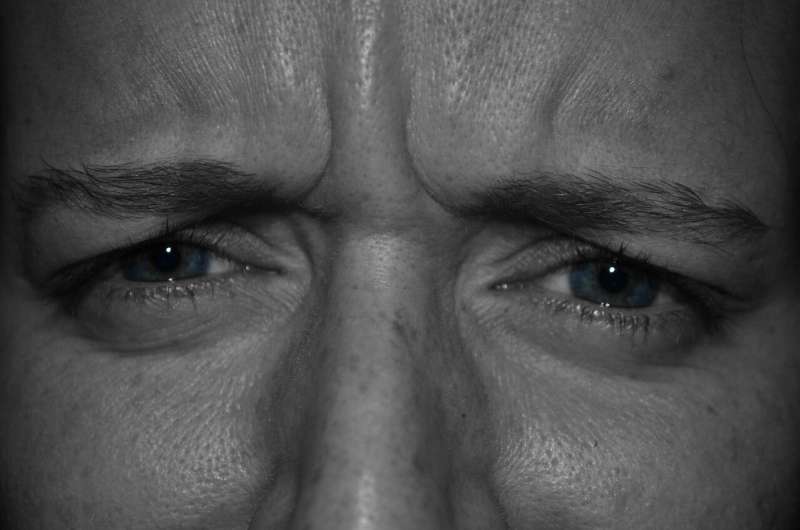
Strabismus, an ophthalmological condition of the misalignment of the eyes typically arising from neurological disorders, results in an inability to focus both eyes on a single point in space. The condition is known to be linked to neuropsychological impairments including amblyopia (lazy eye) and deficits in depth perception.
The exact nature of the deficits in 3-D and depth perception is poorly understood as knowledge of the way individuals with strabismus experience depth has often been based on anecdotal reports and conjecture. Previous studies have focused on one aspect of 3-D perception, the capacity to conduct motoric tasks that require estimates of distances to nearby objects. Relative depth perception is a fundamental aspect of 3-D vision that underlies a person’s capacity to perceive 3-D shapes and layout of objects.
The team of scientists investigated, for the first time, the perception of relative depth from the cue of linear perspective in strabismus using pictorial images. The findings reveal that strabismics are unimpaired in the perception of relative depth in comparison to observers with typically developed binocular vision.
The results contrast with a view often presented in anecdotal reports in popular media that strabismus leads to a general deficit in depth perception.
Lead author, Dr. Giedre Zlatkute, from the School of Psychology & Neuroscience and currently at the School of Medicine at the University of St Andrews, said: “There is considerable ambiguity and confusion in the popular media about the extent of deficits in depth and 3-D perception in strabismus; our findings show that, contrary to popular opinion, there is little impact on a major aspect of 3-D vision for a person with a strabismic vision.”
Senior author of the study, Dr. Dhanraj Vishwanath, said: “These results support a theory that the brain constructs at least three distinct types of representation that support different competencies in 3-D vision: the perception of distances of objects near the viewer (in personal space), the perception of object distances at walking distances, and the perception of 3-D object shape/layout (relative depth). Our results, combined with a few other studies, suggest that individuals with strabismus may be impaired only in the first component (perception of near distances) but have largely intact perception in the other two.”
Dr. Zlatkute explained: “In addition to difficulties in perceiving distances in near space, individuals with strabismus can also be impaired in perceiving the ‘3-D effect’ of 3-D movies. Further studies are required to fully understand how these impairments are linked and how they impact on a person’s overall 3-D perception in comparison to those with typically developed binocular vision.”
Image by Lumina / StocksyOur editors have independently chosen the products listed on this page. If you purchase something mentioned in this article, we may earn a small commission.January 29, 2021 — 2:13 AMShare on:
Somewhere in the annals of sleep history, eight hours became the gold standard for the amount of zzz’s we should all strive for nightly. While it’s true that most adults could use around seven to nine hours in bed every night, this idea that everyone needs the same amount of sleep has not withstood the test of time.
Here, these two experts break down why optimal sleep varies from person to person, and ultimately from night to night.
Factors that can influence how much sleep someone needs on any given night.
Sleep preferences are likely partially genetic, and research has found that a number of sleep traits and sleep disorders are hereditary. So the reason that you need nine hours of sleep to feel rested while your co-worker seems fine after six could come down to DNA.
There are, of course, also outside factors that could shift how much rest you’ll need to wake up feeling alert. Here are a few that Breus and Pelayo note:ADVERTISEMENT
The menstruation cycle:
“I’ve [seen patients] who need more sleep before they have their period and who need less sleep after they have their periods, and we adjust their bedtimes accordingly,” Breus said on the mbg podcast. This is likely due to fluctuations in hormones like progesterone, luteinizing hormone, and prolactin. Uncomfortable cramping can also jolt women awake, and people tend to require more hours of sleep on nights of frequent wakeups.
Seasonal shifts and external stimuli:
Your external environment might also change your sleep needs. If you live in an area that acknowledges daylight saving, for example, Pelayo notes that you might need to shift your sleep routine during the twice-annual clock adjustment.
This idea that our sleep needs shift over the course of a year makes sense from an evolutionary perspective, too. “How could we really be eight-hour sleepers if mothers have to feed their babies every two to three hours when they’re nursing?” he says. “There has to be this mechanism built into our brains to avoid sleeping under certain circumstances. You have to be able to push off sleep, take care of something, and go back to sleep later. There’s got to be some flexibility in the system.”
Health issues:
Sleep is when your immune system repairs itself, so you need more of it when you’re actively fighting an infection. And those who constantly need a lot of sleep to feel rested might be dealing with an underlying health condition.
How to find your ideal number.
Ultimately, how you feel when you wake up is the best indicator of your sleep quality. Waking up feeling energized is a good sign that you got the right amount of sleep for your body.
If you’re unsure what your ideal sleep number is, play around with setting an alarm so you get 7.5 hours and nine hours of sleep to start, corresponding to five and six sleep cycles, respectively. Note how you feel upon waking, and track your findings in a sleep diary. Add details about what time you got in bed, what time you woke up, what you did in the hours leading up to bed, and what (and when) you ate the night before to get a more complete picture of the habits that enhance or harm your sleep.
Once you find your ideal number—or ideal range—stick to it! When it comes to sleep, the experts stress that consistency is key. That means going to bed and waking up at around the same time every day, even on weekends. Pelayo adds that it’s important to leave yourself some wiggle room, too. So if you know you need 7.5 hours of sleep to function at your best, don’t get into bed exactly 7.5 hours before your alarm is set to go off.
“As you get older and life gets more complicated, you learn the amount of sleep you need, and that’s what you home in on,” he says, adding that constantly teetering on a razor’s edge like this can make you more vulnerable to the unfortunate side effects of a night of poor sleep. “If you always sleep as little as possible and then don’t sleep, the next day you’re a basket case.”
The bottom line.
Eight hours has long been a gold standard for the amount of sleep people should aim for, but that number won’t work for everyone. Like so much of health, sleep is highly individualized, and only you know how much sleep you need to feel your best the next morning. Once you find your ideal number, do your best to honor it.
Still from Steven Pinker’s Harvard psych course.Credit: Steven Pinker / HarvardHarvard University professor Steven Pinker is offering free lectures from his Harvard psych course online.Pinker is a celebrated thinker, author, experimental cognitive psychologist, and linguist.The lectures are being shared via Twitter and you can start on one right now.
Steven Pinker, the noted Canadian-American cognitive psychologist and linguist, is offering lectures from his spring Harvard psych course for free online. If you ever wanted to get into psychology, now is your chance, as Pinker has already shared the introductory lecture via his Twitter.
The course is titled “Psy 1 – Introduction to Psychological Science” and as its description states, it has been redesigned in 2021 as a survey of “the scientific study of human psychology.” It will introduce students to such subjects as perception, consciousness, and cognition, as well as how to we make decisions that drive our social behavior, what are emotions, motivations, and psychopathology. Adapted for online learning, students will be watching recorded lectures on their own time, while contact with the professor will take place twice a week. You’d have to be taking the course at Harvard to participate in these sessions of asking questions and diving deeper into the material with Professor Pinker.
Obviously, assignments and tests are also not available unless you’re a student, but the great knowledge from a world-renowned expert is definitely there.
Recognized as an important thinker, Steven Pinker is known for a variety of contributions across scientific fields and as a popular author on language, mind, and human nature.
His research on vision, social relations, and language has won a plethora of prizes from the National Academy of Sciences, the Cognitive Neuroscience Society, the American Psychological Association, the Royal Institution of Great Britain, and other institutions. He has eight honorary doctorates, teaching awards from MIT and Harvard, and many prizes for his books like “The Better Angels of our Nature“.
Steven Pinker: Linguistics as a Window to Understanding the Brain
Pinker’s current research looks at the role of common knowledge in language and social phenomena, studying trends in violence, psycholinguistics of writing, the neurobiology as well as genetics of language and more.
It’s late and you’re exhausted. You barely had time to eat dinner and shower after work. Maybe you watched a few episodes of a show, read a chapter of your book, struggled through your skin-care routine. Now you’re in bed, and you know you should sleep. But you keep scrolling—past the point that feels good. Your eyes start to close and you have to be up at 5 a.m. for work, but you’re not ready for rest. Some part of you is unsatisfied.
This activity has a name: bedtime revenge procrastination.
It’s a phrase popularized by millennials and Gen Z in China, which literally translates to “sleepless night revenge,” Sandra, a 24-year-old Mandarin speaker living in Paris, told Glamour. In the U.S., the pandemic has exacerbated everything that was already broken in a culture where work determines access to health care and sense of value. “The combination of a capitalist workday, mixed with work-from-home life and an ever growing attachment to our technology is the perfect storm that contributes to ‘revenge bedtime procrastination,’” says Aliza Shapiro, a clinical social worker and therapist in Manhattan. “Intuitively, we know we need to rest in order to become productive again, so when we lack the resource of relaxation during the day we try to find it in other places and times—even if it’s at the expense of our sleep.”ADVERTISEMENT
It’s deeply validating to learn that this habit has a name, and that you are not alone in doing it. The term “bedtime revenge procrastination” has spread on social media, each “heart” and “it me” like a little collective sigh of relief, a loss of shame.
Last June writer Daphne K. Lee introduced it to English-speaking Twitter as “a phenomenon in which people who don’t have much control over their daytime life refuse to sleep early in order to regain some sense of freedom during late night hours.”https://platform.twitter.com/embed/index.html?creatorScreenName=glamourmag&dnt=false&embedId=twitter-widget-0&frame=false&hideCard=false&hideThread=false&id=1277101831693275136&lang=en&origin=https%3A%2F%2Fwww.glamour.com%2Fstory%2Frevenge-bedtime-procrastination-is-real-according-to-psychologists&siteScreenName=glamourmag&theme=light&widgetsVersion=ed20a2b%3A1601588405575&width=550px
“Fun fact, did you guys know that there’s this thing called revenge bedtime procrastination,” she asks in a video that has now been viewed 13.6 million times. “Where people will refuse to sleep because they don’t have much control over their daytime life, so they will sleep very late at night, even if they’re super tired, because they just don’t want that free time to end at night, and they don’t want tomorrow to start?”
Haider’s video, bleakly relatable with its stark background and drained Starbucks cup, garnered millions of likes and tens of thousands of comments. “Okay, so it has a name” and “I do this” are common variants. “I feel personally attacked,” reads one comment liked more than 50,000 times.
Why do we do this?
Chel’sea Ryan, a clinical social worker and therapist at the Southwest Center for HIV/AIDS in Phoenix, says she has both personal and professional experience with this phenomenon. After a day of office work and an evening of caring for her kids, she would lose sleep in favor of unwinding, reasoning, “This is my only time to breathe, be human, be a woman.” But her late-night habit created an anxiety spiral that eventually resulted in panic attacks. She’s seen it in her patients too. “A lot of clients have kids, or multiple jobs, or home life isn’t that great,” she says. “So they’re picking and choosing times when they can really cater to themselves, and usually that’s at night.”
If we’re really going to cater to ourselves, why not do a few minutes of yoga, or drink tea, as we’ve been told to do 5,000 times by freakishly cheerful wellness influencers? Why fall face-first into our phones? “For many of us, when we finally put away all of our technology at the end of the night, it is the first time that we are left alone with our thoughts and feelings without any distractions,” says Shapiro. “If we’re afraid of what we may find, or—perhaps more commonly—know that we will be met with uncomfortable, complicated, or heavy thoughts or feelings, we are going to unconsciously try to avoid them. Engaging in the late-night scroll may be an attempt to either push off the flood of emotion that may hit us when we close our eyes, or to exhaust ourselves to the point that we instantly fall asleep and don’t have to think at all.”
Dark! Accurate! And, ultimately, Shapiro says, not going to work. “We’re trying to protect ourselves, but we forget that avoidance actually makes the emotions stronger and we enter into a cycle of late-night anxiety,” she says.
Why is this so much worse right now?
“Demands on our time have gotten higher during the work-from-home period of time, not lower,” Ashley Whillans, Ph.D., a researcher and behavioral scientist at Harvard Business School, tells Glamour. She’s been studying how people are using their time during the pandemic in five countries, including America—her group’s research found that women, especially mothers, are spending more time on childcare and household chores than fathers do. (Surprise, surprise.)
They also found that young women, particularly at the beginning of the pandemic, spent less time on leisure than their male counterparts. This may be because we have more demands on our time—maybe we’re parents, managing Zoom school, or scrambling to pay the bills with a second job, or doing the seemingly endless work of a job search, or simply allowing a 9-to-5 to balloon into an 8-to-6. “Our workdays last longer because there’s no clear separation of when we should stop,” Whillans says. This is not healthy. “Emotional detachment from work is hugely important for job satisfaction!” she says. “But the end-of-our-workday ritual has gone missing in the virtual environment.”https://cb12d9da7d7bce87afe4fabc15662e92.safeframe.googlesyndication.com/safeframe/1-0-37/html/container.htmlMost Popular
And on top of that, we’re lonely. Tea and yoga just aren’t relevant when your deepest urge is not for tranquility but for human connection. “We’re inherently social animals, and social media provides us with an access, a conduit to other people’s social lives that especially right now is less available,” Whillans says. “So it absolutely does not surprise me at all that we are trying to take back control over a very stressful time.” Scrolling through your phone at night, she says, allows us to “imagine alternative realities of things we could be doing.” Overdoing it on social media is an understandable reaction to social distancing, Ryan agrees. “A lot of my patients are struggling during the pandemic with quarantine depression because everything is remote, isolated—their days kind of run together,” she says. Of course we’re trying to scroll our way into feeling better.
So how do we stop?
Laurie Santos, Ph.D., the director of the Comparative Cognition Lab at Yale, whose class on the psychology of happiness has become world-famous, has the answer you might not want to hear: “There’s lots of research showing that feeling like you have a bit of free time is super important for well-being,” she says. But at the same time, “many of the problems that drive revenge sleep procrastination—feeling depressed, being too burned out to enjoy your day, and so on—can be helped by simply getting more sleep,” she adds. “So I worry that people are creating a vicious cycle by ruining what leisure time they do have by not getting enough sleep.” Of course, we all know that we should get more sleep. But Santos offers it not as an annoying cure-all, but as a real, strategic opportunity to potentially break the “revenge bedtime” cycle.
You can also do more to optimize the time you do spend on your nighttime “revenge,” she says. “Often, when we get free time, we flop down and watch TV or scroll through social media. These leisure activities don’t really give us the well-being bump we assume.” We would feel more satisfied at the end of the day, she says, if we spent time on leisure activities that let us learn or give us a sense of “flow.” (Apparently the gentle movement of Netflix’s “next episode” button does not count as “flow.”)
Ryan and Shapiro both recommend carving out breaks while it’s still light outside—calendaring them in and taking them seriously. Ryan, knowing that later in the evening she’ll be busy with her kids, builds 15 minute segments into her workday. “I shut my office door, I put my music on, and I just breathe,” she says. But it would be okay to use that time just to watch half a TV show, she adds. Shapiro says that, to avoid the mindless scroll later at night, you have to practice not being afraid of your thoughts. Meditate, even for five minutes. Actively stopping and asking yourself how you’re doing throughout the day will help you avoid an outpouring of negative feelings—and subsequent hours of scrolling—at night. A bonus: If you do this during work, you can hopefully get “revenge” (or in this case, basic workers’ rights) by taking time out of your workday, not out of your free time.
Haider, whose TikTok launched a thousand “It me”s, says her DMs are currently flooded by people who want to change. Me too—I find myself fighting sleep a few nights a week, desperately grasping for a few more moments of positive emotion before I pass out and start the day again. I think the thing about bedtime revenge procrastination is that, however bleak its origins are and whatever toll it takes, it’s a quiet reminder from your unconscious that you really do like being alive. There are so many good things in life that you don’t want to fall asleep and miss them. We want one more funny video, one more text from a friend, one more moment feeling awake, and happy, and free.





.jpg)
 Bruce's Blog