Month: January 2021
https://www.phonearena.com/news/amazon-alexa-voice-assistant-new-feature-tell-me-when-events-emails_id129422
Amazon improves Alexa’s power and versatility in yet another meaningful way
by Adrian DiaconescuJan 09, 2021, 2:49 PM

The greatest thing about Amazon’s universally acclaimed Alexa virtual assistant may well be how often the company adds cool new features and capabilities to improve both its power and versatility. Some of these are obviously more important than others, and while many smaller updates tend to fly under the radar for the general public, users that might stumble into a freshly released feature will sometimes be pleasantly surprised by what they can do without lifting a finger to make their lives easier.
For instance, the folks over at The Verge are putting the spotlight today on a handy functionality seemingly rolled out at some point last month (and last year) in the US. This allows owners of Echo-branded devices, as well as a variety of other Alexa-enabled gadgets, to indirectly set reminders for events they may be interested in by asking their voice assistant to “tell” them “when” said event is scheduled to take place.
You can simply say the magic words “tell me when” X is, and in addition to, well, answering your question with a relevant time and date, Alexa will remember you showed an interest in a specific occurence, alerting you when that’s about to go down without any extra effort on your part.
Case in point, let’s say you don’t know when this year’s (delayed) Academy Awards will unfold and you also want to be reminded of the ceremony on the big day. Instead of using two different voice commands, you can rely on this single feature to get both jobs done simultaneously.
If that doesn’t impress you much, you might be pleased to hear the feature also supports emails in addition to things like sporting events, TV shows, and public holidays. In other words, if you’re not too worried about privacy, you can ask Alexa to “tell” you “when” an important contact sends you an email so you don’t have to constantly and manually check your inbox like some sort of a savage.
Naturally, that doesn’t quite make this feature life-changing in any meaningful way, but it pretty much goes without saying that you can find a decent use for it from time to time to keep you informed of all the stuff you’re interested in.
https://hellogiggles.com/lifestyle/how-to-wake-yourself-up/
7 Tips Sleep Experts Taught Me to Help Stop My Snooze Button Habit
7 Tips Sleep Experts Taught Me to Help Stop My Snooze Button Habit
And no, getting a louder alarm is not the answer.Morgan Noll Jan 04, 2021 @ 5:27 pmEach product we feature has been independently selected and reviewed by our editorial team. If you make a purchase using the links included, we may earn commission.ADVERTISEMENTFBTweetMore

I’ve always considered myself someone who’s good at sleeping. I can usually fall asleep within 10 minutes of my head hitting the pillow, and I often stay asleep throughout the night, despite the constant busy street noise outside my New York apartment window. What I’m not good at, however, is waking and staying up in the morning.
No matter how determined I am to get a head start on my day, in the morning, my brain always seems more determined to get back to sleep. Sometimes, my half-conscious, half-dreaming mind will even make me think I have to get back to something important in my dreams—like a special work meeting. (The irony, of course, is that doing so only delays my IRL workday.) This groggy morning affliction has become an everyday issue for me, so I consulted sleep experts for advice to better understand why it’s so hard to wake up and what I can do to change it.
Why do I wake up tired?
What I learned is that there are multiple potential reasons for why I have trouble waking up—and none of them are as simple as just being bad at mornings (the conclusion I’d come to on my own). In fact, mornings aren’t necessarily the problem; it’s every other time of day and night that can make the biggest difference in how I, and many others who have trouble getting out of bed, feel when waking up. Eric Nofzinger, M.D., a sleep researcher and founder and chief medical officer of Ebb Therapeutics, describes sleep as “a process of restoration.” If our sleep at night isn’t sufficiently restorative—which could mean we’re not getting in our seven to eight hours, we’re waking up a lot in the night, or we’re not sleeping deeply enough—we’ll feel the effects of that in the morning.
One of the main reasons we might not be getting restorative sleep is stress and anxiety—and the ways in which we deal with it throughout the day. Especially right now, with the pandemic dragging on, removing stress and anxiety from our lives is not easy—but there are ways to work through these emotions and create better nighttime routines so that we aren’t going to bed with so much racing around in our minds.
Of course, there are many other potential factors for why you may be struggling to wake up in the morning, including sleep disorders and depression, so it’s important to consult a doctor if you think something else may be going on. But if you’re simply looking to improve your sleep and help yourself wake up in the morning, keep reading for more expert advice.
How to wake yourself up:
1. Confront your stress and anxiety during the day.
When we keep busy all day long, it’s easy to compartmentalize our worries into the “save for later” tab in our brains. While that might help us focus on other things during the day, those thoughts often come rushing out of hiding right when we’re trying to fall asleep at night. “In order to get into a deep sleep, your mind kind of has to be free of worries and cares,” Dr. Nofzinger says. “When we go to bed at night, we have to feel safe, and we have to feel secure.”
To avoid going to bed with such a busy and heavy mind, Dr. Nofzinger says it’s important to try to deal with and confront our stressors throughout the day. This could look like going to therapy, journaling, talking to a friend, or even just crying it out when you need to.
One specific method that Kelly O’Brien—a board-certified health and wellness coach at Proper—recommends is called a “brain dump,” a technique used in cognitive behavioral therapy. The Four Square Brain Dump, as detailed on PsychCentral, involves dividing a page into four sections—”Thoughts,” “To Do,” “Gratitude,” and “Top Three Priorities”—and filling out each section accordingly. This process can help you manage, organize, and acknowledge your thoughts so they don’t feel as overwhelming in your mind.

2. Create a wind-down routine.
In addition to working through your emotions throughout the day, O’Brien recommends creating a specific bedtime routine. Intentionally engaging in non-activating and non-stimulating behavior before bed will help support a healthy circadian rhythm and prepare both your mind and your body for sleep. “When we send cues to the brain and the body that we’re moving out of doing things during the day and into this more calm state of being at night, that’s when rest and sleep find us most readily,” O’Brien explains.
This wind-down routine can look different for everyone, but it should focus on things that make you feel relaxed. This may mean switching out of your daytime clothes and into your pajamas, lighting candles, doing a calming yoga session, reading, or even masturbating.
Body temperature is also a specific cue that has been shown to affect the body’s readiness for sleep. “Our body temperature has a normal circadian rhythm,” Dr. Nofzinger explains. “It’s high during the daytime and low in the middle of the night, and that transition occurs in that 30 minutes to an hour before going to bed at night, so it’s very important to allow that to happen by not being engaged in stimulating activities.” Somewhat counterintuitively, taking a hot shower or bath a couple of hours before bed can actually support this natural rhythm, because while your body temperature will rise, it will steeply decline once you step out of the shower or bath, helping your body get to that perfect bedtime temperature. According to a National Sleep Foundation poll, approximately 65 degrees Fahrenheit is the perfect temperature for sleeping, so you can also adjust your thermostat before bed to get the environment just right.
3. Keep a consistent bedtime.
Bedtimes aren’t just for young children and elderly adults. One way to support your circadian rhythm is to try to go to bed and wake up at the same time every day. If you keep these times consistent, your body will naturally start to wake itself up without as much resistance in the morning.
For many of us, going to bed at the same time each night is much easier said than done, but simply having a specific bedtime in mind can help us establish consistency in our routine and feel less rushed when going to sleep. For example, if you want to be in bed by 10 or 11 p.m., you can begin working on your wind-down routine at 9 p.m., starting with things like your nighttime skincare regimen or reading in bed for an hour.
4. Put your phone away.
Along with establishing a consistent bedtime, both Dr. Nofzinger and O’Brien (and pretty much any sleep expert you ask) recommends putting your phone and other technology away about 30 minutes to an hour ahead of that time. Research has shown that the blue light emitted from phones, laptops, and many other devices can interfere with our brain’s ability to sleep at night, keeping it in an activated state.
It’s even more than just the light, however. O’Brain explains that using devices before bed hurts our sleep schedule because our brain associates our devices with activation. “We use them for work, and we’re always checking on, you know, do we have notifications? Is there a little red dot on one of our apps that tells us there’s something that needs to be tended to?” she says. “So, using those devices leading up to when we want to fall asleep can confuse the brain a little bit again. It’s like, ‘Hey, am I supposed to be powering down? Or am I supposed to be engaged and ready to dive into answering an email or a text?'”
5. Remember that grogginess is completely normal.
While working on some of the behaviors listed above can certainly help you get better sleep and make it easier to wake up in the morning, it’s important to understand that a certain amount of grogginess is completely normal. “Brain imaging studies have shown that it takes probably five to 15 minutes in order for the brain to get fully back in gear,” Dr. Nofzinger explains. “For example, even after we’ve awakened from a night of sleep, the prefrontal cortex is still at a fairly low level of activity, so that feeling one has of drowsiness on awakening or not quite being fully alert, not really being focused—there is a physiological basis for that.”
Because of the drowsiness upon awakening, Dr. Nofzinger says many people think they should go back to sleep to get more rest, but this only disrupts the circadian rhythm more. So just be patient with yourself in the morning and allow your mind and body time to get back into the swing of things. “Just to be clear, we have these commercials that show people bounding out of bed with rainbows and butterflies in the morning, and that’s pretty unrealistic,” O’Brien says. So, go easy on yourself—no one actually wakes up feeling amazing right off the bat.
6. Get yourself a real—and gentle—alarm clock.
If you’ve been looking for a fast-track solution to waking up in the morning, you may have considered getting an intense alarm clock—like one that moves across the room or sounds like it’s been certified for the military—to force yourself awake. However, this is not the answer. While an aggressive alarm may work to jolt you awake and help you get out of bed, O’Brien explains that it can end up backfiring. “Your brain is going to say, ‘I don’t like waking up in the morning because I get this shock or this jolt.’ So it’s kind of creating this natural aversion and hyperarousal around sleep and potentially affects overall the quality of sleep,” she says.
Instead, look for something more traditional and gentle—while still being enough to wake you—that will allow you to have a more gradual transition into a wakeful state. O’Brien also recommends getting an actual alarm, not just your phone app, in order to create even more separation from your device and your sleep routines.
Shop a few gentle alarm clock options below.

Amazon Basics Small Digital Alarm Clock with Nightlight and Battery Backup$12.49SHOP ITAmazon

Philips SmartSleep Wake-Up Light Therapy Alarm Clock$44.95( $49.99 save 10%)SHOP ITAmazon

Kikkerland Retro Alarm Clock$38.42SHOP ITAmazon
7. Create a wind-up routine.
Once you’ve worked to improve your nighttime routine, you can establish somewhat of a wind-up routine, which can help awaken your body in a healthy way. Dr. Nofzinger recommends first turning on the lights and opening up your curtains, going for a walk or run, and engaging in some kind of social stimulation—whether that’s talking to roommates or family at home or sending a “good morning” text—to signal to your brain that it’s time to be active.
All of these recommendations are not only helpful for getting better at sleeping and waking up in the morning, they’re also beneficial for overall physical and mental health. So if you want to work on being more kind to your mind and body, this is a great way to practice.
https://e.vnexpress.net/news/news/vietnamese-researchers-extract-dna-from-ancient-animal-bone-for-first-time-4218386.html
Vietnamese researchers extract DNA from ancient animal bone for first time
By Nguyen Xuan January 9, 2021 | 05:00 pm GMT+7 Samples and relics are retrieved from a volcanic cave in Krong No District, Dak Nong Province. Photo by VnExpress.A research team from the Central Highlands science program has managed to extract DNA from ancient animal bones for the first time in Vietnam.
The three-year research, part of the 2016-2020 Central Highlands Program, a scientific program entailing dozens of scientific missions to develop the region’s socio-economic situation, extracted the DNA of an animal that lived thousands of years from a bone found in a volcanic cave in Krong No District, Dak Nong Province, the team said on Friday.
Duong Van Tang, a member of the team, which is from the Vietnam National Museum of Nature, said gene bank analysis of the bone sample initially showed it was human.
But apparently the sample was contaminated with someone’s DNA during the expedition, he said.
So the team used a gene analysis technique based on polymerase chain reaction (PCR) that detects even tiny amounts of genes in a bone sample and is capable of telling animal and human genes apart, he said.
The team succeeded in extracting the animal’s DNA, which revealed it was a mountain goat that lived 4,000-7,000 years ago, he added.
La The Phuc, head of the research project, said Vietnam never had any particular method to extract DNA from ancient bones since the trace amount of genes left was often too little.
But the technique used this time could serve as the foundation for future DNA extraction, he said.
The team also charted 22 volcanic caves and found prehistoric relics in five of them. They also discovered 30 new species in the caves, including scorpion species endemic to volcanic caves in Krong No, he said.
The team would continue its expedition to caves to evaluate their safety, and its findings would help decide on the construction of museums at the Dak Nong archaeological sites, he added.
https://www.yahoo.com/lifestyle/crows-self-aware-know-know-150000400.html
Crows Are Self-Aware and ‘Know What They Know,’ Just Like Humans
Caroline DelbertSat, January 9, 2021, 7:00 AM PST·3 min read

- In a study, crows performed a complex task that involved hundreds of firing sensory analytical neurons.
- Crows can do jobs, share knowledge, and even ritualistically mourn their dead.
- What this new study suggests is still being interpreted in the scientific community.
In what now feels like an annual update, crows are even more surprisingly smart than we thought. But do they have true consciousness? Research shows that crows and other corvids “know what they know and can ponder the content of their own minds,” according to STAT. This is considered a cornerstone of self-awareness and shared by just a handful of animal species besides humans.
In research published in Science, German scientists put crows through a series of puzzling tasks. During those tasks, the scientists measured neural activity in different kinds of neurons with the goal of tracking how crows were sensing and reasoning through their work. They sought to study a specific kind of thinking called sensory consciousness, and they chose birds in particular as an evolutionary history pivot.
The task is simple, but involves some high-level brain stuff:
“After the crow initiated a trial, a brief visual stimulus of variable intensity appeared. After a delay period, a rule cue informed the crow how to respond if it had seen or had not seen the stimulus. [A] red cue required a response for stimulus detection (“yes”), whereas a blue cue prohibited a response for stimulus detection.”
“Sensory consciousness, the ability to have subjective experience that can be explicitly accessed and thus reported, arises from brain processes that emerged through evolutionary history,” the researchers write. “Today, the neural correlates of consciousness are primarily associated with the workings of the primate cerebral cortex, a part of the telencephalic pallium that is laminar in organization. Birds, by contrast, have evolved a different pallium since they diverged from the mammalian lineage 320 million years ago.”
The birds performed in a way that affirms their sensory consciousness, which scientists say could mean the “neural correlates of consciousness” date back to at least the last time birds and mammals shared that brain section:
“To reconcile sensory consciousness in birds and mammals, one scenario would postulate that birds and mammals inherited the trait of consciousness from their last-common ancestor. If true, this would date the evolution of consciousness back to at least 320 million years when reptiles and birds on the one hand, and mammals on the other hand, evolved from the last common stem-amniotic ancestor.”
In an analysis in the same issue of Science, another researcher, Suzana Herculano-Houzel of Vanderbilt University, makes a critique of the study’s hypothesis. The structure being studied, she says, could resemble another structure because of physical properties more than a shared evolution or an indication of extremely early consciousness. The size of the structures matter a great deal, too.
“[T]he level of that complexity, and the extent to which new meanings and possibilities arise, should still scale with the number of units in the system,” Herculano-Houzel explains. “This would be analogous to the combined achievements of the human species when it consisted of just a few thousand individuals, versus the considerable achievements of 7 billion today.”
https://scitechdaily.com/lack-of-sleep-could-be-a-problem-for-artificial-intelligence/
Lack of Sleep Could Be a Problem for Artificial Intelligence
TOPICS:Artificial IntelligenceDOELos Alamos National LaboratorySleep Science
By GARRETT KENYON, LOS ALAMOS NATIONAL LABORATORY JANUARY 9, 2021
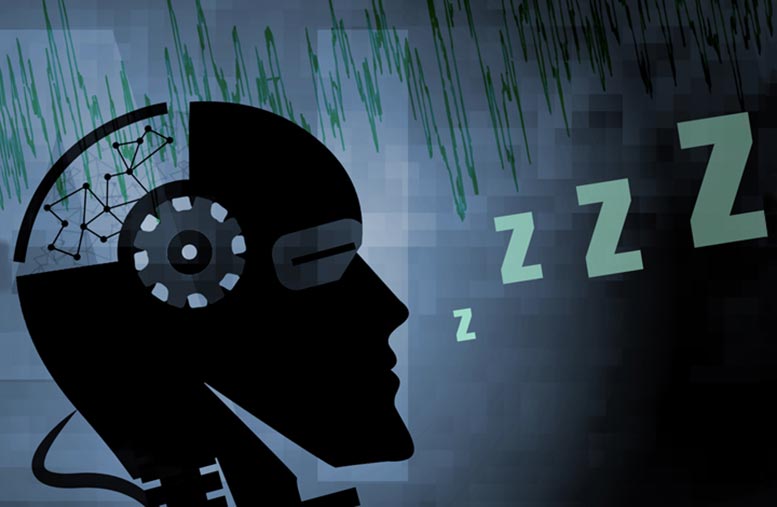
Some types of artificial intelligence could start to hallucinate if they don’t get enough rest, just as humans do. Credit: Los Alamos National Laboratory
One of the distinguishing features of machines is that they don’t need to sleep, unlike humans and any other creature with a central nervous system. Someday though, your toaster might need a nap from time to time, as may your car, fridge and anything else that is revolutionized with the advent of practical artificial intelligence technologies.
The change will come when (and if) AI systems that mimic living brains are incorporated into the wide range of devices that currently rely on conventional computers and microprocessors to help us through the day. At least that’s the implication of new research that we are conducting in Los Alamos National Laboratory to understand systems that operate much like the neurons inside living brains.
Our realization came about as we worked to develop neural networks that closely approximate how humans and other biological systems learn to see. We were investigating the way that these simulated networks respond to unsupervised dictionary training. In this sort of activity, networks set about classifying objects without having prior examples with which to compare them. Imagine handing many images of exotic animals to a child, and asking them to group similar ones together. The child might not know what an antelope is, but they would place them in a separate pile from the lions or penguins, for example.
Read the rest of the story as it appeared in Scientific American.
https://mobilesyrup.com/2021/01/10/google-phone-app-may-add-feature-always-record-calls-unknown-numbers/
Google Phone app may add new feature to always record calls from unknown numbers Hints of the feature have been discovered in a teardown By Aisha Malik@AiishaMalik1JAN 10, 2021 11:24 AM EST0 COMMENTS The Google Phone app may be getting a new feature in the future that automatically records calls from unknown numbers. XDA Developers has found hints in the app’s code suggesting that Google is currently working on an automatic call recording feature. If the feature is activated, users would see a disclaimer warning them about the legal consequences of call recording based on their jurisdiction. Similarly, an audio warning would be played on the line before the recording starts to notify all parties that the call is being recorded. Other hints indicate users will see a confirmation dialog box asking whether you want to “always record” or “cancel.” Further, the code suggests that there will be a toggle to turn the feature on or off in the app’s settings. It’s worth noting that nothing has been confirmed and Google has yet to acknowledge that the feature exists. Google may also choose to scrap the feature altogether before it is released. The Google Phone app is quite capable of blocking unwanted calls, and this automatic call recording feature could be a great addition to the app.
https://www.wellandgood.com/getting-enough-sleep/
Toggle SearchHEALTHY SLEEPING HABITS
The 7-Day Plan That’ll Make a Nightly Ritual Out of Your Transition To Sleep Mode

Arianna Huffington・January 10, 2021

Pin ItPhoto: Getty Images/Dean Mitchell; Graphic: W+G CreativeShare on facebookShare on twitterShare on pinterestShare on email

This isn’t your standard New Year’s plan. No restrictive diets, no weekly weigh-ins, no “whole new you” for this new year—because, hey, you’re pretty great already. These four expert-led plans—designed to help you move your body, eat more veggies, get a better night’s sleep, or show yourself some loving care—are all about developing healthy habits that better align with your goals.Get the Program
Walking through the door of our bedroom should serve as a symbolic moment that marks leaving the day, with all of its problems and unfinished business, behind. When we wake up in the morning, there will be plenty of time for us to pick up our projects and deal with our challenges, refreshed and recharged.
Because of this boundary I have between sleep time and wake time, I treat my transition to sleep as a sacrosanct ritual. Before bed, I take a hot bath with Epsom salts and a candle flickering nearby, and if I’m feeling anxious or worried about something, I soak longer. I don’t sleep in my workout clothes the way I used to (think of the mixed message that sends to the brain) but have pajamas, nightdresses, even T-shirts dedicated to sleep. Sometimes I have a cup of chamomile or lavender tea for something warm and comforting before going to bed.
Because of this boundary I have between sleep time and wake time, I treat my transition to sleep as a sacrosanct ritual.
Each step I take helps me transition to bed. Each of this week’s tips for shifting into sleep mode are designed to help you shed more of your stubborn daytime worries.
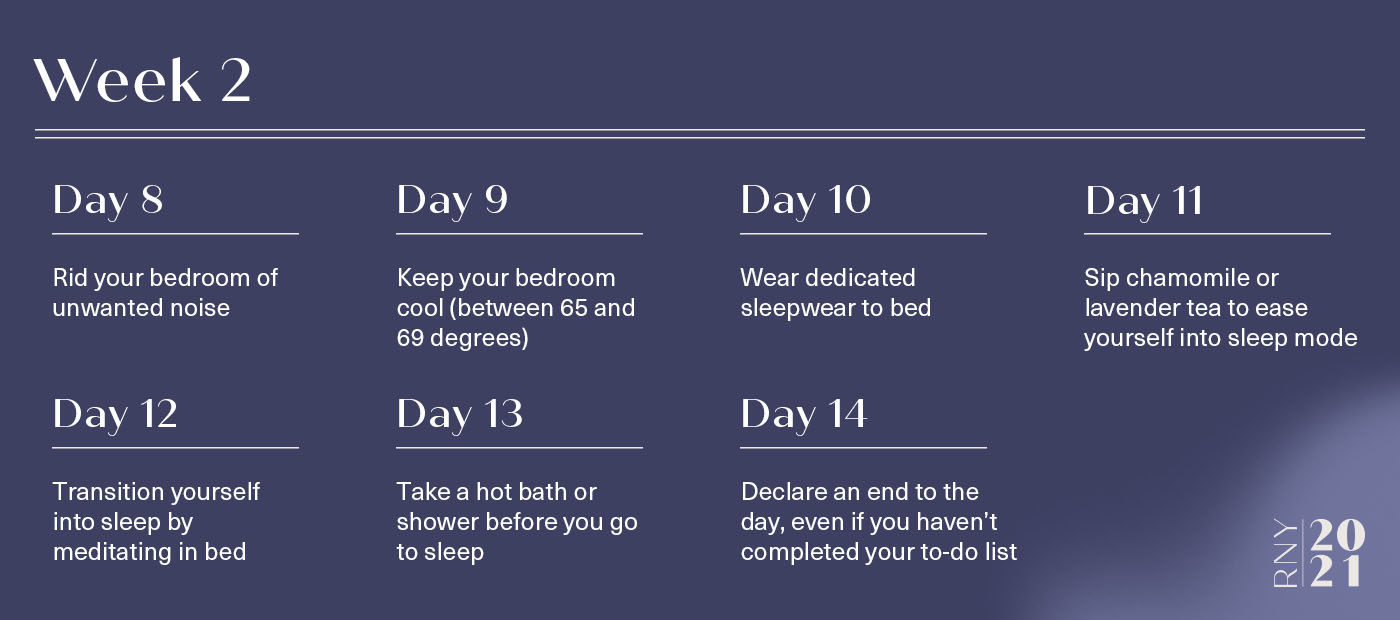
Day 8: Rid your bedroom of unwanted noise
Sound is one of the simplest and most direct impediments to sound sleep. Identify any sources of unwanted noise (starting with your devices) and either remove them from your bedroom or silence them. And if white noise or another soothing sound helps you to block out unwanted disturbances and ease your transition to sleep, that’s great!
Day 9: Keep your bedroom cool (between 65°F and 69°F)
Open a window, switch on a fan, or set your thermostat to your preferred cool temperature. Research shows even a small drop in our body temperature sends a sleep signal to our brains.
Day 10: Wear dedicated sleepwear to bed
When you get dressed for sleep, whether it’s in pajamas or a special T-shirt, it sends a sleep-friendly message to your body. We’re all living in comfy clothes these days, but still make a point to change into something else before climbing into bed.
Day 11: Sip chamomile or lavender tea to ease yourself into sleep mode
Drinking something warm and comforting can put you in a calm frame of mind and help you shed your stubborn daytime worries. (Just skip the green tea, please, it has caffeine!)
Day 12: Transition yourself into sleep by meditating in bed
Even a few deep breaths will help ease your transition to sleep. If you don’t meditate, try playing a guided sleep meditation on your device.
Day 13: Take a hot bath or shower before you go to sleep
The ritual of taking a bath or shower can ease the transition to bedtime and helps you symbolically wash the day away.
Day 14: Declare an end to the day, even if you haven’t completed your to-do list
It’s almost impossible to do all you could have done in any single day. Effectively prioritizing means being comfortable with incompletions and taking the time to recharge, so you’ll be able to return to your to-do list the next day ready to seize opportunities.
Oh hi! You look like someone who loves free workouts, discounts for cult-fave wellness brands, and exclusive Well+Good content. Sign up for Well+, our online community of wellness insiders, and unlock your rewards instantly.
https://interestingengineering.com/institute-breaks-transmission-world-record-with-125000-gbps-using-an-optical-fiber
Institute Breaks Transmission World Record With 125,000 Gbps Using an Optical Fiber
This experiment beats the current record transmission in a multi-mode fiber by 2.5.By Loukia PapadopoulosJanuary 10, 2021 NICT
NICT
Researchers from the Network System Research Institute of the National Institute of Information and Communications Technology (NICT, Japan) have achieved the world’s first transmission exceeding 1 petabit per second (125,000 Gbps) in a single-core multi-mode optical fiber. This beats the current record transmission in a multi-mode fiber by 2.5 times.
RELATED: RESEARCHERS SQUEEZED BREAKNECK 44.2 TBPS THROUGH ORDINARY FIBER OPTIC CABLES
15 fiber modes
“To date, transmission experiments in optical fibers supporting large number of modes were limited to small optical bandwidths. In this study, we demonstrated the possibility of combining highly spectral efficient wideband optical transmission with an optical fiber guiding 15 fiber modes that had a cladding diameter in agreement with the current industry standard of 0.125 mm,” wrote the researchers in a statement.
To conduct their experiment, the researchers developed a wideband transceiver subsystem to transmit and receive several hundred highly spectral efficient WDM (Wavelength Division Multiplexing) channels of high signal quality. It was this transmission system that made use of a multi-mode fiber that demonstrated the record-breaking transmission speed. Top ArticlesWorld’s Fastest, Most Powerful NeuromorphicProcessor for AI Unveiled
 READ MORE
 READ MORE
 READ MORE
 READ MORE
 READ MORE
 READ MOREhttps://imasdk.googleapis.com/js/core/bridge3.433.1_en.html#goog_81325782200:14/00:15SKIP AD
“When increasing the number of modes in a multi-mode fiber transmission system, the computational complexity of the required MIMO (Multi-Input Multi-Output) digital signal processing increases. However, the used transmission fiber had a small modal delay, simplifying the MIMO complexity and maintained this low modal delay over a large optical bandwidth. As a result, we could demonstrate the transmission of 382 wavelength channels, each modulated with 64-QAM signals,” the researchers wrote.
High capacity systems
The success of this experiment is expected to advance high-capacity multimode transmission technology for future high capacity optical transmission systems. Now, the researchers have plans to extend the distance of large-capacity multi-mode transmission and integrate it with multi-core technology to establish the foundation of optical transmission technology with increased capacity.
The paper on this experiment was published at the 46th European Conference on Optical Communication, one of the largest international conferences on optical fiber communication.
https://www.ladbible.com/news/technology-you-can-unlock-super-alexa-mode-with-cheat-code-20210110
You Can Unlock ‘Super Alexa Mode’ With Cheat Code
JAKE MASSEY
Last updated 11:58, Sunday 10 January 2021 GMT Share
Share Tweet
Tweet
You can unlock ‘Super Alexa Mode’ with a simple cheat code and leave ordinary non-super Alexa behind you. Watch how here:https://www.ladbible.com/jw-iframe.html?videoId=TQXmDWoY&autoplay=false&isNielsenEnabled=false
Amazon’s Alexa voice assistant has become a popular gadget in homes across the planet, performing all kinds of useful tasks on command.
However, she can also do less useful things too, if you know how to prompt her.
Which brings us to Super Alexa Mode, which you can activate by saying the following: “Alexa, up, up, down, down, left, right, left, right, B, A, start.”
Alexa will then reply: “Super Alexa Mode, activated. Starting reactors, online. Enabling advanced systems, online. Raising dongers. Error. Dongers missing. Aborting.”
It will also play some jaunty music – that’s it, I’m afraid.
If only it enabled your voice assistant to wash the dishes and tell you the results of matches that haven’t kicked off yet; but alas (as Boris would say), it’s just a little joke.
If you don’t get the joke, it’s basically just a nod to the old cheat code on Nintendo games.
The Konami Code was created by Kazuhisa Hashimoto for the Nintendo Entertainment System in 1986. It was initially designed to help developers test games more easily but Hashimoto subsequently forgot to remove the code, according to Lifewire.
Gamers loved it though once they found it, and it went on to become a staple.

MORE LIKE THIS

NewsWorld’s Largest Wind Turbine Can Power A House For Two Days With One Spin

NewsMan Claims He Can Unlock Smartphone With His Severed Thumb

NewsCompany Is Developing A Fully Functioning Condom With A Hole In It

TechnologyYou Can Now Play Cards Against Humanity Online With Your Mates

NewsGoogle Facing $5 Billion Lawsuit For ‘Breaching Privacy’ Over Incognito Mode Tracking

EntertainmentYou Can Buy An R2D2 Case For Your Amazon Echo Dot
Last month, a video of a man kicking off at his Alexa for telling him facts he didn’t want to hear went viral.
Specifically, the Trump supporter didn’t take kindly to his Alexa telling him that Joe Biden is the president-elect.https://www.ladbible.com/jw-iframe.html?videoId=FwlMp25m&autoplay=false&isNielsenEnabled=false
Republican Dean Browning shared the video on Twitter with the caption: “Video sent by a friend – why does @Alexa bring up Joe Biden when asked who the President of the United States is?

You Can Get Your Alexa To Give Children A Message From Santa
 2 months ago
“We have one President at a time and Joe Biden is not the President right now.”
In the tense exchange between Browning’s friend and the virtual assistant, the man asks Alexa: “Who is the President of the United States?”
She responds: “The current President of the United States is Donald Trump.”
However, she then adds: “According to the Associated Press, Joe Biden is the President-elect and will be sworn in on 20 January 2021.
“Did that answer your question?”
Browning’s friend hits back: “Why did you feel the need to tell me that Joe Biden is the President-elect? I asked you who the President is.”
He is met with stony silence and adds: “Hmm, no answer.”
 Bruce's Blog