https://www.cnet.com/health/sleeping-heart-rate-breathing-rate-and-hrv-what-your-sleep-data-means/

Sleeping heart rate, breathing rate and HRV: What your sleep data means

Gathering sleep data is one thing — understanding it is another thing entirely.

Amanda Capritto headshot

Amanda CaprittoJan. 9, 2021 6:00 a.m. PT

LISTEN- 06:00

gettyimages-1095128384
To get a full picture of your health, track more than your activity — track your sleep, too.Getty Images

Got a new smartwatch or fitness tracker for the holidays? Most wrist-worn devices do much more than take calls and track workouts these days, and if you have one, you should take advantage of all the snazzy features — sleep tracking in particular. 

Tracking your sleep can reveal a wealth of information about your health that you may have been totally oblivious to before. If you utilize that data, you can manipulate your diet, workout routinestress management tactics and other factors to become a superhuman. OK, maybe not a superhuman (unless you’re an expert biohacker), but you’ll still feel dang good. 

The information available to you depends on the device you have, but most sleep trackers collect a variety of data points, including sleep stage percentages, heart ratebreathing rate, and maybe even heart rate variability

When you first look at your sleep tracker data, all those numbers and graphs may feel dizzying. In this article, I explain what your sleep data points mean and how to use them to your benefit. 

Read more: 5 reasons to prioritize sleep in 2021

CNET HEALTH AND WELLNESS

Our Health & Wellness newsletter puts the best products, updates and advice in your inbox.SIGN ME UP!

By signing up, you agree to our Terms of Use and acknowledge the data practices in our Privacy Policy. You may unsubscribe at any time.

Sleep stages

Most sleep trackers break your night down into three main categories of sleep: REM, deep and light, although you actually cycle through five stages of sleep each night. Knowing how much time you spend in each sleep stage can help you understand your energy levels and fluctuations during the day. 

fitbit-app-android-sleep-score-free
Devices like Fitbits measure how long you stay in different sleep stages.Fitbit

Light sleep

In order to transition to a deep state of sleep you must pass through light stages of sleep, says Dr. Alison Brager, sleep researcher and performance engineer for Momentous, a sleep supplement company. “Light stages of sleep aren’t necessarily restorative relative to deep sleep, but rather part of the process of getting to the deepest stages,” Dr. Brager says.

How much light sleep you should get: This may come as a surprise, but light sleep constitutes the majority of the sleep cycle. Between the two distinct phases of light sleep (sleep stages one and two), you may spend up to 60% of your night in light sleep.

Deep sleep

During deep sleep, your breathing rate and heart rate slow down even more and your body wholly relaxes. This is when it’s hardest to wake from your slumber — it’s also when tissue repair, cellular regeneration and other important processes happen. “Deep sleep is where all the magic happens,” Dr. Brager says. 

How much deep sleep you should get: Ideally, your sleep tracker will reveal you spent at least a couple of your sleeping hours in deep sleep. Research suggests that healthy adults spend up to 23% of their slumber in deep stages. Anything less than 10% may lead to symptoms of inadequate sleep, even if you spent eight hours in bed.

REM sleep

REM sleep makes up the final stages in your sleep cycle, and it impacts you emotionally and cognitively, says Ariel Garten, co-founder of Muse, a sleep and neuroscience technology company. 

“REM sleep helps us calibrate our sensitive emotional circuits,” she says. It also “helps us make sense of information we learned while waking, as circuits are fired alongside new information, allowing it to be re-organised, consolidated or jettisoned from our brain.”

How much REM sleep you should get: In healthy adults, REM sleep makes up about 20 to 25 percent of a night’s sleep, according to the Institute of Medicine Committee on Sleep Medicine and Research. Less than this may indicate you aren’t processing and storing information to your full potential.

Heart rate

gettyimages-1199653598
Your heart rate should be relatively low while you’re asleep.Getty Images

Sleep is a restorative process, so it only makes sense that your heart rate declines during sleep, Dr. Brager says. Everyone’s daytime resting heart rate is different, so everyone’s sleeping heart rate will differ, too. 

Generally, sleeping heart rates should hover around the low end of normal, even for people who aren’t physically fit. A normal resting heart rate ranges from 60 to 100 beats per minute, according to Harvard Health, although very active people may have resting heart rates from 40 to 50 beats per minute.

During sleep, expect your heart rate to drop to the low end of your normal: If your normal daytime resting heart rate ranges from 70 to 85, for example, expect to see a sleeping heart rate of 70 to 75 beats per minute, or even slower.

If your heart rate doesn’t decline during sleep — or worse, it speeds up to higher than your daytime resting heart rate — consider talking to a sleep doctor. High heart rates during sleep may indicate medical or psychological conditions, including anxiety or atrial fibrillation

There is one caveat: It’s normal for heart rate to increase during REM sleep. During REM sleep, your brain becomes highly active and your heart may follow suit, but your heart rate still shouldn’t soar past your normal daytime heart rate.

Breathing rate

gettyimages-643310502
Your breathing rate should remain relatively stable throughout the night.Whoop

Like heart rate, breathing rate should decline during sleep. If it doesn’t, it could indicate a problem: “Clinically significant alterations in breathing and heart rates are indicative of a sleep disorder, mostly commonly sleep apnea due to the constant, intermittent inability to breathe,” Dr. Brager says.

A normal breathing rate for adults is 12 to 20 breaths per minute, and like heart rate, expect your sleep tracker to show the low end of your normal. 

In a healthy, relaxed adult, breathing should be calm and consistent throughout sleep. Breathing rate may increase during REM sleep when you’re dreaming (especially if you’re having an intense dream), but should revert to a slow pattern when you cycle into non-REM sleep. 

However, over the course of the night — and over several nights — your breathing rate should remain relatively stable, according to Whoop, a neurobiology tracking technology.

Heart rate variability

whoop-app-store-screenshots
Whoop, a performance optimization device, captures your heart rate variability while awake and while asleep.Whoop

Your heart rate variability (HRV) simply refers to the variation in the amount of time between heart beats. 

If you’re in fight-or-flight mode and your heart is racing, there is little time between heart beats (low HRV). On the other hand, when you’re relaxed, your heart beats slower and there’s more time between heart beats (high HRV).

The higher your HRV, the better, especially during sleep. If you have a high HRV, it means your body is adaptable and at the ready. Your HRV is a direct indication of how much stress your body is under at a given time — which is why you want to see a high HRV during sleep. 

If your sleep tracker data shows low HRV, your body is in overdrive during sleep for some reason. Studies show that low sleep HRVs may indicate sleep disorders, so if yours is consistently low, consider the factors that may affect it: stress levels, bedtime routinesleep environment. If you suspect a medication or medical condition is the culprit, talk to your doctor.

https://eurekalert.org/pub_releases/2021-01/nios-npa010821.php

NIST publishes a beginner’s guide to DNA origami

NATIONAL INSTITUTE OF STANDARDS AND TECHNOLOGY (NIST)

Research NewsSHARE PRINT E-MAIL

IMAGE
IMAGE: COLLAGE SHOWS SOME OF THE TECHNIQUES AND DESIGNS EMPLOYED IN DNA ORIGAMI. view more CREDIT: K. DILL/NIST

In a technique known as DNA origami, researchers fold long strands of DNA over and over again to construct a variety of tiny 3D structures, including miniature biosensors and drug-delivery containers. Pioneered at the California Institute of Technology in 2006, DNA origami has attracted hundreds of new researchers over the past decade, eager to build receptacles and sensors that could detect and treat disease in the human body, assess the environmental impact of pollutants, and assist in a host of other biological applications.

Although the principles of DNA origami are straightforward, the technique’s tools and methods for designing new structures are not always easy to grasp and have not been well documented. In addition, scientists new to the method have had no single reference they could turn to for the most efficient way of building DNA structures and how to avoid pitfalls that could waste months or even years of research.

That’s why Jacob Majikes and Alex Liddle, researchers at the National Institute of Standards and Technology (NIST) who have studied DNA origami for years, have compiled the first detailed tutorial on the technique. Their comprehensive report provides a step-by-step guide to designing DNA origami nanostructures, using state-of-the-art tools. Majikes and Liddle described their work in the Jan .8 issue of the Journal of Research of the National Institute of Standards and Technology.

“We wanted to take all the tools that people have developed and put them all in one place, and to explain things that you can’t say in a traditional journal article,” said Majikes. “Review papers might tell you everything that everyone’s done, but they don’t tell you how the people did it. “

DNA origami relies on the ability of complementary base pairs of the DNA molecule to bind to each other. Among DNA’s four bases — adenine (A), cytosine (C), guanine (G) and thymine (T) — A binds with T and G with C. This means that a specific sequence of As, Ts, Cs and Gs will find and bind to its complement.

The binding enables short strands of DNA to act as “staples,” keeping sections of long strands folded or joining separate strands. A typical origami design may require 250 staples. In this way, the DNA can self-assemble into a variety of shapes, forming a nanoscale framework to which an assortment of nanoparticles — many useful in medical treatment, biological research and environmental monitoring — can attach.

The challenges in using DNA origami are twofold, said Majikes. First, researchers are fabricating 3D structures using a foreign language — the base pairs A, G, T and C. In addition, they’re using those base-pair staples to twist and untwist the familiar double helix of DNA molecules so that the strands bend into specific shapes. That can be difficult to design and visualize. Majikes and Liddle urge researchers to strengthen their design intuition by building 3D mock-ups, such as sculptures made with bar magnets, before they start fabrication. These models, which can reveal which aspects of the folding process are critical and which ones are less important, should then be “flattened” into 2D to be compatible with computer-aided design tools for DNA origami, which typically use two-dimensional representations.

DNA folding can be accomplished in a variety of ways, some less efficient than others, noted Majikes. Some strategies, in fact, may be doomed to failure.

“Pointing out things like ‘You could do this, but it’s not a good idea’ — that type of perspective isn’t in a traditional journal article, but because NIST is focused on driving the state of technology in the nation, we’re able to publish this work in the NIST journal,” Majikes said. “I don’t think there’s anywhere else that would have given us the leeway and the time and the person hours to put all this together.”

Liddle and Majikes plan to follow up their work with several additional manuscripts detailing how to successfully fabricate nanoscale devices with DNA.

https://interestingengineering.com/worlds-fastest-most-powerful-neuromorphic-processor-for-ai-unveiled

World’s Fastest, Most Powerful Neuromorphic Processor for AI Unveiled

The innovation functions faster than 10 trillion operations per second (TeraOPs/s).By  Loukia PapadopoulosJanuary 09, 2021World’s Fastest, Most Powerful Neuromorphic Processor for AI UnveiledSwinburne University of Technology

new optical neuromorphic processor developed by Swinburne University of Technology can operate more than 1000 times faster than any previous processor. The processor for artificial intelligence (AI) functions faster than 10 trillion operations per second (TeraOPs/s).

RELATED: HUAWEI LAUNCHES WORLD’S MOST POWERFUL AI PROCESSOR

Optical micro-combs

The invention could revolutionize neural networks and neuromorphic processing in general. “This breakthrough was achieved with ‘optical micro-combs’, as was our world-record internet data speed reported in May 2020,” said in a statement Swinburne’s Professor David Moss.

Micro-combs are new devices made up of hundreds of infrared lasers all held on a single chip. Compared to other optical sources, they are much smaller, lighter, faster, and cheaper.

The new innovation demonstrated by the Swinburne team uses a single processor while simultaneously interleaving the data in time, wavelength, and spatial dimensions through a single micro-comb chip.Top ArticlesResearchers Explain Why and How PlatypusAre So WeirdScientists Just Created New Way to Make Rocket Fuel From Methane on MarsREAD MOREInventor Builds Avengers Hawkeye's Arrows, Bows and QuiverREAD MOREMichio Kaku Says Elon Musk Could Settle Mars Using Self-Replicating RobotsREAD MOREEngineers Turn Pineapple Leaves Into Biodegradable Drone PartsREAD MOREPorsche Taycan Beats Tesla Model 3 as Fastest EV at US Cross CountryREAD MOREResearchers Explain Why and How Platypus Are So WeirdREAD MORESKIP ADResearchers Explain Why and How Platypus Are So Weird

“In the 10 years since I co-invented them, integrated micro-comb chips have become enormously important and it is truly exciting to see them enabling these huge advances in information communication and processing. Micro-combs offer enormous promise for us to meet the world’s insatiable need for information,” added Moss.

Co-lead author of the study Dr. Xingyuan (Mike) Xu explained how this innovative use of micro-combs is giving the researchers a glimpse into the processors of the future. 

Cost and energy reductions

Distinguished Professor Arnan Mitchell from RMIT University added that the “technology is applicable to all forms of processing and communications” and will result in significant future cost and energy consumption reductions.

“Convolutional neural networks have been central to the artificial intelligence revolution, but existing silicon technology increasingly presents a bottleneck in processing speed and energy efficiency,” said key supporter of the research team, Professor Damien Hicks from Swinburne and the Walter and Elizabeth Hall Institute.

“This breakthrough shows how a new optical technology makes such networks faster and more efficient and is a profound demonstration of the benefits of cross-disciplinary thinking, in having the inspiration and courage to take an idea from one field and using it to solve a fundamental problem in another.”

https://www.theverge.com/2021/1/9/22221443/amazon-alexa-new-reminder-skill-tell-me-when

Alexa’s ‘Tell Me When’ skill combines reminders with contextual information

A minor change that might be meaningful to daily Alexa usersBy Ian Carlos Campbell@soupsthename  Jan 9, 2021, 8:44am EST

Share this story

Amazon has updated Alexa in the last month with a modified version of its popular reminders skill. You can now ask Alexa to “Tell me when” an event happens and your device will give you background information and notify you when it actually occurs.

You’ve been able to set a reminder for an event or task at a specific time for a while, and requesting Alexa to tell you when an event occurs can pull up relevant information. “Tell me when” is sort of a synthesis of the two tasks. Amazon provided a few examples: you could ask Alexa to “Tell me when the next Seahawks game is” and Alexa could tell you the time of the game and set a reminder to watch. Another interesting use is for email, you can now ask Alexa to tell you when an email arrives from a specific person, and Alexa can announce the email’s arrival to save you from constantly checking your inbox. Of course, you’d have to be comfortable giving Alexa access to your email for that feature to work.

“Tell me when” shares some overlap with another earlier skill for severe weather alerts. You can ask Alexa to tell you when there’s a severe weather alert, and the assistant can remind you when there’s one in your area.

It’s may not be the most exciting feature on its face, but “Tell me when” is a good example of how Alexa has picked up the ability to provide more contextual information and follow-up questions over time. Amazon didn’t provide a full range of events that “tell me when” works for when we asked, but you should already be able to try out the skill.

https://www.sciencealert.com/platypus-genes-reveal-some-of-the-bizarre-traits-that-come-with-5x-and-5y-chromosomes


Now We Know Why Platypus Are So Weird – Their Genes Are Part Bird, Reptile, And Mammal

CARLY CASSELLA8 JANUARY 2021

The first complete map of a platypus genome has just been released, and it’s every bit as strange as you’d expect from a creature with 10 sex chromosomes, a pair of venomous spurs, a coat of fluorescent fur, and skin that ‘sweats’ milk.

The duck-billed platypus is truly one of the oddest creatures on Earth. Along with the spiky echidna, these two Australian animals belong to a highly-specialised group of mammals, known as monotremes, which both lay eggs but also nurse their young with milk.

The genes of both are relatively primitive and unchanged, revealing a bizarre blend of several vertebrate animal classes, including birds, reptiles, and mammals.

As different as the platypus might seem at first, it’s those very differences that reveal our similarities and our shared ancestry with Earth’s other vertebrates.

Scientists think its genome could tell us secrets about our own evolution and how our distant mammalian ancestors went from laying eggs to giving birth. 

“The complete genome has provided us with the answers to how a few of the platypus’ bizarre features emerged,” explains evolutionary biologist Guojie Zhang from the University of Copenhagen.

“At the same time, decoding the genome for platypus is important for improving our understanding of how other mammals evolved – including us humans.”

In previous years, a female platypus had some of its genome sequenced, but without any Y chromosome sequences, a lot of information was missing.

Using a male platypus, researchers have now created a physical map with a highly accurate platypus genome. 

Today, living mammals are split into three groups, including monotremes, marsupials, and eutherians, or ‘placentals’. We humans belong to that last group. 

Together, the latter two make up a subclass known as therian mammals. Therian mammals all give birth to live young, but monotremes are simply too different to be lumped in with that group as well.

It’s still unclear when all three of these distinct groups first began to diverge from one another. Some think the monotremes split off first, with marsupial and eutherians following suit. Others think all three groups diverged at roughly the same time.

The genome of the platypus has now helped clear up some of the dates. The data collected from echidna and platypus lineages suggests their last common ancestor lived up to 57 million years ago.

Meanwhile, monotremes as a whole appear to have diverged from marsupials and eutherian mammals about 187 million years ago.

Even after all that time, the semi-aquatic platypus has remained remarkably unchanged, fitting a niche in the Australian bush that many marsupials and mammals simply can’t. 

The authors were particularly interested in the animal’s sex chromosomes, which appear to have originated independently from other therian mammals, all of which contain a simple XY pair. 

The platypus, however, is the only known animal with 10 sex chromosomes (echidnas have nine). Platypus have 5X and 5Y chromosomes organised in a ring that appears to have broken apart into pieces over the course of mammalian evolution.

Comparing this chromosome information to humans, opossums, Tasmanian devils, chickens, and lizard genomes, the authors found the platypus’s sex chromosomes have more in common with birds like chickens than mammals such as humans.

But while platypus lay eggs like chickens, they feed their young milk like therian mammals.

It’s not too much of a surprise, therefore, that monotreme genomes contain most of the milk genes that other therian mammals possess.

Casein genes help encode certain proteins in mammalian milk, but monotremes appear to have extra caseins with unknown functions. That said, their milk is not unlike what comes from a cow, or even a lactating human.

As such, the platypus is probably not as dependent on egg proteins as other bird and reptile species because it can later feed their young through the lactation glands on its skin.

Its genome supports this. While birds and reptiles rely on three genes that encode for major egg proteins, the platypus appears to have lost the majority of these genes roughly 130 million years ago. Chickens today have all three egg protein genes, humans have none, and the platypus has only one fully functional copy left.

The platypus is a weird in-between, and its genome is a sort of bridge to our own evolutionary past.

“It informs us that milk production in all extant mammal species has been developed through the same set of genes derived from a common ancestor which lived more than 170 million years ago – alongside the early dinosaurs in the Jurassic period,” Zhang says.

The full genome has also revealed the loss of four genes associated with tooth development, which probably disappeared roughly 120 million years ago. To eat, the platypus now uses a pair of horn-like plates to grind up its food.

The venomous spurs on its hind legs can possibly be explained by the creature’s defensin genes, which are associated with the immune system in other mammals, and appear to give rise to unique proteins in their venom. Echidnas, which also had their full genomes sequenced, appear to have lost this key venom gene. 

The authors say their results represent “some of the most fascinating biology of platypus and echidna” alike. 

“The new genomes of both species will enable further insights into therian innovations and the biology and evolution of these extraordinary egg-laying mammals,” they conclude

The study was published in Nature.

https://medicalxpress.com/news/2021-01-brain-1.html

Which came first, sleep or the brain?

by Kyushu University

Stay awake too long, and thinking straight can become extremely difficult. Thankfully, a few winks of sleep is often enough to get our brains functioning up to speed again. But just when and why did animals start to require sleep? And is having a brain even a prerequisite?

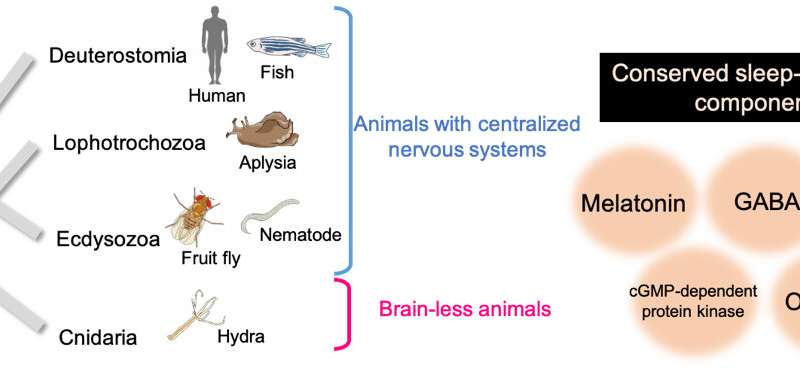
In a study that could help to understand the evolutional origin of sleep in animals, an international team of researchers has shown that tiny, water-dwelling hydras not only show signs of a sleep-like state despite lacking central nervous systems but also respond to molecules associated with sleep in more evolved animals.

“We now have strong evidence that animals must have acquired the need to sleep before acquiring a brain,” says Taichi Q. Itoh, assistant professor at Kyushu University’s Faculty of Arts and Science and leader of the research reported in Science Advances.

While sleeping behavior was also recently found in jellyfish, a relative of hydras and fellow member of the phylum Cnidaria, the new study from researchers at Kyushu University in Japan and Ulsan National Institute of Science and Technology in Korea found that several chemicals eliciting drowsiness and sleep even in humans had similar effects on the species Hydra vulgaris.

“Based on our findings and previous reports regarding jellyfish, we can say that sleep evolution is independent of brain evolution,” states Itoh.

“Many questions still remain regarding how sleep emerged in animals, but hydras provide an easy-to-handle creature for further investigating the detailed mechanisms producing sleep in brainless animals to help possibly one day answer these questions.”

Only a couple of centimeters long, hydras have a diffuse network of nerves but lack the centralization associated with a brain.

While sleep is often monitored based on the measurement of brain waves, this is not an option for tiny, brainless animals.

As an alternative, the researchers used a video system to track movement to determine when hydras were in a sleep-like state characterized by reduced movement—which could be disrupted with a flash of light.

Which came first, sleep or the brain?
Collaborative research led by Kyushu University indicates that multiple sleep-regulatory components are evolutionarily conserved between brainless hydras and animals with central nervous systems. Credit: Taichi Q. Itoh, Kyushu University

Instead of repeating every 24 hours like a circadian rhythm, the researchers found that the hydras exhibit a four-hour cycle of active and sleep-like states.https://googleads.g.doubleclick.net/pagead/ads?guci=2.2.0.0.2.2.0.0&client=ca-pub-0536483524803400&output=html&h=188&slotname=7099578867&adk=4039075515&adf=1897700409&pi=t.ma~as.7099578867&w=750&fwrn=4&lmt=1610209118&rafmt=11&psa=1&format=750×188&url=https%3A%2F%2Fmedicalxpress.com%2Fnews%2F2021-01-brain-1.html&flash=0&wgl=1&uach=WyJNYWMgT1MgWCIsIjEwXzExXzYiLCJ4ODYiLCIiLCI4Ny4wLjQyODAuODgiLFtdXQ..&dt=1610209116771&bpp=117&bdt=14926&idt=1894&shv=r20201203&cbv=r20190131&ptt=9&saldr=aa&abxe=1&cookie=ID%3D159a91dc538ead62-22cf61eea6c20048%3AT%3D1596518137%3AR%3AS%3DALNI_Mbw-dfbnrOLWYH3Rv2C7X_TIML9VA&correlator=3534033145098&frm=20&pv=2&ga_vid=1534776174.1526672041&ga_sid=1610209119&ga_hid=1348241955&ga_fc=0&ga_wpids=UA-73855-15&rplot=4&u_tz=-480&u_his=1&u_java=0&u_h=1050&u_w=1680&u_ah=980&u_aw=1680&u_cd=24&u_nplug=3&u_nmime=4&adx=334&ady=2572&biw=1678&bih=900&scr_x=0&scr_y=0&eid=21068084%2C21068769&oid=3&pvsid=2734617107594360&pem=424&ref=https%3A%2F%2Fnews.google.com%2F&rx=0&eae=0&fc=896&brdim=2%2C23%2C2%2C23%2C1680%2C23%2C1678%2C980%2C1678%2C900&vis=1&rsz=%7C%7CpeEbr%7C&abl=CS&pfx=0&fu=8320&bc=31&ifi=1&uci=a!1&btvi=1&fsb=1&xpc=S5cJuqW6w2&p=https%3A//medicalxpress.com&dtd=2124

More importantly, the researchers uncovered many similarities related to sleep regulation on a molecular and genetic level regardless of the possession of a brain.

Exposing the hydras to melatonin, a commonly used sleep aid, moderately increased the sleep amount and frequency, while the inhibitory neurotransmitter GABA, another chemical linked to sleep activity in many animals, greatly increased sleep activity.

On the other hand, dopamine, which causes arousal in many animals, actually promoted sleep in the hydras.

“While some sleep mechanisms appear to have been conserved, others may have switched function during evolution of the brain,” suggests Itoh.

Furthermore, the researchers could use vibrations and temperature changes to disturb the hydras’ sleep and induce signs of sleep deprivation, causing the hydras to sleep longer during the following day and even suppressing cell proliferation.

Investigating more closely, the researchers found that sleep deprivation led to changes in the expression of 212 genes, including one related to PRKG, a protein involved in sleep regulation in the wide range of animals, including mice, fruit flies, and nematodes.

Disrupting other fruit fly genes appearing to share a common evolutional origin with the sleep-related ones in hydras altered sleep duration in fruit flies, and further investigation of such genes may help to identify currently unknown sleep-related genes in animals with brains.

“Taken all together, these experiments provide strong evidence that animals acquired sleep-related mechanisms before the evolutional development of the central nervous system and that many of these mechanisms were conserved as brains evolved,” says Itoh.


Explore furtherSleep-deprived mice find cocaine more rewarding


More information: Hiroyuki J. Kanaya et al, A sleep-like state in Hydra unravels conserved sleep mechanisms during the evolutionary development of the central nervous system, Science Advances (2020). DOI: 10.1126/sciadv.abb9415Journal information:Science AdvancesProvided by Kyushu University

https://www.mobihealthnews.com/news/amazon-reportedly-building-bedside-sleep-apnea-monitor-clover-finalizes-its-spac-merger-and


Amazon reportedly building bedside sleep apnea monitor, Clover finalizes its SPAC merger and more digital health news briefs

Also: Papa expands its services to all 50 states; Guided audio walks may be coming to Apple Watch.By MobiHealthNewsJanuary 07, 202102:57 pmSHARE 529

An image of Amazon's headquarters

Alexa, listen to me sleep. Hot on the heels of its Halo fitness, weight and sleep wearable, Business Insider reports that Amazon is also working on a contactless bedside device for tracking sleep apnea. The device in development reportedly uses millimeter-wave radar to watch breathing and movement. Codenamed “Brahms,” the tracker is roughly the size of a palm, and would speak with other connected devices and a companion app.

According to the report, Amazon built up the internal team working on the device over the past year. Further, it could use machine learning and cloud connections to deliver additional sleep health insights.


Clover’s SPAC deal is finalized. Medicare Advantage insurtech company Clover Health’s merger with Social Capital Hedosophia Holdings II – a special purpose acquisition company, or SPAC – has been approved by shareholders and formally closed. The newly combined company will be called Clover Health Investments, and will begin trading on Nasdaq under CLOV tomorrow.

Word of the merger first came in early October. The deal rates Clover at an enterprise value of about $3.7 billion and was expected to bring in $1.2 billion in gross proceeds. 


Grandchildren on-demand, countrywide. Papa, a Miami-based startup that uses technology to arrange in-home senior companionship and assistance, announced this week that it’s expanding its reach across all 50 U.S. states.

As of last fall, the service was only active in 17 states. It’s available through a number of plans from major payers, including Aetna, Humana and Florida Blue Medicare.

In addition, the company is also releasing a new version of its coordination app for members and the “Papa Pals” employed by the company. Among the added features are a personalized dashboard for Papa Pals, map support, customized browsing filters and single-tap video calls for virtual visits between members and Papa Pals.

“The current climate of social isolation has exacerbated the health challenges already facing aging Americans,” said Andrew Parker, founder and CEO of Papa. “Our Papa Pals provide companionship and work as boots on the ground to support closing gaps in care and drastically improve health outcomes of older adults and their families.”


Take your Watch for a walk. New fitness features look to be on the horizon for Apple Watch users with the 14.4 iOS. Settings in a beta version of the operating system spotted by a user on Twitter and beta source code investigated by 9to5Mac suggest something called “Time to Walk,” which the outlet speculates will take the form of guided audio workouts with reminders and goals similar to the Apple’s prior “Time to Stand” reminders.


FallCall unveils smartwatch-based PERS. FallCall Solutions announced that it is rolling out its new tech that can detect if a person falls with a connected personal emergency response system (PERS). Dubbed FallCall Detect, the tool was designed to be able to tell if a fall was high-impact. If this kind of fall is detected, the system can automatically connect to emergency services. When a lower-impact fall happens, the tech can connect to community links.

The tech is first going to go live on the Apple Watch app.

“Several older adults I’ve treated for falls owned a medical alert device but didn’t use it. They said it was too bulky, stigmatizing or inconvenient, and they’ve experienced embarrassing false alarms,” FallCall Solutions cofounder Dr. Shea Gregg said in a statement. “By offering simple, safe and smart technology, combined with PERS capabilities on an Apple Watch they already wear, we believe we will have much greater adoption, daily usage and earlier treatment of fall injuries.”


Golf claps all around. The PGA has tapped Boston-based Whoop as its official fitness wearable for the PGA tour and PGA tour champions. As part of the deal, the organizations will work together to create a new program called WHOOP Live for Charity, which lets players see their biometric data over the course of a season. As part of the initiative, players compete to receive $10,000 for the charity of their choice on behalf of the partners.

“We are excited to grow our partnership with WHOOP and utilize their health technology to optimize the way our athletes train, recover and sleep,” Brian Oliver, PGA Tour EVP of corporate partnerships, said in a statement.

“Our athletes understand the importance of maintaining their health to ensure peak competitive performance, career longevity and overall wellbeing. The WHOOP Strap will help our athletes unlock actionable insights via physiological data to help them understand and prepare their bodies for competition. We’re eager to begin a first-of-its-kind activation at the Tour that will incorporate player biometric data with defining moments from the golf course to create fascinating content for fans.”https://players.brightcove.net/1824526989001/default_default/index.html?videoId=6217942898001Tags: AmazonAlexasleep apneasleep healthsleep monitoringBrahmsPapaPapa HealthCloverSPACClover HealthApple WatchApplePERSFallCallWhoopPGAwearablesDigital health news briefs

https://saskatoon.ctvnews.ca/6-ways-to-ward-off-spinning-thoughts-and-overcome-sleep-struggles-1.5259287

6 ways to ward off ‘spinning thoughts’ and overcome sleep struggles

CTV News SaskatoonStaff

ContactPublished Friday, January 8, 2021 1:15PM CSThttps://imasdk.googleapis.com/js/core/bridge3.433.1_en.html#goog_14611320Volume 90% Take ownership of your sleep in 2021 NOW PLAYINGMost of us will admit we need more Z’s, but how can we achieve it? Sleepwell Consulting is here to hep you get your best sleep.

SHARE

SASKATOON — Health Canada recommends adults between the ages of 18 and 65 should get between seven and nine hours of sleep a night. But getting enough shut-eye can be a struggle — especially when stress and anxiety are added to the mix.

However, as Sleepwell Consulting founder and CEO Amanda Hudye explained to CTV Morning Live anchor Stephanie Massicotte, there are some easy steps you can take to encourage sleep and prevent stress from interfering with your visits from the sandman.

Here are some of the top tips Hudye says she shares with clients:

Related Stories

Catch your breath

It certainly is a challenging time right now and the most important thing to know about sleep is that our bodies know exactly how to do it.

Our job when it comes to sleep and especially when we’re going to sleep, is we need to ensure that everything is down at baseline.

So we want to get our breath nice and controlled, our heart rate down, our blood pressure down, and that will allow our body to move into stage one sleep.

The first thing that is really helpful to be mindful of is those nice big deep breaths and at Sleepwell with all of our clients we really love to teach box breathing.

It’s inhaling through your nose for four, holding your breath for four, exhaling through your mouth for four and holding your breath for four.

And as you visualize going around that box and getting control of your breath it will stop that “spinning.”

Sometimes those spinning thoughts that lead into one and then the other and then there’s this whole layering effect, and it increases our heart rate, and our blood pressure and our body cannot get into stage one sleep in that state.

Skip the nightcap

Alcohol is a sleep inducer so it’s going to help you fall asleep, but it’s going to do nothing for the quality of your sleep.

So, two, three hours later when our body starts to metabolize that alcohol, it’s going to have an adverse effect on our sleep, often waking us up.

If it doesn’t wake us up it’s going to pull us out of those deep restorative stages of sleep so we’re going to wake and not feel refreshed at all.

Embrace a routine

100 per cent, a bedtime routine, doing the same thing in succession, every single night is going to help us fall into that stage one sleep.

It doesn’t need to be a big routine.

I mean just maybe a quick shower, brushing your teeth, meditation, maybe some reading on your book and not on your tech, not on a screen, is a great way to really focus on the hygiene of your sleep.

Don’t be afraid to start over

Average is about 15 to 20 minutes, that’s how long it should take the average adult to fall asleep.

So if you’re tossing and turning and if sleep is just not coming I recommend getting out of bed.

It’s a bit of a restart, maybe grab a glass of water, go into a different room, do some light reading, nothing too heavy, and then go back and try again.

The truth about melatonin

The biggest component is just knowledge is power and knowing what happens in our body in order to fall into stage one sleep and taking control of that.

We get the question a lot about melatonin specifically. Melatonin, you can get it over the counter (and) there are a lot of different dosages. We recommend about 0.5 milligrams.

Synthetic melatonin is not a sleep inducer, it’s a sleep regulator, so that means that our bodies naturally will produce melatonin about an hour and a half to two hours before we fall asleep. If you’re using synthetic melatonin, it’s the same thing.

Don’t take it and go to sleep right away because that’s not going to help. Taking it about an hour and a half to two hours prior to your bedtime is going to help regulate your sleep so watch dosage, if you’re taking synthetic melatonin, and especially timing.

Try meditating

When you think about that box breathing and really focus on the breath and going around it’s going to shift the focus from all those spinning thoughts – but also being really proactive.

Meditation during the day is such a great way because if you’re not practicing, you can’t call on a strategy when you need it.

So meditating, a guided meditation even five or 10 minutes a day to start your morning.

For your morning routine it’s an amazing way to start your day.

And then also, after you wash your face and brush your teeth, do your evening routine, do a five minute guided meditation again getting all those body systems down before sleep.

This interview was edited for length and clarity

https://www.psychologytoday.com/us/blog/the-asymmetric-brain/202101/seven-surprising-ways-brain-asymmetries-affect-your-daily-life

Sebastian Ocklenburg, Ph.D.

The Asymmetric Brain

Seven Surprising Ways Brain Asymmetries Affect Your Daily Life

There are many subtle ways how brain asymmetries affect your behavior.

Posted Jan 02, 2021

About 10 percent of people are left-handers, while about 90 percent are right-handers. Pretty much anybody knows whether they are left-handed, right-handed, or (in very rare cases) ambidextrous. Handedness is determined by our brains. The left part of the brain controls the right part of the body, while the right part of the brain controls the left part of the body. In left-handers, the motor areas on the right side of the brain are dominant for activities that require a high level of motor skills such as writing. Interestingly, handedness is not the only example of how such brain asymmetries affect our everyday lives. Here is a list of seven surprising ways brain asymmetries our everyday lives.

1.     In addition to handedness, there is also footedness

While most people are aware of whether they are left- or right-handed, fewer people think about whether they are left- or right-footed. A recent large-scale meta-analysis (Packheiser et al., 2020) reported that about 12.1 percent of people are left-footed. There was a large overlap with handedness, but it was not 100 percent perfect. While only 3.2 percent of right-handers were left-footed, about 60.1 percent of left-handers were left-footed. Thus, the chance of being left-footed is considerably higher for a left-hander than for a right-hander.

2.     We have a favorite side for hugging

When we embrace someone else, we typically lead the hug with one arm. A recent study (in which I was part of the research team) analyzed whether people preferentially hug with their left or their right arm (Packheiser et al., 2019). In the study, hugging couples were observed at the arrivals or departure lounges at international airports. Moreover, videos of people who blindfold themselves and let strangers hug them on the street were analyzed. 

Overall, people preferred to use their right arm for hugging.  In the emotionally neutral situation in which strangers hugged a blindfolded person, 92 percent hugged to the right. However, when people hugged their friends or partners at the airport, only about 81 percent of people hugged to the right. Thus, emotions seem to affect hugging side preferences. The left hemisphere of the brain controls the right half of the body and vice versa. Therefore, it is likely that this leftward shift in hugging is due to greater involvement of the right hemisphere of the brain for emotional processes during hugging in these situations.

3.     People are either left-kissers or right-kissers

When kissing someone, do you turn your head to the left side or the right side?

Research shows that people have a preferred side to turn their head to when kissing and rarely turn to the other side. In a 2003 study, the author observed kissing couples in public places such as international airports, large railway stations, beaches, and parks in the United States, Germany, and Turkey (Güntürkün, 2003). The result? Most of us are right-sided kissers. Overall, 64.5 percent of couples turned their heads to the right and 35.5 percent turned their heads to the left. 

4.     We have a preferred side for chewing

Do you have a favorite side to chew your food on while eating?

A 2016 study from Spain and Mexico in 146 young adults found that 56 percent of people consistently chew on one side, with 77 percent of them preferring the right side of their mouth and only 23 percent on the left side (Rovira-Lastra et al., 2016). The remaining 44 percent of people chewed alternating on the left and the right side.article continues after advertisement

5.     We have a favorite cheek to turn when posing for selfies 

When posing for pictures, do you have a side of your face that you consider your “good side”? 

Interestingly, most of us have a clear preference to put one cheek forward when posing for a picture that is supposed to be posted on social media. A study in which 2000 selfies on Instagram were analyzed regarding the pose of the photographed person (Lindell, 2017) revealed that 41 percent of people show a preference for the left cheek, while 31.5 percent showed a preference for the right cheek. The rest did not show a clear preference for the left or the right cheek. Altogether, 72.5 percent of people had a clear preference for one cheek over the other.

6.     Most people cradle a baby on their left side

If you cradle a baby, which arm do you use?

Despite the fact that most people are right-handers, research shows that we show a leftward bias for cradling a baby. A recent large-scale meta-analysis (Packheiser et al., 2020) shows that about 66 percent of people cradling a baby on their left side, while only about 34 percent cradle a baby on their right side. 

7.     We also have a favorite eye

We do not only a favorite hand and foot, but side preferences can also be observed for sensory organs like the eyes. In a study from 2009, my research team and I determined peoples’ dominant eyes, by asking them which eye they would use to look through a keyhole, down a telescope, and down a monocular microscope (Ocklenburg and Güntürkün, 2009).

The result?

About 75 percent of people showed a preference for the right eye, while about 25 percent preferred the left eye for these activities.

References

Güntürkün O. (2003). Human behaviour: Adult persistence of head-turning asymmetry. Nature, 421, 711.

Lindell AK. (2017). Consistently Showing Your Best Side? Intra-individual Consistency in #Selfie Pose Orientation. Front Psychol, 8, 246.

Ocklenburg S, Güntürkün O. (2009). Head-turning asymmetries during kissing and their association with lateral preference. Laterality, 14, 79-85. 

https://www.sciencedaily.com/releases/2021/01/210107112418.htm

World’s fastest optical neuromorphic processor

Date:January 7, 2021Source:Monash UniversitySummary:A Swinburne-led team has demonstrated the world’s fastest and most powerful optical neuromorphic processor for artificial intelligence. The neuromorphic processor operates faster than 10 trillion operations per second and is capable of processing ultra-large scale data.Share:    FULL STORY


An international team of researchers led by Swinburne University of Technology has demonstrated the world’s fastest and most powerful optical neuromorphic processor for artificial intelligence (AI), which operates faster than 10 trillion operations per second (TeraOPs/s) and is capable of processing ultra-large scale data.

Published in the journal Nature, this breakthrough represents an enormous leap forward for neural networks and neuromorphic processing in general.

Artificial neural networks, a key form of AI, can ‘learn’ and perform complex operations with wide applications to computer vision, natural language processing, facial recognition, speech translation, playing strategy games, medical diagnosis and many other areas. Inspired by the biological structure of the brain’s visual cortex system, artificial neural networks extract key features of raw data to predict properties and behaviour with unprecedented accuracy and simplicity.

Led by Swinburne’s Professor David Moss, Dr Xingyuan (Mike) Xu (Swinburne, Monash University) and Distinguished Professor Arnan Mitchell from RMIT University, the team achieved an exceptional feat in optical neural networks: dramatically accelerating their computing speed and processing power.

The team demonstrated an optical neuromorphic processor operating more than 1000 times faster than any previous processor, with the system also processing record-sized ultra-large scale images — enough to achieve full facial image recognition, something that other optical processors have been unable to accomplish.

“This breakthrough was achieved with ‘optical micro-combs’, as was our world-record internet data speed reported in May 2020,” says Professor Moss, Director of Swinburne’s Optical Sciences Centre and recently named one of Australia’s top research leaders in physics and mathematics in the field of optics and photonics by The Australian.

While state-of-the-art electronic processors such as the Google TPU can operate beyond 100 TeraOPs/s, this is done with tens of thousands of parallel processors. In contrast, the optical system demonstrated by the team uses a single processor and was achieved using a new technique of simultaneously interleaving the data in time, wavelength and spatial dimensions through an integrated micro-comb source.

Micro-combs are relatively new devices that act like a rainbow made up of hundreds of high-quality infrared lasers on a single chip. They are much faster, smaller, lighter and cheaper than any other optical source.

“In the 10 years since I co-invented them, integrated micro-comb chips have become enormously important and it is truly exciting to see them enabling these huge advances in information communication and processing. Micro-combs offer enormous promise for us to meet the world’s insatiable need for information,” Professor Moss says.

“This processor can serve as a universal ultrahigh bandwidth front end for any neuromorphic hardware — optical or electronic based — bringing massive-data machine learning for real-time ultrahigh bandwidth data within reach,” says co-lead author of the study, Dr Xu, Swinburne alum and postdoctoral fellow with the Electrical and Computer Systems Engineering Department at Monash University.

“We’re currently getting a sneak-peak of how the processors of the future will look. It’s really showing us how dramatically we can scale the power of our processors through the innovative use of microcombs,” Dr Xu explains.

RMIT’s Professor Mitchell adds, “This technology is applicable to all forms of processing and communications — it will have a huge impact. Long term we hope to realise fully integrated systems on a chip, greatly reducing cost and energy consumption.”

“Convolutional neural networks have been central to the artificial intelligence revolution, but existing silicon technology increasingly presents a bottleneck in processing speed and energy efficiency,” says key supporter of the research team, Professor Damien Hicks, from Swinburne and the Walter and Elizabeth Hall Institute.

He adds, “This breakthrough shows how a new optical technology makes such networks faster and more efficient and is a profound demonstration of the benefits of cross-disciplinary thinking, in having the inspiration and courage to take an idea from one field and using it to solve a fundamental problem in another.”


Story Source:

Materials provided by Monash UniversityNote: Content may be edited for style and length.


Journal Reference:

  1. Xingyuan Xu, Mengxi Tan, Bill Corcoran, Jiayang Wu, Andreas Boes, Thach G. Nguyen, Sai T. Chu, Brent E. Little, Damien G. Hicks, Roberto Morandotti, Arnan Mitchell, David J. Moss. 11 TOPS photonic convolutional accelerator for optical neural networksNature, 2021; 589 (7840): 44 DOI: 10.1038/s41586-020-03063-0

Cite This Page:

Monash University. “World’s fastest optical neuromorphic processor.” ScienceDaily. ScienceDaily, 7 January 2021. <www.sciencedaily.com/releases/2021/01/210107112418.htm>.