https://www.microsoft.com/en-us/research/blog/full-stack-ahead-pioneering-quantum-hardware-allows-for-controlling-up-to-thousands-of-qubits-at-cryogenic-temperatures/

Full stack ahead: Pioneering quantum hardware allows for controlling up to thousands of qubits at cryogenic temperatures

Published January 27, 2021

By Chetan Nayak , Director of Station Q Condensed Matter Theory

Research Area

Quantum computing offers the promise of solutions to previously unsolvable problems, but in order to deliver on this promise, it will be necessary to preserve and manipulate information that is contained in the most delicate of resources: highly entangled quantum states. One thing that makes this so challenging is that quantum devices must be ensconced in an extreme environment in order to preserve quantum information, but signals must be sent to each qubit in order to manipulate this information—requiring, in essence, an information superhighway into this extreme environment. Both of these problems must, moreover, be solved at a scale far beyond that of present-day quantum device technology.

Microsoft’s David Reilly, leading a team of Microsoft and University of Sydney researchers, has developed a novel approach to the latter problem. Rather than employing a rack of room-temperature electronics to generate voltage pulses to control qubits in a special-purpose refrigerator whose base temperature is 20 times colder than interstellar space, they invented a control chip, dubbed Gooseberry, that sits next to the quantum device and operates in the extreme conditions prevalent at the base of the fridge. They’ve also developed a general-purpose cryo-compute core that operates at the slightly warmer temperatures comparable to that of interstellar space, which can be achieved by immersion in liquid Helium. This core performs the classical computations needed to determine the instructions that are sent to Gooseberry which, in turn, feeds voltage pulses to the qubits. These novel classical computing technologies solve the I/O nightmares associated with controlling thousands of qubits.


Quantum computing could impact chemistry, cryptography, and many more fields in game-changing ways. The building blocks of quantum computers are not just zeroes and ones but superpositions of zeroes and ones. These foundational units of quantum computation are known as qubits (short for quantum bits). Combining qubits into complex devices and manipulating them can open the door to solutions that would take lifetimes for even the most powerful classical computers.

Despite the unmatched potential computing power of qubits, they have an Achilles’ heel: great instability. Since quantum states are easily disturbed by the environment, researchers must go to extraordinary lengths to protect them. This involves cooling them nearly down to absolute zero temperature and isolating them from outside disruptions, like electrical noise. Hence, it is necessary to develop a full system, made up of many components, that maintains a regulated, stable environment. But all of this must be accomplished while enabling communication with the qubits. Until now, this has necessitated a bird’s nest-like tangle of cables, which could work for limited numbers of qubits (and, perhaps, even at an “intermediate scale”) but not for large-scale quantum computers.
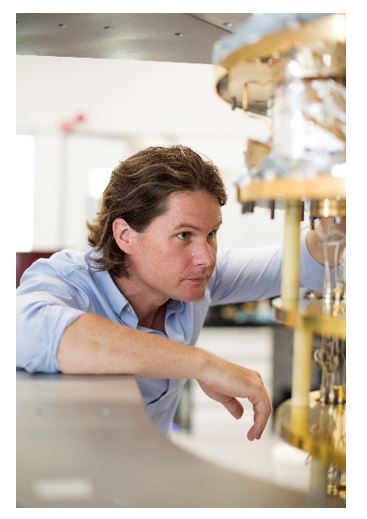
Dr. David Reilly and his team at the Microsoft Quantum lab at the University of Sydney have developed forward-thinking hardware systems for quantum computers, which allow for communication of information between qubits and the outside world while also maintaining the stability of these qubits, a delicate and intricate task.

Microsoft Quantum researchers are playing the long game, using a wholistic approach to aim for quantum computers at the larger scale needed for applications with real impact. Aiming for this bigger goal takes time, forethought, and a commitment to looking toward the future. In that context, the challenge of controlling large numbers of qubits looms large, even though quantum computing devices with thousands of qubits are still years in the future.

Enter the team of Microsoft and University of Sydney researchers, headed by Dr. David Reilly, who have developed a cryogenic quantum control platform that uses specialized CMOS circuits to take digital inputs and generate many parallel qubit control signals—allowing scaled-up support for thousands of qubits—a leap ahead from previous technology. The chip powering this platform, called Gooseberry, resolves several issues with I/O in quantum computers by operating at 100 milliKelvin (mK) while dissipating sufficiently low power so that it does not exceed the cooling power of a standard commercially-available research refrigerator at these temperatures. This sidesteps the otherwise insurmountable challenge of running thousands of wires into a fridge.

Their work is detailed in a paper published in Nature this month, called “A Cryogenic Interface for Controlling Many Qubits.” They’ve also extended this research to create the first-of-its-kind general-purpose cryo-compute core, one step up the quantum stack. This operates at around 2 Kelvin (K), a temperature that can be reached by immersing it in liquid Helium. Although this is still very cold, it is 20 times warmer than the temperatures at which Gooseberry operates and, therefore, 400 times as much cooling power is available. With the luxury of dissipating 400 times as much heat, the core is capable of general-purpose computing. Both visionary pieces of hardware are critical advances toward large-scale quantum computer processes and are the result of years of work.

Both chips help manage communication between different parts of a large-scale quantum computer—and between the computer and its user. They are the key elements of a complex “nervous system” of sorts to send and receive information to and from every qubit, but in a way that maintains a stable cold environment, which is a significant challenge for a large-scale commercial system with tens of thousands of qubits or more. The Microsoft team has navigated many hurdles to accomplish this feat.

The big picture: Topological quantum computing and the quantum stack

Quantum computing devices are often measured by how many qubits they contain. However, all qubits are not created equal, so these qubit counts are often apples-to-oranges comparisons. Microsoft Quantum researchers are pioneering the development of topological qubits, which have a high level of error protection built in at the hardware level. This reduces the overhead needed for software-level error correction and enables meaningful computations to be done with fewer physical qubits.
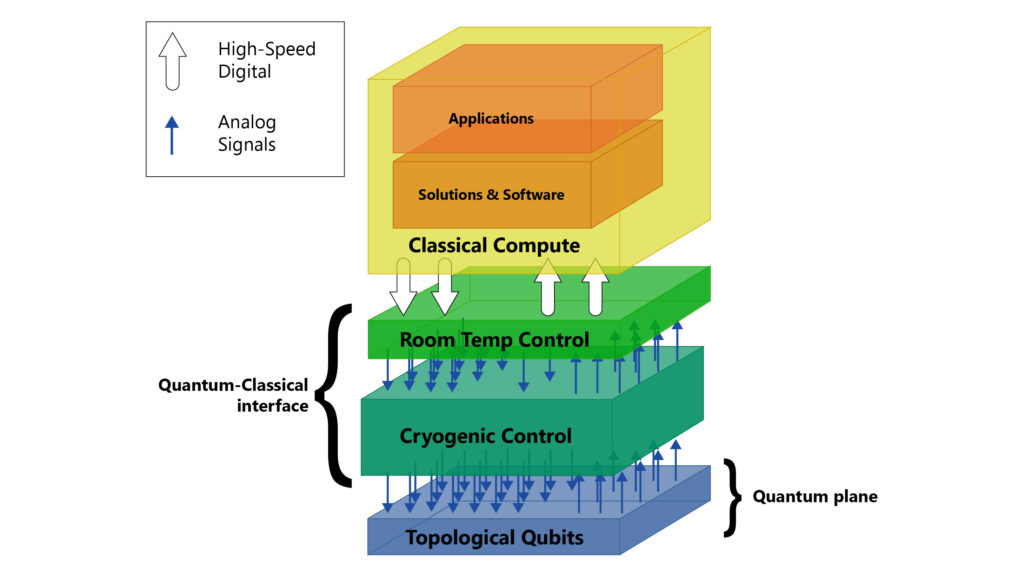
Figure 1: Quantum stack diagram. Topological qubits sit at the bottom of the stack in the quantum plane along with other electronics needed to help with the processing of information from raw qubits. The Gooseberry chip sits very near the qubits, while Alta is positioned at the bottom of the “Classical Compute” portion of the stack, where it is in communication with both Gooseberry and components higher up the stack.

Although this is one of the unique features of Microsoft’s approach, it is not the only one. In the quantum stack, qubits make up its base. The quantum plane (at the bottom of Figure 1) is made up of a series of topological qubits (themselves made up of semiconductors, superconductors, and dielectrics), gates, wiring, and other packaging that help to process information from raw qubits. The vital processes of communication occur in the next layer higher in the stack (labeled “Quantum-Classical Interface” in Figure 1 above). The Gooseberry chip and cryo-compute core work together to bookend this communication. The latter sits at the bottom of the “Classical Compute” portion of the stack, and Gooseberry is unique relative to other control platforms in that it sits right down with the qubits at the same temperature as the quantum plane—able to convert classical instructions from the cryo-compute core into voltage signals sent to the qubits.

Play it cool: Dissipating heat in a CMOS-based control platform

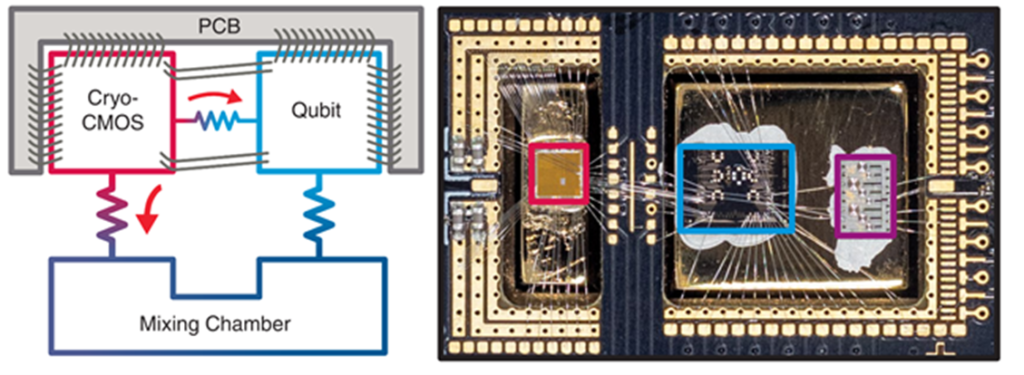
Why does it matter where the Gooseberry chip sits? It is partly an issue of heat. When the wires that connect the control chip to the qubits are long (as they would have to be if the control chip were at room temperature), significant heat can be generated inside the fridge. Putting a control chip near the qubits avoids this problem. The tradeoff is that the chip is now near the qubits, and the heat generated by the chip could potentially warm up the qubits. Gooseberry navigates these competing effects by putting the control chip near, but not too near, the qubits. By putting Gooseberry in the refrigerator but thermally isolated from the qubits, heat created by the chip is drawn away from the qubits and into the mixing chamber. (See Figure 2 below).
Left: A red box labeled
Figure 2: (Left) A simplified version of the thermal conductance model of the Gooseberry (Cryo-CMOS) chip, which helps keep heat away from qubits. Partially separate cooling pillars increase thermal conductivity flowing away from qubits into a mixing chamber and reduce direct heat flowing toward the qubits. (Right) The Gooseberry chip (red) sits next to a qubit test chip (blue) and resonator chip (purple). Each of these is anchored to a gold-plated copper thermalization pillar, with a separate pillar for the CMOS chip.

Placing the chip near the qubits at the quantum plane solves one set of problems with temperature but creates another. To operate a chip where the qubits are, it needs to function at the same temperature as the qubits—100 mK. Operating standard bulk CMOS chips at this temperature is challenging, so this chip uses fully-depleted silicon-on-insulator (FDSOI) technology, which optimizes the system for operation at cryogenic temperatures. It has a back-gate bias, with transistors having a fourth terminal that can be used to compensate for changes in temperature. This system of transistors and gates allows qubits to be calibrated individually, and the transistors send individualized voltages to each qubit.

Gates galore: No need for separate control lines from room temperature to every qubit

Another advantage of Gooseberry is that the chip is designed in such a way that the electrical gates controlling the qubits are charged from a single voltage source that cycles through the gates in a “round-robin” fashion, charging as necessary. Previous qubit controllers required one-to-one cables from multiple voltage sources at room temperature or 4K, compromising the ability to operate qubits at large scale. The design pioneered by Dr. Reilly’s team greatly reduces the heat dissipated by such a controller. The cryogenic temperatures also come into play here to make this possible—the extreme cold allows capacitors to hold their charge longer. This means that the gates need to be charged less frequently and produce less heat and other disruptions to qubit stability.

The Gooseberry chip is made up of both digital and analog blocks. Coupled digital logic circuits perform communication, waveform memory, and autonomous operation of the chip through a finite-state machine (FSM), and the digital part of the chip also includes a master oscillator (see Figure 3). The chip also uses a Serial Peripheral Interface (SPI) for easy communication higher up the quantum stack. The analog component of the chip is a series of cells, called “charge-lock fast-gate” (CLFG) cells, that perform two functions. First, the charge-lock function is the process for charging gates, as described above. The voltage stored on each gate is tailored to individual qubits. Information is processed in qubits by changing the voltages on the gate, and that happens in the second function, “fast-gating.” This creates pulses that physically manipulate the qubits, ultimately directing the processing of information in the qubits.
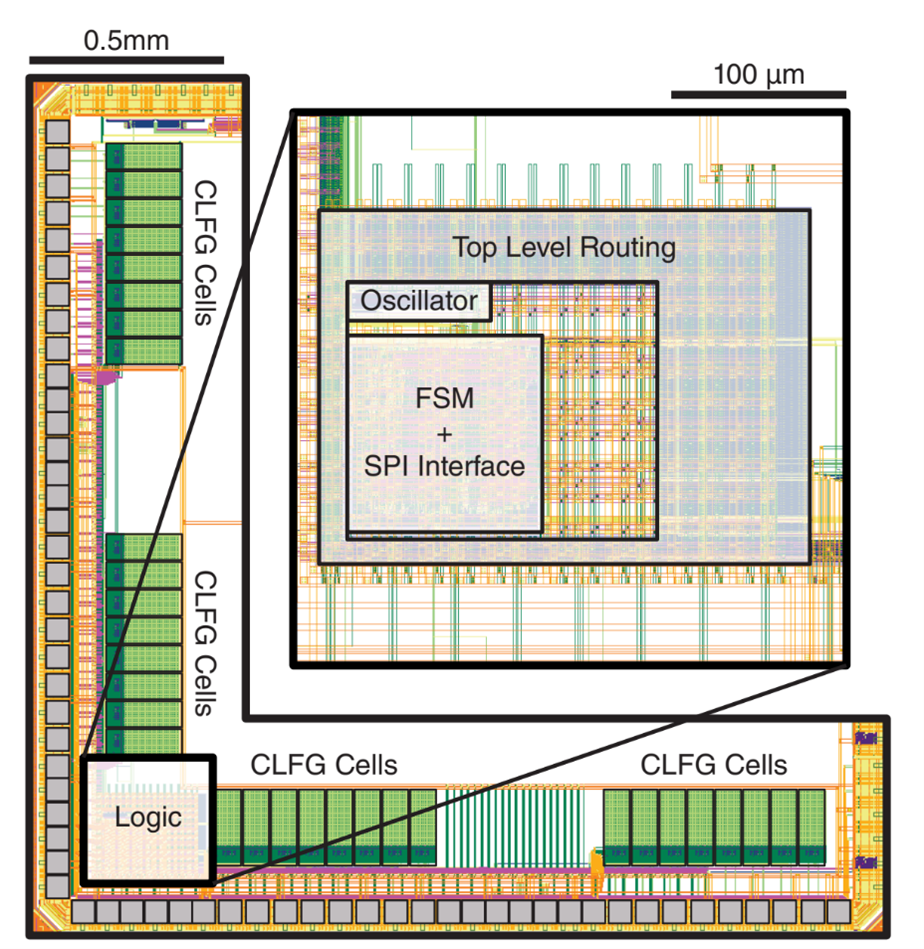
An L-shaped overhead view of digital and analog blocks. At the base of the L there lies a digital logic chip, represented by a square. Moving upward and to right from the digital logic block are 4 sets of charge-lock fast-gate cells (16 cells in each direction) The width of one leg of the L reads 0.5mm. Inset: Four rectangles from outside to inside, Logic, Top Level Routing, Oscillator, FSM and SPI Interface.
Figure 3: Diagram of the digital logic block (inset shows its makeup including a master oscillator, FSM, and SPI) and analog charge-lock fast-gate (CLFG) cells. These 32 CLFG cells are designed to charge up and then manipulate the electrical pulses needed to communicate with qubits.

Benchmarking results of the cryo-CMOS control with a quantum dot chip

Low power dissipation is a key challenge when it comes to communicating with qubits efficiently via these pulses. There are three variables that impact power dissipation: voltage level, frequency, and capacitance. The voltage needed in this case is set by the qubit, and the frequency is set by both the qubit and clock rate of the quantum plane. This leaves capacitance as the only variable you can adjust to create low power dissipation when charging gates and sending pulses—low capacitance means low dissipation. The capacitors in this system are tiny, spaced close together, and are very near the quantum plane, so they require as little power as possible to shuffle charge between capacitors to communicate with the qubits.

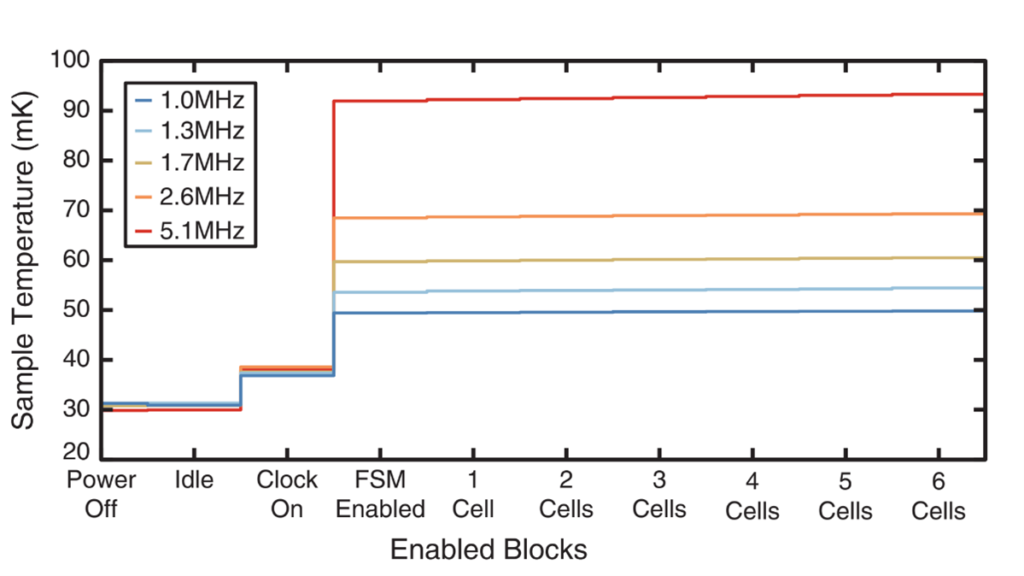
The researchers tested the Gooseberry chip to see how it would perform by connecting it with a GaAs-based quantum dot (QD) device. Some of the gates in the quantum dot device were connected to a digital-analog converter (DAC) at room temperature to compare these results with standard control approaches. Power leakage from the CLFG cells is measured by a second quantum dot in the device, and measurements of the QD conductance provide a way to monitor the charge-locking process. The temperature of all the components of the chip are measured as the control chip is being powered up, revealing that temperature stays below 100 mK within the necessary range of frequencies or clock speeds (see figure 4). See the paper for more details on the benchmarking process.
A graph shows
Figure 4: Measurement of the temperature of the system as each control chip is powered up in sequence. As each cell gets powered up, the temperature progressively increases but remains below 100 mK.

Extrapolating these results, the researchers estimated the total system power needed for the Gooseberry control chip as a function of frequency and the number of output gates. These results take into account both the clock speed and temperature needed for topological qubits, and Figure 5 shows that this chip is able to operate within the acceptable limits while communicating with thousands of qubits. This CMOS-based control approach also appears feasible for qubit platforms based on electron spins or gatemons.
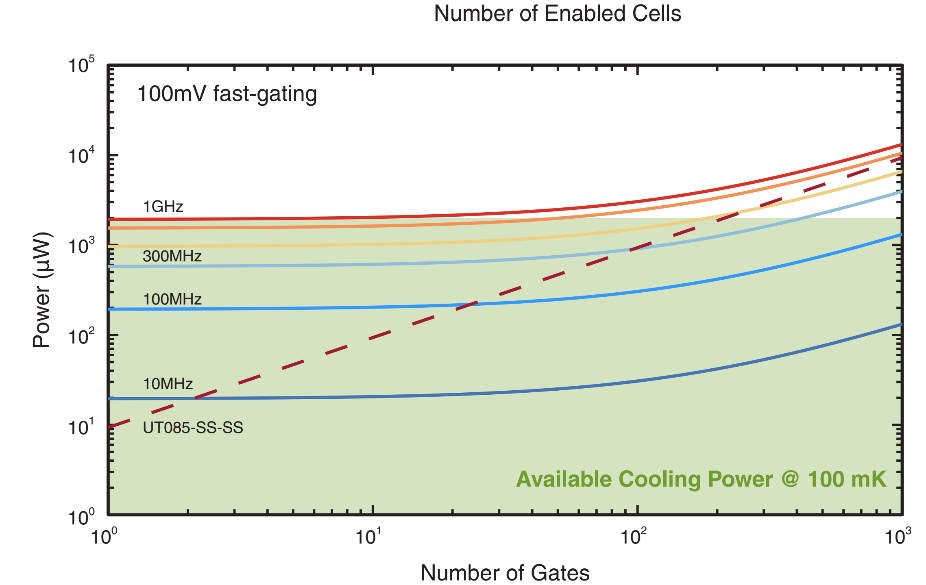
A graph with Power (in microwatts) on the y-axis and Number of Gates on the x-axis. Y-axis ranges from 10^0 to 10^5. X-axis ranges from 10^0 to 10^3. Lines on graph represent different frequencies, from 10 megahertz to 1 gigahertz. They all maintain a similar line, horizonal about halfway then curving slightly upward. Lines labeled 300 megahertz and 1 gigahertz curve above the green shaded section after 10^2, while all other frequencies below do not.
Figure 5: A projection of the total system power (in microwatts) of the Gooseberry chip, showing power dissipation at various frequencies with different numbers of gates (green region indicates cooling power achieved with today’s commercial dilution refrigerators).

Proof of principle that general-purpose compute is possible at cryogenic temperatures

The general-purpose cryo-compute core is a recent development that continues the progress made by Gooseberry. This is a general-purpose CPU operating at cryogenic temperatures. At present, the core operates at approximately 2 K, and it handles some triggering manipulation and handling of data. With fewer limitations from temperature, it also deals with branching decision logic, which requires more digital circuit blocks and transistors than Gooseberry has. The core acts as an intermediary between Gooseberry and executable code that can be written by developers, allowing for software-configurable communication between the qubits and the outside world. This technology proves it’s possible to compile and run many different types of code (written on current tools) in a cryogenic environment, allowing for greater possibilities of what can be accomplished with qubits being controlled by the Gooseberry chip.

Journey before destination: The zen behind the Microsoft approach to quantum computers

There’s no doubt that both Gooseberry and the cryo-compute core represent big steps forward for quantum computing, and having these concepts peer-reviewed and validated by other scientists is another leap ahead. But there are still many more leaps needed by researchers before a meaningful quantum computer can be realized. This is one of the reasons Microsoft has chosen to focus on the long game. While it might be nice to ramp up one aspect of quantum computers—such as the number of qubits—there are many concepts to be developed beyond the fundamental building blocks of quantum computers, and researchers at Microsoft Quantum and the University of Sydney aren’t stopping with these results.

Projects like the Gooseberry chip and cryo-compute core take years to develop, but these researchers aren’t waiting to put new quantum projects into motion. The idea is to keep scaffolding prior work with new ideas so that all of the components necessary for quantum computing at large scale will be in place, enabling Microsoft to deliver solutions to many of the world’s most challenging problems.

https://www.buzzfeed.com/kristatorres/sleep-education-tiktok

A Woman Went Viral For Her Explainer On Why We Shouldn’t Sleep 8 Hours At Once, And There’s Some Truth To It

“Humans were supposed to be segmented sleepers, which means we slept in parts.”by Krista TorresBuzzFeed Staff🔥 View 78 comments

Hello, my favorite internet friends. Today we are here to see if there is any truth behind a couple of sleep-related TikToks. First, we’ll discuss a mega-viral TikTok from user @sedonerrr, who claims that sleeping on your side causes your face to be asymmetrical:

https://www.tiktok.com/embed/v2/6900024427124133126?lang=en-US

ADVERTISEMENT

https://9801b8403cae94e688c084f0c05ae174.safeframe.googlesyndication.com/safeframe/1-0-37/html/container.html

And then we’ll talk about this mega-viral TikTok from user @notyourquirkyblackfriend. She explains how humans are supposed to be segmented sleepers (meaning we should sleep when we felt like it), but industrialization forced us to sleep eight hours at once each night:

https://www.tiktok.com/embed/v2/6897039037379448069?lang=en-US

In her TikTok, she says, “The sleep economy is a $70 billion dollar industry, which profits off the fact that we can’t sleep because we just can’t seem to get the eight hours they recommend for us when — plot twist — we’re not actually supposed to sleep eight hours. You see, kids, humans were supposed to be segmented sleepers, which means we slept in parts. We slept, woke up, then went to sleep again when we felt like it. But that didn’t really fit in with industrialization, did it? Thanks to artificial light and Henry Ford…we now force ourselves to sleep eight hours, then wake up to go to our nine-to-fives, which — who am I kidding — are actually eight-to-sixes. … The sleep economy knows that if you have trouble, you’ll just spend $5,000 on a mattress or hundreds in sleeping pills so you can get those precious eight hours.”

ADVERTISEMENT

To find out the truth, BuzzFeed spoke to Dr. Carleara Weiss, who is a geriatric nurse specialist with a Ph.D. and postdoctoral focus on behavioral sleep medicine and circadian rhythms.

https://www.instagram.com/p/CFZopQFnB0u/embed/?cr=1&v=4&wp=592&rd=https%3A%2F%2Fwww.buzzfeed.com&rp=%2Fkristatorres%2Fsleep-education-tiktok#%7B%22ci%22%3A0%2C%22os%22%3A67436.28999999783%2C%22ls%22%3A66963.95999999368%2C%22le%22%3A67130.34499999776%7D@@dr.weiss_sleep / instagram.com

So, let’s tackle the face symmetry TikTok. Can sleeping on your side or stomach actually change the symmetry of your face? No! “Sleep may affect wrinkle formation on your skin rather than facial symmetry. Facial symmetry is determined by bone structure, like the maxilla or mandible. Sleeping on your side or stomach will not affect your face symmetry because that is shaped during gestational development,” explained Dr. Weiss.

https://www.instagram.com/p/CITM72PHbgS/embed/?cr=1&v=4&wp=592&rd=https%3A%2F%2Fwww.buzzfeed.com&rp=%2Fkristatorres%2Fsleep-education-tiktok#%7B%22ci%22%3A1%2C%22os%22%3A67716.41999999702%2C%22ls%22%3A66963.95999999368%2C%22le%22%3A67130.34499999776%7D@dr.weiss_sleep / instagram.com

“When a person sleeps on their side or stomach, the facial skin is more subjected to compression and mechanical forces, stretching it into different directions. Usually, the facial tissue returns to normal after the compression stops. However, as we age, the skin and muscles in our face naturally lose elasticity and stiffen. In that case, sleeping on the side will likely contribute to wrinkle formation or sleep wrinkles that will not disappear after waking up. Sleep wrinkles may affect one side of the face more than the other, depending on individual preference for sleep position.”

In short, the way you sleep won’t change your facial structure, but it can cause wrinkles to form as you age. Dr. Weiss said you can avoid sleep wrinkles by sleeping on your back. “However, the best way to avoid wrinkles in general is to stay hydrated, exercise, follow a healthy diet, avoid smoking, and limit alcohol consumption to promote healthy skin from inside out,” she added.

MTV

If you have been sleeping on your stomach or side your whole life and struggle to change your sleeping routine, Dr. Weiss recommends adjusting the type of mattress you sleep on to alleviate pressure points and facilitate sleeping on your back. Back sleepers should avoid extra-firm mattress because those are less flexible and may cause lumbar pain.

ADVERTISEMENT

https://9801b8403cae94e688c084f0c05ae174.safeframe.googlesyndication.com/safeframe/1-0-37/html/container.html

OK, on to the TikTok about segmented sleep. Dr. Weiss said that there is some truth to the video, but it also has many misconceptions. “A simple way of explaining this is that segmented sleep is more of a historical social construct than a physiological need,” she said.

https://www.instagram.com/p/CGAKHDpH6qV/embed/?cr=1&v=4&wp=592&rd=https%3A%2F%2Fwww.buzzfeed.com&rp=%2Fkristatorres%2Fsleep-education-tiktok#%7B%22ci%22%3A2%2C%22os%22%3A70047.25999999937%2C%22ls%22%3A66963.95999999368%2C%22le%22%3A67130.34499999776%7D@dr.weiss_sleep / instagram.com

And, before we go any further, it’s important to note that not everyone needs eight hours of sleep per night, and sleep can also vary with age. The American Academy of Sleep Medicine (AASM) has clinical recommendations for sleep in ranges, according to the age group. For example, newborns need 14–17 hours of sleep, while adults and young adults need seven to nine hours. Other people may only need six hours.

https://www.instagram.com/p/CKWbXjvlIrw/embed/?cr=1&v=4&wp=592&rd=https%3A%2F%2Fwww.buzzfeed.com&rp=%2Fkristatorres%2Fsleep-education-tiktok#%7B%22ci%22%3A3%2C%22os%22%3A74164.30499999842%2C%22ls%22%3A66963.95999999368%2C%22le%22%3A67130.34499999776%7D@dr.weiss_sleep / instagram.com

Dr. Weiss said, “Emphasizing that everyone needs eight hours of sleep per night is not an appropriate statement. The definition of how many hours of sleep are needed is based on health outcomes, including weight, diabetes, hypertension, heart disease and stroke, depression, and increased risk of death.”

So, now let’s talk about sleep in general. Sleep is regulated by two processes: sleep homeostasis and circadian process. “Sleep homeostasis, or sleep pressure, refers to the propensity of falling asleep based on how long a person has been awake. The longer somebody is awake, the more sleep pressure they build, hence the more likely they are to fall asleep. The circadian process refers to circadian rhythms, which is a combination of physiological and behavioral changes over approximately 24-hour cycles. Humans, plants, animals, flies, and bacteria have circadian rhythms. For humans, a master biological clock in the hypothalamus regulates rhythmicity — it is called the suprachiasmatic nucleus (SCN),” she said.

“The SCN gathers information from the environment to identify the time of the day and define the timing for behavioral, hormonal, immune, neurological, and other physiological functions,” added Dr. Wiess.

“Light is the most potent cue to communicate time to our biological clock. We have specific cells in the retina — called intrinsically photosensitive ganglion cells — that perceive light in the environment and communicate that to the SCN. As a result, the SCN suppresses melatonin secretion at the pineal gland, contributing to wakefulness. A contrary effect occurs in the absence of light when the SCN promotes melatonin secretion, contributing to sleep,” she said.

A person sitting on the side of their bed and stretching in the morning

ADVERTISEMENT

https://9801b8403cae94e688c084f0c05ae174.safeframe.googlesyndication.com/safeframe/1-0-37/html/container.html

When the TikTok video refers to “segmented sleep,” it is describing something called biphasic sleep, which is where individuals break their sleep need into two blocks of approximately four hours. “Biphasic sleep should not be confused with napping. Historically, there is evidence that European Medieval societies and tribes in South America and Africa followed biphasic sleep to adjust for community wellness,” Dr. Weiss explained.

She added, “This allowed them to check on family members, pray, ensure safety, go hunting, etc., when waking up in the middle of the night. In those communities, a biphasic pattern was typically adopted during the winter. In the video’s comments section, many people shared that they wake up in the middle of the night and cannot fall asleep. There are many reasons for that, like insomnia, anxiety, depression, and poor sleep hygiene. It is not necessarily a need for biphasic sleep.”

The video also points out sleep as being a product of industrialization. “My perspective — as a sleep scientist and clinician — is that capitalism diminishes sleep quality. Our society is pushed to work 24/7, 365 days of the year. We often cannot practice sleep hygiene or keep a regular sleep schedule because of work-related pressure. We have shift-work, late work hours, and overall anxiety and pressure to be productive. We are sleeping less than six hours, and there are health consequences. We cannot blame electricity for that, as this alone does not change the societal pressure for productivity,” she explained.

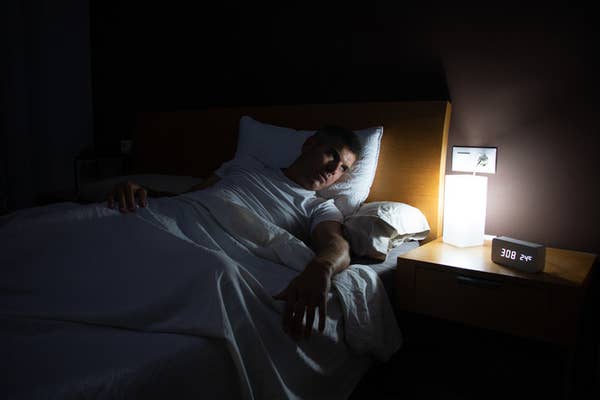
A man in bed staring at his alarm clock at 3:08 in the morning

ADVERTISEMENT

https://9801b8403cae94e688c084f0c05ae174.safeframe.googlesyndication.com/safeframe/1-0-37/html/container.html

Dr. Weiss does not think promoting sleep in blocks would solve the problem, but it can be alternative for those who experience sleep or circadian rhythm disorders and those who have extreme work shifts.

Sony Pictures

Here’s the tl;dr version: Biologically, humans are wired to sleep when it is dark and wake up when it is light. We weren’t meant to be “segmented sleepers,” but historically, it has been practiced in some parts of the world. Lastly, capitalism is a contributing factor to poor sleep.

So, what’s the best way to get good sleep? Dr. Weiss suggests avoiding exposure to bright light an hour before bedtime, going to bed and waking up at the same time each day, and only using your bed for sleeping and sex! (Basically, stop watching TV and checking social media in bed. 😭)

If you want to learn more about sleep, you can follow Dr. Weiss on TwitterFacebook, and Instagram. You can also visit her website.

https://medicalxpress.com/news/2021-01-hypnotic-complex-task-easy-vision.html


Hypnotic suggestions can make a complex task easy by helping vision fill in the blanks

by Association for Psychological Science

hallucinations
Credit: Pixabay/CC0 Public Domain

Popular folklore and anecdotal evidence suggest that people in a hypnotic or suggestible state can experience sensory hallucinations, such as perceiving sounds and sights that are not actually there. Reliable scientific evidence of these experiences, however, has been notoriously challenging to obtain because of their subjective nature.

New research published in the journal Psychological Science provides compelling evidence that hypnotic suggestions can help highly susceptible people “see” imaginary objects, equipping them with the missing details needed to solve an otherwise challenging visual puzzle.

“Hypnosis holds intriguing effects on human behavior,” said Amir Raz, a researcher at McGill University and coauthor on the paper. “The careful, systematic study of hypnotic phenomena can answer important questions about mind-body interactions and advance novel therapies in medicine, psychology, and dentistry.”

For their research, Raz and his colleagues divided 32 participants into two groups: those who were found to be highly hypnotizable and those who were less suggestible. The participants viewed an array of disconnected lines moving around on a display screen. The lines, if lengthened and connected, would have formed various geometric shapes, such as diamonds or triangles.

Participants had to determine whether the rotation of the incomplete geometric figures was clockwise or counterclockwise. This task was inherently difficult because the disconnected lines lacked the visual cues necessary to easily assess the direction of rotation. The participants’ success rate was approximately 50-50, or no better than chance.

The participants were then given the hypnotic suggestion to imagine that something was blocking out part of each shape being observed. Afterward, they repeated the same task of determining the direction of rotation.

The results revealed that participants who were highly susceptible to hypnotic suggestion successfully “hallucinated” visual occluders on top of moving objects. This added imaginary element enabled the participants to better visualize the full geometric shapes and more accurately determine their direction of rotation. On average, their success rate improved to approximately 70%, a statistically significant change.

The participants in the less hypnotizable group, however, were no more likely to complete the observational task following hypnotic suggestion. “Although these results are consistent with our hypothesis, the data surprised us by revealing the decisive and robust nature of the effect,” said Raz.

Previous work on hypnosis has often highlighted its capacity to suppress or remove certain perceptual experiences. The new research shows compelling evidence that a hypnotic suggestion can also enhance or introduce perceptual experiences.

“Our findings support the idea that, at least in some people, suggestions can add perceptual information to sensory input,” said Raz. “This observation adds meaningful weight to theoretical, clinical, and applied aspects of the brain and psychological sciences.”


Explore furtherResearchers induce a form of synesthesia with hypnosis


More information: Mathieu Landry et al, Difficult Turned Easy: Suggestion Renders a Challenging Visual Task Simple, Psychological Science (2020). DOI: 10.1177/0956797620954856Journal information:Psychological ScienceProvided by Association for Psychological Science

https://techcrunch.com/2021/01/28/levity/

Levity is a ‘no-code’ AI tool to let anyone create workflow automations

Steve O’Hear@sohear / 12:00 AM PST•January 28, 2021 CommentA photo of Levity's two founders

Image Credits: Levity

Levity, which has been operating in stealth (until now), is the latest no-code company to throw its wares into the ring, having picked up $1.7 million in pre-seed funding led by Gil Dibner’s Angular Ventures. The Berlin-based startup wants to bring AI-powered workflow automation to anyone, letting knowledge workers automate tedious, repetitive and manual parts of their job without the need to learn how to code.

Suitable for customer service, marketing, operations, HR, and more, Levity has elected to be a horizontal offering from the get-go. Typical repetitive tasks that can be automated include reviewing and categorising documents, images, or text. The premise is that conventional, rule-based automation software isn’t able to automate tasks like these as it requires cognitive abilities, meaning that they are usually done manually. This, of course, is where machine learning come into play.

“We want to solve the problem that people spend so much time at their jobs doing boring, repetitive stuff that can be automated to free up space and time for fun and interesting work,” says Gero Keil, co-founder and CEO. “Even though this is what AI has been promising us for decades, there are very few solutions out there, and even less for non-technical people who can’t code”

Blobr, the ‘no-code’ company turning APIs into products, raises €1.2M pre-seed

To that end, Keil says Levity’s entire mission is to help non-technical knowledge workers automate what they couldn’t automate before. Specifically, the startup targets work processes that involve making decisions on unstructured data, such as images, text, PDFs and other documents.

“For example, if a company receives hundreds or thousands of emails from partners and customers with attachments every day, someone typically has to download the attachment, look at it and then decide what to do with it,” explains Keil. “With Levity, they can train their own custom AI on all of the historic data that they have accumulated, and once it has learned from that it seamlessly integrates with their existing tools and workflows e.g. Dropbox, Gmail, Slack etc.”

More broadly, he says there are many companies struggling to “productionize AI” that would really benefit from having an end-to-end platform “that enables them to build their own AI solutions and make them part of their processes”.

Keil argues that Levity’s main competitor is people doing work manually, but concedes that there is crossover with automation machine learning tools, workflow automation offerings, and labelling tools,

“Instead of going deep into every domain of the ML value chain and making the lives of developers and data scientists at large corporations easier, we focus only the most essential bits and pieces, wrap them in simple and enjoyable UX and abstract the rest away,” he says. “That makes us the best for non-developers in small and medium-sized businesses that want to automate previously non automatable processes in the most straightforward way. The people that have the automation problem become the same people that solve the automation problem; it’s a paradigm shift just like what Wix and Squarespace did to websites”.

Adds Gil Dibner, general partner and founder at Angular Ventures, in a statement: “Levity is driving a massive shift that will affect all knowledge workers. By allowing knowledge workers to easily train AI engines, build AI-powered automations, and integrate them into their everyday workflows, Levity is radically democratizing the benefits of AI.”

Alongside Angular, Levity’s other backers include: System.One, Discovery Ventures (founders of SumUp), Martin Henk (founder of Pipedrive) and various additional unnamed angel investors.

https://www.space.com/full–moon-affects-human-sleep-menstrual-cycle

The full moon may influence sleep and menstrual cycles, scientists say

By Chelsea Gohd a day ago

Is there some science in these old-school myths?

Click here for more Space.com videos…01:48 of 01:58Volume 0%Next UpOTD in Space – January 14: Huygens Probe Lands on Saturn’s Moon Titan00:44 PLAY SOUND

Does the full moon change how we sleep? Does it synchronize with menstrual cycles? 

What might sound like old-school myths might actually hold some truth. People go to bed later and sleep fewer hours before a full moon and menstrual cycles seem to temporarily synchronize with moon cycles, scientists have found in two new studies. 

Throughout history, humans have connected our daily lives to the changing skies, specifically the changing faces of the moon. Lore surrounding the moon’s phases has ranged from full moons inciting werewolves to the moon’s cycle affecting how we feel and our day-to-day moods. 

But, strangely, a couple of these tall tales seem to have roots in real science. 

Related: The moon: 10 surprising lunar facts

Sleeping with the full moon

People go to bed later and sleep fewer hours the night before a full moon, and menstrual cycles seem to temporarily synchronize with moon cycles, scientists have found in two new studies.
People go to bed later and sleep fewer hours the night before a full moon, and menstrual cycles seem to temporarily synchronize with moon cycles, scientists have found in two new studies.  (Image credit: University of Washington)

In a study published today (Jan. 27) in the journal Science Advances, a team of scientists from the University of Washington, the National University of Quilmes in Argentina and Yale University show how sleep cycles seem to change with the lunar cycle. 

They found that, in the days leading up to a full moon, people tend to go to sleep later and sleep for fewer hours. For this work, the team studied college students in the city of Seattle, Washington, and also with those living in indigenous communities in northern Argentina, two different environments where there is a variety in individual access to electricity because of how artificial light might affect the participants. 

Using sleep-monitoring wrist devices, they studied 98 individuals living in three Toba-Qom indigenous communities in Formosa, Argentina and additionally used sleep data from 464 college students in the Seattle area (the data from the college students was originally collected for a separate study). 

The team found that, while the connection between sleep cycles and lunar cycles is a bit more obvious in communities without electricity access, the connection still seems to be present in areas with electricity as well. 

“We see a clear lunar modulation of sleep, with sleep decreasing and a later onset of sleep in the days preceding a full moon,” lead author Horacio de la Iglesia, a professor of biology at the University of Washington, said in a statement. “And although the effect is more robust in communities without access to electricity, the effect is present in communities with electricity, including undergraduates at the University of Washington.”

In these groups, they showed that the nights leading up to a full moon was when people slept the least and went to bed the latest. These nights also had more light in the night sky after dusk as the waxing moon got brighter. 

“We hypothesize that the patterns we observed are an innate adaptation that allowed our ancestors to take advantage of this natural source of evening light that occurred at a specific time during the lunar cycle,” study author Leandro Casiraghi, a University of Washington postdoctoral researcher in the biology department.

Menstrual and lunar cycles

Sleep cycles aren’t the only human function that seems to be affected by the moon, scientists are finding. This is not a new notion. In fact, for a long time, people have suggested that there is a connection between lunar and menstrual cycles, some myths even suggesting that fertility and lunar cycles have some sort of connection, a controversial tale.

In a separate study, also published today in  Science Advances, researchers showed that, while all of the myths surrounding this connection might not hold up, there could be some link between menstrual cycles and moon cycles. 

By analyzing menstrual cycle records that 22 women kept for up to 32 years. They examined long-term data on menstrual cycle onset with data averaging a length of 15 years and including information from women both under and over age 35. They compared this data with fluctuations in the lunar cycles to see how the two lined up. 

They found that, of the women who participated, those whose menstrual cycles last longer than 27 days showed “intermittently synchronized with cycles that affect the intensity of moonlight,” according to a statement. The team determined that this synchronization was slowly lost over time as the participants grew older, and found that the link was lessened with increased exposure to artificial light. 

More specifically, they concluded that “menstrual cycles also aligned with the tropical month (the 27.32 days it takes the moon to pass twice through the same equinox point) 13.1% of the time in women 35 years and younger and 17.7% of the time in women over 35, suggesting that menstruation is also affected by shifts in the moon’s gravimetric forces,” according to the statement.

Email Chelsea Gohd at cgohd@space.com or follow her on Twitter @chelsea_gohd. Follow us on Twitter @Spacedotcom and on Facebook.

https://www.medicalnewstoday.com/articles/brain-exercises#summary

22 brain exercises to improve memory, cognition, and creativity

The brain is the most complex organ of the body. It regulates multiple bodily functions, interprets incoming sensory information, and processes our emotions. It is also the seat of memory, intelligence, and creativity.

Although the brain gets plenty of exercise every day, certain activities may help boost brain function and connectivity. This in turn may help protect the brain from age-related degeneration.

The brain is always active, even during sleep. However, certain activities can engage the brain in new ways, potentially leading to improvements in memory, cognitive function, or creativity.

This article outlines 22 brain exercises that may help boost memory, cognition, and creativity.

1. Meditation

A person moving a chess piece on a chess board.
Gen Sadakane/EyeEm/Getty Images

Meditation generally involves focusing attention in a calm, controlled way. Meditating may have multiple benefits for both the brain and the body.

According to the National Center for Complementary and Integrative Health, research suggests that meditation may benefit the brain by slowing brain aging and increasing the brain’s ability to process information.

2. Visualizing more

Visualization involves forming a mental image to represent information. The mental image may be in the form of pictures or animated scenes.

2018 review notes that visualization helps people organize information and make appropriate decisions.

People can practice visualization in their day-to-day lives. For example, before going shopping, people can visualize how they will get to and from the grocery store, and imagine what they will buy when they get there. The key is to imagine the scenes vividly and in as much detail as possible.

3. Playing games

Playing card games or board games can be a fun way to socialize or pass the time. These activities may also be beneficial for the brain. A 2017 study found a link between playing games and a decreased risk of cognitive impairment in older adults.ADVERTISING

4. Playing memory card games

Memory card games test a person’s short-term memory and ability to remember patterns. They are a simple and fun way to engage the brain and activate areas related to pattern recognition and recall.

5. Practicing crossword puzzles

Crossword puzzles are a popular activity that may stimulate the brain. An older study from 2011 notes that crossword puzzles may delay the onset of memory decline in people with preclinical dementia.

6. Completing jigsaw puzzles

Completing a jigsaw puzzle can be a good way to pass the time and may also benefit the brain. A 2018 study found that puzzles activate many cognitive functions, including:

The study concluded that doing jigsaw puzzles regularly and throughout life may protect against the effects of brain aging.

7. Playing sudoku

Number puzzles, such as sudoku, can be a fun way to challenge the brain. They may also improve cognitive function in some people.

2019 study of adults aged between 50 and 93 years found that those who practiced number puzzles more frequently tended to have better cognitive function.

8. Playing chess

2016 meta-analysis notes that chess and other cognitive leisure activities may lead to improvements in:

  • memory
  • executive functioning, which is the ability to monitor and adapt behavior in order to meet set goals
  • information processing speed

9. Playing checkers

2015 study found that there is a connection between regular participation in checkers or other cognitively stimulating games and larger brain volume and improved markers of cognitive health in people at risk of Alzheimer’s disease.

10. Playing video games

2015 review notes that some types of video games — such as action, puzzle, and strategy games — may lead to improvements in the following:

  • attention
  • problem solving
  • cognitive flexibility

11. Socializing

Enjoying company of friends may be a mentally engaging leisure activity and may help preserve cognitive function. A 2019 study found that people with more frequent social contact were less likely to experience cognitive decline and dementia.

Some social activities that may help stimulate the brain include:

  • having discussions
  • playing games
  • participating in social sports

12. Learning new skills

Learning new skills engages the brain in different ways and may help improve brain function.

2014 study of older adults found that learning a new and cognitively demanding skill, such as quilting or photography, enhanced memory function.

13. Increasing personal vocabulary

Increasing one’s vocabulary range is a great way to broaden knowledge while exercising the brain.

A simple way to increase vocabulary is to read a book or watch a TV program and note down any words that are unfamiliar. A person can then use a dictionary to look up the meaning of the word and think up ways to use the word in a sentence.

14. Learning a new language

“Bilingualism” refers to the ability to speak two languages.

2019 review notes that bilingualism increases and strengthens connectivity between different areas of the brain. The researchers propose that this enhanced connectivity may play a role in delaying the onset of Alzheimer’s disease and other forms of dementia.

15. Listening to music

A 2018 study published in Brain Sciences found that listening to music a person enjoys engages and connects different parts of the brain.

The researchers propose that this may lead to improvements in cognitive function and overall well-being.

16. Learning a musical instrument

Learning an instrument exercises parts of the brain that are responsible for coordination.

According to a 2014 study, playing an instrument may benefit cognitive development in a young brain and help protect against cognitive impairment in an aging brain.MEDICAL NEWS TODAY NEWSLETTERStay in the know. Get our free daily newsletter

Expect in-depth, science-backed toplines of our best stories every day. Tap in and keep your curiosity satisfied.Enter your emailSIGN UP NOW

Your privacy is important to us

17. Taking up engaging hobbies

Taking up a new hobby can be mentally stimulating and exercise the brain in new ways.

Hobbies that require coordination or dexterity will activate a person’s motor skills. Such hobbies may include:

  • knitting
  • embroidery
  • drawing
  • painting
  • dancing
  • learning a musical instrument

18. Exercising regularly

Regular physical exercise is beneficial for both the brain and the body. Authors of a 2019 review note that exercise improves the following aspects of brain health:

  • memory
  • cognition
  • motor coordination

19. Dancing

According to the Centers for Disease Control and Prevention (CDC), exercise has beneficial effects on the following aspects of cognitive health:

  • memory
  • planning
  • organization

Dance is a form of exercise that may also engage areas of the brain involved in rhythm and balance.

20. Engaging in sports

Certain sports are both physically and mentally demanding. Some require a range of cognitive skills, such as:

  • sustained attention
  • planning
  • multitasking
  • the ability to adapt rapidly to changing situations

2019 review notes that elite athletes who participate in high demand sports tend to have improved attention and faster information processing speeds.

21. Practicing tai chi

Tai chi is a form of physical exercise that involves gentle body movements, rhythmic breathing, and meditation.

2019 study compared brain function and connectivity among tai chi practitioners and those who did not practice it.

The researchers found that the tai chi practitioners had enhanced connectivity between different regions of their brain. They proposed that this may improve cognition and decrease the rate of memory loss.

22. Sleeping

While not necessarily an active exercise, sleep is crucial for both the brain and the body.

According to the National Institute of Neurological Disorders and Stroke, most adults need between 7 and 9 hours of sleep each night, although many people get less sleep than they need.

2015 review notes that sleep has been proven to:

As such, making sure to get enough sleep each night is an important step toward maintaining a healthy brain.

Summary

Brain exercises can be as simple as actively engaging the brain in everyday tasks. Others are targeted workouts for the brain, specifically designed to enhance memory, cognition, or creativity.

Exercising the brain may help improve brain function and boost connectivity between the different areas. This may help protect the brain from age-related degeneration.

People are likely to differ in terms of the brain exercises they find most enjoyable. It may be a good idea to try a range of brain-training activities at first and to stick with those that provide the most enjoyment or reward.

https://www.healthline.com/health-news/how-a-full-moon-may-affect-your-sleep#The-bottom-line

How a Full Moon May Affect Your Sleep

BrilliantEye/Getty Images
  • A new study finds we sleep less on the nights leading up to a full moon, but researchers don’t understand why this occurs.
  • Researchers looked at people who live with no, limited, and full access to artificial lighting to find the same changes in sleep as the lunar cycle progresses.
  • Experts are still trying to understand why these sleep changes may happen.

We’ve all heard stories of how things can get a little strange during a full moon, from increased rates of psychiatric hospitalizationTrusted Source to a higher risk of being bittenTrusted Source by an animal.

However, findings from a study published Wednesday, Jan. 27, suggest that the lunar cycle does affect how you sleep.

Researchers looked at groups with differing access to artificial light

Using wrist monitors, researchers tracked sleep patterns among 98 people living in three Toba-Qom indigenous communities in Argentina.

“For the last few years we have been studying Toba-Qom that live in communities with different levels of access to electricity,” lead researcher and University of Washington professor of biology, Horacio de la Iglesia, PhD, told Healthline.

These communities differed in access to electricity during the study period:

  • One community had no electricity.
  • Another had limited access to electricity, such as a single source of artificial light.
  • A third community lived in an urban setting with full access to electricity.

Researchers collected sleep data for one to two lunar cycles for about 75 percent of the Toba-Qom participants.

Researchers found participants in all three communities showed the same sleep pattern changes as the moon progressed through its 29.5-day cycle.

On average, people went to bed latest and slept the least 3 to 5 days before a full moon.

Then they analyzed sleep-monitor data from 464 Seattle-area college students collected for a separate study to find the same pattern of sleep changes.

Sleep was shortest before a full moon

“Although we had hypothesized that sleep would be inhibited during moonlit nights, we were particularly surprised by two findings,” de la Iglesia said.

“First, we did not see a maximal inhibition of sleep exactly during the full moon nights, as we had predicted; instead, nocturnal activity increased and sleep was shortest starting a few nights before the night of full moon,” he said.

De la Iglesia said he initially believed this was because more moonlight is available during the first half of the night, but not necessarily the nights that follow the full moon (because the moon rises later every night).

“Second, we were extremely surprised to find that the effect, although smaller, was present regardless of the access to electricity, and in fact, even in university students living in Seattle!” he said.

Experts say findings are plausible

Dr. Alex Dimitriu, who is double board-certified in psychiatry and sleep medicine, said the moon most likely exerts its effect by an increase in evening or nighttime light. This might suppress melatonin (a sleep hormone), which affects the onset and duration of sleep.

“According to this study, it does seem that there is a significant delay and decrease in total sleep time on nights leading up to a full moon,” said Dimitriu, founder of Menlo Park Psychiatry & Sleep Medicine.

“We know that light, whether artificial or natural — from the moon, or the setting sun — can have a suppressant effect on melatonin,”he said. “So it is plausible that moonlight could have a natural wake promoting effect.”ADVERTISING

Study doesn’t explain how moon affects sleep

De la Iglesia said the main limitation of the study is that they can’t establish a causal link between moon phase and the changes in sleep.

“Obviously, sleep timing is synchronized with the moon phases, but we still do not know how this happens,” he said.

But he thinks the moon’s gravity might explain it.

“We believe that the gravitational pull cycles associated with the lunar month may predispose humans to be particularly sensitive to the effects of light, moonlight, or artificial, on the nights close to the full moon,” de la Iglesia said.

Expert says it’s all about light

“The point of all this is humans are really light sensitive,” said Dr. Steven H Feinsilver, director of the Center for Sleep Medicine at Lenox Hill Hospital in New York.

“We all have a circadian rhythm, a built-in body clock, it doesn’t necessarily run a 24-hour cycle, and probably runs slower in most people — a 25-hour cycle,” he said.

It’s exposure to light that trains us into a normal 24-hour cycle, he said, and that “light is the thing that really turns your brain on.”

Feinsilver was unsure about lunar gravity having any appreciable effect on sleep.

“We can talk about that it’s possible it’s not light,” he said, “but the gravitational pull of the moon, and that’s a lot harder to understand, there’s not even a biological known basis for that.”

Does it affect your health?

According to Dimitriu, a sleep loss of 20 to 30 minutes is generally well tolerated in someone who ordinarily gets about 7 to 8 hours of sleep per night.

However, he cautioned that this can become problematic for people who sleep fewer than 7 hours on average or who don’t usually sleep well.

“Healthy sleepers will most likely do just fine with a minor decrease in their total sleep time. For people with insomnia, thin, or unrefreshing sleep, a loss of 20 minutes can be adding insult to injury,” he said.

Dimitriu said that modern life, with its artificial light sources, and forms of entertainment like smartphones and TVs, “likely exerts a far greater effect on our sleep than moon phases.”

This puts the emphasis on maintaining “healthy sleep behaviors and bedtime habits,” he said.

The bottom line

A new study finds we sleep less on the nights leading up to a full moon. However, researchers don’t understand why this occurs.

Researchers looked at people who live with no, limited, and full access to artificial lighting to find the same changes in sleep as the lunar cycle progresses. They think the moon’s gravity might have something to do with it.

Experts say there’s still no evidence that lunar gravity can affect sleep, and that light in some way is likely causing this effect.

https://www.cnet.com/roadshow/news/tesla-cybertruck-elon-musk-production/

Tesla Cybertruck engineering is done, first deliveries will happen this year, Musk says

The first trucks should make their way into customers’ hands later this year.

Steven Ewing headshot

Kyle Hyatt headshot

Steven EwingKyle HyattJan. 27, 2021 5:57 p.m. PT

LISTEN- 01:01

cybertruck-gal-promo
Will the production model look like this? Who knows.Tesla

Tesla plans to deliver the first examples of its Cybertruck by the end of this year. That’s the latest from Tesla CEO Elon Musk, speaking to members of the media during the company’s quarterly earnings call on Wednesday.

“We’ll make a few deliveries of the Cybertruck in 2021,” Musk said, “but volume production is set for next year.”

Musk also confirmed the Cybertruck is past its design and engineering phases. “We’ve got the designs fixed,” he said. “We’ll soon order the equipment necessary to make the Cybertruck.” Whether or not the production version will look like the angular debut truck is still anyone’s guess.

On that note, Musk said Cybertruck production will require an even larger casting press than the one being used for the Model Y. An 8,000-ton press will be necessary to make the truck, compared to 6,000 tons for the Model Y.

The first Cybertrucks to reach production will be the most powerful, tri-motor variants, according to an earlier report. The more affordable versions will be built in 2022. The Cybertrucks will be built at Tesla’s new Gigafactory in Austin, Texas, which could be up and running as soon as May.

https://scitechdaily.com/new-fast-forward-algorithm-could-unleash-the-power-of-quantum-computers/

New “Fast Forward” Algorithm Could Unleash the Power of Quantum Computers

TOPICS:AlgorithmDOELos Alamos National LaboratoryQuantum Computing

By LOS ALAMOS NATIONAL LABORATORY JANUARY 27, 2021

Quantum Computer Code Concept

Fast-forwarding quantum calculations skips past the time limits imposed by decoherence, which plagues today’s machines.

A new algorithm that fast forwards simulations could bring greater use ability to current and near-term quantum computers, opening the way for applications to run past strict time limits that hamper many quantum calculations.

“Quantum computers have a limited time to perform calculations before their useful quantum nature, which we call coherence, breaks down,” said Andrew Sornborger of the Computer, Computational, and Statistical Sciences division at Los Alamos National Laboratory, and senior author on a paper announcing the research. “With a new algorithm we have developed and tested, we will be able to fast forward quantum simulations to solve problems that were previously out of reach.”

Computers built of quantum components, known as qubits, can potentially solve extremely difficult problems that exceed the capabilities of even the most powerful modern supercomputers. Applications include faster analysis of large data sets, drug development, and unraveling the mysteries of superconductivity, to name a few of the possibilities that could lead to major technological and scientific breakthroughs in the near future.

Recent experiments have demonstrated the potential for quantum computers to solve problems in seconds that would take the best conventional computer millennia to complete. The challenge remains, however, to ensure a quantum computer can run meaningful simulations before quantum coherence breaks down.

“We use machine learning to create a quantum circuit that can approximate a large number of quantum simulation operations all at once,” said Sornborger. “The result is a quantum simulator that replaces a sequence of calculations with a single, rapid operation that can complete before quantum coherence breaks down.”

The Variational Fast Forwarding (VFF) algorithm that the Los Alamos researchers developed is a hybrid combining aspects of classical and quantum computing. Although well-established theorems exclude the potential of general fast forwarding with absolute fidelity for arbitrary quantum simulations, the researchers get around the problem by tolerating small calculation errors for intermediate times in order to provide useful, if slightly imperfect, predictions.

In principle, the approach allows scientists to quantum-mechanically simulate a system for as long as they like. Practically speaking, the errors that build up as simulation times increase limits potential calculations. Still, the algorithm allows simulations far beyond the time scales that quantum computers can achieve without the VFF algorithm.

One quirk of the process is that it takes twice as many qubits to fast forward a calculation than would make up the quantum computer being fast forwarded. In the newly published paper, for example, the research group confirmed their approach by implementing a VFF algorithm on a two qubit computer to fast forward the calculations that would be performed in a one qubit quantum simulation.

In future work, the Los Alamos researchers plan to explore the limits of the VFF algorithm by increasing the number of qubits they fast forward, and checking the extent to which they can fast forward systems. The research was published September 18, 2020 in the journal npj Quantum Information.

Reference: “Variational Fast Forwarding for Quantum Simulation Beyond the Coherence Time” by Cristina Cîrstoiu, Zoë Holmes, Joseph Iosue, Lukasz Cincio, Patrick J. Coles and Andrew Sornborger, 18 September 2020, npj Quantum Information.
DOI: 10.1038/s41534-020-00302-0

The research was supported with funding from the Los Alamos National Laboratory Information Science & Technology Institute, Department of Energy Advanced Scientific Computing Beyond Moore’s Law program, and the Los Alamos National Laboratory Directed Research and Development program.

We recommend

  1. Superconducting quantum bits*Wei-Yang Liu et al., Chinese Physics B, 2018
  2. Research of micro-seismic source location method in layered velocity medium based on 3D fast sweeping algorithm and arrival time differences database techniqueGUO Chao et al., Rock and Soil Mechanics, 2019
  3. Model and Algorithm of Sequence-Based Quantum-Inspired Neural NetworksPanchi LI et al., Chinese Journal of Electronics, 2018
  1. Nuclear magnetic resonance for quantum computing: Techniques and recent achievements☆Tao Xin et al., Chinese Physics B, 2018
  2. The Heart of the Matter: An In-Depth Look at the Latest Evidence With CLL Therapies and How to Optimize Treatment SafetyAn independent learning activity funded by Janssen Inc. 15minutes

https://www.psychologytoday.com/us/blog/canine-corner/202101/do-dogs-react-the-scent-human-fear


Stanley Coren PhD., DSc, FRSC

Canine Corner

FEAR

Do Dogs React to the Scent of Human Fear?

Can dogs be trained to be lie detectors based on their ability to scent fear?

Posted Jan 27, 2021

THE BASICS

JackieLou DL/Pixabay

Source: JackieLou DL/Pixabay

Can dogs identify our emotional state by scent alone? Back in the 1970s I had a conversation with a colleague from the University of Utah who studied lie detection. He told me “I have been talking to some dog handlers who work for the police and they suggested to me that dogs might turn out to be good at lie detection. After all, the polygraph that we use to detect lies is simply measuring a cluster of physiological changes associated with stress. It’s looking for changes in heart rate, blood pressure, breathing patterns, increased sweating and that sort of thing that might indicate anxiety and thus a lie. These police canine officers believe that their dogs know when someone is lying. They reason that this is because when people are fearful and stressed over the possibility that their guilty behavior might be discovered, their body chemistry might change a wee bit, enough at least to alter the odor of their sweat. Since dogs are so good at scent discrimination perhaps they could be taught to respond to these chemical signals and to point out to us that a person is likely to be telling us lies.”

To the best of my knowledge there were no published reports exploring this question coming out of his laboratory; however some recent research from a team headed by Biagio D’Aniello of the Department of Biology at the University of Naples Federico II suggests that this area of inquiry might be worth a second look. This is because one of the necessary components for canine lie detection, namely the ability of dogs to detect fear or stress by scent alone, now appears to have been confirmed.

Obviously, if you are going to explore the behavioral responses of dogs to emotional scents, the first thing you need are appropriate samples of emotion-laced odors to test. To obtain these the investigators had eight different Caucasian male university students watch videos which were designed to evoke fear and stress or, alternatively, videos designed to produce feelings of happiness and relaxation. During the video viewing period the students had scent collecting pads placed under their armpits to collect their odors and sweat. These pads were later frozen and preserved to serve as scent samples. Prior to testing each pad was cut into quarters and one quarter was put in a container along with samples from three other individuals who had experienced the same emotional condition. This gives you a sort of “super sample”, which in effect averages the fear or the happiness scent of four people and smudges out the other differences unique to particular individuals. In addition there was a control scent, obtained by using pads fresh out of the pack which had not been exposed to any biological sources of odor.

The testing set-up was fairly straightforward: 84 dogs and their owners were individually tested in a room which contained two chairs diagonally opposite each other in the corners. In one of these the dog’s owner sat, while in the other was a stranger. Both remained passively seated during the testing session. In the center of the room was an apparatus which contained the odor sample. After the odor sample (the fear scent, happy scent or control scent) was released into the air the dog’s behavior was videotaped and analyzed.article continues after advertisement

The researchers were looking for a number of different things. Obviously they were looking for signs of stress, such as panting, yawning, mouth licking, barking, pacing, and so forth. They also noted whether the dog was looking toward or approaching the door which allowed exit from the room. In addition they monitored which person the dog approached and paid attention to — its owner or the stranger — and which person the dog would try to interact with. Previous research has shown that dogs tend to hover around their owner when they are feeling stressed, using that familiar person as a safe base.

The major finding was quite unambiguous: When the odor released into in the room was based on scents collected from people experiencing fear or anxiety producing conditions, the dogs indicated that they recognized something negative by showing more signs of stress and staying close to and trying to interact more with their owners. Both the male and female dogs responded in the same way to the fear-based odorant.

There was a surprise, however, and this had to do with responses to the scent associated with happiness. Researchers found that the male dogs really didn’t seem to recognize, or at least didn’t respond to, the happiness scent in any way that was different than how they responded to the emotion-free control scent. Female dogs, however, did seem to recognize the happiness scent, since when it was in the air they showed an increased interest in the stranger on the other side of the room. Thus both male and female dogs responded to the scent of fear, while only the females seemed to be responsive to the scent of happiness.

The fact that dogs can recognize the scent of fear or stress, and respond to it, does seem to reopen the question as to whether dogs can be used to detect whether a person is lying or telling the truth.

While this research suggests that all dogs might have some ability to become biological lie detectors, this data also suggests that female dogs also have the ability to detect and respond to scents associated with happy emotions. Thus it might be that female dogs can be assigned an additional, non-forensic task, namely detecting whether or not a person is experiencing positive emotions in the presence of their owner — perhaps a nice addition to a dating app?article continues after advertisement

Copyright SC Psychological Enterprises Ltd. May not be reprinted or reposted without permission

References

D’Aniello, Biagio, Fierro, Barbara, Scandurra, Anna, Pinelli, Claudia, Aria, Massimo and Semin, Gün R. (2021). Sex differences in the behavioral responses of dogs exposed to human chemosignals of fear and happiness. Animal Cognition, https://doi.org/10.1007/s10071-021-01473-9

About the Author

Stanley Coren, Ph.D., FRSC., is a professor of psychology at the University of British Columbia.Online:Personal WebsiteTwitter