Researchers have invented a smartphone-controlled soft brain implant that can be recharged wirelessly from outside the body
Date:January 26, 2021Source:The Korea Advanced Institute of Science and Technology (KAIST)Summary:Researchers have invented a smartphone-controlled soft brain implant that can be recharged wirelessly from outside the body. It enables long-term neural circuit manipulation without the need for periodic disruptive surgeries to replace the battery of the implant. Scientists believe this technology can help uncover and treat psychiatric disorders and neurodegenerative diseases such as addiction, depression, and Parkinson’s.Share: FULL STORY
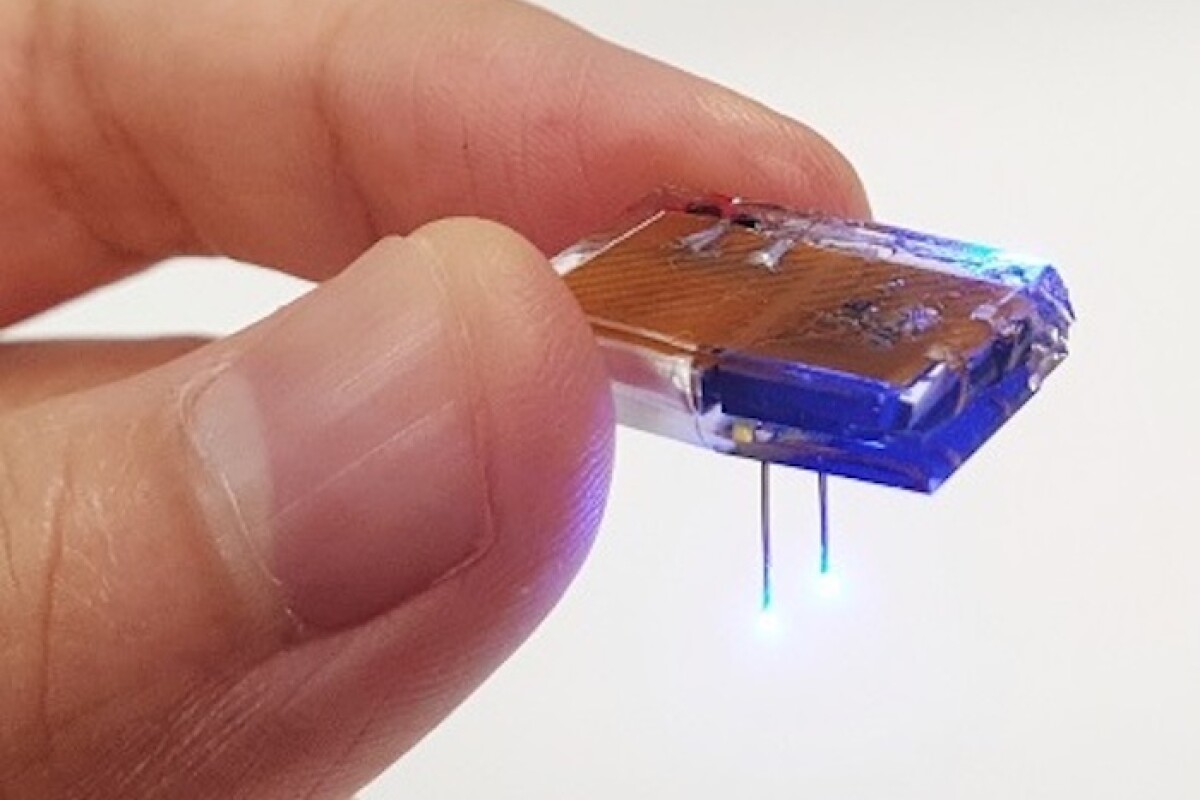
A group of KAIST researchers and collaborators have engineered a tiny brain implant that can be wirelessly recharged from outside the body to control brain circuits for long periods of time without battery replacement. The device is constructed of ultra-soft and bio-compliant polymers to help provide long-term compatibility with tissue. Geared with micrometer-sized LEDs (equivalent to the size of a grain of salt) mounted on ultrathin probes (the thickness of a human hair), it can wirelessly manipulate target neurons in the deep brain using light.
This study, led by Professor Jae-Woong Jeong, is a step forward from the wireless head-mounted implant neural device he developed in 2019. That previous version could indefinitely deliver multiple drugs and light stimulation treatment wirelessly by using a smartphone.
For the new upgraded version, the research team came up with a fully implantable, soft optoelectronic system that can be remotely and selectively controlled by a smartphone. This research was published on January 22, 2021 in Nature Communications.
The new wireless charging technology addresses the limitations of current brain implants. Wireless implantable device technologies have recently become popular as alternatives to conventional tethered implants, because they help minimize stress and inflammation in freely-moving animals during brain studies, which in turn enhance the lifetime of the devices. However, such devices require either intermittent surgeries to replace discharged batteries, or special and bulky wireless power setups, which limit experimental options as well as the scalability of animal experiments.
“This powerful device eliminates the need for additional painful surgeries to replace an exhausted battery in the implant, allowing seamless chronic neuromodulation,” said Professor Jeong. “We believe that the same basic technology can be applied to various types of implants, including deep brain stimulators, and cardiac and gastric pacemakers, to reduce the burden on patients for long-term use within the body.”
To enable wireless battery charging and controls, researchers developed a tiny circuit that integrates a wireless energy harvester with a coil antenna and a Bluetooth low-energy chip. An alternating magnetic field can harmlessly penetrate through tissue, and generate electricity inside the device to charge the battery. Then the battery-powered Bluetooth implant delivers programmable patterns of light to brain cells using an “easy-to-use” smartphone app for real-time brain control.
“This device can be operated anywhere and anytime to manipulate neural circuits, which makes it a highly versatile tool for investigating brain functions,” said lead author Choong Yeon Kim, a researcher at KAIST.
Neuroscientists successfully tested these implants in rats and demonstrated their ability to suppress cocaine-induced behaviour after the rats were injected with cocaine. This was achieved by precise light stimulation of relevant target neurons in their brains using the smartphone-controlled LEDs. Furthermore, the battery in the implants could be repeatedly recharged while the rats were behaving freely, thus minimizing any physical interruption to the experiments.
“Wireless battery re-charging makes experimental procedures much less complicated,” said the co-lead author Min Jeong Ku, a researcher at Yonsei University’s College of Medicine.
“The fact that we can control a specific behaviour of animals, by delivering light stimulation into the brain just with a simple manipulation of smartphone app, watching freely moving animals nearby, is very interesting and stimulates a lot of imagination,” said Jeong-Hoon Kim, a professor of physiology at Yonsei University’s College of Medicine. “This technology will facilitate various avenues of brain research.”
The researchers believe this brain implant technology may lead to new opportunities for brain research and therapeutic intervention to treat diseases in the brain and other organs.
This work was supported by grants from the National Research Foundation of Korea and the KAIST Global Singularity Research Program.
Choong Yeon Kim, Min Jeong Ku, Raza Qazi, Hong Jae Nam, Jong Woo Park, Kum Seok Nam, Shane Oh, Inho Kang, Jae-Hyung Jang, Wha Young Kim, Jeong-Hoon Kim, Jae-Woong Jeong. Soft subdermal implant capable of wireless battery charging and programmable controls for applications in optogenetics. Nature Communications, 2021; 12 (1) DOI: 10.1038/s41467-020-20803-y
Mozilla has always championed the open web. So why is it abandoning desktop web apps, the most powerful alternative to proprietary App Stores?
[Illustration: FC]
BY JARED NEWMAN6 MINUTE READADVERTISEMENTADVERTISEMENTADVERTISEMENT
In theory, I would love to use Mozilla Firefox as my everyday web browser.ADVERTISEMENT
Mozilla’s stances on privacy are admirable, and Firefox has a lot of neat customization features that its competitors lack. I also just like the idea of supporting a web browser that isn’t controlled by tech giants and preserves a modicum of competition among web browser engines.
Unfortunately, Firefox is missing one key feature found in Google Chrome and Microsoft Edge, and that’s the ability to install websites as desktop apps. Over the last year, this feature has fundamentally changed the way I work by reducing browser tab clutter and providing faster access to favorite sites, and I can’t go back to Firefox without it.
“Our focus is on developing and exposing features that deliver real value to our users,” Romain Testard, a Mozilla product manager, said in an email statement. “Initial exploration showed that [the current web app approach] was not going to provide that value.”
That puts Firefox at a disadvantage against Chrome and Edge, both of which are speeding ahead in making web apps an integral part of their desktop browsers. But it’s also just disappointing to see Mozilla abandon what is becoming a bastion against walled garden app stores.
A PATH TO BETTER WEB APPS
To get a bit technical for a moment, the specific feature that Mozilla abandoned is called “site-specific browsers,” or SSBs. These allowed websites to run in their own windows, without address bars, navigation buttons, or other clutter. In Chrome, a similar feature is available by clicking the “…” menu, then heading to More Tools > Create Shortcut and selecting “Open as Window.” Microsoft Edge makes the feature even easier to reach: Under its “…” menu, there’s a menu called “Apps,” with an option to “Install this site as an app.”
Firefox’s implementation clearly needed a lot of work. It didn’t integrate with any extensions that users might’ve installed, and it didn’t let users easily add launch icons to the MacOS dock or Windows Start menu. That may help explain why Mozilla had buried the feature in an advanced settings menu while developing it behind the scenes.
Still, Firefox’s SSBs were an important precursor to another technology called Progressive Web Apps, or PWAs, which let websites behave even more what you’d find in an app store. PWAs can store images and other assets locally so they load faster, and apps that don’t require data from the internet can run entirely offline. PWAs can also launch when users click an associated file type on their computers, keep the screen awake for things like presentations, and interact with a wider range of controllers and peripherals compared to standard websites.
Just as importantly, Progressive Web Apps are easier to find and install. Both Chrome and Edge show a “+” button in their address bars for sites that offer one of these apps, and the sites themselves can create pop-ups encouraging users to install their web apps. Once installed, PWAs can be uninstalled just liek a desktop app, for instance through the “Add or Remove Programs” menu in Windows.
Instead of building toward those features, Mozilla is now removing support for SSBs entirely. While the company says it’s still evaluating other ways to support Progressive Web Apps on the desktop, it doesn’t have any alternatives under development.
“The signal I hope we are sending is that PWA support is not coming to desktop Firefox anytime soon,” Firefox architect Dave Townsend wrote in Mozilla’s bug tracking forums at the end of December.
Meanwhile, Apple’s Safari browser has not been particularly welcoming to Progressive Web Apps either. Although users can “install” web apps to their home screens on iOS, the same feature isn’t available in Safari for Mac, and Apple has refused to support a wide range of web technologies for what it says are privacy reasons. In the long run, this may be more damaging to the state of Progressive Web Apps than Mozilla’s decision, though it’s also less surprising given everything that Apple had riding on the success of native iOS apps.
USAGE ON THE RISE
Alex Russell, a senior staff software engineer at Google and one of the biggest purveyors of Progressive Web Apps, says he’s sad to see Mozilla abandon some of the groundwork it had laid for PWA support.
“I understand the instinct to say, if you can’t do a really great job, then maybe don’t try,” he says. “We have a long list of scars from having to do it ourselves.”
FROM A USER PERSPECTIVE, YOU JUST WANT THESE THINGS TO FEEL LIKE APPS.”
ALEX RUSSELL, GOOGLERussell notes that implementing Progressive Web Apps can be difficult for browser makers, but believes it’s worth the effort. Google says PWAs now have hundreds of millions of active users, and in 2020, the number of desktop app installs quadrupled year-over-year, while the number of mobile app installs doubled. Several major services such as Spotify, Hulu, and Adobe Spark offer installable Progressive Web Apps now, and Google itself has created apps for YouTube Music, Google Photos, and Google Maps.
“From a user perspective, you just want these things to feel like apps,” Russell says.
Developers say they’re seeing a payoff from Progressive Web Apps as well. The web-based video editor ClipChamp says installation of its web app grew by 97% per month since launching last May, and user retention rates are 9% higher compared to ClipChamp’s desktop software.
Bil Bryant, CEO of the online music creation tool Amped Studio, says it’s too early to share usage numbers for its Progressive Web App, which just launched about a month ago. Still, he says it should be a popular with Amped’s users, many of whom use Chromebooks and other low-power computers that can’t run full-blown digital audio workstation software.
“It’s a real game-changer, because one of the big fears of making music in the web is that you’re going to lose your stuff if you lose your internet connection,” he says.
AN ANSWER TO WALLED GARDENS
For some app makers, the appeal of Progressive Web Apps isn’t just about the features they offer, but about their ability to circumvent app stores as a means of distribution.
“As a developer, you spend so much time and money creating this thing,” says Bil Bryant of Amped Studio. “A web app is giving you the freedom to do what you want to do, and not have to pay the Apple developer fee, and hope and pray it goes through after spending all your time developing it.”
Although Google says avoiding app stores isn’t a primary motivation for most developers, the company itself has benefitted from being able to make more powerful web apps. Last month, Google released a web app version of Stadia for iOS, allowing the company to avoid the tight restrictions Apple has placed on game streaming services in the App Store. Other game streaming services, including Amazon’s Luna and Nvidia’s GeForce Now, have released their own web apps as well.
Russell says “it’s handy for Google and Stadia team” that web apps have advanced to the point of supporting features such as more responsive gamepad support, though he notes that Stadia’s competitors benefit from those developments as well.
While closed platforms tend to be more of an issue on smartphones, even desktop platforms are starting to look more like walled gardens. Apple’s M1-powered Macs, for instance, can now run iOS apps, which could further discourage development outside the App Store, and as a Windows user, I get my fair share of scary warnings while trying to install software from outside the Microsoft Store. Progressive Web Apps are, in some sense, a great equalizer, providing increasingly-powerful software that runs on practically any computer, no app store required.
Mozilla was once fond of saying “the web is the platform.” It’s a shame the company has taken a break from building it.
ABOUT THE AUTHOR
Jared Newman covers apps and technology from his remote Cincinnati outpost.
A low-power and non-volatile technology called the memristor shows initial promise as a basis for machine learning. According to new research, memristors efficiently tackle AI medical diagnosis problems, an encouraging development that suggests additional applications in other fields, especially low-power or network “edge” applications. This may be, the researchers say, because memristors artificially mimic some of the neuron’s essential properties.
Memristors, or memory resistors, are a kind of building block for electronic circuits that scientists predicted roughly 50 years ago but only created for the first time a little more than a decade ago. These components, also known as resistive random access memory (RRAM) devices, are essentially electric switches that can remember whether they were toggled on or off after their power is turned off. As such, they resemble synapses—the links between neurons in the human brain—whose electrical conductivity strengthens or weakens depending on how much electrical charge has passed through them in the past.
One challenge with developing applications for memristors is the randomness found in these devices. The level of electrical resistance or conductivity seen in memristors depends on a handful of atoms linking up two electrodes, making it difficult to control their electrical properties from the outset, says study lead author Thomas Dalgaty, an electrical engineer at Grenoble Alpes University in France.
Now Dalgaty and his colleagues have developed a way to harness this randomness for machine learning applications. They detailed their findings this month in the journal Nature Electronics.
Memristors are programmed by cycling through high-conductance on states and low-conductance off states. Usually the level of electrical conductivity seen in memristors can vary between one on state and the next due to intrinsic random processes within the devices.
However, if memristors are cycled on and off enough, the electrical conductivity of each memristor follows a pattern—“a bell curve,” Dalgaty says. The scientists revealed they could implement an algorithm known as Markov chain Monte Carlo sampling that could actively exploit this predictable behavior to solve a number of machine-learning tasks.
When compared with the performance of conventional digital CMOS electronics, the researchers’ memristor arrays achieved a stunning five order of magnitude reduction in energy. This, Dalgaty says, is because the memristors did not need to shuffle data back and forth between processors and memory. For context, that 100,000-fold discrepancy is equivalent to “the difference in height between the Burj Khalifa, the tallest building in the world, and a coin,” he explains.
One potentially exciting application for memristors would be devices capable of learning, adapting and operating at the far ends of a network (a.k.a. its “edge”), where low-power devices like embedded systems, smart home gear and IoT nodes sometimes reside. Indeed, Dalgaty says, memristors could help make edge learning devices a reality.
“Currently edge learning is not possible because the energy required to perform machine learning with existing hardware is far greater than the energy that is available at the edge,” he explains. “Edge learning [using memristors] … can potentially open up completely new application domains that were not possible before.”
For example, the researchers used an array made of 16,384 memristors to detect heart rhythm anomalies from electrocardiogram recordings, reporting a better detection rate than a standard neural network based on conventional, non-memristor electronics. The team also used their array to solve image recognition tasks such as diagnosing malignant breast-tissue samples.
Potential future edge learning memristor applications might include implanted medical early-warning systems that can adapt to a patient’s state as it changes over time. “We are looking towards these really energy-constrained edge applications that maybe don’t or can’t exist yet because of energy [restrictions],” Dalgaty says.
The next big challenge, Dalgaty says, “will be putting all of this functionality together onto a single integrated chip that can be applied outside of the laboratory.” It may take a few years before such a chip exists, he says.
Visitors wearing face coverings view the Telsa Cybertruck at the recently reopened Petersen Automotive Museum in Los Angeles, California, July 1, 2020. ROBYN BECK via Getty Images
On Tesla’s quarterly earnings call, CEO Elon Musk reported its first annual profit and mentioned the company’s highly anticipated pickup. According to Musk, Tesla expects to make a “few deliveries of the Cybertruck in 2021, but volume production is set for next year.
As far as what we’ll see, Tesla didn’t release any visual updates in its documents, but the redesigned 2021 Model S / X interiors feature a steering yoke just like the original Cybertruck prototypes, so that seems likely to make the production model. Musk says the design is done and Tesla is no longer iterating on it, so we should probably get a look at the final version soon. Prices for single motor versions of the truck are still set to start at $39,900, and the truly optimistic can put down $100 for a pre-order now
Sophia the Robot Creators Announce Plan to Mass-Produce Robots This Year
Let Sarah Connor know… just in case.
By Wesley LeBlancUpdated: 26 Jan 2021 8:51 amPosted: 26 Jan 2021 8:43 amSophia the Robot and three other models from Hanson Robotics will go into mass production this year and are expected to begin rolling out of factories in the first half of 2021.This news comes by way of a new report from Reuters after a tour through Hanson Robotics’ Hong Kong factory conducted by Sophia the Robot, whom you might recognize as the viral robot from years ago that was granted citizenship in Saudi Arabia back in 2017. Hanson Robotics believes now to be a better time than ever to roll out these robots as they can help not only the healthcare sectors of the world, but the retail and airline industries as well.Sophia the Robot Gallery
21 IMAGES
“Social robots like me can take care of the sick or elderly,” Sophia said during the tour, according to Reuters. “I can help communicate, give therapy and provide social stimulation, even in difficult situations.”
Have you seen Ex Machina?YESNOHanson Robotics founder and chief executive, David Hanson, said the company is planning to sell thousands of robots of many different sizes in 2021, although he didn’t give an exact number as to how many. He did say that four models, including Sophia, will roll out to the public this year.
Reuters noted that according to the International Federation of Robots, worldwide sales of professional-service robots jumped up 32% to $11.2 billion from 2018 to 2019. Those numbers have likely risen during the current COVID-19 pandemic as robots are seen around the world helping in the healthcare sector and Hanson said he believes that in a world of COVID-19, more automation is needed to keep people safe.IGN at CES: $14,000 Gaming Chair and Dating RobotsshareShareAutoplay setting: On2:56One of the robots Hanson Robotics is launching this year, Grace, has been created specifically for the healthcare sector.
“Sophia and Hanson robots are unique by being so human-like,” Hanson said. “That can be so useful during these times where people are terribly lonely and socially isolated.”
That speaks to the larger mission of Hanson Robotics. The company’s “About” page says its, “innovations in AI research and development, robotics engineering, experiential design, storytelling and material science bring robots to life as engaging characters, useful products, and as evolving AI.”The 12 Greatest Giant Robots Ever
Apple Car is expected to reach market in 2024-2027.
Apple AR Smart Glasses can be released as early as next year.
The markets for these products are growing at tremendous rates. Apple can take a decent market share in the long term.
Entering the new markets will positively affect sales and profits, thereby creating an upside potential.
Investment Thesis
Apple (AAPL) is expected to present two brand-new products in the coming years: Apple Car and Apple AR Smart Glasses. The expansion of the product line will increase sales, moreover, Apple has a high chance of becoming a key supplier in the consumer AR eyewear market and capturing a decent share of the EV market in the long term. The active steps that the company takes, will help it to sustain and enhance its position on the market. With that in mind, I reckon Apple is a fairly good long-term investment with relatively low risk.
Every year Apple presents new products. Usually, these are upgrades of existing products such as iPhone, Mac, iPad, and so on, but sometimes we see some new technologies and products. Recent rumors report the upcoming release of Apple Car and Apple AR Smart Glasses. While the glasses do not have much hype around them, the electric vehicle might become a second iPhone for the company (as a technological breakthrough). On December 23rd Apple shares rose 3% just because of the news about EV and the market capitalization increased by $140 bn. Upcoming positive updates on the Apple Car can significantly drive the company’s price. The article gives some prospects on how the launch of the named products can affect the share price.
The regular upgrades of existing products do not create a completely new path for the company, but just sustain and increase sales of consumer electronics. While the development of the existing products steadily raises sales and share price, the launch of the new ones might become a high driver for the stocks. I will summarise information about Apple Car and Apple Smart Glasses (even though it is going to be an accessory for iPhone, it is a highly anticipated product), make forecasts, and build valuation models for these products.
Market Research: High Growth And Great Potential
I mostly pay attention to Apple Car since EV is a rapidly expanding market where we can see some competitors and existing products. However, AR Smart Glasses could revive the poor niche.
Apple Smart Glasses May Create A Whole New Niche Of Consumer AR Eyewear
This product was highly anticipated in recent years, at the peak of augmented reality technology. But today it fell behind EV and battery technology, despite the fact that many companies continue to develop AR software and sensors (basically self-driving systems use the same technology). There were first rumors that Apple is going to create smart glasses after the release of Google Glass by Google (GOOG) (GOOGL). However, the more specific news came in 2016-2017 (Bloomberg: Apple contemplating smart glass move (NASDAQ:AAPL) and Apple reported to intensify efforts on augmented reality eyewear (NASDAQ:FB)). Many other companies already announced (or even launched) their smart eyewear, such as HoloLens by Microsoft (MSFT), Oculus by Facebook (FB), Spectacles by Snapchat (SNAP), Vuzix (VUZI), and others.
While official sources can’t provide detailed information except for the expectations, I analyzed the recent article from MacRumors. Basically, Apple is expected to release 2 eyewear products, specifically the glasses and the headset. Both of them will be based on the same technology, but have different purposes. The AR headset is expected to come on the market first, providing more features than glasses, but for an extremely high price. The release of the headset can take place in 2021-2023, and the smart glass one year later.
The share of the market is questionable due to the market is still small despite high growth rates. It is difficult to find any useful and accurate data about the smart glasses industry. However, everything that Apple creates, finds its market niche. Currently, the technology is being used mostly for industrial purposes. Nevertheless, with the release of Apple Smart Glasses (not AR headset), it might turn into the consumer sector, thereby rapidly expanding the market volume.
The research made by Tractica and Statista in 2017 projects the market of Smart AR Reality glasses to reach $19.7 bn in 2022. Research And Markets provide a very optimistic outlook in the July 2020 report. They forecast AR wearable devices 2020-2027 CAGR as 104.6%. According to their report, the industry now (2020) at the level of 207.3 thousand units and it is expected to reach 31.1 million units by 2027. It is still unclear what market share can Apple count on. Apple has an 11% market share in smartphones, but the wearables market share was 29% in 1Q 2020 and it was rapidly growing. Smart glasses are not that common for people as smartwatches, wireless earphones or etc., so in my valuation model, I assume that Apple’s market share in this segment will range from 5% to 15%.
Apple Car: The New Technology Will Provide A Quick Entry To The Market
The recent news reveals, that Apple’s long-rumored electric vehicle is on the way. The story behind “Project Titan” (that’s the code name for Apple’s EV) started back in 2014 (you can find more information here), then different cars with self-driving sensors that were leased or owned by Apple were noticed in California repeatedly. In December 2020 Reuters said, that Apple is aiming to unveil it in 2024, but this day might be postponed.
Apple Car is going to have two key features: a self-driving system and a brand-new battery design. We are familiar with the high quality of Apple’s software, nevertheless, it is hard to impress the modern customer with an intelligent self-driving car (especially with the current amount of limitations of auto-pilot usage). Nonetheless, new battery technology sounds very promising and might make a difference between Apple’s and other carmakers’ electric vehicles. According to Reuters, new batteries will be cheaper to produce and more efficient, therefore, reducing the cost of the car and increasing the vehicle’s range. I doubt that the first model will be at the low price range of the market. It is more likely to be the competitor to Tesla’s (TSLA) Model 3 and some other cars at the medium price segment.
Recently Reuters reported that Hyundai (OTCPK:HYMLF) and Apple are in an early discussion about the Apple Car project. Probably, Apple is looking for a car assembler, and the Korean manufacturer is one of the best options. Apple hasn’t announced any comments on the project yet.
EV Market Outlook
The EV market was growing rapidly during the recent decade and the forecasts are very promising. It looks like Apple selected the perfect timing for the car release. According to BloombergNEF, the EVs will hit 10% of global passenger vehicle sales by 2025 (the moment of Apple’s car release) and 28% by 2030. This forecast implies a CAGR of 25% for the 2025-2030 period and 7.6% in a long term.
The Competitors Of Apple Car
As I mentioned above, it is most likely that Apple’s competitors are going to be mid-priced car producers. There is no information about the car’s segment. However, its competitors have to own several futures of Apple’s expected car:
High nominal range. The new battery technology provides opportunities for cheaper production and higher efficiency. Thus, it is expected to be a long-range car.
Premium status and quality. One of Apple’s key features is the premium status of its products, shame should be concerned about the car.
International sales. Nowadays China is the leading market for EV, therefore there are a lot of domestic producers that are not planning to expand to global markets.
I created a list of cars that are already on sale or expected to enter the market in 2021-2022. Also, they match the specified features. The prices are rounded up and represent the lower bound of the MRSP.
Producer
Model
Price
Jaguar
I-pace
$70000
Mercedes-Benz
EQC
$69000
Audi
e-tron
$66000
Polestar
2
$60000
Tesla
Model Y
$50000
Ford
Mustang SUV
$44000
Kia
e-Niro
$40000
Volkswagen
ID.4
$40000
Tesla
Model 3
$38000
Chevrolet
Bolt EV
$37000
Hyundai
Kona
$37000
Average
$50091
Source: Created by the author using price data from edmunds.com
Valuation Model For Apple AR Smart Glasses
To value the Smart Glasses division, I chose to use the PEG ratio. In case of data scarcity, it is easy to use, requires fewer assumptions than DCF valuation, and allows to account high growth rate. First of all, I analyzed financial statements and built some assumptions that are presented in the table below. One very important assumption is a growth rate. According to the articles mentioned above, the CAGR of the market for the following 6 years is 104.6%. However, it can’t stay like this for a long time. Therefore, I assume it to be a little higher than the last annual growth of Apple’s wearables sales (~30%), which is 40%.
Source: Created by the author
(*) – it is not correct to exclude interest expense from the calculation, however, it is almost impossible to forecast the amount of assets debt for this investment project.
Based on these assumptions, I built a forecast for various market shares. As I mentioned above, it is difficult to foresee what share will Apple take. The first year is 2022 since Apple is expected to present one, or even both AR Smart Glasses devices this year.
Market share, mn USD
2022
2023
2024
2025
2026
15%
3401
6959
14238
29132
59604
12.50%
2773
5673
11607
23749
48590
10%
2169
4438
9080
18577
38008
7.50%
1590
3253
6655
13616
27858
5%
1035
2118
4333
8866
18140
Source: Created by the author
The next stage is an income forecast. It is presented in the following table. As a basic market share, I used 10%. For the calculation of the price of this project, I will use the net income of 2022.
mn USD
2022
2023
2024
2025
2026
Revenue
2169
4438
9080
18577
38008
COGS
1195
2446
5004
10238
20946
R&D
122
250
511
1046
2139
SG&A
67
138
282
576
1179
EBIT
784
1605
3283
6717
13743
Tax
113
231
473
967
1979
Net income
671
1374
2810
5750
11764
Source: Created by the author
According to the theory, the fair valued company has the PEG ratio of 1. We earnings of $671 mn and the growth rate of 40%. Thus, the fair value of Apple’s Smart Glasses division is about $27 bn. The table below shows the possible value of the division based on market share.
Market share
PEG
Net income
Value
15%
1
1053
42 120
12.5%
1
858
34 320
10%
1
671
26 840
7.5%
1
492
19 680
5%
1
320
12 800
Source: Created by the author
Note that this calculation based on a high CAGR, which may decrease every year together with the growth of revenues and income.
Valuation Model For Apple Car
The evaluation of the electric vehicle division is more complex but more interesting. AR eyewear is a rapidly growing segment of consumer electronics, but it won’t create a big and crucial value for the company. However, the EV might become a new breaking-through product for the company and create an enormous value.
The first step of valuation is the estimation of the market share, car sales, and revenues. According to the research, published by insideevs.com, Tesla is a leader in passenger EV sales in 2020 and it is far ahead of the followers. Tesla Model 3 is the most sold EV in the world with 13% of the market. The reason for that is one of main Tesla’s features: a well-established production process. According to the article mentioned above, Apple is most likely to outsource production to one of the global automakers. Currently, there are no other car manufacturers other than Tesla and some Chinese factories that can produce hundreds of thousands of cars annually. So the possible market share for Apple is approximately 1-1.5%, which approximately ranges from 85 to 130 thousand cars in 2025.
My valuation model of Apple’s Car division is based on the P/S multiplier. The PEG, which I used previously, does not fit EV industry, because of the low margins (or even negative). There is no information available on possible pricing of the car, quantities, or anything else essential. In this case, to build a sales model, I made some assumptions based on market research. The car price is estimated as the average price of the range of possible analogs that are already on the market (or expected to come in 2021-2022).
Source: created by the author
I selected several big-cap and mid-cap EV producers to calculate the average P/S ratio. The standard deviation is quite high, so the average might represent the industry not as good. I chose companies listed in the US, such as Tesla (TSLA), NIO (NIO), XPeng (XPEV), and Li Auto (LI). The results are presented in the table below:
Company name
P/S ratio
Tesla
28.43
NIO
51.55
XPeng
110.46
Li Auto
39.11
Average ratio
57.39
Source: created by the author using data from finviz.com
The final results of the evaluation are shown in the following table.
Source: Created by the author
In case when Apple Car reaches a 1.25% market share in 2025, the valuation of the project might reach $305 bn. Note, that this model doesn’t include growth opportunities, expansion of the model range and etc. The uncertainty of the future included in this model only as the P/S ratio (currently, peers are overvalued because of unclear prospects). The actual value of the project will be revealed right upon the presentation (or after certain rumors).
Conclusion
Entering new markets is certainly an important move for any company. Even though Apple is not a founder of the new market (industry), it definitely seeks to provide the best quality and make it profitable. Same for Apple AR Smart Glasses (and headset) and Apple Car.
The markets of the expected products are rapidly developing. The AR eyewear industry estimated growth is outstanding, and Apple will enter the market right on time. The company might take a big share of the market due to new technologies. Besides, Apple has high margins in producing consumer electronics, the company will definitely benefit from it. The EV is a less quickly developing market, nevertheless, it is much larger. In this field, Apple can create a cutting-edge technology that will allow it to secure a decent market share, despite the volume production.
While the augmented reality glasses might come relatively soon, EV is a long-term project and still under privy development. Closer to 2024 there will be more news, rumors, and specifications, that will allow to clarify prospects and build a better valuation model. Both valuation models are based on the market forecasts provided by various researches, but not financial statements (some assumptions are based on the financial reports though). Thus, the valuation might be far from reality.
I have a positive outlook on the company and I reckon, that Apple-branded electric vehicle will have tremendous success. Based on my calculations, just entering the EVs market can create a 10-15% boost for the stock. The battery technology that Apple keeps secret could raise them even higher in case of the technological breakthrough. Meanwhile, the smart glasses might have a less significant impact (around 1%) due to the small market in comparison to the existing Apple business. Probably, EV will give new opportunities for expansion, thereby adding even more market value to the Apple stocks. After all, we will find it out only after the official release or pre-release rumors.
On this point, Apple is a very long-term investment. The key factors, that can affect the course of events before presentations are the development of the new technologies by the rivals, the industry growth, and the uncertainty about Apple’s technologies inasmuch as all the company’s developments remain secret until the official release.
Disclosure: I/we have no positions in any stocks mentioned, and no plans to initiate any positions within the next 72 hours. I wrote this article myself, and it expresses my own opinions. I am not receiving compensation for it (other than from Seeking Alpha). I have no business relationship with any company whose stock is mentioned in this article.
Additional disclosure: The information contained in this article is not and should not be construed as investment advice, and does not purport to be and does not express any opinion as to the price at which the securities of any company may trade at any time. The information and opinions provided herein should not be taken as specific advice on the merits of any investment decision. Investors should make their own decisions regarding the prospects of any company discussed herein based on such investors’ own review of publicly available information and should not rely on the information contained herein. The information contained in this article has been prepared based on publicly available information and proprietary research. The author does not guarantee the accuracy or completeness of the information provided in this document. All statements and expressions herein are the sole opinion of the author and are subject to change without notice. Any projections, market outlooks, or estimates herein are forward-looking statements and are based upon certain assumptions and should not be construed to be indicative of the actual events that will occur. Other events that were not taken into account may occur and may significantly affect the returns or performance of the securities discussed herein. Neither the author nor any of its affiliates accept any liability whatsoever for any direct or consequential loss howsoever arising, directly or indirectly, from any use of the information contained herein. In addition, nothing presented herein shall constitute an offer to sell or the solicitation of any offer to buy any security.
You got under the covers around 10 p.m. last night, but judging by how tired you were this morning, you know you probably didn’t get to sleep sleep until way later. And you’re not alone. A recent report from Sleep Cycle, an app that tracks and analyzes your slumber, found a 54-percent increase in stress among Americans, affecting zzz patterns in teens and adults across the country. Yep, “coronasomnia,” or COVID-19-related sleep stress, is keeping lots of us awake at night.
And yes, there are plenty of ways to up your sleep game, from nutrition to movement and even supplements. But, c’mon, we have enough to deal with these days. We need something simple—and we need it now. So, we asked Frida Rångtell, sleep expert at Sleep Cycle, for her quickest go-to solution to our restless night woes, and her answer was surprisingly easy. In fact, it was stupid easy.
The one trick to fall asleep faster?
Wear warm socks to bed.
We told you it was easy. And there’s good reason behind it, too. Rångtell explained to us that while there are only a few scientific articles on the effects of socks on sleep, experts do know there is a relationship between sleep initiation and temperature. “It’s likely that the increase in temperature from wearing socks is exerting positive effects on sleep,” Rångtell explains. This might be the same reason why taking a warm bath or shower shortly before bedtime can make you doze off in an instant.
Reaching for the best pair of warm socks to try your sleep experiment tonight? While there’s not lots of data pointing toward which types of socks are most helpful, Rångtell suggests natural and breathable materials. “I would personally go with something like a thin wool or bamboo socks. Ideally, as environmentally friendly as possible.”
Woven from 90 precent natural fiber from bamboo and 10 percent Spandex, this five-pack is breathable and it has antibacterial properties, to keep odor problems at bay.
A newly developed brain implant can target neuron behavior and be recharged wirelesslyKAISTVIEW 1 IMAGES
Medical implants that help regulate activity in the brain could go a long way to treating conditions like Parkinson’s and depression, and scientists at the Korea Advanced Institute of Science and Technology have just developed one with some very useful functionality. The device uses light to manipulate targeted neurons in the brain, and thanks to newfound capabilities, can be recharged wirelessly from outside the body.
The device is a continuation of research we looked at last year, where the same group of scientists demonstrated a type of plug-and-play brain implant that uses tiny LEDs to alter the behavior of brain cells that are sensitive to light. These are fixed to very fine probes around the thickness of a human hair, which can also be used to deliver drugs to the organ.
All of this was built onto a device that could be mounted in the brain and controlled wirelessly by a smartphone, but the scientists have now made some tweaks to the system. The new and improved version incorporates a wireless energy harvester with a coil antenna that captures alternating magnetic fields that are harmlessly pulsed through the skin, generating electricity and charging the small battery onboard.
“This powerful device eliminates the need for additional painful surgeries to replace an exhausted battery in the implant, allowing seamless chronic neuromodulation,” said Professor Jae-Woong Jeong, who led the research team. “We believe that the same basic technology can be applied to various types of implants, including deep brain stimulators, and cardiac and gastric pacemakers, to reduce the burden on patients for long-term use within the body.”
The device features a Bluetooth chip enabling the LED lights to be controlled via smartphone, delivering programmable patterns that can be tailored for specific outcomes. This was demonstrated in experiments on rats that had been injected with cocaine, where the implants were used to suppress cocaine-induced behaviors.
“The fact that we can control a specific behaviour of animals, by delivering light stimulation into the brain just with a simple manipulation of smartphone app, watching freely moving animals nearby, is very interesting and stimulates a lot of imagination,” said Jeong-Hoon Kim, a professor of physiology at Yonsei University’s College of Medicine. “This technology will facilitate various avenues of brain research.”


 By
By 




 Bruce's Blog

