Month: February 2021
https://www.inputmag.com/tech/voice-assistants-are-finally-being-trained-to-account-for-speech-impediments
Voice assistants are finally being trained to account for speech impediments
Inclusivity and accessibility tend to take longer to arrive despite arguably being more valuable to those who need it than those who don’t.
ShutterstockMehreen Kasana9 hours ago
Voice-recognition technology has come a long way. Today we can turn to Alexa or Siri and ask whatever is on our minds and hold conversations, albeit awkward ones, with these smart assistants. But there is major room for improvement as scores of people around the world with speech impairments and disabilities still haven’t been included in the conversation.https://4f60a0c35612db03939fcdf0bf4a1a68.safeframe.googlesyndication.com/safeframe/1-0-37/html/container.html
MORE LIKE THIS
Tom Maxwell21 hours agoTECHDeepfake videos of Tom Cruise show the technology’s threat to society is very realMehreen Kasana2.26.2021 11:06 AMTECHMyHeritage’s deepfake tool animates ancient photos and it’s as weird as it soundsTom Maxwell2.22.2021 3:18 PMTECHMicrosoft is adding predictive typing to Word in March
STAY UP TO DATE
SUBSCRIBE
Now tech companies are trying to make up for that by training voice assistants to understand atypical speech, The Wall Street Journal reports. According to the National Institute on Deafness and Other Communication Disorders, there are 7.5 million individuals in America who have some form of speech impairment and struggle to have their speech understood. Getting smart speakers and related technologies to understand them would be a major leap forward, and a genuine display of “smarts.”
NEW SKILLS — To make sure that people with speech disabilities are understood by their smart devices, Google’s artificial intelligence team is working on expanding the company’s voice technology skills. Product managers and interns are using atypical speech data from different people and training Google Assistant to recognize the patterns for better familiarity. In some cases, voice recognition tools are being trained on data from seniors who may have degenerative diseases, individuals with amyotrophic lateral sclerosis (ALS) — a neuron disease that results in slurred or slowed speech — stutterers, and those with other speech impediments. If the tech industry gets this right, voice technology is about to become a lot more hospitable, inclusive, and useful.
WELCOMING EVERYONE — According to the WSJ, Amazon is working on integrating software called Voiceitt with Alexa. The program trains algorithms on different vocal patterns, including non-standard ones. Apple, meanwhile, is also trying to make sure Siri is able to listen to users without interrupting them, which could be highly beneficial for users who stammer or stutter and who might need it to pause during their questions and replies.
Voice assistants improve in proportion to the quantity and quality of data provided to them, and based on the rules their designers create for them. When it comes to people with atypical speech, making smart assistants work for them is about making deliberate changes to the way systems work. Atypical speakers have always existed, after all.
Of course, it will take time before Alexa, Siri, Google Assistant, Bixby (remember Samsung’s smart assistant?) and the smart assistants found elsewhere (like in high-end cars) are able to fully address the issue of accessibility, but the fact that the biggest players are now paying attention to the problem is encouraging.
https://venturebeat.com/2021/02/27/gpt-3-were-at-the-very-beginning-of-a-new-app-ecosystem/
GPT-3: We’re at the very beginning of a new app ecosystem
Dattaraj Rao, Persistent SystemsFebruary 27, 2021 10:20 AM
 An app has 2 GPT-3 based bots debate each other. This is one of 14 GPT-3 apps profiled by YouTuber Bakz T. Future.ADVERTISEMENT
Data: Meet ad creative
From TikTok to Instagram, Facebook to YouTube, and more, learn how data is key to ensuring ad creative will actually perform on every platform.Register NowADVERTISEMENThttps://e128cbce23c2b29b2c43efe4208e3fed.safeframe.googlesyndication.com/safeframe/1-0-37/html/container.html
Join Transform 2021 for the most important themes in enterprise AI & Data. Learn more.
The most impressive thing about OpenAI’s natural language processing (NLP) model, GPT-3, is its sheer size. With more than 175 billion weighted connections between words known as parameters, the transformer encoder-decoder model blows its 1.5 billion parameter predecessor, GPT-2, out of the water. This has allowed the model to generate text that is surprisingly human-like after only being fed a few examples of the task you want it to do.
Its release in 2020 dominated headlines, and people were scrambling to get on the waitlist to access its API hosted on OpenAI’s cloud service. Now, months later, as more users have gained access to the API (myself included), interesting applications and use cases have been popping up every day. For instance, Debuild.co has some really interesting demos where you can build an application by giving the program a few simple instructions in plain English.How to Build the Metaverse 2143K11PauseUnmuteLoaded: 16.85% FullscreenUp Nexthttps://imasdk.googleapis.com/js/core/bridge3.444.1_en.html#goog_991270401
Despite the hype, questions persist as to whether GPT-3 will be the bedrock upon which an NLP application ecosystem will rest or if newer, stronger NLP models with knock it off its throne. As enterprises begin to imagine and engineer NLP applications, here’s what they should know about GPT-3 and its potential ecosystem.
GPT-3 and the NLP arms race
As I’ve described in the past, there are really two approaches for pre-training an NLP model: generalized and ungeneralized.ADVERTISEMENThttps://e128cbce23c2b29b2c43efe4208e3fed.safeframe.googlesyndication.com/safeframe/1-0-37/html/container.html
An ungeneralized approach has specific pretraining objectives that are aligned with a known use case. Basically, these models go deep in a smaller, more focused data set rather than going wide in a massive data set. An example of this is Google’s PEGASUS model, which is built specifically to enable text summarization. PEGASUS is pretrained on a data set that closely resembles its final objective. It is then fine-tuned on text summarization datasets to deliver state-of-the-art results. The benefit of the ungeneralized approach is that it can dramatically increase accuracy for specific tasks. However, it is also significantly less flexible than a generalized model and still requires a lot of training examples before it can begin achieving accuracy.
A generalized approach, in contrast, goes wide. This is GPT-3’s 175 billion parameters at work, and it’s essentially pretrained on the entire internet. This allows GPT-3 to execute basically any NLP task with just a handful of examples, though its accuracy is not always ideal. In fact, the OpenAI team highlights the limits of generalized pre-training and even cede that GPT-3 has “notable weaknesses in text synthesis.”
OpenAI has decided that going bigger is better when it comes to accuracy problems, with each version of the model increasing the number of parameters by orders of magnitude. Competitors have taken notice. Google researchers recently released a paper highlighting a Switch Transformer NLP model that has 1.6 trillion parameters. This is a simply ludicrous number, but it could mean we’ll see a bit of an arms race when it comes to generalized models. While these are far and away the two largest generalized models, Microsoft does have Turing-NLG at 17 billion parameters and might be looking to join the arms race as well. When you consider that it cost OpenAI almost $12 million to train GPT-3, such an arms race could get expensive.
Promising GPT-3 applications
GPT-3’s flexibility is what makes it attractive from an application ecosystem standpoint. You can use it to do just about anything you can imagine with language. Predictably, startups have begun to explore how to use GPT-3 to power the next generation of NLP applications. Here’s a list of interesting GPT-3 products compiled by Alex Schmitt at Cherry Ventures.ADVERTISEMENThttps://e128cbce23c2b29b2c43efe4208e3fed.safeframe.googlesyndication.com/safeframe/1-0-37/html/container.html
Many of these applications are broadly consumer-facing such as the “Love Letter Generator,” but there are also more technical applications such as the “HTML Generator.” As enterprises consider how and where they can incorporate GPT-3 into their business processes, a couple of the most promising early use cases are in healthcare, finance, and video meetings.
For enterprises in healthcare, financial services, and insurance, streamlining research is a huge need. Data in these fields is growing exponentially, and it’s becoming impossible to stay on top of your field in the face of this spike. NLP applications built on GPT-3 could scrape through the latest reports, papers, results, etc., and contextually summarize the key findings to save researchers time.
And as video meetings and telehealth became increasingly important during the pandemic, we’ve seen demand rise for NLP tools that can be applied to video meetings. What GPT-3 offers is the ability not just to script and take notes from an individual meeting, but also to generate “too long; didn’t read” (TL;DR) summaries.
How enterprises and startups can build a moat
Despite these promising use cases, the major inhibitor to a GPT-3 application ecosystem is how easily a copycat could replicate the performance of any application developed using GPT-3’s API.
Everyone using GPT-3’s API is getting the same NLP model pre-trained on the same data, so the only differentiator is the fine-tuning data that an organization leverages to specialize the use case. The more fine-tuning data you use, the more differentiated and more sophisticated the output.ADVERTISEMENT
What does this mean? Larger organizations with a higher number of users or more data than their competitors will better be able to take advantage of GPT-3’s promise. GPT-3 won’t lead to disruptive startups; it will allow enterprises and large organizations to optimize their offerings due to their incumbent advantage.
What does this mean for enterprises and startups moving forward?
Applications built using GPT-3’s API are just starting to scratch the surface of possible use cases, and so we haven’t yet seen an ecosystem of interesting proof-of-concepts develop. How such an ecosystem would monetize and mature is also still an open question.
Because differentiation in this context requires fine-tuning, I expect enterprises to embrace the generalization of GPT-3 for certain NLP tasks while sticking with ungeneralized models such as PEGASUS for more specific NLP tasks.
Additionally, as the number of parameters expands exponentially among the big NLP players, we could see users shifting between ecosystems depending on whoever has the lead at the moment.ADVERTISEMENT
Regardless of whether a GPT-3 application ecosystem matures or whether it’s superseded by another NLP model, enterprises should be excited at the relative ease with which it’s becoming possible to create highly articulated NLP models. They should explore use cases and consider how they can take advantage of their position in the market to quickly build out value-adds for their customers and their own business processes.
Dattaraj Rao is Innovation and R&D Architect at Persistent Systems and author of the book Keras to Kubernetes: The Journey of a Machine Learning Model to Production. At Persistent Systems, he leads the AI Research Lab. He has 11 patents in machine learning and computer vision.
https://www.businessinsider.com/neuralink-elon-musk-microchips-brains-ai-2021-2
Everything you need to know about Neuralink, Elon Musk’s company that wants to put microchips in people’s brains
Isobel Asher Hamilton 10 hours ago
- Neuralink is one of Elon Musk’s strange and futuristic portfolio of companies.
- It’s developing neural interface technology — a.k.a. putting microchips into people’s brains.
- The technology could help study and treat neurological disorders.
- Visit the Business section of Insider for more stories.
Tesla billionaire Elon Musk is known for high-profile companies like Tesla and SpaceX, but the billionaire also has a handful of unusual ventures. One them, he says, he started to one day achieve “symbiosis” between the human brain and artificial intelligence.
Neuralink is Musk’s neural interface technology company. Simply put, it is building technology that could be embedded in a person’s brain, where it could both record brain activity and potentially stimulate it.
While Musk likes to talk up his futuristic vision for the technology, merging human consciousness with AI, the tech has plenty of near-term potential medical applications such as the treatment of Parkinson’s disease.
Here’s everything you need to know about Neuralink:
ADVERTISING
Neuralink was quietly founded under the radar in 2016.
Although Musk has touted the near-term applications of Neuralink, he often links the company up with his fears about artificial intelligence. Musk has said that he thinks humanity will be able to achieve a “symbiosis” with artificial intelligence.
Musk told “Artificial Intelligence” podcast host Lex Fridman in 2019 that Neuralink was “intended to address the existential risk associated with digital superintelligence.”
“We will not be able to be smarter than a digital supercomputer, so, therefore, if you cannot beat ’em, join ’em,” Musk added.
Musk has made lots of fanciful claims about the enhanced abilities Neuralink could confer. In 2020 Musk said people would “save and replay memories” like in “Black Mirror,” or telepathically summon their car.
Experts have expressed doubts about these claims.
In September 2020, Insider spoke to neuroscientist Prof. Andrew Jackson of the University of Newcastle. He said: “Not to say that that won’t happen, but I think that the underlying neuroscience is much more shaky.”
He added: “We understand much less about how those processes work in the brain, and just because you can predict the position of the pig’s leg when it’s walking on a treadmill, that doesn’t then automatically mean you’ll be able to read thoughts.”
Another professor, Andrew Hires, told Insider in August 2020 that Musk’s claims about merging with AI is where he goes off into “aspirational fantasy land.”
Neuralink is developing two bits of equipment. The first is a chip that would be implanted in a person’s skull, with electrodes fanning out into their brain.
The chip Neuralink is developing is about the size of a coin, and would be embedded in a patients’ skull. From the chip an array of tiny wires, each roughly 20 times thinner than a human hair, fan out into the patient’s brain.
The wires are equipped with 1,024 electrodes which are able to both monitor brain activity and, theoretically, electrically stimulate the brain. This data is all transmitted wirelessly via the chip to computers where it can be studied by researchers.https://aeaa41655a065b76c207e57a605a103b.safeframe.googlesyndication.com/safeframe/1-0-37/html/container.html
The second is a robot that could automatically implant the chip.
The robot would work by using a stiff needle to punch the flexible wires emanating from a Neuralink chip into a person’s brain, a bit like a sewing machine.
Neuralink released a video showcasing the robot in January 2021.https://www.youtube.com/embed/-gQn-evdsAo
Musk has claimed the machine could make implanting Neuralink’s electrodes as easy as LASIK eye surgery. While this is a bold claim, neuroscientists previously told Insider in 2019 that the machine has some very promising features.
Professor Andrew Hires highlighted a feature, which would automatically adjust the needle to compensate for the movement of a patient’s brain, as the brain moves during surgery along with a person’s breathing and heartbeat.
The robot as it currently stands is eight feet tall, and while Neuralink is developing its underlying technology its design was crafted by Woke Studios.
In 2020, the company showed off one of its chips working in a pig named Gertrude during a live demo.
The demonstration was proof of concept, and showed how the chip was able to accurately predict the positioning of Gertrude’s limbs when she was walking on a treadmill, as well as recording neural activity when the pig snuffled about for food. Musk said the pig had been living with the chip embedded in her skull for two months.https://www.youtube.com/embed/iSutodqCZ74
“In terms of their technology, 1,024 channels is not that impressive these days, but the electronics to relay them wirelessly is state-of-the-art, and the robotic implantation is nice,” said Professor Andrew Jackson, an expert in neural interfaces at Newcastle University.
“This is solid engineering but mediocre neuroscience,” he said.
Jackson told Insider following the 2020 presentation that the wireless relay from the Neuralink chip could potentially have a big impact on the welfare of animal test subjects in science, as most neural interfaces currently in use on test animals involve wires poking out through the skin.
“Even if the technology doesn’t do anything more than we’re able to do at the moment — in terms of number of channels or whatever — just from a welfare aspect for the animals, I think if you can do experiments with something that doesn’t involve wires coming through the skin, that’s going to improve the welfare of animals,” he said.ADVERTISING
Although none of the tech Neuralink has showcased so far has been particularly groundbreaking, neuroscientists are impressed with how well it’s been able to bundle up existing technologies.
“All the technology that he showed has been already developed in some way or form, […] Essentially what they’ve done is just package it into a nice little form that then sends data wirelessly,” Dr. Jason Shepherd, an associate professor of neurobiology at the University of Utah, told Insider following the 2020 demonstration.
“If you just watched this presentation, you would think that it’s coming out of nowhere, that Musk is doing this magic, but in reality, he’s really copied and pasted a lot of work from many, many labs that have been working on this,” he added.https://aeaa41655a065b76c207e57a605a103b.safeframe.googlesyndication.com/safeframe/1-0-37/html/container.html
Elon Musk has boasted multiple times that the company has put the chip in a monkey, though neuroscientists aren’t that blown away by this.
Elon Musk excitedly announced in Neuralink’s 2019 presentation that the company had successfully implanted its chip into a monkey. “A monkey has been able to control a computer with its brain, just FYI,” he said, which appeared to take Neuralink president Max Hodak by surprise. “I didn’t realize we were running that result today, but there it goes,” said Hodak.
Musk re-iterated the claim in February 2021 with a little extra detail.
“We’ve already got a monkey with a wireless implant in their skull, and the tiny wires, who can play video games using his mind,” Musk said during a long and wide-ranging interview on Clubhouse.
Neuroscientists speaking to Insider in 2019 said that while the claim might grab the attention of readers, they did not find it surprising or even particularly impressive.
“The monkey is not surfing the internet. The monkey is probably moving a cursor to move a little ball to try to match a target,”said Professor Andrew Hires, an assistant professor of neurobiology at the University of California.
Implanting primates with neural-brain interfaces that allow them to control objects on screens has been done before, and is expected in any research that aims to one day implant technology into human brains.ADVERTISING
Elon Musk has said human testing could start by the end of this year, but he also said that last year.
Elon Musk said during an appearance on the “Joe Rogan Experience” podcast in May 2020 that Neuralink could begin testing on human subjects within a year. He made the same claim during an interview on Clubhouse in February 2021.
Previously in 2019 Musk said the company hoped to get a chip into a human patient by the end of 2020.
Experts voiced doubt about this timeline at the time, as part of safety testing a neural interface device involves implanting it in an animal test subject (normally a primate) and leaving it there for an extended amount of time to test its longevity — as any chip would have to stay in a human patient’s brain for a lifetime.
“You can’t accelerate that process. You just have to wait — and see how long the electrodes last. And if the goal is for these to last decades, it’s hard to imagine how you’re going to be able to test this without waiting long periods of time to see how well the devices perform,” Jacob Robinson, a neuroengineer at Rice University, told STAT News in 2019.ADVERTISING
In the near-term, the uses of a chip in someone’s brain could be to treat neurological disorders like Parkinson’s.
Improved neural interface technology like Neuralink’s could be used to better study and treat severe neurological conditions such as Parkinson’s and Alzheimer’s.
Prof. Andrew Hires told Insider another application could be allowing people to control robotic prostheses with their minds.
“The first application you can imagine is better mental control for a robotic arm for someone who’s paralyzed,” Hires said in a 2019 interview with Insider, saying that the electrodes in a patient’s brain could potentially reproduce the sensation of touch, allowing the patient to exert finer motor control over a prosthetic limb.ADVERTISING
Elon Musk also says in the long-term the chip could be used to meld human consciousness with artificial intelligence — though experts are skeptical of this.
Although Musk has touted the near-term applications of Neuralink, he often links the company up with his fears about artificial intelligence. Musk has said that he thinks humanity will be able to achieve “symbiosis with artificial intelligence” through
Musk told “Artificial Intelligence” podcast host Lex Fridman in 2019 that Neuralink was “intended to address the existential risk associated with digital superintelligence.”
“We will not be able to be smarter than a digital supercomputer, so, therefore, if you cannot beat ’em, join ’em,” Musk added.
Musk has made lots of fanciful claims about the enhanced abilities Neuralink could confer. In 2020 Musk said people would “save and replay memories” like in “Black Mirror,” or telepathically summon their car.
Experts have expressed doubts about these claims.
“Not to say that that won’t happen, but I think that the underlying neuroscience is much more shaky. We understand much less about how those processes work in the brain, and just because you can predict the position of the pig’s leg when it’s walking on a treadmill, that doesn’t then automatically mean you’ll be able to read thoughts,” said Prof. Andrew Jackson.
In 2019 Prof. Andrew Hires said Musk’s claims about merging with AI is where he goes off into “aspirational fantasy land.”
Musk’s also made dubious claims about its medical applications. At one point he also claimed the technology could “solve autism.”
During an appearance on the “Artificial Intelligence” podcast with Lex Fridman in November 2019, Elon Musk said Neuralink could in future “solve a lot of brain-related diseases,” and named autism and schizophrenia as examples.
Autism is classified as a developmental disorder, not a disease, and the World Health Organization describes schizophrenia as a mental disorder.
One neuroscientist told Insider there are big ethical problems with the idea of performing brain surgery for anything other than essential treatment.
Dr. Rylie Green of Imperial College London told Insider in 2019 that the notion of performing brain surgery on a healthy person is deeply troubling.
“To get any of these devices into your brain […] is very, very high-risk surgery,” she said. “People do it because they have severe limitations and there is a potential there to improve their life. Doing it for fun is not a great idea,” she added.
https://bigthink.com/surprising-science/lucid-dreaming-communication?rebelltitem=2#rebelltitem2
Inception is here: Researchers “talk” to lucid dreamers for the first time
New studies show that some people can hear and respond to questions while dreaming.
DEREK BERES23 February, 2021

Credit: slayer87 / Adobe Stock
- Four research teams in four countries independently communicated with sleeping volunteers.
- A total of 36 participants correctly responded to questions 18.6% of the time.
- Researchers believe this could open up new avenues for treating anxiety, depression, and trauma.
From Leonardo DiCaprio to Freddie Krueger, pop culture has long been fascinated with the idea of entering someone else’s dreams to influence their thoughts—or steal their souls. Of course, dreams have a much longer track record than blockbuster movies. We’ve long been enthralled with the possibilities of what occurs when we drift off into that “other” world.
But what if that world isn’t as “other” as we believed?
Unlike many studies, which are conducted by one team of researchers, four teams in four labs in four countries (France, Germany, the Netherlands, and the United States) recently attempted to communicate through dreams. The results were published in the journal, Current Biology.
In total, 36 volunteers—a number of lucid dreamers and some novices who claim to remember at least one dream per week—were asked a total of 158 questions. Methods of replying ranged from smiling and frowning to eye movements. The German team went so far as to request Morse code tapped out with eye patterns in a display of, as the team writes, “interactive dreaming.”
While lucid dreaming dates back to at least the writings of Aristotle, the term was coined in 1913 by Dutch psychiatrist Frederik van Eeden, who identified seven types of dreams. He believed lucid dreaming was “the most interesting and worthy of the most careful observation and study.” Lucid dreaming is described as the ability to take control of elements of the dream due to an awareness that you’re dreaming.
A link between lucid dreams and the rapid eye movement (REM) phase of sleep was first made in 1975 by Keith Hearne. Roughly half of the population experiences at least one lucid dream in their lives, though some people regularly have them—some even train for them.
Philosophy professor Evan Thompson investigates the intersection between Buddhism and lucid dreaming in consciousness studies. In his book “Waking, Dreaming, Being,” he describes what occurs when you experience metacognition—in this case, an awareness that you’re awake while asleep—while dreaming.
“Use your imagination to manipulate the dream. Be playful. Change things and transform them… Explore the plasticity of the dream. In this way, the mind’s supple nature will manifest, and you’ll gain a deeper understanding of the dreamscape as a mental construct, a product of imagination.”
https://www.eatthis.com/news-one-major-side-effect-eating-eggs-every-day/
One Major Side Effect of Eating Eggs Every Day, Says Science
Dare we say they’re not as harmful as they seem?

BYCHEYENNE BUCKINGHAMFEBRUARY 25, 2021FACT CHECKED BY KIERSTEN HICKMAN

Eggs don’t always get the best reputation. In fact, the first thing that may come to mind when you hear the word “eggs” is cholesterol. So, it may come as a surprise to some to see the term “fat-blasting” associated with eating eggs regularly.
But first, let’s clear up the cholesterol confusion. Each egg contains about 185 milligrams of cholesterol, however, you’ll notice the most recent USDA dietary guidelines don’t specify how much cholesterol you should limit yourself to each day (they got rid of that guideline in the 2015-2020 edition). Many experts agree the focus should instead be on limiting the amount of saturated and trans fats you consume as well as added sugars. So, why do eggs continue to receive backlash?00:04 / 02:05
“Eggs have a history of being marketed poorly. Many people still think that eggs can raise their cholesterol levels, but that’s actually not true. Dietary cholesterol actually improves your cholesterol profile,” Keri Glassman, MS, RD, CDN, founder of Nutritious Life told Eat This, Not That! in a different article.
In fact, several studies have shown that participants’ HDL (the good kind of cholesterol) levels improved after they ate between one and three eggs daily. And according to Harvard Health Publishing, the higher your HDL levels are, the better. (Related: The 7 Healthiest Foods to Eat Right Now).
HDL can help remove the bad kind of cholesterol, called LDL, from the walls of your arteries, aka the blood vessels that deliver oxygen-rich from the heart to the tissues of the body. If there’s enough HDL available in the body, it will actually latch onto the LDL that’s building up in the arteries (which can lead to a form of heart disease known as atherosclerosis) and transport through the bloodstream until it reaches the liver. Then, the liver removes the harmful cholesterol by dumping it into the intestines by way of bile where it will be excreted through well, going number two.
Aside from boosting HDL cholesterol levels, eggs also contain an essential nutrient called choline, which is essential for a healthy metabolism. In fact, a group of studies found that obese patients who followed a low-fat diet and ate choline-rich eggs for breakfast lost weight compared to those who ate a bagel for breakfast—for the same amount of calories. For context, a single egg offers about 20-25% of your daily requirement of choline.
More importantly, choline is essential for making a substance that is necessary for removing that harmful cholesterol from your liver and into your intestines.
More Egg Stories on Eat This, Not That!
https://www.ladbible.com/news/news-sleep-expert-shares-tennis-ball-trick-to-stop-snoring-20210125
Get To Sleep Straight Away
Jess Hardiman
Published 20:13, 26 February 2021 GMT
| Last updated 20:23, 26 February 2021 GMT
Experts have shared their top tips to help you get to sleep straight away, with one saying you can nod off in just 60 seconds with a simple breathing technique.https://www.ladbible.com/jw-iframe.html?videoId=2ij1ndY4&autoplay=false&isNielsenEnabled=false
Dr Andrew Weil, a specialist in integrative medicine at the University of Arizona, believes people can fall asleep in just one minute using what’s known as the ‘4-7-8’ method, which is also known as ‘relaxing breath’.
Weil says the yoga breathing technique is the ‘single best method’ for sleep, explaining: “You try to keep your tongue in the yogic position, touching the tip of the tongue to the ridge of tissue behind your upper front teeth.
“You breathe in quietly through your nose to a count of four and you hold your breath for a count of seven, and then blow air out forcefully through your mouth.
“It helps if you purse your lips out, and you make a ‘whoosh’ sound when you do that.”
Weil recommends repeating this routine for four breath cycles, saying it’s a great way to help you get to sleep easily – not least because it’s ‘time and cost effective’ and requires no equipment.

He also added that, as you get more experienced with the technique, it can also be used to help relax yourself in other moments, such as ‘if someone pushes your button’ or for ‘cravings’.
Similarly, there’s another method known as Jacobson’s Relaxation Technique, which is a type of therapy that focuses on tightening and relaxing muscle groups in sequence.
Also known as progressive relaxation therapy, it was invented by Dr Edmund Jacobson in the 1920s as a way of helping people deal with anxiety, believing that, if patients relaxed muscles, they could relax their minds as well.
According to Healthline, there are two different approaches you can try, with a whole-body technique and a localised technique.
For the first, Joy Rains – author of Meditation Illuminated: Simple Ways to Manage Your Busy Mind – recommends beginning with a breathing exercise then moving upwards from the feet.
Healthline says Rains advises you to start by pointing your feet downwards and curling your toes under, tightening your toe muscles gently without straining.
Notice the tension for a few moments and release, before repeating – becoming aware of the difference in how the muscles feel when tensed and when relaxed.
Moving upwards, repeat the same exercise with the muscles in your abdomen, before concluding with those in your shoulders and neck – shrugging towards your ears and releasing.
Recently, we also reported on a military sleep secret that helps you fall asleep in two minutes.
The trick, which was used by the US army, was originally published in the book Relax and Win: Championship Performance back in 1981.
The technique is said to work for 96 percent of people who use it after six weeks of practice.
So what is it? It’s simply following these steps:
- Relax the muscles in your face, including tongue, jaw and the muscles around the eyes.
- Drop your shoulders as far down as they’ll go, followed by your upper and lower arm, one side at a time.
- Breathe out, relaxing your chest followed by your legs, starting from the thighs and working down.
You should then spend 10 seconds trying to clear your mind before thinking about one of the three following images:
- You’re lying in a canoe on a calm lake with nothing but a clear blue sky above you.
- You’re lying in a black velvet hammock in a pitch-black room.
- You say ‘don’t think, don’t think, don’t think’ to yourself over and over for about 10 seconds.
And that’s it.
Then there’s another sleeping hack we covered earlier this month, which comes from a TikTok doctor called Josh Hanson (@doctorhanson).https://www.ladbible.com/jw-iframe.html?videoId=IwdrNsF4&autoplay=false&isNielsenEnabled=false
In a video, Hanson guides people to an area located behind the ear known as the ‘anmian’, which should be rubbed between 100 and 200 times to help relax the nervous system.
Hanson, who is a doctor of acupuncture based in Tampa, Florida, says in the clip: “If you’re having trouble sleeping, you want to rub the spot right here – it’s called ‘anmian’. Anmian means peaceful sleep.
“What you want to do is come to your ear, slide your finger back. You’re going to find a little ridge, a little notch right here. It’s going to be tender and sore.
“Rub in a circular motion 100-200 times, and that’s going to help relax your nervous system, calm things down and make sleep easier.”
Sweet dreams!
https://theconversation.com/napping-in-the-afternoon-can-improve-memory-and-alertness-heres-why-154423
Napping in the afternoon can improve memory and alertness – here’s why
February 26, 2021 9.56am EST
Authors
- John AxelssonProfessor, Clinical Neuroscience, Karolinska Institutet
- Tina SundelinResearch fellow in Psychology, Stockholm University
Disclosure statement
The authors do not work for, consult, own shares in or receive funding from any company or organisation that would benefit from this article, and have disclosed no relevant affiliations beyond their academic appointment.
Partners


Karolinska Institutet and Stockholm University provide funding as members of The Conversation UK.
 We believe in the free flow of information
Republish our articles for free, online or in print, under Creative Commons licence.
Republish this article
Some people swear by an afternoon nap – whether it’s to catch up on lost sleep or to help them feel more alert for the afternoon ahead. Even Boris Johnson supposedly favours a power nap during his work day (though the prime minister’s staffers contest this claim). Winston Churchill, Albert Einstein, and Leonardo Da Vinci were all famous nappers.
But while many of us may not feel we usually have enough time to squeeze a nap into our day, working from home during the pandemic may now afford us an opportunity to give napping a try.
Napping is a great way to feel more rested and alert – and some research shows it can benefit our cognitive function. However, you may want to consider how long you have to sleep before heading to bed for your midday nap.
If you need to be alert right after waking up (for example, if you’re catching a few extra minutes of sleep during your lunch break), so-called “power naps” of 10-30 minutes are recommended. Longer naps may cause some initial drowsiness – though they keep sleepiness at bay longer. But drinking coffee directly before a nap may help you wake up without feeling drowsy while also boosting your alertness.
Listen to ‘Don’t Call Me Resilient,’ a provocative new podcast about race
Find out more
While short naps are great for increasing energy, longer naps are both more restorative and beneficial for learning. For example, they improve activation of the hippocampus – an area of the brain important for learning and memory. A one to two hour afternoon nap is shown to benefit both your motor skills and your ability to recall facts and events.
A recent study from China has even suggested that regular afternoon napping is linked to better cognitive function in older adults. The researchers asked 2,200 over-70s about their napping habits before having them undergo a series of cognitive tests which measured things like memory and language skills. They found that those who usually napped were less likely to have cognitive impairments than those who didn’t. This was true regardless of age or level of education.
But nap length may play a role here – a similar study showed that those who usually napped for 30-90 minutes had better overall cognition compared to those who napped for longer or shorter, or who didn’t nap at all.
Why naps work
The reasons why short naps are so beneficial for alertness and focus are not well understood. It’s possible that napping helps the brain clean up sleep-inducing waste products that would otherwise inhibit brain activity, and that they replenish the brain’s energy stores. Short naps may also help improve your attention by letting particularly sleepy areas of the brain recover, thereby preventing instability in the brain’s networks.
Longer naps, on the other hand, are more restorative partly because there is time to enter multiple sleep stages, each of which supports different learning processes. For example, during REM (rapid eye movement) sleep, the brain is almost as active as when awake. This activity in different brain regions – including those important for learning and memory – may be why REM sleep supports both long-term memory and emotional memory.
During REM sleep in particular, the brain strengthens newly developed connections that are important for improvements in motor skills. Longer sleep also reduces unimportant connections, and this balance can improve how quickly and effectively the brain works as a whole.
Non-REM sleep – the sleep stage we spend most of our time in – contains both slow brain waves and sleep spindles. The sleep spindles are periodic burst-like signals between different brain areas, which are believed to reactivate and consolidate memories. Both the slow brain waves and the spindles increases plasticity – the brain’s ability to learn and adapt to new experiences.
Although napping has many positive short-term effects, they are not recommended for people who suffer from insomnia. Because naps decrease sleepiness, they may make it harder to fall asleep when going to bed in the evening. Naps should also be avoided in situations where optimal performance are needed instantly afterwards, as it may take some time to fully wake up.
Other research has shown that frequent napping was related to high BMI and high blood pressure. Napping was more common in shift workers, retired people, and smokers, and in people with genes related to sleep disorders or obesity. To what degree napping was harmful or beneficial for these groups remains unknown, but it’s clear that napping is more common in groups who have disturbed sleep or need more sleep.
If you’re finding that your attention span is wavering in the afternoon while working from home, perhaps try squeezing a nap into your lunch break. Short naps are great at improving alertness and attention – and if you have time for a longer nap, this can support memory and learning.
https://insideevs.com/news/490901/tesla-model-x-refresh-suvs-spotted-fremont-factory/
Refreshed Tesla Model X Crossovers Parked At Fremont Factory

Feb 26, 2021 8h ago2+

By: Steven Loveday
Tesla may not get any of these delivered this month, but there’s still a chance.
It has certainly been an interesting week for Tesla. Just about as quickly as reported the rumor that the Fremont factory was closed, we learned that it had already reopened. Perhaps more importantly, we learned from CEO Elon Musk himself that refreshed Model S and Model X orders are in high demand.
In a leaked email to employees, Musk wrote:
“Model S/X production lines are almost done with the retooling and will be aiming for max production next quarter. There is high demand, so we are soon going to need to go back to two shifts. Please recommend friends for recruiting.”
When Tesla first announced the Model S and Model X refresh, we questioned whether it would really create a notable boost in sales. These are expensive cars for a small audience, and the outgoing models haven’t been selling in massive numbers on our shores. However, people have been waiting a long time for a Model S refresh, and Tesla has made plenty of welcome improvements.
Despite the brief closure, we’ve learned that Tesla has produced some refreshed Model S vehicles, which are currently sitting in its logistics lot, seemingly ready for delivery. Musk did say to expect these deliveries to begin in February, though that may or may not still happen. He also said the refreshed Model X would come to market after the Model S.
The Kilowatts have been busy frequenting the Tesla factory in Fremont to provide updates about Tesla’s progress. Just days after capturing images and video of the refreshed Model S, it has now posted what appears to be multiple refreshed 2021 Model X crossovers.https://platform.twitter.com/embed/Tweet.html?dnt=false&embedId=twitter-widget-0&frame=false&hideCard=false&hideThread=false&id=1365017604155314176&lang=en&origin=https%3A%2F%2Finsideevs.com%2Fnews%2F490901%2Ftesla-model-x-refresh-suvs-spotted-fremont-factory%2F&siteScreenName=InsideEVs&theme=light&widgetsVersion=889aa01%3A1612811843556&width=550px
Do you think Tesla will deliver at least one refreshed Model S or Model X before the month is over? If anyone here has an order for a 2021 Model S or X, let us know the status.
https://earthsky.org/human-world/people-sleep-less-before-full-moon
People sleep less before a full moon
Posted by Kelly Kizer Whitt in HUMAN WORLD | MOON PHASES | February 25, 2021
Researchers find that whether you live in a rural or urban environment, your sleep patterns are affected by the full moon. On the nights leading up to full moon, people fall asleep later and sleep less overall.Sharing is caring!
- 1
Full moon is coming up this weekend, and, as you might know, superstitions about full moons abound. Many lunar effects have been debunked, but some are still being studied. A new study published in late January, 2021 at the peer-reviewed journal Science Advances now shows a correlation between the moon cycle and the amount of sleep you’re getting. In other words – if it feels like you’re going to bed later, and sleeping less overall, around the time of full moon – this study has your back.
The study – conducted by scientists at the University of Washington, the National University of Quilmes in Argentina and Yale University – analyzed sleep patterns in two very different locales: first, the Toba/Qom communities of rural Argentina, where people have little to no access to artificial light sources, and second, a community of college students living in downtown Seattle, Washington. Their results show that, even in urbanized locations where the full moon is drowned out by city lights, people’s sleep patterns are influenced by the phases of the moon.
In the nights leading up to a full moon, the waxing gibbous moon is rising in the evening sky, brightening the night and providing more light for activities to extend past daylight hours. Historically, people would spend more hours outside after dark around the time of a waxing gibbous or full moon. The best-known example of a full moon that lights up human activity is probably the full Harvest Moon. It happens in the autumn months when, for several nights in a row around the time of full moon, there’s no long period of darkness between sunset and moonrise. And, of course, autumn is also harvest time, so farmers would gather in their crops by the light of the moon.180.3K80Visible Planet Guide – February
This extension of the day around the time of full moon is especially pronounced in autumn. But full moons come in a regular 29.5-day cycle. And now we learn that, according to one study at least, the moon phases seem related to humans’ sleep and wake patterns.
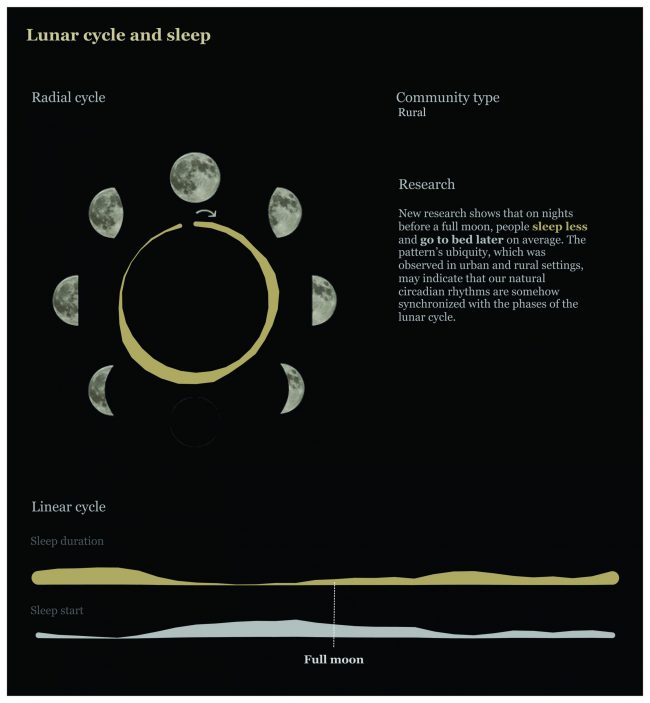
This diagram shows how people go to sleep later and sleep less overall on nights leading up to a full moon. Image via Phys.org, Rebecca Gourley/ University of Washington.
In preindustrial society, humans’ lives revolved around sunrise and sunset. When it was dark, it was not safe to hunt or gather food. But with the advent of artificial light, humans could change their sleep and wake patterns to new demands.
Humans and animals are both subject to circadian rhythms, 24-hour cycles that dictate when wakefulness and sleep occur. The cycles are tied to light, with sunlight waking diurnal creatures and sending nocturnal animals back to their lairs.
Scientists who participated in the study showed that the oscillation patterns in people’s sleep coincided with moon phases. These researchers, led by University of Washington professor of biology Horacio de la Iglesia, reported that from three to five days leading up to a full moon, people tend to go to bed later in the evening and sleep less overall. Participants in the study wore wristwatches that monitored their activity.
The study showed that whether the people are in a dark rural environment or an urban environment where moonlight is not as much of a factor compared to the lights of the big city, their test subjects still followed the pattern of falling asleep later and sleeping less in the week leading up to full moon. This means that even if you are not aware of the moon phase, it still probably has an affect on you.
People in the study groups fell asleep up to a half hour later on full moon nights as compared to new moon nights, and they slept for up to an hour less on full moon nights than during new moon. The more rural the people in the study were, the stronger the effect, but those in the big city still showed they were influenced by the moon.
In the nights following full moon, when the waning moon rises later in the evening after people have already fallen asleep, the researchers found no effect on the sleep patterns of people studied.
Future sleep researchers will probe questions of the full moon’s effect on our circadian rhythms.
For now, if you find yourself tossing and turning on nights leading up to a full moon, no need to stress. It may be just a remnant behavior left behind by your ancestors. You can blame them … or you can blame the full moon.
View at EarthSky Community Photos. | Gustavo Rojas in Los Angeles City, Chile, captured this photo of a waxing gibbous moon on January 24, 2021, 4 days before last month’s full moon. Thanks, Gustavo!
Bottom line: A new study showed that – whether you live in a rural or urban environment – your sleep patterns may be affected by the full moon. On the nights leading up to full moon, people fall asleep later and sleep less overall.
Source: Moonstruck sleep: Synchronization of human sleep with the moon cycle under field conditions
 Bruce's Blog