https://physics.aps.org/articles/v14/27

The Tiniest Superfluid Circuit in Nature

  • Faculty of Physics, Warsaw University of Technology, Warsaw, Poland
  • Department of Physics, University of Washington, Seattle, WA, USA

February 25, 2021• Physics 14, 27A new analysis of heavy-ion collision experiments uncovers evidence that two colliding nuclei behave like a Josephson junction—a device in which Cooper pairs tunnel through a barrier between two superfluids.
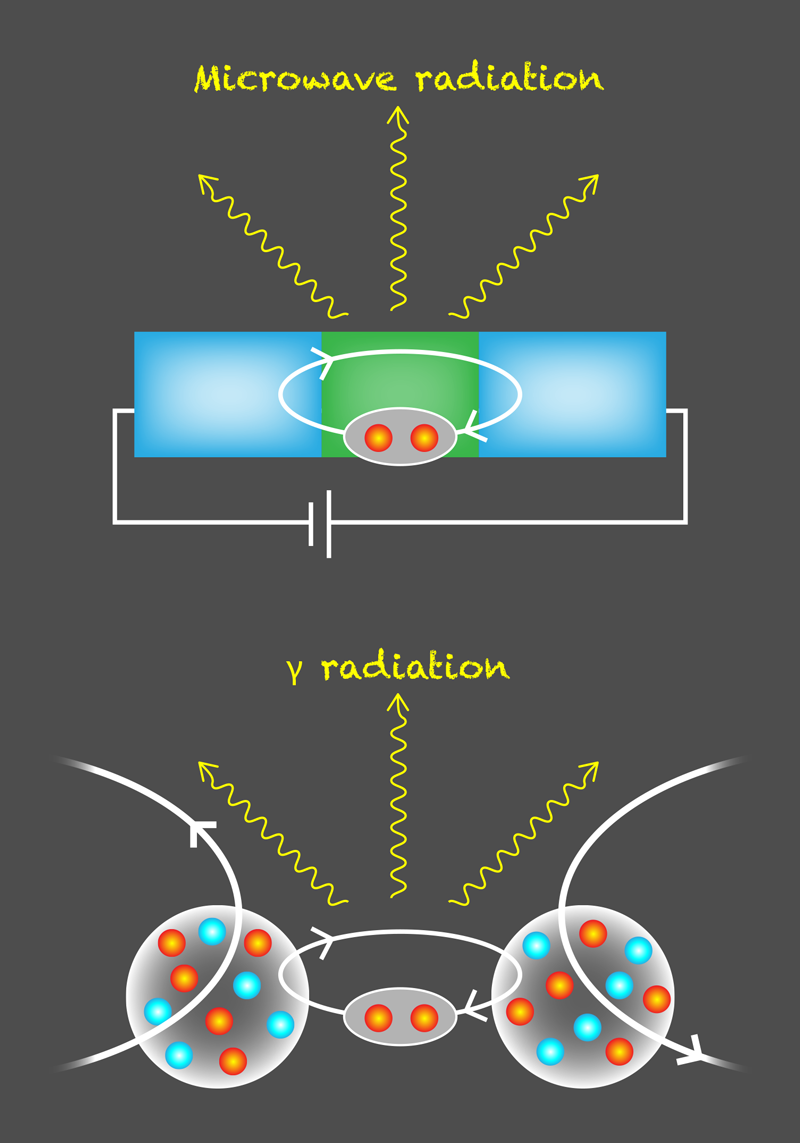
Figure caption
Figure 1: (Top) Sketch of a Josephson junction, in which Cooper pairs tunnel through a barrier (green) between two superconductors (blue). In the ac Josephson effect, an applied dc voltage produces an oscillating, or ac, current, leading to the emission of mic… Show more

The Josephson effect is a remarkable example of a macroscopic quantum phenomenon, in which, without an applied voltage, current flows between two superconductors separated by a thin film of normal material. In this structure, called a Josephson junction, the current is due to the quantum tunneling of paired, superconducting electrons (so-called Cooper pairs) [1]. For decades, nuclear physicists have hypothesized that similar effects can occur on much smaller scales, since atomic nuclei could be regarded as superfluids consisting of paired nucleons. Recent experiments have supported this hypothesis, delivering hints that two colliding nuclei could be described as a Josephson junction in which entangled neutron pairs play the role of Cooper pairs (Fig. 1) [23]. Now, Gregory Potel from Lawrence Livermore National Laboratory in California and colleagues have put these ideas on firmer ground [4]. Analyzing tin-nickel collisions from previous experiments, they found that experimental observables offer compelling signatures that two nuclei indeed form, for a split second, a Josephson junction.

The orderly motion of gigantic ensembles of correlated electron pairs makes superconductors behave as a single object—a macroscopic quantum state called a condensate. The condensate is characterized by its density and phase, and the latter plays the same role as the orientation of magnetic moments in a ferromagnet: an isolated ferromagnet can be rotated at no energy cost, but two ferromagnets with different orientations affect each other. Similarly, according to quantum mechanics, the phase doesn’t have implications for a single condensate. But if two condensates are sufficiently close, a Cooper-pair current, whose magnitude depends on the phase difference, may flow from one condensate to the other. A striking feature of this effect is that electric current may flow without a driving voltage.

There may be other systems in Nature where this effect occurs, and atomic nuclei, which can be regarded as superfluid ensembles of nucleons, are good candidates. This idea appeared among nuclear physicists as early as the 1970s [5]. In the 1980s and 1990s, several experiments indicated an enhanced probability of neutron-pair transfer between colliding nuclei—a possible manifestation of the Josephson effect. But the evidence for this interpretation wasn’t compelling. There were doubts, in particular, about whether ensembles of nucleons are sufficiently large to be treated as a pair condensate. Superconductivity is an emergent phenomenon: It appears when dealing with a huge number of particles but vanishes when the system is broken down into smaller constituents. But can we consider a nucleus made of about 100 nucleons a huge ensemble of particles? Can we expect that two nuclei in close proximity exhibit a Josephson effect?

The study by Potel and his colleagues provides strong arguments for affirmative answers to these questions. The researchers analyzed data from previous experiments in which tin-116 ( 116Sn116Sn) nuclei were collided with nickel-60 ( 60Ni60Ni) [2]. With energies between 140.60 and 167.95 MeV, these collisions are “gentle”: they allow the nuclei to overcome just enough of the Coulomb repulsion to get sufficiently close to exchange a few neutrons at most. Under such conditions, two reactions are possible: the transfer of one neutron and the transfer of two neutrons, producing 115Sn+61Ni115Sn+61Ni and 114Sn+62Ni114Sn+62Ni, respectively. The case of two-neutron transfer is particularly interesting, as it may carry signatures of the correlated pairing of neutrons in the nuclei.

The team devised a way to uncover the experimental evidence of Josephson flow. Their idea is that there can be a nuclear equivalent of the alternating current (ac) Josephson effect (Fig. 1). In this variant of the Josephson effect, a constant, or dc, voltage applied to a Josephson junction produces an ac current. This striking behavior arises because the voltage causes the phase difference between the two condensates to increase over time. Since phases that differ by multiples of 2𝜋2𝜋 are equivalent, a linear phase growth produces an oscillating current. The researchers argue that for the nuclear case, a similar effect can occur because neutron pairs inside two colliding nuclei possess different energies. This energy difference plays the role of the dc voltage in the ac Josephson effect.

Therefore, similar oscillatory behavior is expected to occur during a nuclear collision: the back-and-forth tunneling of neutron pairs means that 116Sn+60Ni116Sn+60Ni transforms into 114Sn+62Ni114Sn+62Ni and then again into 116Sn+60Ni116Sn+60Ni—a cyclical process whose frequency is determined by the energy difference of neutron pairs in initial and final nuclei. Because the collision lasts for only a short time, the team estimates that only about three such back-and-forth transfer cycles may occur in an experiment. However, even these few oscillations can lead to observable consequences. Since neutrons and protons interact strongly, oscillating neutron pairs cause protons to oscillate at the same frequency. Because of their charge, oscillating protons should emit electromagnetic radiation at this frequency. While electrons oscillating in a standard Josephson junction emit microwave photons [6], nuclei are expected to emit gamma-ray photons because of the much larger nuclear energy differences involved. The researchers calculate the expected radiation energy to be slightly less than 4 MeV, which matches the gamma-ray spectrum seen in previous experiments.

The results are thrilling for two reasons. First, they indicate that the principles of superconductivity valid for macroscopic phenomena in solids may be applicable to the much smaller (femtometer) nuclear scales—a truly spectacular conclusion. Second, the analysis shows that the pairing description is appropriate for a small number of particles—the hundreds of nucleons making up the nuclei. It is worth pointing out, however, that this description contains a puzzling inconsistency. According to quantum mechanics, the phase and the number of particles in the condensate are related by the uncertainty principle—much like the position and momentum of a quantum particle: if either quantity is well defined, the other isn’t. But for the nuclear case, the number of nucleons is always exactly defined. Further theoretical work will need to resolve this inconsistency.

These findings whet our appetite for more work aimed at validating superfluid nuclear models by confronting theory with experiments. In particular, it would be crucial to show that such models can deliver accurate, quantitative predictions for analogous effects in nuclear collisions beyond those involving tin and nickel.

References

  1. B. D. Josephson, “Possible new effects in superconductive tunnelling,” Phys. Lett. 1, 251 (1962).
  2. D. Montanari et al., “Neutron pair transfer in 60Ni+116Sn60Ni+116Sn far below the Coulomb barrier,” Phys. Rev. Lett. 113, 052501 (2014).
  3. D. Montanari et al., “Pair neutron transfer in 60Ni+116Sn60Ni+116Sn probed via 𝛾𝛾-particle coincidences,” Phys. Rev. C 93, 054623 (2016).
  4. G. Potel et al., “Quantum entanglement in nuclear Cooper-pair tunneling with 𝛾𝛾 rays,” Phys. Rev. C 103, L021601 (2021).
  5. K. Dietrich, “On a nuclear Josephson effect in heavy ion scattering,” Phys. Lett. B 32, 428 (1970).
  6. S. Shapiro, “Josephson currents in superconducting tunneling: The effect of microwaves and other observations,” Phys. Rev. Lett. 11, 80 (1963).

About the Author

Image of Piotr Magierski

Piotr Magierski is Professor of Physics and Head of the Nuclear Physics Division at Warsaw University of Technology, Poland, and an Affiliate Professor at the University of Washington. He is a theoretical physicist whose research interests include superfluidity and superconductivity in systems far from equilibrium, such as nuclear fission and fusion reactions, nuclear matter in neutron stars, and ultracold atomic gases.

https://globalnews.ca/news/7661952/mars-perseverance-rover-panorama-photos/


Take a look around Mars with Perseverance rover’s HD photo panorama

ByJosh K. Elliott  Global NewsPosted February 25, 2021 7:53 am

Click to play video 'NASA releases 1st video of Perseverance rover landing on Mars'
WATCH: NASA released a 3-minute video of the historic landing of its Perseverance rover as it descended onto the surface of Mars last Thursday.

Descrease article font size-AIncrease article font sizeA+

NASA‘s Perseverance rover is offering Earthlings the next-best thing to standing on Mars with a series of high-definition panorama photos that allow you to look around the Red Planet at your leisure.

The space agency released the panorama footage on Wednesday, a few days after it successfully landed its Perseverance rover in the Jezero Crater on Mars.

“The newly released panorama reveals the crater rim and cliff face of an ancient river delta in the distance,” NASA said in a news release.

READ MORE: NASA’s Perseverance rover sends back ‘stunning’ images after landing on Mars

It also reveals the scene around the rover in extremely high detail, so that you can actually see the rivets on the vehicle and the pores in individual Martian rocks.STORY CONTINUES BELOW ADVERTISEMENThttps://ec868b0d898e73bfb9037ff0b3fd8056.safeframe.googlesyndication.com/safeframe/1-0-37/html/container.html

The interactive footage is a bit like Google Maps on Mars. You can swipe, drag or zoom the camera to take a look at the full 360-degree field of view around Perseverance, thanks to 142 high-definition photos that have been stitched together.

Click on the image below to explore the panorama footage from Mars.

Perseverance captured the photos with its Mastcam-Z camera over the weekend. The high-definition camera can pick out details as small as 3 to 5 millimetres at close range, and between 2 to 3 metres across on the mountainous horizon, according to NASA.Click to play video 'Richmond company goes to Mars'1:58Richmond company goes to MarsRichmond company goes to Mars

NASA says the view from Perseverance is similar to what it has seen at past landing sites.STORY CONTINUES BELOW ADVERTISEMENT

“We’re nestled right in a sweet spot, where you can see different features similar in many ways to features found by Spirit, Opportunity, and Curiosity at their landing sites,” said Jim Bell, NASA’s principal investigator for the camera, in the news release.

NASA researchers have already started picking out interesting sights from the Martian surface, including a rock formation that appears to have been carved by the merciless Martian wind.

This wind-carved rock seen in first 360-degree panorama taken by the Mastcam-Z instrument shows just how much detail is captured by the camera systems.
This wind-carved rock seen in first 360-degree panorama taken by the Mastcam-Z instrument shows just how much detail is captured by the camera systems. NASA/JPL-Caltech/MSSS/ASU

The rover’s primary mission is to search for signs of ancient life on Mars, and to eventually send samples of the Martian surface back to Earth for analysis.

One of the first steps in that mission is to scan the crater’s surface for rocks that are worthy of closer inspection.

The crater was once a lake filled with liquid water, but that water disappeared about three billion years ago.STORY CONTINUES BELOW ADVERTISEMENTClick to play video 'Significance of NASA’s historic landing on Mars'4:52Significance of NASA’s historic landing on MarsSignificance of NASA’s historic landing on Mars

Scientists hope that some forms of microbial life might have lived in that ancient sea, and that their microscopic remains can be found in the rock and soil on the surface today.

The rover will eventually collect several samples, package them up and leave them at designated retrieval points, where a future mission will one day retrieve them and fly them back to Earth.

READ MORE: Scientists ‘shocked’ to find life in extreme depths under Antarctic ice

NASA will also scan the photos for a flat spot where it can launch the rover’s miniature helicopter.

All those efforts start with reviewing the same panorama photos that NASA has now released to the public.STORY CONTINUES BELOW ADVERTISEMENT

That means you can join scientists in scanning the photos for interesting details on the distant Martian surface.

https://www.popsugar.com/family/why-i-let-my-child-plan-his-own-bedtime-routine-48154301


I Give In to My Son’s Bedtime Demands, and It’s Helped Us All Go to Sleep Easier

February 24, 2021by CHRISSY BOBIC16 Shares

tmp_yjiqrE_ca079badde0bdbac_GettyImages-1047524408.jpg

Image Source: Getty / Adene Sanchez

If you ask almost any parent what bedtime looks like in their home, they might say something about the dozens of times their kid gets out of bed to ask for a glass of water. Or, they’ll complain about reading too many bedtime stories. I get it. I, too, have been the victim of a seven-year-old’s adorable manipulations. But there came a time when I realized I could compromise without totally losing my mind, all while appeasing my son’s anxiety about sticking to our family rituals.

My son is a creature of habit. He might enjoy playing unpredictable video games as much as the next elementary school kid who acts like a preteen, but he has always thrived on his routines. If there’s a surprise or a shift in the matrix of our daily activities, he feels just a little taken back. Usually, I can remind him to take some deep breaths and find his “inner calm.” When it comes to bedtime, though, he tends to lean on the habits we have developed as a family. It’s our thing. The older he gets, the more lax he becomes, even if he keeps adding things to the list of bedtime routine must-dos. Still, you’d better believe I know it won’t last forever.

I don’t subscribe to the idea of doing away with bedtime stories or certain bedtime activities just because my kid is getting a little older. Someday he will no longer squeeze himself in bed next to my husband and I in the middle of the night and when that day comes, I’ll know he no longer needs me at his bed every evening before lights are out. Until then, I have no problem giving in to what makes him comfortable during his bedtime routine. Because that’s just it — it’s not about giving in to the demands of your kid or failing to teach them to fall asleep on their own without sneaking out of bed at least once to get another “tuck-in.”Related:I Started Using This Simple Trick During My Kids’ Bedtime, and It’s Saved Us HOURS Each Week

When it comes down to it, adhering to my kid’s preference in a bedtime routine is about making him comfortable in every sense of the word. Put yourself in your kid’s shoes and think about how you would feel if you couldn’t scroll through TikTok for an hour in bed before you turned in for the night. Or if you were no longer able to indulge in your before bed skincare routine.

We all have ways to help us unwind at the end of the day and your kid’s bedtime routine, however frivolous it might seem and however hard you want to roll your eyes, it’s theirs to have. Side note — I am not averse to eye-rolling myself. I just get called out for it by my kid these days, so there’s that.

But what, you ask, is my son’s much-needed bedtime routine that has seemed to get more intricate and necessary for him?

First, we do the typical things like brushing teeth and getting pajamas on. That’s the easy part. Afterward, he needs to know how his stuffed animals behaved while he was at school. My husband or I make up some scenario wherein a stuffed animal acted out even though we all know it’s a running gag. My kid still plays along and seems to get a kick out of it. Who am I to judge?

Then, we read a couple of chapters of the latest bedtime book together. After that, my son usually insists on each of us taking turns with his dream catcher that hangs precariously from the edge of his headboard. We each hold the dream catcher to our chests and give our “energy” so he can have good dreams as opposed to the sometimes vivid bad ones he describes.

Once my husband and I make it to the doorway we say the same goodnight spiel every evening. We let him know the hall light is on and that we’ll be in the living room and his younger sister is also fast asleep upstairs. It has become a mantra, or a chant, to somehow trick him into lulling to sleep.Related:7 Tips to Get Your Kid Into a Solid Bedtime Routine

tmp_IdHS9h_e2dbd3b5f5f4e381_bedtime_routine.jpg

Image Source: Chrissy Bobic

Does it work every time? Not necessarily. Does he still appear in the living room doorway five nights out of seven to ask one of us to tuck him in again, even though if he hadn’t crept out of bed he wouldn’t need to be tucked in again at all? Of course. But we’re parents. We all know the neediness that comes with younger kids.

I know, it sounds like a lot. And some nights, ahead of bedtime, my husband and I speak with our son about skipping one portion or keeping a part of it a little shorter. Most of the time, he acquiesces. And it’s those times that I know, someday he won’t want to know how his stuffed animals behaved while he was at school (which we both silently know he doesn’t believe anyway).

Someday, he’ll choose playing Fortnite for an extra half hour over reading a bedtime story together. And, at some point, his door will remain closed from the time dinner is over until the following morning. Until then, I’ll give in to an extra “tuck-in.” I’ll kiss his dream catcher to give it extra “energy.” And I’ll concede to another glass of water if he needs it as badly as he says.

But, rest assured, I won’t say no to investing in some rubber sheets.

https://phys.org/news/2021-02-unbound-limits-optical-antennas.html

Light unbound: Data limits could vanish with new optical antennas

by University of California – Berkeley

Light unbound: Data limits could vanish with new optical antennas
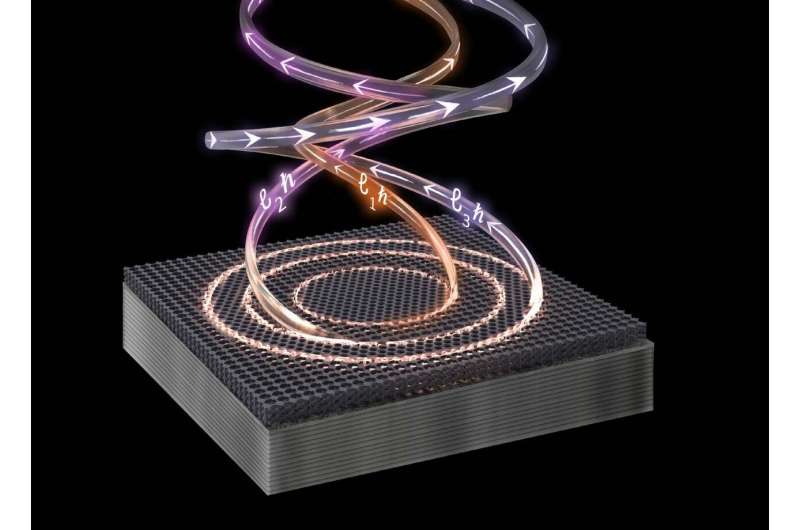
Researchers at the University of California, Berkeley, have found a new way to harness properties of light waves that can radically increase the amount of data they carry. They demonstrated the emission of discrete twisting laser beams from antennas made up of concentric rings roughly equal to the diameter of a human hair, small enough to be placed on computer chips. Credit: Boubacar Kanté

Researchers at the University of California, Berkeley, have found a new way to harness properties of light waves that can radically increase the amount of data they carry. They demonstrated the emission of discrete twisting laser beams from antennas made up of concentric rings roughly equal to the diameter of a human hair, small enough to be placed on computer chips.

The new work, reported in a paper published Thursday, Feb. 25, in the journal Nature Physics, throws wide open the amount of information that can be multiplexed, or simultaneously transmitted, by a coherent light source. A common example of multiplexing is the transmission of multiple telephone calls over a single wire, but there had been fundamental limits to the number of coherent twisted lightwaves that could be directly multiplexed.

“It’s the first time that lasers producing twisted light have been directly multiplexed,” said study principal investigator Boubacar Kanté, the Chenming Hu Associate Professor at UC Berkeley’s Department of Electrical Engineering and Computer Sciences. “We’ve been experiencing an explosion of data in our world, and the communication channels we have now will soon be insufficient for what we need. The technology we are reporting overcomes current data capacity limits through a characteristic of light called the orbital angular momentum. It is a game-changer with applications in biological imaging, quantum cryptography, high-capacity communications and sensors.”

Kanté, who is also a faculty scientist in the Materials Sciences Division at Lawrence Berkeley National Laboratory (Berkeley Lab), has been continuing this work at UC Berkeley after having started the research at UC San Diego. The first author of the study is Babak Bahari, a former Ph.D. student in Kanté’s lab.

Kanté said that current methods of transmitting signals through electromagnetic waves are reaching their limit. Frequency, for example, has become saturated, which is why there are only so many stations one can tune into on the radio. Polarization, where lightwaves are separated into two values—horizontal or vertical—can double the amount of information transmitted. Filmmakers take advantage of this when creating 3-D movies, allowing viewers with specialized glasses to receive two sets of signals—one for each eye—to create a stereoscopic effect and the illusion of depth.

Harnessing the potential in a vortex

But beyond frequency and polarization is orbital angular momentum, or OAM, a property of light that has garnered attention from scientists because it offers exponentially greater capacity for data transmission. One way to think about OAM is to compare it to the vortex of a tornado.https://googleads.g.doubleclick.net/pagead/ads?client=ca-pub-0536483524803400&output=html&h=280&slotname=5350699939&adk=2265749427&adf=780081655&pi=t.ma~as.5350699939&w=750&fwrn=4&fwrnh=100&lmt=1614304039&rafmt=1&psa=1&format=750×280&url=https%3A%2F%2Fphys.org%2Fnews%2F2021-02-unbound-limits-optical-antennas.html&flash=0&fwr=0&rpe=1&resp_fmts=3&wgl=1&uach=WyJNYWMgT1MgWCIsIjEwXzExXzYiLCJ4ODYiLCIiLCI4OC4wLjQzMjQuMTgyIixbXV0.&dt=1614304033321&bpp=215&bdt=9480&idt=6013&shv=r20210224&cbv=r20190131&ptt=9&saldr=aa&abxe=1&cookie=ID%3D6d20cec83a9677a1-22c493fe55c20058%3AT%3D1595014948%3AR%3AS%3DALNI_MZJCuPZLUdRM6AO3kXi5hBFw_OsUA&correlator=6656804585011&frm=20&pv=2&ga_vid=981691580.1517602527&ga_sid=1614304039&ga_hid=1529628234&ga_fc=0&u_tz=-480&u_his=1&u_java=0&u_h=1050&u_w=1680&u_ah=980&u_aw=1680&u_cd=24&u_nplug=3&u_nmime=4&adx=335&ady=2413&biw=1680&bih=900&scr_x=0&scr_y=0&oid=3&pvsid=3740815408905811&pem=46&ref=https%3A%2F%2Fnews.google.com%2F&rx=0&eae=0&fc=896&brdim=0%2C23%2C0%2C23%2C1680%2C23%2C1680%2C980%2C1680%2C900&vis=1&rsz=%7C%7CpeEbr%7C&abl=CS&pfx=0&fu=8320&bc=31&ifi=1&uci=a!1&btvi=1&fsb=1&xpc=5mXow3DYBA&p=https%3A//phys.org&dtd=6688

“The vortex in light, with its infinite degrees of freedom, can, in principle, support an unbounded quantity of data,” said Kanté. “The challenge has been finding a way to reliably produce the infinite number of OAM beams. No one has ever produced OAM beams of such high charges in such a compact device before.”

The researchers started with an antenna, one of the most important components in electromagnetism and, they noted, central to ongoing 5G and upcoming 6G technologies. The antennas in this study are topological, which means that their essential properties are retained even when the device is twisted or bent.

Creating rings of light

To make the topological antenna, the researchers used electron-beam lithography to etch a grid pattern onto indium gallium arsenide phosphide, a semiconductor material, and then bonded the structure onto a surface made of yttrium iron garnet. The researchers designed the grid to form quantum wells in a pattern of three concentric circles—the largest about 50 microns in diameter—to trap photons. The design created conditions to support a phenomenon known as the photonic quantum Hall effect, which describes the movement of photons when a magnetic field is applied, forcing light to travel in only one direction in the rings.

“People thought the quantum Hall effect with a magnetic field could be used in electronics but not in optics because of the weak magnetism of existing materials at optical frequencies,” said Kanté. “We are the first to show that the quantum Hall effect does work for light.”

By applying a magnetic field perpendicular to their two-dimensional microstructure, the researchers successfully generated three OAM laser beams traveling in circular orbits above the surface. The study further showed that the laser beams had quantum numbers as large as 276, referring to the number of times light twists around its axis in one wavelength.

“Having a larger quantum number is like having more letters to use in the alphabet,” said Kanté. “We’re allowing light to expand its vocabulary. In our study, we demonstrated this capability at telecommunication wavelengths, but in principle, it can be adapted to other frequency bands. Even though we created three lasers, multiplying the data rate by three, there is no limit to the possible number of beams and data capacity.”

Kanté said the next step in his lab is to make quantum Hall rings that use electricity as power sources.


Explore furtherLaser cavities take on new shapes and functionalities


More information: Bahari, B., Hsu, L., Pan, S.H. et al. Photonic quantum Hall effect and multiplexed light sources of large orbital angular momenta. Nature Physics (2021). DOI: 10.1038/s41567-021-01165-8Journal information:Nature PhysicsProvided by University of California – Berkeley

https://www.xda-developers.com/firefox-86-total-cookie-protection/

Firefox 86 adds Total Cookie Protection for improved privacy

Mozilla has declared an all-out war on web tracking, recently cracking down on supercookies with the release of Firefox 85. The company is taking it a step further with a new tool called Total Cookie Protection in Firefox 86.https://d6df8ed418cd0b158dd5b0a59a1e0e66.safeframe.googlesyndication.com/safeframe/1-0-37/html/container.html

According to Mozilla, Total Cookie Protection stops cookies from tracking you around the web by creating a separate cookie jar for every website. Mozilla said when combined with last month’s supercookie protections, Firefox is more equipped than ever to provide users with “very strong, comprehensive protection against cookie tracking.” The new feature is available in Enhanced Tracking Protection (ETP) Strict Mode in both the desktop and Android versions.

The below graphic helps explain how Total Cookie Protection works.

Firefox Total Cookie Protection feature

Image: Firefox

The latest feature adds to Firefox’s growing list of tools that aim to protect users from being tracked across the web. In last month’s update, Mozilla tackled pesky supercookies, which the company said is a type of tracker that can stay hidden in your browser and track you online, even after you clear cookies.

“In our ongoing commitment to bring the best innovations in privacy, we are working tirelessly to improve how Firefox protects our users from tracking,” Mozilla said in a blog post.

In addition to Total Cookie Protection, Mozilla is also adding multiple picture-in-picture support in Firefox 86, which is available on Mac, Linux, and Windows. With March Madness on the horizon, Mozilla is releasing the feature at just the right time.https://d6df8ed418cd0b158dd5b0a59a1e0e66.safeframe.googlesyndication.com/safeframe/1-0-37/html/container.html

The new updates are a precursor to what we expect to be a major “Proton” redesign expected later this year. Teased back in January, the redesign will see Mozilla tweak Firefox’s address bar, toolbar, tabs bar, and introduce tools to make it easier than ever to customize the look of the New Tab page.

Firefox’s Total Cookie Protection and multiple picture-in-picture features are available now in Firefox 86.

Firefox Browser: fast, private & safe web browser

DownloadQR-CodeFirefox Browser: fast, private & safe web browserDeveloper: MozillaPrice: Free 

https://www.prevention.com/health/g35590823/best-pillow-for-neck-pain/


13 Best Pillows to Help Alleviate Neck Pain, According to Experts

Whether you sleep on your side, back, or stomach, we’ve got you covered with these supportive picks.

By Jake SmithFeb 24, 2021pillows to help neck painRETAILER

If all those hours hunched over your computer or phone have led to annoying neck pain, you’re not alone. About one in three people experience neck pain, and women deal with it more than men, according to the National Institutes of Health.

The good news is, there are things you can do to alleviate the ache—including changing up your pillow. In fact, certain pillows are designed to ease neck pain by correcting your posture and straightening your neck while you sleep. They might even help you stay asleep and wake up feeling more refreshed, too.

How does the right pillow help with neck pain?

You’ve probably woken up with a crick in your neck from sleeping wrong, but chronic neck pain is more likely to be exacerbated, rather than caused, by sleep habits, says Viral R. Patel, M.D., acting instructor in orthopedics and sports medicine at the University of Washington School of Medicine. “The most common cause of neck pain is postural,” he explains. Activities like sitting at a desk all day can weaken and overwork your neck muscles, leading to tension and aches.

Pillows designed to ease neck pain can help: They gently guide your spine into a straight line from your head to your pelvis, Dr. Patel explains. Normal pillows, on the other hand, are more likely to accentuate spine curvature and keep neck muscles from relaxing.

How to choose the best pillow for neck pain

Whether you sleep on your back or your side, there’s a pillow out there that’ll help alleviate your neck pain (although it might take a little while to adjust to a more ergonomic design). Here’s how to choose the right one, according to the experts.

Consider your preferred sleeping position. Your cervical pillow should be tailored to how you sleep. Side-sleepers should choose pillows that are on the taller end, which will keep your neck straight in line with your spine. Back- and stomach-sleepers, meanwhile, should go for shorter pillows, which keep your head from jutting out too far. Height is also important, Dr. Patel explains, because too much or too little elevation can lead to breathing difficulties and sleep interruptions, as confirmed by a 2015 study.

If you’re not sure which height is best for you, adjustable pillows are especially useful—they allow you to control the height and firmness. The shape, too, should work for your preferred position, offering enough room for your shoulders, for example. And stomach-sleepers should make sure their pillow offers good airflow, since they may be breathing through it.

Don’t worry too much about material. When it comes to neck pain, the material of your pillow doesn’t matter too much. You can choose almost any material with confidence, Dr. Patel notes, including foam, microfiber, latex, polyester, air, and water. Most are designed with memory foam, a firmer material that provides comfortable neck support and instantly snaps back into shape, says Michael Breus, Ph.D., an author and clinical psychologist who specializes in sleep disorders.

There is one caveat, though: Avoid down pillows. “I don’t recommend feather pillows because I’ve seen patients who have had pretty bad experiences with them,” Dr. Patel warns. Most true down pillows, he says, just don’t provide enough support through the night to be worthwhile to people with neck pain. Plus, the fill might trigger allergies.

See a doctor if your neck doesn’t feel better. Finding a corrective pillow is a great first step in treating neck pain, but if you’re still struggling with chronic pain in your neck, shoulders, and arms, it’s best to see a doctor. “A pillow is not treatment,” Dr. Patel says. Make an appointment with your healthcare provider, who may refer you to an orthopedist for a full evaluation.

Ready to find the best pillow to alleviate your neck pain? Read on—and sweet dreams!1BEST OVERALL PILLOW FOR NECK PAINCoop Home Goods Adjustable Loft PillowAMAZONamazon.com$59.99SHOP NOW

Coop Home Good’s bestselling pillow has all the features you could want in a pillow: Its height and firmness are adjustable, its memory foam fill is breathable and hypoallergenic, and its removable cover is machine-washable. And with nearly 20,000 5-star reviews on Amazon, it’s one of the highest-rated pillows anywhere.
ADVERTISEMENT – CONTINUE READING BELOW2BEST VALUE PILLOWHokeki Contour PillowAMAZONamazon.com$59.99$29.99 (50% off)SHOP NOW

On a budget? This is a great pillow for neck pain for less than $30. It doesn’t have all the bells and whistles of other models, but it’s supportive, cooling, and great for side-sleepers. “I have arthritis in my neck and it’s hard for me to get comfortable in bed,” one reviewer explains. “I personally am very pleased and highly recommend!”3RAVE REVIEWSLayla Kapok Pillow

laylasleep.com$99.00SHOP NOW

This pillow is one of Layla’s top sellers, and after testing it out for ourselves, we understand why. It’s soft but supportive, as it contains a unique blend of Kapok (a natural fiber that’s light and airy) and memory foam, so it cradles your neck as you sleep. It contains a convenient zipper on the edge, so you can adjust the stuffing to your liking, too. Best of all, it’s also cooling and breathable, so no worries about night sweats here.ADVERTISEMENT – CONTINUE READING BELOWhttps://f6e0436239b846d31e5217f7c25782b0.safeframe.googlesyndication.com/safeframe/1-0-37/html/container.html4BEST PILLOW FOR SIDE-SLEEPERSTempur-Pedic Ergo Neck PillowAMAZONamazon.com$129.00$80.48 (38% off)SHOP NOW

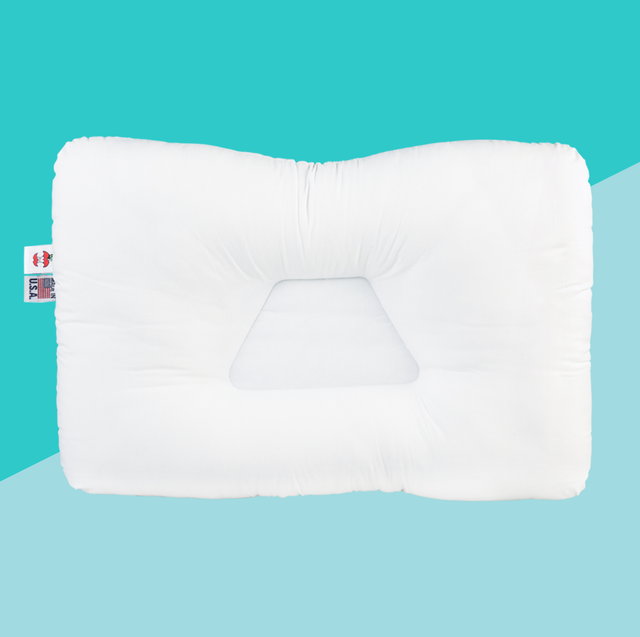
The distinctive shape of Tempur-Pedic’s pillow is ideal for supporting and straightening the necks of side-sleepers. And its firm, supportive memory foam ensures that your neck won’t bend and twist during the night, Breus says. 5BEST PILLOW FOR BACK-SLEEPERSCore Products Tri-Core Cervical PillowAMAZONamazon.com$44.18$39.07 (12% off)SHOP NOW

The trapezoidal divot in this pillow is designed specifically to cradle the head when you’re sleeping on your back. “I was introduced to this pillow by my physical therapist and it was just what my neck needed,” writes one reviewer who had spine surgery. “The concept of this pillow is genius.” It’s one of the firmer pillows on this list, but for good reason: It actively straightens your spine.ADVERTISEMENT – CONTINUE READING BELOW6BEST FOR STOMACH-SLEEPERSSable Down Alternative PillowsAMAZONamazon.com$34.99SHOP NOW

Although they might look extra-plush, these polyester-filled pillows can be thinned out thanks to a zipper on the side. Reviewers love how similar they are to true down without the allergy risk, plus how soft yet supportive they can be. And because they’re not made from solid foam, you’ll be able to breathe right through them.7BEST ADJUSTABLE PILLOWZoey Sleep Side Sleeper PillowAMAZONamazon.com$99.95$79.99 (20% off)SHOP NOW

Zoey Sleep’s curved pillow is completely adjustable; you unzip it and choose the level of foam that best keeps your neck in place overnight. “If you sleep on your side or sleep on your back, this is a game changer,” raves one Amazon reviewer, who also appreciates that the curved design allows room for your shoulders.ADVERTISEMENT – CONTINUE READING BELOWhttps://f6e0436239b846d31e5217f7c25782b0.safeframe.googlesyndication.com/safeframe/1-0-37/html/container.html8BEST PILLOW FOR FIRM SUPPORTTherapeutica PillowAMAZONamazon.com$107.55$72.98 (32% off)SHOP NOW

The strangest-looking pillow on this list is also one of the most dense—but it’s just what you need if you’re really struggling with neck pain. Its distinctive shape cradles and aligns the head and neck, making it perfect for people who sleep on their backs, but occasionally turn to the side. “It takes a bit of getting used to,” one user says, but “I haven’t had pain from sleeping in six months. Do yourself a favor and try it.”9BEST PILLOW FOR MEDIUM SUPPORTCasper Foam PillowCASPERcasper.com$80.00SHOP NOW

Casper’s signature pillow is plush, but not too soft, offering a happy medium between comfort and support. Constructed from three layers of cooling memory foam—all of which have tiny holes for maximum airflow—the pillow checks all the ergonomic boxes and feels like something you’d want to steal from a hotel room.ADVERTISEMENT – CONTINUE READING BELOW10BEST PILLOW FOR SOFT SUPPORTBeckham Hotel Collection Gel PillowAMAZONamazon.com$79.99$39.99 (50% off)SHOP NOW

For people who aren’t quite ready to give up sleeping on a soft pillow, these gel fiber-filled pillows are among the most-loved on Amazon, with over 60,000 perfect 5-star reviews. “I had some doubts at first because I thought they’d be too soft,” one reviewer explains, but “I would now describe them as soft, yet firm enough to support my head and neck correctly.”11BEST COOLING PILLOWThe Purple PillowPURPLEpurple.com$109.00SHOP NOW

Purple’s pillow is made from the same technology that the brand uses in its mattresses: a plastic mesh with hundreds of cooling airways and the perfect amount of give for back-sleepers. Along with adjustable boosters for side-sleepers and a moisture-wicking cover for warm nights, it’s worth a shot if more traditional pillows don’t work well for you.ADVERTISEMENT – CONTINUE READING BELOW12BEST CYLINDRICAL PILLOWSachi Organics Buckwheat Cylinder Neck PillowAMAZONamazon.com$37.00SHOP NOW

Cylindrical pillows offer great neck support, and with a 4.5-star average on Amazon, this organic option is one of the best available anywhere. It’s filled with buckwheat, not synthetic materials, which reviewers note can be a touch noisy, but surprisingly soft and supportive. You can even remove some of the filling to adjust for your body and preferred sleeping position.13BEST NECK PILLOWCrafty World Neck PillowAMAZONamazon.com$19.99SHOP NOW

Neck pillows aren’t just ideal for traveling—they can make all the difference for people recovering from surgery or injuries, plus people with chronic neck pain. This memory foam option is a “life saver” for one reviewer who has been recovering from a neck injury and uses it at home and in the car: “I highly recommend this neck pillow.”

https://phys.org/news/2021-02-nanobodies-crispr-genes.html


Nanobodies could help CRISPR turn genes on and off

by Stanford University School of Engineering

crispr
Credit: CC0 Public Domain

The genetic tool CRISPR has been likened to molecular scissors for its ability to snip out and replace genetic code within DNA. But CRISPR has a capability that could make it useful beyond genetic repairs. “CRISPR can precisely locate specific genes,” says Lacramioara Bintu, an assistant professor of bioengineering at Stanford. “What we did was attach CRISPR to nanobodies to help it perform specific actions when it reached the right spot on DNA.”

Her lab recently used this combo technique to transform CRISPR from a gene-editing scissors into a nanoscale control agent that can toggle specific genes on and off, like a light switch, to start or stop the flow of some health-related protein inside a cell.

“There are a lot of things you can’t fix with scissors,” Bintu says. The novel technique her team describes in the journal Nature Communications could enable researchers to explore new therapeutic applications in the field of epigenetics—which is the study of how genes behave inside cells.

As Bintu explains, every cell in the human body has the same DNA—a full complement of genes—but not every gene is switched on in every cell. Some cells have certain genes on, telling the cell to produce specific proteins. Others have those genes turned off, but others turned on. Sometimes, as with genetic diseases, things go awry in this switching. The Bintu lab’s new tool has the potential to correct those mistakes.

The new tool is more complicated than scissors because ordinary CRISPR cannot turn genes on and off in a controlled manner without breaking the DNA. To make changes without harm to the DNA, CRISPR needs an assist from other large, complex proteins, known as “effectors.” With the new combo tool, CRISPR finds the right gene, and the effector can flip the switch.

“But these effector molecules are usually too big to easily deliver into a cell for therapeutic use,” says Ph.D. student Mike Van, first author of the paper. Further complicating matters, several effectors are usually used in combination to efficiently regulate specific cell behaviors, making the CRISPR-effectors combo even bigger, hence harder to produce and deliver.

To get around this roadblock, Bintu’s team turned to smaller proteins known as nanobodies. Nanobodies don’t act as stand-ins for the effectors. Instead, they act like tiny hooks that snare the needed effectors that are already swimming about within the cell. Choose the right nanobody and it will recruit the right effector for the switching job.

The new technique could be used to correct epigenetic defects without the need to combine CRISPR to large effectors. “The cells already have these proteins,” explains Bintu. “We thought: Why are we reattaching them? Let’s use nanobodies to do that.”

At this point the technique is at the proof-of-concept stage. The next step is for the team to sort through millions of potential nanobodies, and start figuring out how to attach them to CRISPR to target specific epigenetic breakdowns.

“We just came up with a method of testing hundreds of thousands at a time,” says Bintu, who hopes to further develop the technique in future experiments.


Explore furtherCre-Controlled CRISPR: Conditional gene inactivation just got easier


More information: Mike V. Van et al, Nanobody-mediated control of gene expression and epigenetic memory, Nature Communications (2021). DOI: 10.1038/s41467-020-20757-1Journal information:Nature CommunicationsProvided by Stanford University School of Engineering

https://www.express.co.uk/life-style/health/1402030/how-to-live-longer-metformin-nmn-resveratrol-longevity

How to live longer: Three supplements linked to a longer lifespan – what to take

LONGEVITY hinges on healthy lifestyle decisions, many of which are supported through robust research. A body of evidence has alighted upon three supplements that may boost your longevity.

By ADAM CHAPMANPUBLISHED: 04:00, Thu, Feb 25, 2021 | UPDATED: 14:26, Thu, Feb 25, 20215Copy link

Loose Women: Dr Hilary discusses how to live longer

https://imasdk.googleapis.com/js/core/bridge3.443.0_en.html#goog_181246736Volume 0% This video file cannot be played.(Error Code: 232001)Sign up for FREE health tips to live a long and happy life SUBSCRIBE

When you subscribe we will use the information you provide to send you these newsletters. Sometimes they’ll include recommendations for other related newsletters or services we offer. Our Privacy Notice explains more about how we use your data, and your rights. You can unsubscribe at any time.

Life expectancy is largely governed by how effectively we can wield the tools at our disposal. What we choose to put in our body illustrates this point – poor dietary decisions can invite a host of health problems, whereas eating well can provide a barrier against them. Supplements are often met with a healthy dose of scepticism, but evidence suggests that some can extend your lifespan.

RELATED ARTICLES

READ MORE

“Scientists believe that there are some supplements that can naturally activate our longevity genes,” Lewis Dartnell of cosmetic beauty clinic GBS Clinic explained to Express.co.uk.https://www.ad-sandbox.com/static/html/sandbox.htmlDartnell and his team searched the literature on supplements and three stuck out.

Metformin

Metformin is a medicine used to treat type 2 diabetes, and to help prevent type 2 diabetes if you’re at high risk of developing it.

As Dartnell explains, its health benefits are not confined to type 2 diabetes.

READ MORE: How to live longer: Four simple dietary decisions that are proven to boost longevity

Metformin offers protection against a host of chronic diseases

How to live longer: Metformin offers protection against a host of chronic diseases (Image: Getty Images)

One study of over 41,000 metformin users found the drug decreased frailty by 24 percent, decreased cancer risk by six percent, reduced cardiovascular disease risk by 19 percent, and increased overall lifespan by six percent.

In their concluding remarks, the study researchers wrote: “The apparent reductions in all-cause mortality and diseases of ageing associated with metformin use suggest that metformin could be extending life and health spans by acting as a neuroprotective agent.”

NMN

According to Dartnell, another supplement that may extend one’s lifespan is NMN (nicotinamide mononucleotide).

As he explained Inside the body, NMN is transformed into NAD+ – a critical coenzyme found in every cell in your body.PROMOTED STORY

DON’T MISS
How to live longer: Eat a ‘modified’ Mediterranean diet [TIPS]
Statins side effecs: Three side effects in your eyes [ADVICE]
Simon Gregson health: Coronation Street star’s anxiety [INSIGHT]

TRENDING

The body naturally produces NAD+ but levels decline as we get older.

A key study of NAD-boosting molecules (NMN) found that boosting NAD+ levels in older age can “promote health and extend lifespan”.

“NMN is thought to boost our longevity genes in a way that mimics the effects of exercise,” Dartnell reports.

In their concluding remarks, the study authors wrote: “Restoration of NAD+ levels in old or diseased animals can promote health and extend lifespan, prompting a search for safe and efficacious NAD-boosting molecules.

Resveratrol is also available in red wine

Best supplements: Resveratrol is also available in red wine (Image: Getty Images)

READ MORE

“Such molecules hold the promise of increasing the body’s resilience, not just to one disease, but to many, thereby extending healthy human lifespan.”

Resveratrol

Resveratrol is a micronutrient available in supplement form.

According to Dartnell, studies have shown resveratrol activates longevity genes and can slow the rate of ageing.

And it works by tricking the body into thinking it is fasting,” suggests one study.

RELATED ARTICLES

Key lifestyle tips to boost longevity

How to live longer: Key lifestyle tips to boost longevity (Image: Getty Images)

“The good news is, resveratrol is also available in red wine, just in case you don’t fancy taking the supplements.”

According to research, determining the mechanism(s) by which resveratrol and similar molecules act, and developing methods to improve bioavailability and/or specificity, has enormous potential to benefit human health.

It is thought that resveratrol mimics fasting, said Dartnell.

As he explained, fasting is essential for switching “on” our longevity genes.

It should be noted that GBS Clinic does not sell any of these supplements and does not necessarily endorse or agree with the findings here. Dartnell just reporting on what the scientific literature has discovered.

https://9to5mac.com/2021/02/25/withings-apple-health-devices-

Withings expands Apple Health accessories with new cellular smart scale and blood pressure monitor

Michael Potuck

– Feb. 25th 2021 6:00 am PT

@michaelpotuck

2 Comments

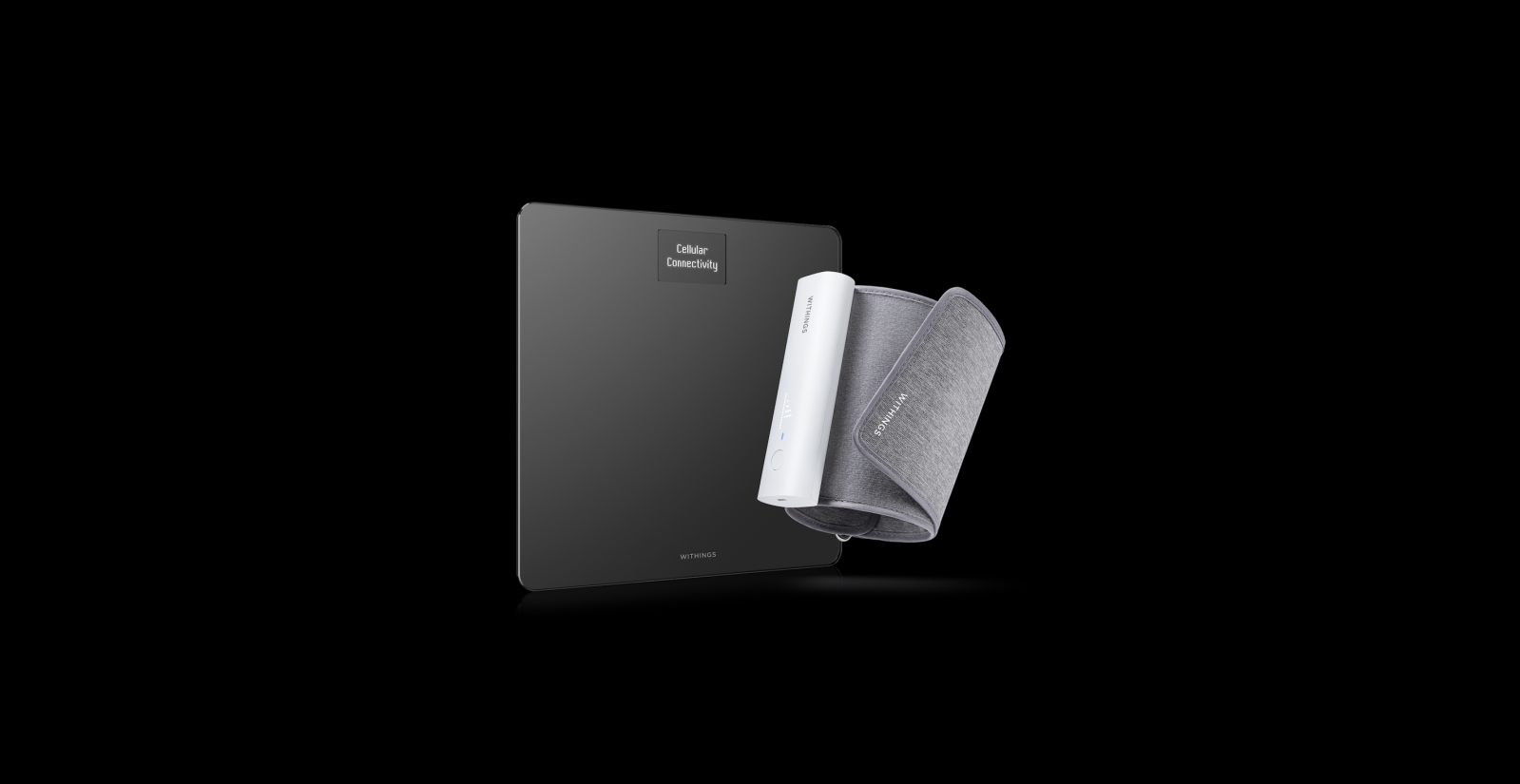
Withings has been a leader in the smart health device market for years and today the company has announced its latest releases, the Body Pro cellular smart scale and Withings BPM Connect Pro cellular blood pressure monitor. With the extra connectivity, Withings is able to offer out of the box secure transfer of patients’ data from home to health care professionals.

https://googleads.g.doubleclick.net/pagead/ads?client=ca-pub-4606108652482128&output=html&h=280&adk=466652548&adf=2529329910&w=336&fwrn=4&fwrnh=100&lmt=1614283192&rafmt=1&psa=1&format=336×280&url=https%3A%2F%2F9to5mac.com%2F2021%2F02%2F25%2Fwithings-apple-health-devices-cellular-smart-scale-blood-pressure-monitor%2F&flash=0&host=ca-host-pub-5506057612223327&fwr=0&rpe=1&resp_fmts=3&wgl=1&uach=WyJNYWMgT1MgWCIsIjEwXzExXzYiLCJ4ODYiLCIiLCI4OC4wLjQzMjQuMTgyIixbXV0.&dt=1614283191097&bpp=19&bdt=19685&idt=1716&shv=r20210224&cbv=r20190131&ptt=9&saldr=aa&abxe=1&cookie=ID%3D8ef480abdac84ea9-227e07c7b8c60054%3AT%3D1614283192%3AS%3DALNI_MbyL0km-HY19IeTJgwuJPYKoAy8ZA&prev_fmts=0x0&nras=1&correlator=7596283074693&frm=20&pv=1&ga_vid=1676181868.1614283192&ga_sid=1614283192&ga_hid=1783003524&ga_fc=0&u_tz=-480&u_his=1&u_java=0&u_h=1050&u_w=1680&u_ah=980&u_aw=1680&u_cd=24&u_nplug=3&u_nmime=4&adx=984&ady=1381&biw=1680&bih=900&scr_x=0&scr_y=0&eid=42530887%2C21067213%2C44737563%2C21068083%2C21068893%2C44734255&oid=3&pvsid=1511920080609386&pem=478&ref=https%3A%2F%2Fnews.google.com%2F&rx=0&eae=0&fc=1920&brdim=0%2C23%2C0%2C23%2C1680%2C23%2C1680%2C980%2C1680%2C900&vis=1&rsz=%7C%7ClEbr%7C&abl=CS&pfx=0&fu=8320&bc=31&ifi=2&uci=a!2&btvi=1&fsb=1&xpc=ah865K6nXa&p=https%3A//9to5mac.com&dtd=1752

The existing Withings Body smart scales and BPM blood pressure monitors feature WiFi, Bluetooth, and Apple Health functionality. And with the new Pro lineup, Withings is aiming to improve the telehealth experience for patients by including built-in cellular connectivity.

Withings announced the new Body Pro cellular smart scale and Withings BPM Connect Pro cellular blood pressure monitor that will be sold directly to health professionals in a press release:

Today, Withings, an early pioneer of the connected health revolution, takes another step to bridge the gap between patients and health professionals, unveiling a new business-to-business range of cellular-connected devices designed to eliminate significant pain points of remote patient monitoring. The Withings Body Pro cellular smart scale and Withings BPM Connect Pro cellular blood pressure monitor significantly streamline the telehealth process by working straight out of the box, requiring no setup, and automatically transmitting accurate, secure data to health professionals.

VP of the Withings B2B division, Antoine Robiliard noted the new Pro versions of these health devices with cellular is all about removing friction so that anyone can use them and health professionals get consistent access to patient data.

“For telehealth and remote patient monitoring to be successful for health professionals, they must have access to continuous, reliable and accurate at-home data that is collected, transmitted and analyzed in a frictionless, consistent manner,” said Antoine Robiliard, vice president of Withings business-to-business division, Health Solutions. “Connected health products have a central role to play. For optimal results, they must be simple for anyone to use, drive engagement, take medical-grade measurements, be consistently used by patients, and must autonomously transmit private, secure data.”

Like the standard version of these health devices, Withings notes fast and precise measurements with the Pro devices and that the new cellular integration and out of the box connectivity with health professionals is “fully HIPAA compliant.”

Another key piece of this is that health professionals may be eligible for $1,900 per patient per year that use the Withings Pro devices for “chronic care management and/or remote patient monitoring.”

For interested health professionals, learn more and get in touch with Withings about the new Pro devices on Withings’ website here.