Want to Sleep Better Tonight? A Single Bout of Cardio May Help
One 60-minute bout of cardio may improve that evening’s slow-wave sleep quality.
Posted Mar 25, 2021 | Reviewed by Jessica Schrader
THE BASICS
SUMMARY
- New research found improvements in sleep quality following an hour of vigorous exercise.
- Participants did not report a change in the quality of their sleep, despite the objective difference.
- A vigorous workout in the daytime may mean more time spent in the deepest sleep cycle.
Source: ClassicVector/Shutterstock
Even if someone who worked out vigorously during the day is unaware that they’re sleeping better that night, new research (Park et al., 2021) suggests that an hour of cardio during the day may improve deep, slow-wave sleep quality in ways that are imperceptible to the sleeper.
This peer-reviewed paper, “Exercise Improves the Quality of Slow-Wave Sleep by Increasing Slow-Wave Stability,” was recently published in the journal Scientific Reports.
“The results were surprising. We found that exercise improved the quality of sleep as measured using objective techniques, while the participants reported no change in the quality of their sleep,” lead researchers, Insung Park and Javier Díaz, said in a March 24 news release.
For this study, the University of Tsukuba researchers evaluated the effects of a single 60-minute bout of aerobic exercise (at 60 percent VO₂ Max) on subsequent sleep quality that night. Instead of using well-conditioned athletes, the researchers had untrained study participants work out for an hour at a relatively high intensity.
Because the test subjects weren’t accustomed to hour-long bouts of vigorous exercise, the researchers speculate that study participants’ self-reported sleep quality ratings may have been skewed by post-workout muscle soreness, fatigue, and other variables commonly experienced by “weekend warriors” after a hard workout. As the authors explain:
“Individuals who engage in vigorous exercise may perceive a decrease in the quality of their sleep compared with if they had not exercised at all. However, the findings of this study indicate that the sleep structure may indeed be improved by exercise and have potential application in developing new treatment recommendations for various sleep disorders.”
60 Minutes of Cardio May Promote Deeper Stage IV Sleep
From a real-world perspective, the fact that these study participants weren’t well-conditioned athletes sheds light on the possibility that even if someone doesn’t think they’re sleeping better after doing a vigorous workout in the daytime hours before bed, their post-workout sleep may include more time spent in the deepest (Stage IV) sleep cycle.
“The results of the subjective evaluations of sleep quality indicate that regular moderate exercise may be more beneficial for perceived sleep quality than occasional vigorous exercise, which might not have a subjective effect despite objective improvements in sleep,” senior author Kaspar Vogt of the University of Tsukuba’s International Institute for Integrative Sleep Medicine noted.article continues after advertisement
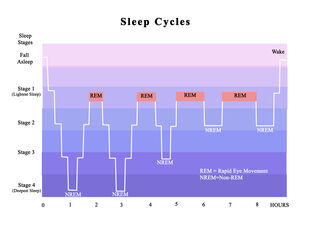
Delta waves are low frequency (1–4 Hz), slow-wave oscillations associated with the deepest level of sleep (Stage IV) that occurs during NREM cycles.Source: arka38/Shutterstock
Another thing that makes this study unique: Instead of simply using conventional EEG—which has been used to measure rapid eye movement (REM) and non-REM (NREM) sleep cycles since the 1960s—the Tsukuba researchers road-tested a novel polysomnography technique called CVE to measure slow-wave brain oscillations during various sleep cycles.
CVE is a state-of-the-art computational method for quantifying how deeply someone is sleeping based on the characteristics of their neuronal synchronization and rhythmic oscillations associated with specific brainwave-frequency bands (e.g., gamma, beta, alpha, theta, and delta).
For the study participants who performed 60 minutes of cardio at 60 percent VO₂ Max, data analysis showed “significantly increased delta power in slow-wave sleep together with increased slow-wave sleep stability in early sleep phases, based on delta wave envelope analysis.”
“Although vigorous exercise does not lead to a subjective improvement in sleep quality, sleep function is improved,” the researchers conclude. “To our knowledge, this is the first report of exercise exerting such an effect. Further investigation into the mechanisms and consequences of this increased [delta] wave stability are necessary.”
DISCLAIMER: This blog post is not intended as medical advice. Please use common sense and always consult with your primary care physician before doing any moderate-to-vigorous physical activity or high-intensity training that is not a well-established part of your weekly routine.
References
Insung Park, Javier Díaz, Sumire Matsumoto, Kaito Iwayama, Yoshiharu Nabekura, Hitomi Ogata, Momoko Kayaba, Atsushi Aoyagi, Katsuhiko Yajima, Makoto Satoh, Kumpei Tokuyama & Kaspar E. Vogt. “Exercise Improves the Quality of Slow-Wave Sleep by Increasing Slow-Wave Stability.” Scientific Reports (First published: February 24, 2021) DOI: 10.1038/s41598-021-83817-6
 Bruce's Blog