No pillow can guarantee you a good night’s sleep. The average person sleeps with 2.2 pillows, according to the National Sleep Foundation — so by that logic, if multiple pillows could somehow do the trick, we’d all be getting our eight hours per night and resting comfortably.
The truth is that the most important contribution a pillow can make to you getting a sound, relaxing sleep is to make you feel better. It probably shouldn’t come as a shock to learn that if you pick a poor pillow, one that doesn’t address your comfort the right way, you’re more likely to suffer from less restful sleep. In that case, hone in a pillow that offers every chance to deliver the comfort every sleeper needs, like this Refresh Memory Foam Pillow from Blu Sleep.496.3KApple’s App Tracking Transparency in new iOS update
The Refresh is a true Ferrari in the pillow market, a luxury bedding item engineered to address as many of the comfort and sleep logistical concerns as possible to help more people enjoy fitful slumber. It’s a truly international creation, containing Oeko-Tex certified polyurethane foam from Italy, a bamboo covering made in Canada, and infused with green tea oil native to China.
That combination makes the Refresh soft to the touch, but offers plenty of support to the head and neck, adapting to the natural shape of a sleeper’s body for a customized sleep fit. Meanwhile, the foam and cover are both designed to be extremely breathable, with ventilation holes to keep the air flowing throughout the pillow throughout the night. That same design also helps wick away moisture, so users always wake up both fresh and dry. Finally, the green tea oil helps heighten relaxation, not to mention moisturizing skin, restoring shine and smoothness to hair, and generally working as one of the world’s great anti-aging treatments.
Red blood cell hitchhiking enhances the accumulation of nano- and micro-particles in the constriction of a stenosed microvessel. Credit: Sarah Shattuck and Dr. Huilin Ye
Drugs and vaccines circulate through the vascular system reacting according to their chemical and structural nature. In some cases, they are intended to diffuse. In other cases, like cancer treatments, the intended target is highly localized. The effectiveness of a medicine —and how much is needed and the side effects it causes —are a function of how well it can reach its target.
“A lot of medicines involve intravenous injections of drug carriers,” said Ying Li, an assistant professor of mechanical engineering at the University of Connecticut. “We want them to be able to circulate and find the right place at the right time and to release the right amount of drugs to safely protect us. If you make mistakes, there can be terrible side effects.”
Li studies nanomedicines and how they can be designed to work more efficiently. Nanomedicine involves the use of nanoscale materials, such as biocompatible nanoparticles and nanorobots, for diagnosis, delivery, sensing or actuation purposes in a living organism. His work harnesses the power of supercomputers to simulate the dynamics of nanodrugs in the blood stream, design new forms of nanoparticles, and find ways to control them.
Over the last decade, with support from the National Science Foundation, Li and his team have investigated many key aspects of nanomedicines, pioneering methods to model their flow and how they interact with structures within the body.
“My research is centered on how to build high-fidelity, high-performance computing platforms to understand the complicated behaviors of these materials and the biological systems down to the nanoscale,” he said.
“I’m a 100% computational person, there’s no dirty hands,” Li said. “Because of the size of these particles, this problem is very hard to study using experiments.”
Writing in Soft Matter in January 2021, Li described the results of a study that looked at how nanoparticles of various sizes and shapes —including nanoworms—move in blood vessels of different geometries, mimicking the constricted microvasculature. Nanoworms are long, thin, engineered encapsulations of drug contents.
He determined that nanoworms can travel more efficiently through the bloodstream, passing through blockages where spherical or flat shapes get stuck.
“The nanoworm moves like a snake. It can swim between red blood cells making it easier to escape tight spots,” Li said.
Speed is of the essence—drugs must reach their destination before they are discovered and neutralized by the body’s immune system, which is always on the hunt for foreign particles.
The first nanoparticle-based treatment to be FDA approved for cancer was Doxil—a formulation of the chemotherapy agent doxorubicin. Many more are currently in development. However, a 2016 study in Nature Reviews Materials found only 0.7% of an administered nanoparticle dose is delivered to a solid tumor.
“We know that anti-cancer drug molecules are highly toxic,” Li said. “If they don’t go to the right place, they hurt a lot. We can reduce the dosage if we actively guide the delivery.”
Red blood cell hitchhiking enhances the accumulation of nano- and micro-particles in the constriction of a stenosed microvessel. Credit: Sarah Shattuck and Dr. Huilin Ye
Tailor-made shapes are one way to improve the delivery of cancer drugs. (Currently, 90% of administered nanoparticles are spherical.) Another way is to coax drugs to their target.
Li’s team has computationally modeled nanoparticles that can be manipulated with a magnetic field. In a 2018 paper in the Proceedings of the Royal Society, they showed that even a small magnetic force could nudge the nanoparticles out of the blood flow, leading to a far greater number of particles reaching the right destination.
Li’s work is powered by the Frontera supercomputer at the Texas Advanced Computing Center (TACC), the ninth fastest in the world. Li was an early user of the system when it launched in 2019, and has used Frontera continuously since then to perform a variety of simulations.
“We’re building high-fidelity computational models on Frontera to understand the transport behavior of nanoparticles and nanoworms to see how they circulate in blood flow,” Li said. His largest models are more than 1,000 micrometers long and include thousands of red blood cells, totaling billions of independent ways that the system can move.
“Advanced cyberinfrastructure resources, such as Frontera, enable researchers to experiment with novel frameworks and build innovative models that, in this example, help us understand the human circulatory system in a new way,” said Manish Parashar, Director of the NSF Office for Advanced Cyberinfrastructure. “NSF supports Frontera as part of a broader ecosystem of cyberinfrastructure investments, including software and data analytics, that push the boundaries of science to yield insights with immediate application in our lives.”
Frontera allows Li not only to run computational experiments, but also to develop a new computational framework that combines fluid dynamics and molecular dynamics.
Writing in Computer Physics Communications in 2020, he described OpenFSI: a highly efficient and portable fluid–structure simulation package based on the immersed-boundary method. The computational platform serves as a tool for the broader drug-design community and can be translated for many other engineering applications, such as additive manufacturing, chemical processing and underwater robotics.
“The current computational model covers many important processes, but the whole process is so complicated. If you consider a patient-specific vasculature network, that makes our computational model intractable,” Li said.
He is taking advantage of artificial intelligence (AI) and machine learning to serve as a high-speed vehicle for the rapid generation of new nanoparticle designs and methods. Like all AI and machine learning, this approach requires massive quantities of data. In Li’s case, the data is coming from simulations on Frontera.
“We’re currently building the training database for the machine learning aspect of our work. We ran a lot of simulations with different scenarios to get broad training data,” Li explained. “Then, we can pre-train the neural network using the hypothetical data we take from these simulations so they can quickly and efficiently predict the effects.”
Li’s typical simulations use 500 to 600 processors, though some aspects of the research requires up to 9,000 processors computing in parallel. “My research productivity is correlated with the speed of the system I use. Frontera has been fantastic.”
When people picture medical research, they typically think of lab experiments or drug trials, but there are limitations to this type of work, whether economic or physical, Li said.
“The computational approach is getting more powerful and more predictive,” he said. “We should take advantage of computational simulations before we run very expensive experiments to rationalize the problem and provide better guidance.”
NASA’s Mars helicopter Ingenuity (lower right, photographed by the Perseverance rover) didn’t get off the ground as planned on April 29, 2021. (Image credit: NASA/JPL-Caltech)
NASA’s Mars helicopter Ingenuity was supposed to get a real workout this morning (April 29), but things didn’t go as planned.
The 4-lb. (1.8 kilograms) chopper was scheduled to lift off from the floor of Mars’ Jezero Crater today around 10:12 a.m. EDT (1412 GMT), kicking off its fourth flight on the Red Planet. That didn’t happen.
“Aim high, and fly, fly again. The #MarsHelicopter’s ambitious fourth flight didn’t get off the ground, but the team is assessing the data and will aim to try again soon. We’ll keep you posted,” NASA’s Jet Propulsion Laboratory in Southern California, which manages Ingenuity’s technology-demonstrating mission, said via Twitter today.
Tests here on Earth suggested that fix would be effective about 85% of the time, Ingenuity team members said. It’s possible that the same issue cropped up today, and the latest attempt just fell into the unlucky 15% slot. But we’ll have to wait until Ingenuity’s handlers have performed the requisite analyses to find out more.
Ingenuity landed with NASA’s Perseverance rover on Feb. 18 inside the 28-mile-wide (45 kilometers) Jezero, which hosted a big lake and a river delta in the ancient past.
Ingenuity deployed from Perseverance’s belly on April 3 and began prepping for its flight campaign, which is designed to show that aerial exploration is possible on Mars.
The helicopter has performed three flights to date, one apiece on April 19, April 22 and April 25. Those sorties have gotten increasingly ambitious, with the solar-powered chopper traveling 330 feet (100 meters) at a top speed of 4.5 mph (7.2 kph) during April 25’s 80-second flight.
The fourth flight was designed to push those boundaries even more. Today’s plan called for Ingenuity to cover about 872 feet (266 m) of ground and reach a top speed of 8 mph (13 kph) while staying aloft for 117 seconds, NASA officials said.
Ingenuity’s flight window is coming to an end. The campaign is capped at five flights over a one-month stretch from the April 3 deployment date, because Perseverance needs to start focusing on its own mission, which involves hunting for signs of long-gone Mars life and collecting samples for future return to Earth.
(Perseverance has been documenting and supporting Ingenuity’s work; for example, communications to and from the helicopter must go through the rover.)
It’s unclear at this point if Ingenuity will be able to squeeze five flights in before its time is up, but the helicopter team members have said they will do their best to make that happen.
‘A.rtificial I.mmortality’ review: Doc explores idea of eternal life through technology
ByChris Jancelewicz Global NewsPosted April 28, 2021 5:00 am Updated April 27, 2021 9:54 amhttps://www.youtube.com/embed/U1d9zQC7reU?start=2&feature=oembed&rel=0&autoplay=1WATCH: ‘A.rtificial I.mmortality’ trailer
Descrease article font size-AIncrease article font sizeA+
Have you ever thought about living forever? Failing that, how about storing your memories and life experiences into a hard drive and then uploading them so future generations in your family can know you more intimately?
These are just two of the (very, very deep) questions Toronto documentary filmmaker Ann Shin explores in her latest movie, A.rtificial I.mmortality, which is playing on opening night at the all-virtual 2021 Hot Docs Documentary Film Festival.
Inspired by the aging of her father — currently in a care facility suffering from dementia — Shin found herself at a loss when trying to press him for information about her deceased mother, or how it felt for her parents when they were starting their family. There were huge gaps in her own personal history, and she didn’t want that same misfortune to befall her own children, so she set out to see what options exist. Was it possible to keep a little piece of her father, along with his memories and experiences, forever? What about herself? Could she live on into infinity?STORY CONTINUES BELOW ADVERTISEMENThttps://0364c1105b72fbd2221e63ac2e9a9b0e.safeframe.googlesyndication.com/safeframe/1-0-38/html/container.html
“When my father developed dementia, I realized we were losing him in bits and pieces,” Shin says. “I wondered, what if we had captured his memories in an AI clone before his memory started going? What would it be like for us all to have AI clones — a way for us to be part of our families’ lives even after we die?”
Ann Shin animates the face of her avatar during a facial mapping session. Stephen Chung/Fathom Film Group
Shin found many options out there, some of them advanced beyond our wildest sci-fi dreams.
From pseudo-religious movements like transhumanism to wholly technological developments like Singularity.net, there are many avenues to take for those seeking to preserve their minds and memories.
Indian-American author and alternative medicine guru Deepak Chopra is featured and interviewed in A.rtificial I.mmortality, and we’re introduced to a “digital Deepak.” Chopra is in the midst of having his own “A.I. mind twin” created; that is, his memories, mannerisms and his essence of “being” are transferred into a “mind file” and embedded in his digital self for people to access once he’s dead and gone. (Yes, there’s even an app for that.)STORY CONTINUES BELOW ADVERTISEMENT
In a nutshell, Chopra is trying to ensure that he and his teachings will never really die. While it’s hard to deny the possibilities of this method of extending existence, there’s something inherently creepy and unnatural about it.
Along her cinematic journey, Shin encounters many androids and human-like robots — machinery implanted or infused with human controls or memories. Despite how “cool” they are, or futuristic-looking, the filmmaker almost always recoils when she reaches out to touch them. One handshake is particularly disturbing to Shin, knowing that the robot extending its human-resembling hand is doing so based on its own “memory” of what to do in certain situations.
Even Digital Deepak doesn’t really seem like the real-life Chopra. Something in the avatar’s shiny eyes is off-putting, even disturbing.
Chopra is not the only one, not by a long shot. Shin explores the phenomenon of searching for eternity, and there is no shortage of technological geniuses out there looking for the answer. And these are the ones we know about.
Among others, CEOs like Martine Rothblatt, inventor of Sirius XM, is developing Bina 48, a clone AI robot of her real-life wife, Bina, and director of the Intelligent Robotics Laboratory Hiroshi Ishiguro is developing his own uncannily realistic clone, Geminoid. (In some instances, audiences couldn’t tell the two apart, they’re that much alike.)STORY CONTINUES BELOW ADVERTISEMENT
The child robot, Ibuki, takes a walk at Osaka University. Iris Ng/Fathom Film Group
“Visions of the apocalypse have haunted us through millennia. In the past, we turned to God for the promise of salvation and eternal life, but in the 21st century we live in the digital realm and look to technology for the answers,” Shin says. “As we develop more powerful AI systems, are we creating an AI supreme being in our own likeness? What happens if the creation outsmarts the creator?”
A.rtificial I.mmortality does its best to answer these questions, but because of the philosophical complexity of the subject matter and each person’s diverse take on the topic, there can never be one “correct” viewpoint.
Juxtaposed with shots of space and computer code, the movie at once understands both the beauty and enormity of the possibilities. Maybe one day we’ll have vast hard drives filled with virtual versions of our loved ones, easily accessible with the push of a button. For now, we’ll just have to be satisfied with the idea of it, and wait for the technology to catch up with the dream.
What’s the Absolute Minimum of Exercise I Can Do For Better Sleep?
Everyone is different, but here is how to get started with figuring it out.By Casey Johnston28.4.21
SHARE
TWEET
Snap
Sick of clean eating, perfect gym outfits, and chiseled abs? A Swole Woman is here to help you be healthy, enjoy carbs, and get jacked.SEE MORE →
Hi Swole Woman!! I respect what you’re doing with the lifting at all, but here is the thing—I hate working out, it’s the worst part of my day any time I do it, even if, as you say, it’s pretty short. I’m willing to do it, but here is the thing—I just want to work out enough in order to help me sleep.
I have chronic insomnia that always has me waking up in the middle of the night, and sometimes makes it hard for me to get to sleep in the first place. To make the problem worse, as a result of sleeping badly, I feel incredibly tired all day, too tired to work out. But then sleeping time rolls around, and I can’t fucking sleep!!ADVERTISEMENT
I feel like I have tried everything, including medication, and even my doctor is suggesting trying to work out. I really, really don’t want to, but so here is my question: What is the absolute minimum amount of working out I can do that will help me sleep? That is all I want; I don’t want to be more attractive, I don’t want to be stronger, I don’t want to eat more; I just want to go back to sleeping through the night like I did when I was a kid and not feeling terrible all day as a result of sleeping like ass. Any help you can provide, I would super appreciate. —Up All Night, Might Sleep All Day
It’s time for me to come clean: I should not have wished on the monkey’s paw for an opportunity to find out how badly I’d sleep if I never had to leave my house or really move from my couch ever again. Instead, we’ve had a year where that was basically the luckiest and most fortunate possible outcome. My upfront findings from this experiment were that I sleep like garbage and am even in physical pain at night when I don’t work out at all. On those nights, when I’m lying wide awake at 4 a.m., my hips actively hurting, I remember when I was in high school and doing sports practice three hours a day and slept like clockwork every night from 9 p.m. to 6 a.m. And I know, intellectually at least, I can be mad all I want that I can’t sleep, but it’s not actually that deep or confounding of a problem.ADVERTISEMENT
There are infinite memes out there about our general resistance to basic caretaking and life improvement tasks that go something like:
Me: Why am I depressed and in pain
My body: Go for a walk. Go to sleep before 4am. Eat one vegetable. Talk to a therapist
Me: I guess we’ll never know
We are all on board, again, at least intellectually, with the idea that exercise has lots of benefits that outweigh whatever the costs are, even if it’s not a cure-all. More specifically, we want to be just physically tired enough, and mobile enough that we’re not climbing into bed feeling like a gnarled tree cursed by a witch. So then we are left with the questions of “how do I even begin to do that,” which I answer more thoroughly in my column about motivation, and “how much,” which is trickier to answer.Health
We can start with the basic health guidelines for exercise, which are a little opaque but a decent jumping-off point: the U.S. Department of Health and Human Services recommends 150 minutes of “moderate-intensity” activity per week (one example it gives is “brisk walking”) or 75 minutes of “vigorous intensity” activity per week (“jogging or running”) or any combo thereof that would add up accordingly, plus muscle-building activities “on 2 or more days a week that work all major muscle groups.” Yes; the authorities say do strength training, but are painfully non-specific about how much or for how long. They are clear that it doesn’t count toward the 150 or 75 minutes.
So that is actually quite a lot of exercise; two days of strength training, even for 20 minutes, plus let’s say three 25-minute jogging sessions, for a total of just under two hours a week. In 2018, only 23 percent of people were actually exercising this much, so if you’re not, you’re in the majority. You might say, hold on, I was asking for the bare minimum and this sounds like a lot. Our government can be a pretty bare-minimum kind of regulator. The “recommended daily allowance” for protein intake, for instance, sounds like it would be an overshoot, but is actually a floor, the very smallest amount required. I’m not sure that this is also true of its recommended amounts of exercise, but the guidelines also say that even more exercise would be better.ADVERTISEMENT
But you are not totally out of luck in terms of apathy just yet, because there is the factor of your personal biology. Health
One way that I like to think about the general synergy of activity with our well-being is to consider dogs. Dogs come in all manner of energy levels: There are the little roly-poly ones people push around in carriages more than they walk them; there are the high-energy ones that will whine and tear your house apart unless they get no fewer than two straight hours of sprinting per day on open farmland; there are lots of kinds of dogs in between. (It feels worth noting that there are no dogs, to my knowledge, where a vet would say, “don’t walk this one. Best to keep it inside and as immobile as possible.”) While people are not dogs, people and dogs are alike enough animals that I feel comfortable saying we can probably apply a similar activity-needs spectrum for people.
Do you have a question about working out, eating, health, or why you shouldn’t be afraid of lifting heavy weights? Know of a health trend you want Casey to try? Send it toswole.woman@vice.comand follow @swolewoman on Instagram.
There is also the question of “current fitness level.” Even the sprinting farm dog could be tired out from a few minutes of sprinting if it were somehow prevented from doing its sprinting for months or years at a time. But as it adapts with more exercise, the 15 minutes might have once worked to tucker him out won’t cut it. Probably most people don’t need tons and tons of exercise to reach a balance, but if you’ve ever gone, “I tried walking 20 minutes five times a week and it didn’t do shit for me,” or “it did shit for me but then my sleep problems came back after a couple weeks,” you might have greater exercise needs than an hour and a half of strolling per week can fulfill.
Taking all of this together would mean that we each have individual, potentially moving targets to hit, in terms of exercise: you have a certain amount that you need, and if you’re not working out at all currently, it might take some time to find your personal threshold for what your own set of “healthy habits” is.Health
So how do you figure it out where you are on the dog-energy spectrum? As friend of the column Jon Gabrus of High and Mighty would say: you titrate.
You may remember “titration” from middle-school chemistry class, but outside of chemistry class, “to titrate” generally means “continuously measure and adjust the balance of.” In chemistry practice this means, if you are trying to create a salt-water solution, you don’t start by dumping a barrel of salt on top of a glass of water. You add a little bit of salt, measure the saltiness of the water, add a little bit more, measure, and so on, until you have water that is salty in the way that works for whatever it is you needed salt water for. In other words, you try an incremental amount of something, measure the results, and repeat until you find something that works. https://oembed.vice.com/au0QHoS?app=1
In personal terms, in the same way you would not back up a salt truck to a thimble of water to make a salt solution, you don’t begin the process of integrating working out into your life by going from nothing to three hours of Peloton classes twice a day. This is for two reasons: 1), it is obviously overkill in the sense of you are in no shape to be doing that, and 2), it’s almost certainly way more than you need ultimately unless you really missed your calling as an Olympic athlete, and you will probably get tired and burned out, no matter how fun and friendly the Peloton instructor seems at first.
So start slow! Go for some walks, maybe try a couple of gentle fitness classes per week, and then keep track of how you sleep. If you don’t have some sort of tracking device for this, start a notebook or other document where you can keep track of your sleep and workouts and see how they fit together. You’re doing a little experiment on yourself. If you find something that works for you, stick with it; if it seems to stop working, consider where you’re at in terms of the recommended amount and types of exercise and see if you can stand to bump it up. You might find like two hours of walking a week really does it for you, or you might find that it does nothing, but you won’t know unless you start to keep track.ADVERTISEMENT
I want to add one more note on the dimension of intensity, which the exercise guidelines sort of get at but in such a vague way I would not blame anyone for being confused and just sort of glossing over it. But basically, workout intensity can do two things: it can help keep your workouts shorter, and it will probably make you a different kind of tired than strictly less-intense exercise. For instance, if you were on an all-walking regimen but needed to walk like 10 hours a week to tire yourself out enough physically, you might convert an hour of that walking to something more intense, like lifting weights, and find that then you only need five, or three, or two total hours of working out. Health
Lifting weights is meaningfully different from cardio in that it builds and maintains muscle, which we need for lots of reasons. It does not make me feel wonderful, exactly, to agree with the government on something, but lifting truly does not get a fair shake in the grand scheme of workouts: it makes them overall faster and you get more health bang for your time buck. I’m over the walking hegemony, frankly; yes it does more than anything at all, but almost anything else does more than walking.
So maybe shoot for two total hours a week of working out in the longer run, even if some of it is just walking, as long as you get two days a week of lifting. It sounds like a lot, but two hours is one percent of your whole week. If you can get by with less, great! But if you’re doing less and not sleeping great still, it might be time to play around with the intensity and time commitment.
I know you hate working out and feel like it’s undignified. The first few times can feel mortifying even if nothing specifically bad happens; it took me a very long time to get used to the idea of having to wave at people driving by in cars when I was getting into running, or having to ask someone when they would be done with a squat rack so I could use it next (a very normal-to-the-gym but alien-to-me-at-the-time interaction). But I swear, like anything new, you will get used to both the logistics and personal feelings of awkwardness, if you just give yourself space to get over that initial hurdle. And I can confirm, it’s totally worth it for a good night’s sleep.
Disclaimer: Casey Johnston is not a doctor, nutritionist, dietitian, personal trainer, physiotherapist, psychotherapist, doctor, or lawyer; she is simply someone who has done a lot of, and read a lot about, lifting weights.
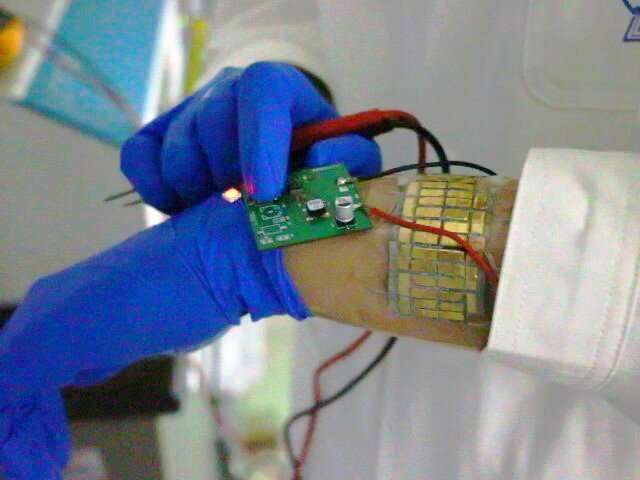
A person wearing the self-powered electric system composed of a TEG band and an LED. Credit: Yijie Liu
Scientists in China have developed a small, flexible device that can convert heat emitted from human skin to electrical power. In their research, presented April 29 in the journal Cell Reports Physical Science, the team showed that the device could power an LED light in real time when worn on a wristband. The findings suggest that body temperature could someday power wearable electronics such as fitness trackers.
The device is a thermoelectric generator (TEG) that uses temperature gradients to generate power. In this design, researchers use the difference between the warmer body temperature and the relatively cooler ambient environment to generate power.
“This is a field with great potential,” says corresponding author Qian Zhang of Harbin Institute of Technology, Shenzhen. “TEGs can recover energy that’s lost as waste heat and thus improve the rate of power utilization.”
Unlike traditional generators that use the energy of motion to produce power, thermoelectric generators have no moving parts, making them essentially maintenance free. These generators are installed on machines located in remote areas and on board space probes to supply energy.
Zhang and her colleagues have been working on designing thermoelectric generators for years. With wearable devices becoming increasingly popular in recent years, the team wanted to explore whether these reliable generators could replace traditional battery in these devices, including fitness trackers, smart watches, and biosensors.
“Don’t underestimate the temperature differences between our body and the environment—it’s small, but our experiment shows it can still generate power,” she says.Play00:0000:17MuteSettingsPIPEnter fullscreenPlayThe flexible TEG wristband converts heat emitted by skin into electric power and light up an LED. Credit: Yijie Liu
Conventional TEGs are usually rigid and can only withstand fewer than 200 instances of bending. Although the flexible kinds can meet the bending requirement, their performance tends to be inadequate. To overcome this limitation and make the device more adaptable to wearables, researchers attached the core electrical components to a stretchable and more adhesive polyurethane material. Tests showed that the device survived at least 10,000 instances of repeated bending without significant changes in performance.
Researchers designed a prototype of a self-powered electronic system. They connected an LED to a TEG band measuring 4.5 in long and 1.1 in wide. Then, the team wrapped the TEG band around the wrist of someone whose body temperature measured at 92.9 F in ambient environmental conditions. With a temperature difference, the generator harvested heat given off from the skin and successfully lit up the LED.
“Our prototype already has good performance if it’s introduced to the market,” says corresponding author Feng Cao of Harbin Institute of Technology, Shenzhen. He adds that with the proper voltage converter, the system can power electronics such as smart watches and pulse sensors.
Looking forward, the team plans to further improve the design so the device can absorb heat more efficiently.
“There’s an increasing demand for greener energy, and TEGs fit right in, for they can turn wasted heat into power,” Cao says. “While, for example, solar energy can only be generated when there’s sun, TEGs can produce power in many scenarios—as long as there’s a temperature difference.”
The Tesla Cybertruck might look like it was designed by someone who is at war with curves, but its sharp angles certainly make for an interesting vehicle. Poised like a furious triangle, its front and back strip lights add to the aggressive stance of this new pickup-meets-luxury truck.
At the rear is that truck bed which is accessed, at least in the concept car, with a folding tailgate that contains a ramp. That makes for an interesting proposition for everyone from farmers though to families that want to take a quad bike out for some sand dune racing.
Inside is the traditional Tesla minimalism that allows for six people to travel, with all the latest technology to make the journey as pleasant as possible. There’s a lot more to the Cybertruck than almost anything on the road, so here’s everything you need to know about this very unique EV. RECOMMENDED VIDEOS FOR YOU…CLOSEhttps://imasdk.googleapis.com/js/core/bridge3.453.0_en.html#goog_91430807Volume 0% PLAY SOUNDThis video file cannot be played.(Error Code: 232001)
Tesla Cybertruck price and release date
Tesla Cybertruck may have accessories that allow the rear bed to be used for all sorts of activities (Image credit: Tesla Cybertruck)
Tesla says that production on the Cybertruck would start later on in 2021. Customers ordering now will be able to complete their configurations nearer to the start of production. The company also says that the cheaper, rear-wheel drive model will only be available in late 2022.
It’s currently unclear whether Tesla will stick to that schedule and the company may have other obstacles to clear before it’s ready to start production. For one, could it fall foul of pedestrian safety rules with its sharp, angular design?
According to tesla.com the price for the Cybertruck will start at $39,900 for the single motor rear-wheel drive model. The dual motor all-wheel model will cost $49,900 and the three motor all-wheel drive car will cost $69,900. All models can be reserved now for a $100 refundable deposit.
Anyone wanting Tesla’s autopilot feature will need to pay an additional $10,000 when they buy their truck.
The Cybertruck is supposed to be heading to the UK to but questions remain over its arrival here. You can certainly order one already, but stricter rules about pedestrian safety might cause some problems.
Tesla Cybertruck design
(Image credit: Tesla)
The one thing you can’t accuse the Cybertruck of is a lack of individuality.
The vehicle’s approach to materials is a little different than most cars or trucks on the road. It uses what Tesla described as ultra-hard 30x cold-rolled stainless steel. This is formed into an exoskeleton, which the company says is just about the hardest thing it could find.
However, Elon Musk was involved in a Twitter exchange around the materials being used. In response to an article on SpaceX’s Starship Musk responded, saying, “We’re rapidly changing alloy constituents & forming methods, so traditional names like 304L will become more of an approximation.” He was then asked if that included the Cybertruck, to which he replied simply “yes”.
Musk also said that the final Cybertruck would be around 3% smaller than the prototype shown at the launch event. Presumably the company will also have done some work on its smash resistant glass, which was famously smashed by a large ball bearing during the event.
Tesla Cybertruck interior
(Image credit: Tesla)
Early previews of the interior show a very Tesla look. There’s seating for up to six people, three in the front and bench seating in the back for another three. The new steering wheel is present, offering an almost aircraft yoke design, and there’s a modest screen mounted centrally in a marble-effect dash. It’s a very simple, very functional design that hides a lot of the technology involved in making the Cybertruck work.
Tesla Cybertruck battery and range
The range of the Cybertruck will vary depending on which model you buy. The single motor RWD model claims a range of more than 250 miles, according to Tesla. The dual motor will do 300 miles and the three motor model 500 miles.Advertisementhttps://457f805b04f6ae89c41a6a5729d3905e.safeframe.googlesyndication.com/safeframe/1-0-38/html/container.html
It’s not clear yet what capacity the cells in the Cybertruck will be. However, it’s important to note that Elon Musk has stated that new technologies would be used in the Tesla Semi, Roadster and Cybertruck. Production, he said, would not be high-volume until 2022.
But this does match Tesla’s quest to improve battery technology. New spiral batteries promise 16% more range and six times the power of the existing cells. There’s also a price reduction here that should see the cost of cells decrease quite substantially. Tesla’s long term goal of the $25,000 low-cost electric car hinges on this becoming a reality.
Tesla Cybertruck performance
(Image credit: Tesla)
Tesla says the single motor Cybertruck will go from zero to 60 mph in under 6.5 seconds. That might seem slow by Tesla standards, but try that in a factory fresh Ford F150 and you’ll realise how impressive it is.
The dual motor car manages the 0-60 sprint in 4.5 seconds, and the three-motor variant can do it in 2.9 seconds. That’s all fantastically quick for a large vehicle that can tow weights ranging from 7,500 lbs with the single motor, 10,000 lbs for the dual and 14,000 lbs for the triple motor setup.
Tesla Cybertruck outlook
(Image credit: Tesla)
The Cybertruck is likely to be automotive gold for Tesla. For one thing, the price is pretty reasonable. If you were speccing up a Ford F150 you’d spend between $36,000 and $70,000 depending on the options. That means for many people the Tesla is going to be an affordable option, especially since you won’t be paying for fuel.
What’s more, the radical design of Cybertruck means that it’s gathering interest from people who wouldn’t usually even consider a truck. Sure, it’s practical, but it’s also designed to be comfortable and eye-catching. Everyone from farmers to TikTok creators are going to be keen to have this truck on their driveway.
Deep Bandivadekar does not work for, consult, own shares in or receive funding from any company or organisation that would benefit from this article, and has disclosed no relevant affiliations beyond their academic appointment.
More recently Nasa landed the biggest-ever rover on Mars and its companion, an ingenious helicopter, both of which have been setting new milestones since.
The next visitor to the planet will be Tianwen-1 mission’s lander, which will attempt to reach the surface of the Mars in mid-May. To enter the Martian atmosphere, it will use a slightly different technique to previous missions.
Landing on Mars is notoriously dangerous – more missions have failed than succeeded. A successful Mars landing requires entering the atmosphere at very high speeds, then slowing the spacecraft down just the right way as it approaches its landing location.
Read news coverage based on evidence, not alarm.
Get newsletter
This phase of the mission, known as entry-descent-landing, is the most critical. Previous missions have used several different ways of Martian atmospheric entry.
Perfecting entry to Mars’s atmosphere has been helped by the experience of returning spacecraft to Earth. Earth may have a significantly different atmosphere to Mars, but the principles remain the same.
A spacecraft orbiting a planet will be moving very fast, to keep itself bound to that orbit. But if the spacecraft entered an atmosphere at such high speed, even one as thin as Mars’s, it would burn up. Anything entering the atmosphere needs to be slowed down significantly and to get rid of the heat generated during this brief journey. There are several ways to go about it.
Spacecraft are protected from the heat generated during atmospheric entry using heat shields. Various missions in the past have used techniques such as absorbing heat, an insulating coating, reflecting the heat back into atmosphere or by ablation – burning up the shield material.
From Apollo missions of 1960s to the more recent SpaceX’s Dragon, these techniques have been used successfully, and they work really well for Earth. But when it comes to Mars, engineers need to employ some additional measures.
Landing on Mars
Orbiters are designed to monitor a planet’s surface from the orbit and act as a communications relay station. When approaching a planet, the spacecraft is usually directed along successively smaller elliptical orbits, slowing down each time, until it reaches its target orbit. This technique can also be used to lower the orbit of a spacecraft ahead of a lander’s atmospheric entry.
The entire manoeuvre occurs over a few months and doesn’t need any additional equipment – an efficient way to conserve fuel. Since it uses the planet’s upper atmosphere to apply brakes, it’s called as aerobraking. Aerobraking has been used for various Mars missions including ExoMars Trace Gas Orbiter and the Mars Reconnaissance Orbiter.
Aerobraking can significantly slow down the spacecraft, but for missions with rovers to land it gets more complicated. On Mars, the atmospheric density is just 1% of Earth and there are no oceans for the spacecraft to safely splash into. The blunt shape of the spacecraft alone is not enough to reduce the speed.
Previously, successful missions have used extra measures. Mars Pathfinder spacecraft used parachutes to decelerate, while relying on a unique airbag system that sprung into action in the final few seconds to absorb the landing shock. The Spirit and Opportunity rovers landed successfully on Mars with the same technique.
A few years later, Curiosity rover used a new landing system. In the final few seconds, rockets were fired, allowing the spacecraft to hover while a tether – a skycrane – lowered the rover to the dusty Martian surface. This new system demonstrated delivery of a heavy payload to Mars and paved the way for bigger missions.
More recently, the Perseverance rover which landed in early 2021, used the the reliable skycrane as well as two more advanced technologies. These new features which used live images taken from its cameras enabled a more accurate, reliable and safer landing.
Zhurong: the ‘fire-god’
The Chinese Tianwen-1 rover landing is the next Mars mission. The ambitious mission has orbiting, landing and roving components – the first mission to include all three on its first attempt. It has already been circling the red planet since it entered Mars’s orbit on February 24 and will attempt to land its rover Zhurong – which means “fire god” – in mid May.
In size, Zhurong falls between Spirit and the Perseverence and it is carrying six pieces of scientific equipment. After landing, Zhurong will survey the surroundings to study Martian soil, geomorphology and atmosphere, and will look for signs of subsurface water ice.
Traditionally, the Chinese authorities don’t reveal a lot of information before the event. However, based on an early overview of the mission by some Chinese researchers, we know the landing sequence the spacecraft will attempt to follow.
On May 17, Zhurong – protected by an aeroshell (a protective shell surrounding the spacecraft which includes the heat shield) – will enter the atmosphere at a speed of 4 km/s. When it slows down enough, parachutes will be deployed. In the last phase of the sequence, rockets with variable thrust engines will be used for further deceleration.
In contrast with its American counterpart, Tianwen-1 will employ two reliable technologies – a laser range finder to work out where it is relative to Martian terrain and a microwave sensor to determine its speed more accurately. These will be used for navigational correction during its parachuted descent phase. During the powered descent phase at the end, optical and Lidar imaging will assist in hazard detection.
Just before touchdown, an automated obstacle avoidance sequence will begin for soft landing. If the mission is successful, China will be the first country to land a rover on Mars in its first attempt. A few days after that, Zhurong will be ready to explore the surface.













 We believe in the free flow of information
 Bruce's Blog