Vagus nerve stimulation (VNS) is a drug-free treatment for various disorders, neurological ailments, and inflammatory diseases.
VNS is FDA-approved to treat bipolar disorder, cluster headaches, epilepsy, migraines, and treatment-resistant depression.
When the vagus nerve is electrically stimulated, vagal-evoked potentials (VEPs) can be observed in the cerebral cortex.
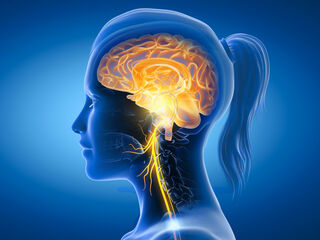
Illustration showing brain and active vagus nerve (tenth cranial nerve or CN X)Source: Axel_Kock/Shutterstock
New research in freely behaving macaque monkeys suggests that cortical responses to vagus nerve stimulation (VNS) are modulated by changes in brain states during sleep and wakefulness. These findings (Rembado et al., 2021) were published on June 21 in the peer-reviewed journal Cerebral Cortex.
For this Feinstein Institutes study led by Stavros Zanos, the researchers focused on how various intensities of vagus nerve stimulation affected different cortical areas during four brain states and activity levels: Active wakefulness, resting (sedentary) while awake, rapid eye movement sleep (REM), and non-REM sleep.
“Our findings suggest that ongoing brain state modulates the evoked effects of VNS on cortical activity,” the authors write in the paper’s abstract. “This has implications for the role of ongoing cortical activity and brain state in shaping cortical responses to peripheral stimuli, for the modulation of vagal interoceptive signaling by cortical activity, and for the dose calibration of VNS therapies.”
Vagus Nerve Stimulation Is an Effective (Albeit Mysterious) Non-Pharmacological Treatment
Although scientists still aren’t 100 percent certain how VNS actually works, accumulating evidence suggests that stimulating the vagus nerve activates vagal-evoked potentials (VEPs), which are thought to be transmitted via ascending cholinergic (acetylcholine) and noradrenergic (noradrenaline) neurotransmitter systems. However, whether or not VEPs are modulated by the waking or sleeping state of the nonhuman primate brain at the time of stimulation wasn’t known until now.
For this study, Zanos and colleagues from the Feinstein Institutes and the University of Washington delivered five pulses of VNS to the left cervical vagus nerve at frequencies ranging from 5-300 Hz while they were also recording local field potentials (LFPs) from cortical areas in contralateral prefrontal, sensorimotor, and parietal region of the cerebral cortex.
“Brain states were inferred from spectral components of LFPs and the presence of overt movement: active awake, resting awake, REM sleep, and NREM sleep,” the authors explain.
Vagus nerve stimulation elicited vagal-evoked potential in all of the sampled cortical areas. Notably, about 70-250 milliseconds after VNS, the magnitude of VEPs was largest during brain states associated with non-rapid eye movement sleep and smallest during wakefulness.article continues after advertisement
Pinpointing How VNS Works Differently Depending on Brain States Will Help Fine-Tune Treatments
These findings suggest that how VNS affects cortical functions may be modulated by the brain’s state of consciousness at the exact moment electric stimulus is delivered to the vagus nerve.
As the authors explain in a June 22 news release: “This has implications about the interoceptive functions of the vagus nerve: sensory stimuli from peripheral organs may be received differently by the brain at different times of day. It also suggests that VEPs can be used as markers of engagement of vagal fibers to observe and tailor VNS treatment in individual patients.”
In addition to their latest (2021) findings, Zanos and colleagues (Chang et al., 2020) recently developed a noninvasive way to monitor precisely which vagus nerve fibers are being stimulated during VNS and how electric stimulation of individual A, B, and C vagal fibers affects breathing, heart rate, and neck muscles. Earlier this year, they also unveiled a long-term VNS implant that successfully modulates heart rate and inflammatory proteins in mice.
“The brain monitors and controls healthy organ function because it receives and processes information in the vagus nerve,” Kevin Tracey, president and CEO of the Feinstein Institutes for Medical Research, noted. “Dr. Zanos’ important research sheds light on how the brain processes these signals and offers new clues into how to advance bioelectronic medicine,” he concluded.
References
Irene Rembado, Weiguo Song, David K. Su, Ariel Levari, Larry E. Shupe, Steve Perlmutter, Eberhard Fetz, Stavros Zanos. “Cortical Responses to Vagus Nerve Stimulation Are Modulated by Brain State in Nonhuman Primates.” Cerebral Cortex (First published: June 21, 2021) DOI: 10.1093/cercor/bhab158
Ibrahim T Mughrabi, Jordan Hickman, Naveen Jayaprakash, Dane Thompson, Umair Ahmed, Eleni S Papadoyannis, Yao-Chuan Chang, Adam Abbas, Timir Datta-Chaudhuri, Eric H Chang, Theodoros P Zanos, Sunhee C Lee, Robert C Froemke, Kevin J Tracey, Cristin Welle Is a corresponding author, Yousef Al-Abed, Stavros Zanos. “Development and Characterization of a Chronic Implant Mouse Model for Vagus Nerve Stimulation.” eLife (First published: April 06, 2021) DOI: 10.7554/eLife.61270
Yao-Chuan Chang, Marina Cracchiolo, Umair Ahmed, Ibrahim Mughrabi, Arielle Gabalski, Anna Daytz, Loren Rieth, Lance Becker, Timir Datta-Chaudhuri, Yousef Al-Abed, Theodoros P. Zanos, Stavros Zanos. “Quantitative Estimation of Nerve Fiber Engagement by Vagus Nerve Stimulation Using Physiological Markers.” Brain Stimulation (First available online: September 18, 2020) DOI: 10.1016/j.brs.2020.09.002
Descrease article font size-AIncrease article font sizeA+
When the SKUs appeared for Lorde’s Solar Power album, her first record in four years, something was missing. There was a number for a digital download, another for something called a “Music Box” (more on that in a minute), and a vinyl version. There was no mention of a compact disc edition of the album. And for good reason: There won’t be one.
Lorde (well, her label, if we’re honest) is positioning the absence of a CD for Solar Power as an eco-friendly move, a way to distribute music in a more plastic-free way. While fans pining something physical to purchase can always buy the high-margin vinyl, they’ll also be offered the Music Box edition, a cardboard box containing handwritten notes, exclusive photos, extra visual content (whatever that means), and a download code for a high-quality digital (lossless? almost certainly) version of the record.
The download in the Music Box will come with two tracks not available anywhere else along with “some special surprises.” The plan has already met with much approval from organizations that want us to reduce our dependency on plastic. And it’s meant to assuage bricks-and-mortar record stores who need something in lieu of a CD to put on the shelves.
Let’s think about this for a moment: A major-label release from a globally famous artist that will not be available on CD. Is this a sign of things to come? I’d bet on it.
How times have changed. When CDs first appeared in the marketplace in the spring of 1983, they were positioned as vinyl killers: better sound, totally indestructible (they weren’t, but never mind), and more portable (well, eventually). The technology was also pitched as a way for the recorded music industry to dig out of the horrible recession that plagued the world at the beginning of the 1980s.3:37What’s Streaming June 2021What’s Streaming June 2021 – Jun 6, 2021
After some initial reticence, the industry bought in. And so did the general public, largely because the physical quality of vinyl records in the early ’80s had reached a nadir. The use of recycled vinyl, a consequence of the oil crises of the 1970s, resulted in thinner records with shallower grooves incapable of storing as much information (especially bass) as LPs released prior to 1974. They scratched easily and were prone to skipping. Plus, the recycled vinyl contained impurities that affected the overall sound.STORY CONTINUES BELOW ADVERTISEMENT
When CDs appeared, we couldn’t wait to dump vinyl, even if it meant repurchasing our music libraries at prices substantially more than what we paid for the original vinyl records.
Then along came Napster and its file-sharing brethren. Apple then rode to the rescue with the iTunes music store in 2003, saving the music industry from total digital destruction. Five years after that, Spotify went online, ushering in the era of streaming with an endless supply of music for free.
It took a while for the recorded music industry to wrap its head around streaming, but when it finally did, it managed to pull itself out of a death spiral of declining revenues that began around the turn of the millennium. The money isn’t quite what it was pre-Napster in 1999, but overall, everyone on the label side seems to be very happy where things are going.STORY CONTINUES BELOW ADVERTISEMENThttps://ecd60f4da6616f13e406a59a17ead921.safeframe.googlesyndication.com/safeframe/1-0-38/html/container.html
In fact, after desperately defending their business model of selling plastic, record labels would love it if CDs disappeared tomorrow. And we’re headed in that direction.
Given that over 70 per cent of all recorded music revenues are now derived from streaming, there’s an ever-shrinking need to release music on CD. Think of all the manufacturing, warehousing, shipping, distribution, and accounts payable hassles that would disappear overnight if there were no more CDs. It’s just a matter of time before the compact disc, once the international currency of music, occupies the same niche as vinyl records.
Actually, CDs may fall below that level sooner than you might think. In 2020, several territories, including the U.S. and the U.K. (the number one and three music markets, respectively) reported that the dollar value of vinyl sold exceeded that of compact discs. That hadn’t happened since at least 1991. Canada might have well seen the same thing had it not been supply chain shortages stemming from a factory fire that destroyed most of the world’s capacity for creating the lacquer masters vital to record pressing. However, we seem to have rebounded from that.
Here in Canada, year-to-date sales of CDs are down another eight per cent. With half the year gone, Canadians have barely purchased a million new CDs. And that’s all titles. Meanwhile, vinyl — which, remember, sells at a premium — is up by a staggering 56 per cent, moving nearly 450,000 copies. And that’s just new vinyl. That number doesn’t include used records sold and traded in stores and online.STORY CONTINUES BELOW ADVERTISEMENThttps://ecd60f4da6616f13e406a59a17ead921.safeframe.googlesyndication.com/safeframe/1-0-38/html/container.html
The Lorde move hasn’t come as a surprise to industry watchers. For the last couple of years, it’s become common for an artist to release the digital version of an album weeks or even months before any kind of physical release. This gave the label a chance to gauge the success of the album and determine exactly how many physical units need to be produced. This has cut down the number of returns from record retailers dramatically.
Again, the CD isn’t going away, probably ever. But the days of expecting every new release to come in a compact disc version are over.
People were having trouble sleeping even before the pandemic. New technologies are here that claim to track and induce better sleep.ILLUSTRATION BY HOI CHAN
Enrich your perspective. Embolden your work. Become a Quartz member.
Your membership supports a team of global Quartz journalists reporting on the forces shaping our world. We make sense of accelerating change and help you get ahead of it with business news for the next era, not just the next hour. Subscribe to Quartz today.Start free trialLog in
THE BIG IDEAPeople were having trouble sleeping even before the pandemic. New technologies are here that claim to track and induce better sleep.IMAGE COPYRIGHT:ILLUSTRATION BY HOI CHAN
BY THE DIGITS7: Minimum hours of sleep adults need each night, according to the CDC40%: People in 13 countries who had trouble sleeping during the pandemic, according to a review study58%: Rise in US google searches for insomnia during the first five months of 202035%: Adults who say they got less than seven hours of sleep per night, according to a 2014 (pre-pandemic) CDC study$8,000: Cost of a King-sized split smart bed from ReST that tracks your sleep and automatically adjusts to changes in pressure$12.5 billion: Value of the smart sleep market in 2020$40.6 billion: Anticipated value of the smart sleep market in 2027
EXPLAIN IT LIKE I’M 5!So why can’t I sleep, exactly? There’s never just one reason why people can’t sleep. Among the multitude of factors that have been blamed for our inability to sleep are stress, anxiety, caffeine, the news, alcohol, social media, working too much, not having work to do, and blue light—all of which are, arguably, artifacts of our productivity-obsessed culture. For most people, cutting them out entirely is near impossible because they’re so baked into the way we live.Sleeplessness was already at what the World Health Organization called “epidemic” levels even before Covid-19, but the pandemic has made those feelings more widespread and intense, which can lead to a condition some health experts have termed “coronasomnia.”Therapy and medication are the gold standard of treatment for sleeplessness. But in recent years, there’s been an explosion of gadgets and apps promising better sleep through technology.Read more here.
CHARTING WHY ECONOMIC LOSSES FROM SLEEP DEPRIVATIONThat groggy, I-need-coffee feeling you get after a night of not sleeping enough? There’s a real economic cost to it.Read more here.
TECH ENTERS THE CHATIf you’ve ever found yourself frantically scrolling through Google for insomnia hacks at 3am, the appeal of sleep tech is obvious: the promise of instant sleep is impossible to ignore. And while sleep tech will probably never take the place of a trained therapist, there is room for some gadgets, especially those designed by scientists or with scientific principles in mind, to work in tandem with current methods to lead to better sleep.Sleep gadgets generally fit into two broad categories:Sleep trackersWhat they’re supposed to do: Track metrics associated with sleep and serve them to the user.Upsides: Some kinds of sleep trackers are pretty good at detecting metrics like heart rate and breathing, movement, time spent sleeping, disturbances throughout the night, and time spent in different stages of sleep.Downsides: Most people don’t know what to do with the devices’ informationExamples:📱 Apps💍 Wearables (Oura ring, FitBit)👂 Movement and auditory sensors (Amazon’s Alexa-powered Sleeptracker)🛏️ Smart beds (ReST, Eight Sleep Pod)Sleep augmenters What they’re supposed to do: Apps and gadgets that claim to make you fall asleep faster and get a better night’s rest, including optimizing sleeping conditions.Upsides: Many of them are based on scienceDownsides: Most are still too new to be proven effectiveExamples:💡 Customizable lighting (Philips Smartsleep, Casper Glow Light)🎧 Soothing sounds (white noise machines, playlists, noise-canceling headphones)💆 Devices that monitor brain activity and guide it towards calm (FocusCalm and Muse headbands)🤖 Cuddly robots that encourage a person to slow their breathing (Somnox sleep robot)Read more here.
WATCH THISJane Evans feels great after five hours of sleep each night. Now scientists are studying people like Evans in an effort to help those of us who need more sleep and have trouble getting it.Watch here.
FUN FACT!The way humans evolved, certain frequencies of light set our circadian rhythms (the body’s 24-hour internal clock that regulates sleep and other processes). We’re used to more blue and green wavelengths in the day, and more red at night.But the way we live now tends to scramble that natural inclination. Our screens, which we stare at during many of our waking hours, emit blue light, which wakes us up (screen time has been connected to sleep problems). And we never fully get the “quiet down” signal because we don’t go to bed with the sun, instead staying up past dark with our artificial lights.“We’ve sort of made the night optional,” says Michael Grandner, director of the Sleep and Health Research Program at the University of Arizona. Darkness might be optional, but sleep certainly isn’t.
DIYWant a quick way to sleep better? In a world where constant stimulation is the norm, being deliberate about carving out peace and quiet is paramount for good sleep.📵 Keep electronic devices out of the bedroom🕯️ Have a consistent nighttime routine🍷 Avoid big meals and alcohol before bed
Scientists have discovered a unique form of cell messaging occurring in the human brain that’s not been seen before. Excitingly, the discovery hints that our brains might be even more powerful units of computation than we realized.
Early last year, researchers from institutes in Germany and Greece reported a mechanism in the brain’s outer cortical cells that produces a novel ‘graded’ signal all on its own, one that could provide individual neurons with another way to carry out their logical functions.
By measuring the electrical activity in sections of tissue removed during surgery on epileptic patients and analysing their structure using fluorescent microscopy, the neurologists found individual cells in the cortex used not just the usual sodium ions to ‘fire’, but calcium as well.
This combination of positively charged ions kicked off waves of voltage that had never been seen before, referred to as a calcium-mediated dendritic action potentials, or dCaAPs.
Brains – especially those of the human variety – are often compared to computers. The analogy has its limits, but on some levels they perform tasks in similar ways.
Both use the power of an electrical voltage to carry out various operations. In computers it’s in the form of a rather simple flow of electrons through intersections called transistors.
In neurons, the signal is in the form of a wave of opening and closing channels that exchange charged particles such as sodium, chloride, and potassium. This pulse of flowing ions is called an action potential.
Instead of transistors, neurons manage these messages chemically at the end of branches called dendrites.
“The dendrites are central to understanding the brain because they are at the core of what determines the computational power of single neurons,” Humboldt University neuroscientist Matthew Larkum told Walter Beckwith at the American Association for the Advancement of Science in January 2020.
Dendrites are the traffic lights of our nervous system. If an action potential is significant enough, it can be passed on to other nerves, which can block or pass on the message.
This is the logical underpinnings of our brain – ripples of voltage that can be communicated collectively in two forms: either an AND message (if x and y are triggered, the message is passed on); or an OR message (if x or y is triggered, the message is passed on).
Arguably, nowhere is this more complex than in the dense, wrinkled outer section of the human central nervous system; the cerebral cortex. The deeper second and third layers are especially thick, packed with branches that carry out high order functions we associate with sensation, thought, and motor control.
It was tissues from these layers that the researchers took a close look at, hooking up cells to a device called a somatodendritic patch clamp to send active potentials up and down each neuron, recording their signals.
“There was a ‘eureka’ moment when we saw the dendritic action potentials for the first time,” said Larkum.
To ensure any discoveries weren’t unique to people with epilepsy, they double checked their results in a handful of samples taken from brain tumors.
While the team had carried out similar experiments on rats, the kinds of signals they observed buzzing through the human cells were very different.
More importantly, when they dosed the cells with a sodium channel blocker called tetrodotoxin, they still found a signal. Only by blocking calcium did all fall quiet.
Finding an action-potential mediated by calcium is interesting enough. But modelling the way this sensitive new kind of signal worked in the cortex revealed a surprise.
In addition to the logical AND and OR-type functions, these individual neurons could act as ‘exclusive’ OR (XOR) intersections, which only permit a signal when another signal is graded in a particular fashion.
“Traditionally, the XOR operation has been thought to require a network solution,” the researchers wrote.
More work needs to be done to see how dCaAPs behave across entire neurons, and in a living system. Not to mention whether it’s a human-thing, or if similar mechanisms have evolved elsewhere in the animal kingdom.
Technology is also looking to our own nervous system for inspiration on how to develop better hardware; knowing our own individual cells have a few more tricks up their sleeves could lead to new ways to network transistors.
Exactly how this new logic tool squeezed into a single nerve cell translates into higher functions is a question for future researchers to answer.
Enlarge / Technology advances in positional mic arrays as well as voice recognition software are beginning to make voice command an integral part of billions of people’s lives.Westend61 / Getty Images
Last week, the Linux Foundation created a new open source industry association called the Open Voice Network (OVN). The new group is an independently governed directed fund of the Linux Foundation, with the goals of improving trust, choice, inclusivity, and openness in voice recognition technology.
While similar to Amazon’s Voice Interoperability Initiative in some ways, the OVN claims a primary focus on ethics. Although Amazon’s effort does touch on user choice and freedom, its primary goal is considerably narrower than OVN’s—to provide “multiple, simultaneous voice services on the same product, each with its own wake word.” Amazon did not say much about ethical restrictions or guidelines for those individual services, either in its current mission statement or in the 2019 press release announcing it.
The Open Voice Network is a neutral nonprofit industry association with some impressive names in its founding-member registry, including Target and Microsoft. OVN’s goal is not to develop the technology itself but to deliver open, trustworthy, and inclusive standards and usage guidelines.
OVN’s initial press release goes into further detail, stating that the association will begin by focusing in these areas:
Standards development: research and recommendations toward the global standards that will enable user choice, inclusivity, and trust.
Industry value and awareness: identification and sharing of conversational AI best practices that are both horizontal and specific to vertical industries, serving as the source of insight and value for voice assistance.
Advocacy: working with and through existing industry associations on relevant regulatory and legislative issues, including those of data privacy.
Membership in the Open Voice Network entails supporting its research, awareness, and advocacy with direct resource contribution as well as active participation in its conferences and workshops.Advertisement
Mike Dolan, senior VP and project manager at the Linux Foundation, says that “voice [command] is expected to be a primary interface to the digital world… it is already increasingly being used beyond smart speakers to include applications in automobiles, smartphones, and home electronics devices of all types.” He goes on to say that “the potential impact of [voice] is staggering, and we’re excited to bring it under the open governance model of the Linux Foundation.”
Target VP of Architecture Joel Crabb describes Target as “continuously exploring and embracing new technologies,” including voice recognition, and states that “the Linux Foundation, with its role in advancing open source for all, is the perfect home for this initiative.”
Microsoft Azure AI General Manager Ali Dalloul underlines the importance of the technology itself, saying, “to speak is human”—and following that up with a bold statement that “voice is rapidly becoming the primary interaction modality between users and their devices and services at home and work.” (We aren’t certain we agree that voice command as the primary method of communication with devices and systems will arrive soon—or perhaps ever—but it’s certainly increasingly important.)
Founding OVN member and Schwarz Gruppe Chief Digital Officer Rolf Schumann points out the stark need for ethical design and standards in voice recognition: “voice includes more information than a fingerprint and can entail data about the emotional state or mental health of a user. Therefore, it is of utmost importance to put data protection standards in place to protect the user’s privacy. This is the only way we will contribute to the future of voice.”
Sponsoring memberships of the Open Voice Network are available to enterprises in Platinum, Gold, and “Advocate” levels at $100K, $50K, and $7.5K annually, respectively, with Platinum sponsors serving on the OVN steering committee and the other two levels “represented” on the committee. Individuals and smaller businesses wishing to get involved may do so as Friends of the Open Voice Network—a commitment that requires volunteer participation and signing a charter but no cash contributions.
Graphic: Elena Scotti, Angelica Alzona (Photos: Getty Images)Ed CaraToday 9:00AM20SaveAlerts
Every morning, I am stirred awake by one of the dumbest creatures in existence: a once-abandoned, now adopted 3-year-old orange tabby cat named Cheddar. In exchange for this wake up service, Cheddar gets free meals, pricy vet trips, and plenty of scritches, as do tens of millions of other pets in the U.S. alone. The more cynical among us might say that pets are little more than expensive and far too loud roommates. Not only do you have to regularly pay attention to and feed these roomies, but oftentimes you’ll need to fork over lots of money to keep them alive, particularly for breeds predisposed to health problems. It shouldn’t be surprising, then, that for decades, some segment of the population has hoped that these furballs could one day be replaced by mechanical facsimiles with less upkeep and cost but all the benefits of domestic companionship—a robotic pet, in so many words. So, it’s worth asking: Will we be any close to that goal by 2030?ADVERTISEMENT
The first clear memory I have about the possibility of a real-life robopet, as I’m sure it might be for many millennials, is when the AIBO robot dog, developed by Sony, was released to the public in May 1999.
The first consumer AIBO was a lightly golden robot equipped with button sensors on each of its paws, head, and chin; LED lights that flashed green to express happiness or red for anger; and software advertised to make AIBO an “intelligent and trainable” companion that reacted to its surroundings and owner. It could also run for a whopping 1.5 hours of battery life, moved with the grace of an iceberg, and retailed for $2,500. Though AIBO was certainly popular in the public imagination upon release, it never became the hottest Christmas toy out there. By 2008, Sony discontinued its regularly updated line of AIBO dogs and ended all consumer support by 2014.
Then, like everything else these days, AIBO got a reboot. The new version, which first debuted in 2018, now retails for $3,000 and boasts plenty of upgrades. For one, it just looks more dog-like than the original. It also can move much more fluidly in response to a voice command, aping the curious and unsteady shuffle of a puppy, and it even pretends to pee at inopportune times. Just looking at the two dogs side-by-side, as this YouTube video does—the differences are astonishing. It’s pretty good for a robot, all things considered, and it’s still very clearly a fake dog.ADVERTISEMENT
A boy playing with Sony’s AIBO ERS-7 during AIBO’s 5th anniversary exhibition held in Tokyo, Japan on May 2004.
Robotics as a field is ever progressing, and there’s no denying that the next decade will bring all sorts of advancements. So the robopets of tomorrow could very well get even better at trotting and yelping like an animal. In our lifetime, we may yet have long-running robots that are nearly or fully autonomous in their ability to physically adapt to any immediate stimuli, using methods like deep learning that weave together layers of data collected from lots of training sessions that allow them to react to even unexpected situations, essentially mimicking how a brain works.“The same principle applies if you wanted to use these robots in a home environment; that robot just needs to be trained to have different behaviors—more interactive, cutesy behavior with humans, like the way a dog sits there or moves his body so it can get a bit indulged by the owner.”
There are several research teams currentlyusing deep learning to improve the movement capabilities of dog-like robots. And while these early efforts are geared toward creating industrial robots designed for search-and-rescue or navigation, some of these skills may trickle down to consumer robots like AIBO eventually. According to Alex Li, head of the Advanced Intelligent Robotics lab at the University of Edinburgh in the UK, it’s also possible that deep learning could one day be used to improve the social fluency of public-facing robots, bringing them closer to the sort of spontaneous yet familiar interaction that’s possible with living creatures.ADVERTISEMENThttps://6bb04656e026339d9d1f649250ab871c.safeframe.googlesyndication.com/safeframe/1-0-38/html/container.html
“The same principle applies if you wanted to use these robots in a home environment; that robot just needs to be trained to have different behaviors—more interactive, cutesy behavior with humans, like the way a dog sits there or moves his body so it can get a bit indulged by the owner,” Li said over the phone. It’s feasible to think that this AI training could someday allow robopets to better mimic the foibles of a pet, quirks and annoying habits alike, essentially taking the concept of the randomly peeing AIBO to a whole new level.
To be clear, though, we shouldn’t expect any consumer robot to really pull off replacing your pooch by 2030. At most, according to developmental psychologist Gail Melson, they could become sophisticated enough to become their own category of thing—not a living pet necessarily, but not a glorified toaster either. This might be especially true for the youngest of us growing up around them.
“What I see emerging with this kind of highly interactive technology is new categories of thought that did not exist in human thinking before,” said Melson, who has studied how people, including children, interact with current-day robots. In one study, they even asked preschool children how they felt about AIBO compared to a living dog, particularly when it came to something known as “moral standing”—the concept of an entity deserving to be treated with dignity and respect.“What I see emerging with this kind of highly interactive technology is new categories of thought that did not exist in human thinking before.”ADVERTISEMENT
“I mean, they weren’t fooled. They didn’t think the AIBO was alive at all. But when we asked them about morality, they kind of hedged,” Melson said. “They didn’t think that it had the same moral standing as a living dog. But no, you couldn’t just treat it like a machine.”
Some researchers do think that robopets could become more than a passing curiosity in the near-future, but in a specific context: as companions for the lonely and/or very ill elderly. For instance, there’s already the Paro seal, advertised as an “advanced interactive therapeutic robot designed to stimulate patients with dementia, Alzheimer’s, and other cognition disorders.” Paro and others like Hasbro’s Joy for All robot cat are sometimes known as socially assistive robots. They’re outfitted with soft, snuggable fur as well as technology that allows them to cry out and respond to a person’s petting through motorized purring. They could be seen as the logical extension of doll therapy, which is sometimes used for these patients as well.
There have been studies suggesting that socially assistive robots can help relieve some of the anxiety and loneliness experienced by dementia patients or even just elderly people still able to live independently. But some of this research has also suggested that these benefits aren’t anything more than you would expect from a much cheaper plush toy (each Paro is custom-built and currently costs $6,000) or that they don’t really work for certain groups, such as those with advanced dementia.
It’s certainly possible that these robots could become a fixture in nursing homes by 2030, especially if the next generation are designed to address their current shortcomings or are packaged with other useful functions that can actively assist a elderly person’s daily living, like reminders for prescription medications. Strangely enough, though, these future robots may turn out to be more humanoid than pet-like, since some studies have suggested that people prefer the former over the latter.ADVERTISEMENT
But beyond their possible utility, there’s the underlying moral question of whether we should even want these robots to become “ersatz companions’’ for the elderly, according to Robert Sparrow, an Australian philosopher who first began writing about robot pets nearly two decades ago. Sparrow doubts we’ll ever come anywhere close to truly pet-like robots in our time, nor is he convinced that today’s socially assistive robots are really as beneficial as the most encouraging research suggests. But even if they were, designing these robots to do a mediocre job of pretending to be another living creature for the sick, elderly, or especially lonely is little more than deception at its best and cruelty at its worst, he argues—a trick that doesn’t really address their needs.
“It’s a failing on our part, if we think that’s a good solution,” Sparrow said. “It’s the moral equivalent of pushing a television into the room and saying, ‘Here, watch some soap operas.’ And if someone’s going to be in a room with no television, and you give them a television, no doubt that will lift their spirits a little bit. But it’s still a pretty shitty response to social isolation.”“It’s a failing on our part, if we think that’s a good solution.”
Sparrow has long used the existence of robots and other emergent technologies as a philosophical exercise for exploring deeper issues, such as why we can form such deep bonds with living creatures like pets in the first place. Animals may not be intelligent in the same way as humans are, for instance, but in their behavior, there’s a clear degree of otherness, something that makes them truly distinct from us. Pets also rely on us, a burden that in a way further endears them in our hearts, Sparrow notes.ADVERTISEMENT
“There’s this genuine need—the fact that your pets get lonely and will trash your home if you ignore them; that it will make its emotions felt. That’s part of what makes that relationship what it is,” he said. “And it’s a useful reminder, knowing that we need each other, that it’s actually part of what makes life rewarding for us. It’s in contrast to this other model, where we are sort of these atomized individuals surrounded by our technologies and our technologies that only exist to serve us, that is ultimately profoundly depressing and alienating.”
For all the nifty features and doodads that 2030’s version of the AIBO or Paro could contain, they simply won’t replicate the sheer anarchy of life that makes a pet a pet. And it’s worth wondering what would happen if these robots ever did become a household mainstay that kids or families gravitate to because they’re cheaper or don’t need to be taken to the vet, Melson asks.
“What are we losing in that kind of a scenario? I think we’re losing a lot. Because the living world is still so much richer,” she said.
Thinking back to my own cat-shaped hunk of cheese at home, I’m reminded of how utterly unpredictable he is. Sure, he’ll chirp for food or his toys several times a day and saunter around my bed most mornings, his tail lifted high in the air so that the scent of his rear pucker can waft on by. But he never makes the exact same motions from day to day, and throughout our years together, his once deeply frightful behavior around me has melted into something approaching love, or at least into the willingness to use me as a pillow to nap on.ADVERTISEMENTSubscribe to our newsletter!News from the future, delivered to your present.Type your emailSign me upBy subscribing you agree to our Terms of Use and Privacy Policy.
Cheddar may not be the brightest bulb in the drawer, but he is a furry, fleeting agent of chaos that brings a smile to my face every day. And for that gift alone, I wouldn’t trade him for all the current and future robopets in the world.
Do you listen to quiet music to help you wind down before sleep? If you do, you’re following the advice of all kinds of organisations, including the US National Institutes of Health and the National Sleep Foundation. However, this advice could be counter-productive, according to a new study by Michael K. Scullin and colleagues at Baylor University. The work, published in Psychological Medicine, found that bedtime music was associated with more sleep disruptions — and that instrumental music is even worse than music with lyrics.
In the first study, 199 online participants living in the US reported on their sleep quality and music listening frequency and timing, as well as their beliefs about how this affected their sleep. Almost all — 87% — believed that music improves sleep, or at least does not disrupt it. However, the team found that more overall time spent listening to music was associated with poorer sleep and daytime sleepiness. Just over three quarters of the participants also reported experiencing frequent “earworms” — having a song or tune “stuck” and replaying in their minds. A quarter reported experiencing these during the night at least once per week, and these people were (unsurprisingly) six times as likely to report poor sleep quality. The team’s analysis suggested that listening specifically to instrumental music near bedtime was linked to more sleep-related earworms and poorer sleep quality.
The team then ran an experimental study on 48 young adults. After arriving at the sleep lab at 8.45pm, participants went to a quiet, dimly lit bedroom, where they completed a host of questionnaires that included measures of stress, sleep quality and daytime sleepiness. They also had electrodes applied, ready for the night-time polysomnography (which recorded their brain wave activity, as well as heart rate and breathing), and reported on how relaxed, nervous, energetic, sleepy and stressed they felt.
At 10pm, they were given some “downtime”, with quiet music playing. Half were randomised to hear three songs: “Don’t Stop Believin’’’ by Journey, “Call Me Maybe” by Carly Rae Jepsen and “Shake It Off” by Taylor Swift, while the other half heard instrumental-only versions of these same songs. (The team chose these songs because they are known to cause earworms and were likely to be very familiar to the participants.)
Participants reported decreases in stress and nervousness and increased relaxation after listening to either set of songs, and also showed decreases in blood pressure. So — as earlier studies have also suggested — quiet music at bedtime was indeed relaxing at the time. However, a quarter of the participants woke from sleep with an earworm, and the polysomnography data showed that instrumental versions of the songs were more likely to trigger these awakenings as well as to cause other sleep disruptions, such as shifts from deeper sleep to lighter sleep. Taken together, the findings represent “causal evidence for bedtime instrumental music affecting sleep quality via inducing earworms,” the team writes.
The EEG data showed that the participants who woke up with an earworm had significantly greater “frontal slow oscillations” — a classic signature of memory consolidation during sleep. Earworm-associated slow oscillations were also seen in the auditory cortex, which processes sounds. Earworm awakenings seem, then, to result from the reactivation of melodies heard during the day during sleep, as part of the memory consolidation process. The team’s overall data suggests that this is more likely to happen when the melodies are heard around bedtime, and are instrumental.
Why instrumental-only songs should have a bigger impact than music with lyrics isn’t clear. The three songs used in this study were chosen because they were likely to be familiar. Hearing them without the lyrics might have prompted the participant’s brains to try to add the words, which might have made earworms more likely. If this is the case, all instrumental music may not have the same effect. However, the data from the first study is consistent with the idea that instrumental music generally is more of a problem.
This work has practical implications, of course. “Just because music listening is enjoyable does not mean that more music is always better for health outcomes,” the team writes.
And for anyone who finds themselves struggling with earworms at night, the researchers have a few recommendations: limit how much music you listen to during the day, and avoid listening to music before bed. Instead, perhaps spend 5-10 minutes writing out a to-do list for the next day, as earlier work involving Scullin has found that this helps people to get to sleep. If you do struggle with sleep, you might also want to look into digital interventions, or even a rocking bed.
WhatsApp lets you make voice and video calls on Windows and Mac. If you prefer using your computer over your smartphone, we’ll show you how to make voice and video calls using WhatsApp’s desktop apps.
Even though you’ll be able to make WhatsApp calls on desktop, there are some limitations that you should be aware of. To use desktop calling on WhatsApp for Windows, you should update to Windows 10 64-bit version 1903 or newer versions. Similarly, on Mac, WhatsApp desktop calling is supported on macOS 10.13 High Sierra or newer versions.
You’ll also need the latest version of the WhatsApp desktop apps for Windows or Mac (as well as on your smartphone). Voice and video calls aren’t supported on WhatsApp Web.
You should make sure that both your smartphone and computer have an internet connection and that the latest versions of WhatsApp are installed. Even though WhatsApp has dedicated desktop apps, they still need your phone to be connected to the internet and in close proximity to your computer.
Finally, you should check that WhatsApp has access to your computer’s camera and microphone. On Mac, click the Apple logo at the top left of the screen and select “System Preferences.”
In macOS System Preferences, click “Security & Privacy.”
When you’ve opened Security & Privacy settings on your Mac, click “Camera,” and make sure that you’ve checked the box next to “WhatsApp.”
You can then click “Microphone” in Security & Privacy settings on macOS and ensure that the box next to “WhatsApp” is checked.
On Windows 10, go to Settings > Privacy > Microphone. Check that the switch next to “WhatsApp” is set to “On.” If it isn’t, just click the switch once to allow WhatsApp access to your microphone.
To give WhatsApp for Windows 10 access to your camera, go to Settings > Privacy > Camera. Click the switch next to “WhatsApp” to make sure that it’s “On.”
Finally, you should know that WhatsApp doesn’t support group calling or virtual audio and video devices on desktop.
How to Make WhatsApp Voice and Video Calls on Windows and Mac
Before you get started with WhatsApp calls on desktop, be sure to install the latest version of WhatsApp on Windows or Mac. You’ll see a QR code on the screen with instructions on linking your smartphone to use WhatsApp on desktop.
Now, open WhatsApp on your smartphone. If it’s an iPhone, open WhatsApp’s chats page and tap the “Settings” button in the bottom right of the screen.
On WhatsApp for Android, open the chats page and tap the three-dot icon in the top-right part of the screen.
In WhatsApp settings on your smartphone, select “WhatsApp Web/Desktop.”
On the next screen in WhatsApp’s settings, tap “Link A Device.”
To complete the linking process, you’ll have to authenticate using fingerprint or face unlock on your smartphone. Once you do that, WhatsApp will open your phone’s camera. Point it at the QR code on your computer to start using WhatsApp on desktop.
We’re entering the home stretch now. Just open any chat in WhatsApp on your computer and click the phone icon to make a voice call. The phone icon is in the top bar of the chat window next to the camera icon.
ADVERTISEMENT
To make a desktop video call on WhatsApp, open any chat in the app and click the camera icon located in the top bar to the right of the contact’s name.
Once you’re on a desktop call on WhatsApp, you’ll see four icons onscreen—camera, microphone, three-dot icon, and a red end call button. With voice calls, these icons will appear along with your contact’s name in the top right of the screen. If you’re on a video call, you’ll see these icons inside the video window.
The camera icon lets you enable or disable your camera during a video call. If you hit it when you’re on a voice call, it will switch to a video call.
The microphone icon lets you mute or unmute your microphone.
The three-dot icon will open camera and video settings. It allows you to change the camera, microphone, and audio output device. You can use this if you want to use an external microphone instead of the built-in option, for example.
ADVERTISEMENT
To end a voice or video call on WhatsApp’s desktop apps, hit the red end call button.
That’s all you need to know about making voice and video calls using WhatsApp’s desktop apps. Since you’re using WhatsApp on multiple platforms, you should find out how to secure your WhatsApp account, too.
Important areas of the brain undergo maturation during adolescence.
When adolescents do not sleep well, brain development is affected.
Brain development related to poor sleep is most affected in early to mid-adolescence.
Improving sleep in adolescents is crucial for optimal outcomes in cognitive, emotional, and physical health.
Source: Photo by Toubibe on Pixabay
In science, constructing a theory proceeds stepwise. A good theory first consists of descriptions, then provides explanations, and finally allows for prediction. After a phenomenon is fully described, relations with other phenomena are then discovered, and plausible explanations are hypothesized as to why those relations exist. The explanations are then put to test by controlled experimentation. A theory is amplified even further when the origins, emergence, and developmental change of a phenomenon can be described and explained. Ultimately, predictions of future outcomes from past observations can be made. Furthermore, the theory must be consistent, or consilient with the existing knowledge base in its primary discipline and in related disciplines according to the eminent biologist, Edward O. Wilson.
While observations and descriptions of human sleep are as old as humanity itself, theories about its functions and purposes have yet to attain full maturity. For example, only in the last several decades have relations between sleep, learning, and memory been described scientifically, and plausible explanations are still being explored. It has been well-established by correlational and experimental studies that sleep must be of sufficient duration and quality for optimal mental functioning to take place. In general, when individuals have poor sleep, they do not perform as well on tests of learning and memory.
Moreover, when a person’s sleep is experimentally restricted by not allowing them to sleep, their performance is significantly impaired. Once those observations have been made many times by many different scientists, further questions remain. Through what physiological mechanisms do the relations take place? Do all individuals show similar effects or are there individual differences? Why do those differences exist? How large are those differences? Do different “doses” of sleep deprivation produce different degrees of impairment? Are there age differences in effects? Cultural differences?
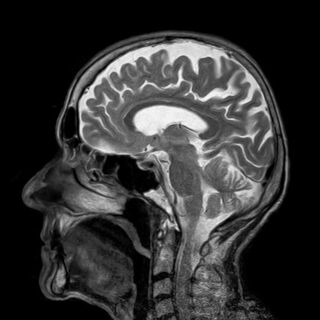
Significant advances in the science of sleep have been made possible by the relatively recent availability of two technologies: physiological imaging and genetic analyses. Both have enabled a better understanding of the purposes of sleep and the ways in which sleep can affect us. In a paper just published in the journal Sleep, investigators used MRI to show how differences in the sleep of adolescents related to structural differences in their brains. It was already known that growth of the thickness of areas in the cortex is steady until middle childhood (9-10) and then gradually decreases.article continues after advertisement
Also, known was that the volume of the cortex increases until middle adolescence (ages 14-15). What was unknown was whether and how those changes relate to sleep. A large sample of adolescents wore wrist actigraphs for at least five nights and the following measures were collected: sleep duration (minutes from the time of going to sleep until the time of waking), sleep timing (hours during which the sleep occurred), sleep continuity (the number of minutes awake during the night), and sleep regularity (how much the duration of sleep varied over the successive nights). The thickness and volume of the cortex in different brain regions were measured with MRI.
Results were that shorter sleep duration, later sleep (going to sleep and waking later), and poorer continuity (more awakening during the nights) were associated with thinner and lower volumes of cortex in several brain regions. Importantly, these associations were found in early to mid-adolescence but not for later adolescents, indicating possible critical periods during which poor sleep is particularly detrimental to brain development. Improving sleep in children and adolescents is important at all ages, but these results imply that there are periods of greater vulnerability due to poor sleep. Fortunately, there are ways to identify insufficient sleep, and there are proven methods for improving it. Improving sleep, in turn, will result in fewer adverse outcomes in numerous domains, including cognitive performance and achievement, emotion regulation and problem behavior, and physical health.
References
Wilson, E.O. (1998). Consilience: The unity of knowledge. New York: Alfred A. Knopf.
Intellia Therapeutics (NTLA) investors probably can’t wait for the new week to kick into action.
On Saturday, the company released interim data from the Phase 1 trial of its collaboration with Regeneron on an experimental therapy for transthyretin amyloidosis (ATTR) – a protein misfolding disorder.
The data showed that for the six people that received a single 0.3 mg/kg dose of NTLA-2001, there was an 87% mean reduction in serum TTR, while there was a maximum 96% serum TTR reduction following a month’s treatment.
NTLA-2001 is intended to shut down the TTR gene in liver cells to stop the production of misfolded TTR protein, which can gather in body tissues and cause fatal complications of ATTR amyloidosis.
There’s no underplaying the results’ significance, says RBC’s Luca Issi, who says the data amounts to a “best-case scenario,” especially considering the standard the drug is up against.
“The bogie was the 80% TTR KD on Onpattro’s label, but NTLA delivered even better data with mean and max reduction of 87% and 96%, respectively,” the analyst said. “Data is small (n=6) but we see several positives: 1) clear dose response (52% KD at 0.1 mg/kg, 87% at 0.3 mg/kg), 2) safety was clean (no immunogenicity, no ALT/AST elevations, no SAEs, no detectable off-target effectsin vitro), 3) effect was seen at remarkably low doses (second lowest dose drove up to 96% KD), and 4) data appears consistent (no clear outliers, tight error bars, KD agnostic to genotypes).”
While it is still early days, Issi calls the data a “major de-risking event for the platform,” and sees the shares surging by 35-45% on the news. Other names in the gene-editing space – BEAM, EDIT, CRSP – should also experience an uptick with the analyst also expecting to see “retail money back in the mix.”
On the other hand, Issi expects shares of Alnylam – Onpattro’s manufacturer – to come under pressure, although this will most likely not last too long given NTLA has “still a long way to go before getting NTLA-2001 over the finish line.”
All in all, the analyst reiterated an Outperform (i.e., Buy) for NTLA shares, backed by a $110 price target. There’s upside of 24% from current levels. (To watchIssi’s track record, click here)https://www.tipranks.com/config/bnr?btype=wide&bscope=news&bid=2
There’s widespread agreement on Wall Street with Issi’s stance. Based on 10 Buys and 2 Holds, the stock has a Strong Buy consensus rating. The average price target stands at $95.92, suggesting one-year upside of 8%.




 3:37What’s Streaming June 2021What’s Streaming June 2021 – Jun 6, 2021
 IMAGE COPYRIGHT:ILLUSTRATION BY HOI CHAN










 Bruce's Blog