https://www.psypost.org/2021/08/early-life-sleep-disruptions-linked-to-irregular-development-of-the-prefrontal-cortex-61765


Early-life sleep disruptions linked to irregular development of the prefrontal cortex

by Christian RiggAugust 27, 2021in Cognitive Science
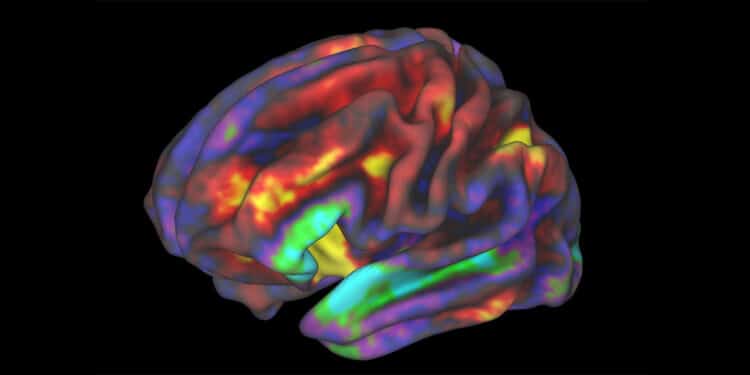
(Photo credit: Richard Watts/NIH)

(Photo credit: Richard Watts/NIH)

The period of neurodevelopment extending from birth to roughly two years of age is one of frenetic, constant change. Neurons and synapses form, are organized, and are pruned. It is well known that sleep plays a fundamental role in these processes, and disruptions to sleep at this stage can be devastating to neurodevelopment and may be the cause of disorders like autism spectrum disorder (ASD).

Understanding the relation between sleep and neurodevelopment in early life is thus essential to understanding (and perhaps preventing) developmental disorders. Building on previous work with prairie voles—a highly social animal with neurodevelopmental similarities to humans—researchers from Portland and California recently published a paper in Current Research in Neurobiology examining the effects of early life sleep disruptions (ELSD) on the prefrontal cortex (PFC).

The prefrontal cortex plays an important role in higher-order social learning, executive function, and cognitive flexibility. It’s also one of the last brain structures to mature, and is thus particularly sensitive to disruptions in development.

In the study, male and female prairie voles were either subject or not to ELSD from 14 to 21 days of age. This period roughly corresponds to the first and second years of human neurodevelopment. The authors then tested the voles for reduced cognitive flexibility and related disruptions in synaptic structures in the prefrontal cortex.

To test cognitive flexibility, the authors subjected voles to fear conditioning, applying a light electric shock through the floor in association with a sound (acquisition phrase). Then, in a separate session, the sound was played repeatedly without shock (extinction phrase). The more quickly a subject is able to adjust its response to the sound, the greater its cognitive flexibility.https://googleads.g.doubleclick.net/pagead/ads?client=ca-pub-9585941727679583&output=html&h=60&slotname=1119529262&adk=216074849&adf=92264163&pi=t.ma~as.1119529262&w=468&lmt=1630090641&rafmt=12&psa=1&format=468×60&url=https%3A%2F%2Fwww.psypost.org%2F2021%2F08%2Fearly-life-sleep-disruptions-linked-to-irregular-development-of-the-prefrontal-cortex-61765&flash=0&wgl=1&uach=WyJtYWNPUyIsIjEwXzExXzYiLCJ4ODYiLCIiLCI5Mi4wLjQ1MTUuMTU5IixbXSxudWxsLG51bGwsbnVsbF0.&tt_state=W3siaXNzdWVyT3JpZ2luIjoiaHR0cHM6Ly9hdHRlc3RhdGlvbi5hbmRyb2lkLmNvbSIsInN0YXRlIjo3fV0.&dt=1630291580570&bpp=2&bdt=6101&idt=315&shv=r20210826&mjsv=m202108240201&ptt=9&saldr=aa&abxe=1&cookie=ID%3Dc228e13108d49cc4-229beb47bfc700c3%3AT%3D1622404274%3AS%3DALNI_MbRhYkk8XcDQ0XVBYjdgR6u_cmNcA&prev_fmts=0x0%2C970x90&correlator=6909804597065&frm=20&pv=1&ga_vid=489211584.1622404280&ga_sid=1630291581&ga_hid=1716630919&ga_fc=0&u_tz=-420&u_his=1&u_java=0&u_h=1050&u_w=1680&u_ah=980&u_aw=1680&u_cd=24&u_nplug=3&u_nmime=4&adx=456&ady=1599&biw=1679&bih=900&scr_x=0&scr_y=0&eid=182982000%2C182982200%2C31062388%2C21065724%2C44749371%2C21067496%2C31062297&oid=3&pvsid=1200498657365564&pem=924&ref=https%3A%2F%2Fnews.google.com%2F&eae=0&fc=896&brdim=0%2C23%2C0%2C23%2C1680%2C23%2C1679%2C980%2C1679%2C900&vis=1&rsz=%7C%7CeEbr%7C&abl=CS&pfx=0&fu=256&bc=31&ifi=3&uci=a!3&btvi=1&fsb=1&xpc=FdgLBcviOT&p=https%3A//www.psypost.org&dtd=567

The results of the study confirmed the authors hypothesis, in that voles subject to ELSD were less able to change their behavior following the “extinction” phase. That is, while control voles froze (a fear response) less and less frequently as they learned that the sound no longer predicted a shock, ELSD voles continued to freeze in anticipation. Importantly, both groups froze at similar levels during acquisition, meaning they acquired information equally well, but could not adapt it to the same degree.

As in humans, cognitive flexibility in voles relies on the prefrontal cortex. Neurodevelopmentally, the authors found significantly more dendritic spines in the PFC of ELSD voles, compared to the control group. The spines were also much thinner, which is a sign of underdevelopment. Dendritic spines are small protrusions on dendrites, the “receiving” part of a neuron, where other neurons connect via the synapse.

Both greater numbers of dendritic spines and their malformation can both result in cognitive and behavioral disorders. Indeed, neurodevelopmental disorders like ASD, also characterized by cognitive inflexibility, show similar neurophysiological malformations.

The mechanism by which sleep disruption impedes neurodevelopment, however, is still not well understood. It may be that increased wakefulness due to sleep disruption increases glutamate circulation in the brain, affecting glutamatergic structures. Alternatively, decreased REM sleep may reduce “pruning”, an essential developmental process in which superfluous synapses are removed to improve signaling and organization.

The authors note a few limitations, including the limited timespan of the study. Future work, they suggest, should examine ELSD at different points in time and for different durations. And, of course, any lessons learned from animal studies should be considered in light of all the developmental and neurological differences between subjects and humans.

Neurodevelopmental disorders are among the most difficult to diagnose, treat, and understand. Animal models provide an important opportunity, especially where developmental and cognitive correlates exist, as they do in voles and humans. It seems clear that sleep plays a critical role in the development of the prefrontal cortex. Furthering our knowledge of that role will lead to more effective interventions.

The study, “Early life sleep disruption alters glutamate and dendritic spines in prefrontal cortex and impairs cognitive flexibility in prairie voles”, was authored by Carolyn E. Jones et al and published July 10, 2021.

https://www.bustle.com/wellness/millennials-sleeping-background-noise

Why Do Millennials Fear The Sound Of Silence?

Our generation loves to sleep with background noise – but what does that say about our collective state of mind?

Francesco Riccardo Iacomino, Rickson Liebano, Xuanyu Han, shaunl/Getty Images, Irina Polonina/StocksyBy Charlotte MooreAug. 29, 2021

It’s nearly midnight. My teeth are brushed, my phone is on charge, and after I’ve mumbled something vaguely affectionate to my boyfriend, it’s time to sleep.

“What are we listening to tonight?” he asks.

You see, for the past seven years, I’ve been falling asleep in the exact same way — with a TV show on in the background. So, as the theme song to The Office U.S. belts through our bedroom, I feel myself drifting off.

Although the statistics around this particular sleeping habit are few and far between, what we do know is that, in 2011, a study commissioned by the National Sleep Foundation found that 60% of Americans watch TV immediately before going to sleep “every night or almost every night.” And the fact that it’s not uncommon to see articles such as “17 Relaxing Netflix Shows To Fall Asleep To” and “10 Podcasts To Help You Fall Asleep” floating about the internet tells us something, right?

In a bid to do some of my own research, I conducted a highly unscientific poll with my Instagram followers, many of whom responded saying that they too need a TV show or podcast to get to sleep. Even more interestingly, when asked why, most said that background noise is the only way that they can quiet their stressed-out internal monologue.

For the past seven years, I’ve been falling asleep in the exact same way — with a TV show on in the background. So, as the theme song to The Office U.S. belts through our bedroom, I feel myself drifting off.

“For me, it started with Harry Potter audiobooks. Until I was about 17, I couldn’t sleep without them,” Katie, a 27-year-old based in London, explains of her inability to sleep without background noise, which dates back to when she was a teenager. “Now I tend to just put Netflix or a podcast on. I know that everyone says sleeping with the TV on is bad for you, but there’s something really soothing about it. I get really anxious and, without having it on, I spend the whole night just reliving my day, panicking about everything I said or did.”

Up until recently, I hadn’t honestly put too much thought into why I couldn’t sleep without the TV — I just knew that I couldn’t. It started after I’d moved back to the United Kingdom from France, where I’d lived in a room-share with six other girls. It’s likely that I became so used to falling asleep in a room full of chatter, shift-changes, and close proximity that suddenly finding myself in total silence was somewhat overwhelming. My listening began with Friends. After six months of cycling through every episode, I moved onto Scrubs, The OfficeParks and Recreation, Brooklyn 99. Each show followed an unspoken tick list: nothing surprising or scary, just something with light, playful, and (by the end) predictable dialogue.

After around a year of this, I tried to go cold turkey, which left me lying awake for hours on end. Like Katie, I’d find myself reliving the day’s events, over and over again. I’d wonder if all my friends secretly hated me and if tomorrow would be the day that I’d lose my job or my house. I’d stare into the silent night, heart racing, frozen.

Until I caved and hit play on the familiar sounds of J.D. and Turk.

“It’s not as uncommon as you might think,” psychologist Dr Maryhan assures me. “If you’re anxious, then you’ll often find that your mind goes into overdrive [when trying to sleep]. It can feel completely overwhelming and having something on to distract your mind from that can help some people.”

“If you’re anxious, then you’ll often find that your mind goes into overdrive [when trying to sleep]. It can feel completely overwhelming and having something on to distract your mind from that can help some people.”

Dr Maryhan, who specialises in anxiety among young people, adds, “We all know just how important sleep is and your anxiety can have a huge impact on that.”

According to The Sleep Foundation article “Mental Health and Sleep,” “Anxiety disorders have a strong association with sleeping problems.” It’s a bit of a viscous cycle, it explains: “Worry and fear contribute to a state of hyperarousal in which the mind is racing, and hyperarousal is considered to be a central contributor to insomnia. Sleep problems may become an added source of worry, creating anticipatory anxiety at bedtime that makes it harder to fall asleep.”

Irina Polonina/Stocksy

Claire, 30, from Glasgow, can definitely recognise the feeling of a racing mind. In fact, she says, “I’ll be exhausted but still feel as if my brain is going a million miles per hour.” Her solution? “I’ll mostly watch something I’ve seen before. I think it’s the familiarity that does the trick. It just feels as if everything is safe.”

This definitely resonated with me. The shows that I select are always ones that I’ve seen thousands of times before. Because having something to go back to, something that won’t offer any surprises, is comforting. Especially when we’re stressed.

For Harry, 27, from London, background noise offers something different, though. “Whenever I’m feeling unsettled or in a new place, I fall back on [sleeping with the TV on],” he says. “When I was a child, my favourite thing was falling asleep to the sound of my mum having a dinner party downstairs and I think part of it is a continuation of that. I like hearing hubbub going on without necessarily being a part of it.”

Clinical psychotherapist and host of Psychotherapy — Off the Couch Stephanie Regan has recognised something else among her clients who need background noise to sleep. For them, it’s about creating white noise, which “works to block out normal everyday environmental noises that could cause a person of any age to startle awake or keep them awake in the middle of the night where solid and consistent sleep is needed the most.” But, again, it all comes back to feeling comforted. “Finding a noise that offers comfort can help improve anyone’s sleep,” she says.

“The silence just gives too much space in my brain and I find that I just plan these crazy fake scenarios. In the quiet and the dark, I just feel like something bad will happen. But as soon as I add noise, I feel comforted. It’s a security that’s unmatched.”

Jess, a 20-year-old from Manchester, shares this feeling of security within sound. “I’m naturally quite an anxious person,” she says. “The silence just gives too much space in my brain and I find that I just plan these crazy fake scenarios. In the quiet and the dark, I just feel like something bad will happen. But as soon as I add noise, I feel comforted. It’s a security that’s unmatched.”

However, while the dulcet tones of Michael Scott instantly soothe me, for my partner, it’s the opposite. Prior to meeting me, he would drift off in complete silence. He likes the quiet and my laptop-loving habits were initially a tricky issue.

A few months into our relationship, I had to explain why I can’t sleep without noise, saying that it’s the only way I know how to actually relax into sleep. Dr Maryhan believes this is the best way for two people to approach the subject of sleep needs: an open and honest chat early on in the relationship. She recommends explaining the issue to your partner and agreeing on some practical solutions together.

Six years into our relationship, my partner has become accustomed to my nighttime viewing habits. And while we’ve talked about phasing it out or exploring alternatives, we accept that, for now, The Office offers me something that therapy, antidepressants, and yoga have been unable to do: a good night’s sleep.

https://neurosciencenews.com/icp-ultrasound-19211/

New Ultrasound Scanner Measures Brain Pressure

FeaturedNeurologyNeuroscienceNeurotech·August 28, 2021

Summary: A new ultrasound technology dubbed Nisonic P-100 allows doctors to quickly determine whether a patient is at risk of a dangerous increase of intracranial pressure.

Source: SINTEF

“We’re through the eye of the needle on this one”, says Tormod Selbekk. Selbekk is Head of Technology at the spin-off company Nisonic AS. He is also co-inventor of the new device, and was previously a research scientist in medical technology and ultrasound at SINTEF, where the idea was born.

“Increased intracranial pressure (ICP) or brain pressure, can result in brain damage and can be caused by either accidents or illness”, he says.

It is important in all cases to detect brain pressure increases as soon as possible, in order to make treatment easier and more effective. One treatment option may be as straightforward as the timely administration of diuretic drugs.

Ultrasound may replace surgery

Brain pressure is currently measured directly using a sensor or via a drain that is inserted into the patient’s brain tissue through a hole the cranium. The procedure must be carried out in an operating theatre. It is expensive, onerous and, not least has a small risk of side-effect for the patient.

The new ultrasound scanner, called Nisonic P-100, can relieve the burden on hospitals and offer patients more sensitive treatment. It is equipped with built-in software that automatically processes the ultrasound images. The device makes it possible for doctors rapidly to determine whether a patient may be developing dangerous increases in brain pressure. The technology is based on an algorithm that interprets ultrasound images of the patient’s optic nerve sheath, which changes its dimensions in response to increases in intracranial pressure.

A demanding approval process

Achieving CE marking approval for the Nisonic P-100 technology has been a demanding process, but the technology has recently been passed by the various control agencies and was given the green light.

“We’re all very pleased about this”, says Selbekk. “This last year has been particularly challenging because the EU has recently amended its CE marking approval legislation for medical equipment. On top of this, we’ve had to deal with the effects of the Covid-19 pandemic. In spite of these issues, we’ve succeeded in the space of just over two years in advancing our prototype and achieving approval as medical equipment”, he says.

This means that not only can the technology now be used in hospitals throughout the EU, but it will also be easier for us to gain access to large and growing U.S. markets in the future. The market for ICP detection and monitoring equipment is expected to increase significantly in the years ahead. Several reports have estimated a market valued at USD 270 million, with the biggest levels of annual growth in the field of ultrasound detection.Nisonic is thus ideally positioned to take advantage of a future growth area.

Possible game changer

Eirik Helseth is a Professor and Head of Neurosurgery at Oslo University Hospital, Ullevål. He is principal investigator in a clinical research study, in which ultrasound images of the optic nerve are recorded in patients suffering from severe head injuries. The collaboration in the research project makes it possible for Nisonic to receive anonymized ultrasound images and ICP measurements for the further development of the methods.https://b20041ff8b885846309cf37d88d2f3c4.safeframe.googlesyndication.com/safeframe/1-0-38/html/container.html

As part of a standard procedure, these patients have had a sensor surgically inserted into their brains in order to monitor intracranial pressure. The aim of the research project is to assess whether processed ultrasound images of the optic nerve captured by Nisonic’s technology can provide a reliable measure of brain pressure.

Helseth calls the method a potential game changer:

“Current technology only enables us to make reliable measurements of intracranial pressure with the help of a sensor, or via a drain, that is inserted into the patient’s cerebroventricular (brain cavity) system”, says Helseth. “Both methods require admission to a hospital’s neurological department and a surgical procedure in order to insert the pressure sensor or drain. If ultrasound images of the optic nerve prove to be a reliable method of measuring ICP, this will open opportunities for the method to be applied not only in all other hospital departments, but also in GP surgeries and ambulances. This will be fantastic – and a global sensation”, he says.

The more data, the better the result

However, Helseth is keen to point out that the equipment can never be better than the data provided to the algorithm.

“It is essential that the equipment is used in many hospitals so that we can obtain even more patient data to work with”, he says. All medical professionals know that such equipment has to be tested on a large number of patients before reliable measurement data can be obtained. For example, there may be differences in optic nerve sheath structure between men and women, and among different age groups.https://b20041ff8b885846309cf37d88d2f3c4.safeframe.googlesyndication.com/safeframe/1-0-38/html/container.html

“This is why the Neurological Department at Ullevål is assisting Nisonic with its research and data gathering. We have great faith in the approach and the technology”, says Helseth.See also

This shows two brain scans from a glioblastoma patient

Brain CancerFeaturedNeurologyNeuroscienceApril 1, 2021

Chemo for Glioblastoma May Work Better in Morning Than Evening

Looking for financial partners

Nisonic is now on the lookout for more capital investment and business partners who can help the company realise its overseas growth plans.

“If we succeed in establishing our method for the non-invasive monitoring of ICP, market assessments have indicated that there is significant interest among clinicians in hospitals in Europe and the USA, and a high economic potential for the technology”, says Selbekk.

This shows a brain
Achieving CE marking approval for the Nisonic P-100 technology has been a demanding process, but the technology has recently been passed by the various control agencies and was given the green light. Image is in the public domain

The company has succeeded with the development of Nisonic P-100, by collaborating with several Norwegian contributors. These include ultrasound companyVitacon AS, which has provided key assistance in connection with the CE marking approval process; Medistim ASA, which specialises in ultrasound imaging linked to cardiac surgery; and Aurotech AS, based in Tydal, which has provided hardware. The Nisonic P-100 is at large an entirely Norwegian product.

In use in Stockholm

The first Nisonic system is already on its way to the Bragée clinic in Stockholm, which is collaborating with the Karolinska institute in clinical research. Here, the equipment will be used for research into patients suffering from chronic fatigue syndrome (ME).https://b20041ff8b885846309cf37d88d2f3c4.safeframe.googlesyndication.com/safeframe/1-0-38/html/container.html

Swedish researchers are working with a theory that ME patients also exhibit elevated intracranial pressure. Nisonic’s equipment will be used to measure the diameters of ME patients’ optic nerve sheaths, as well as those of a control group. Selbekk says that these measurements will then be compared with diameters measured using magnetic resonance imaging (MRI) .

This research will provide Nisonic with even more patient data, which will further improve the system’s algorithms.

“The more patient data we have, the better the equipment will be. This is because the method is based on deep learning and neural networks, which are branches of the field of machine learning and artificial intelligence”, he says, adding;

“Our job will be much easier now that the equipment is CE approved. CE marking enables us to capture anonymous data much more rapidly than in the past. We expect to achieve even better results by means of systematic data analysis and training of the neural networks.

About this neurology and neurotech news

Author: Christina Benjaminsen
Source: SINTEF
Contact: Christina Benjaminsen – SINTEF
Image: The image is in the public domain

https://neurosciencenews.com/icp-ultrasound-19211/

New Ultrasound Scanner Measures Brain Pressure

FeaturedNeurologyNeuroscienceNeurotech·August 28, 2021

Summary: A new ultrasound technology dubbed Nisonic P-100 allows doctors to quickly determine whether a patient is at risk of a dangerous increase of intracranial pressure.

Source: SINTEF

“We’re through the eye of the needle on this one”, says Tormod Selbekk. Selbekk is Head of Technology at the spin-off company Nisonic AS. He is also co-inventor of the new device, and was previously a research scientist in medical technology and ultrasound at SINTEF, where the idea was born.

“Increased intracranial pressure (ICP) or brain pressure, can result in brain damage and can be caused by either accidents or illness”, he says.

It is important in all cases to detect brain pressure increases as soon as possible, in order to make treatment easier and more effective. One treatment option may be as straightforward as the timely administration of diuretic drugs.

Ultrasound may replace surgery

Brain pressure is currently measured directly using a sensor or via a drain that is inserted into the patient’s brain tissue through a hole the cranium. The procedure must be carried out in an operating theatre. It is expensive, onerous and, not least has a small risk of side-effect for the patient.

The new ultrasound scanner, called Nisonic P-100, can relieve the burden on hospitals and offer patients more sensitive treatment. It is equipped with built-in software that automatically processes the ultrasound images. The device makes it possible for doctors rapidly to determine whether a patient may be developing dangerous increases in brain pressure. The technology is based on an algorithm that interprets ultrasound images of the patient’s optic nerve sheath, which changes its dimensions in response to increases in intracranial pressure.

A demanding approval process

Achieving CE marking approval for the Nisonic P-100 technology has been a demanding process, but the technology has recently been passed by the various control agencies and was given the green light.

“We’re all very pleased about this”, says Selbekk. “This last year has been particularly challenging because the EU has recently amended its CE marking approval legislation for medical equipment. On top of this, we’ve had to deal with the effects of the Covid-19 pandemic. In spite of these issues, we’ve succeeded in the space of just over two years in advancing our prototype and achieving approval as medical equipment”, he says.

This means that not only can the technology now be used in hospitals throughout the EU, but it will also be easier for us to gain access to large and growing U.S. markets in the future. The market for ICP detection and monitoring equipment is expected to increase significantly in the years ahead. Several reports have estimated a market valued at USD 270 million, with the biggest levels of annual growth in the field of ultrasound detection.Nisonic is thus ideally positioned to take advantage of a future growth area.

Possible game changer

Eirik Helseth is a Professor and Head of Neurosurgery at Oslo University Hospital, Ullevål. He is principal investigator in a clinical research study, in which ultrasound images of the optic nerve are recorded in patients suffering from severe head injuries. The collaboration in the research project makes it possible for Nisonic to receive anonymized ultrasound images and ICP measurements for the further development of the methods.https://b20041ff8b885846309cf37d88d2f3c4.safeframe.googlesyndication.com/safeframe/1-0-38/html/container.html

As part of a standard procedure, these patients have had a sensor surgically inserted into their brains in order to monitor intracranial pressure. The aim of the research project is to assess whether processed ultrasound images of the optic nerve captured by Nisonic’s technology can provide a reliable measure of brain pressure.

Helseth calls the method a potential game changer:

“Current technology only enables us to make reliable measurements of intracranial pressure with the help of a sensor, or via a drain, that is inserted into the patient’s cerebroventricular (brain cavity) system”, says Helseth. “Both methods require admission to a hospital’s neurological department and a surgical procedure in order to insert the pressure sensor or drain. If ultrasound images of the optic nerve prove to be a reliable method of measuring ICP, this will open opportunities for the method to be applied not only in all other hospital departments, but also in GP surgeries and ambulances. This will be fantastic – and a global sensation”, he says.

The more data, the better the result

However, Helseth is keen to point out that the equipment can never be better than the data provided to the algorithm.

“It is essential that the equipment is used in many hospitals so that we can obtain even more patient data to work with”, he says. All medical professionals know that such equipment has to be tested on a large number of patients before reliable measurement data can be obtained. For example, there may be differences in optic nerve sheath structure between men and women, and among different age groups.

“This is why the Neurological Department at Ullevål is assisting Nisonic with its research and data gathering. We have great faith in the approach and the technology”, says Helseth.See also

This shows two brain scans from a glioblastoma patient

Brain CancerFeaturedNeurologyNeuroscienceApril 1, 2021

Chemo for Glioblastoma May Work Better in Morning Than Evening

Looking for financial partners

Nisonic is now on the lookout for more capital investment and business partners who can help the company realise its overseas growth plans.

“If we succeed in establishing our method for the non-invasive monitoring of ICP, market assessments have indicated that there is significant interest among clinicians in hospitals in Europe and the USA, and a high economic potential for the technology”, says Selbekk.

This shows a brain
Achieving CE marking approval for the Nisonic P-100 technology has been a demanding process, but the technology has recently been passed by the various control agencies and was given the green light. Image is in the public domain

The company has succeeded with the development of Nisonic P-100, by collaborating with several Norwegian contributors. These include ultrasound companyVitacon AS, which has provided key assistance in connection with the CE marking approval process; Medistim ASA, which specialises in ultrasound imaging linked to cardiac surgery; and Aurotech AS, based in Tydal, which has provided hardware. The Nisonic P-100 is at large an entirely Norwegian product.

In use in Stockholm

The first Nisonic system is already on its way to the Bragée clinic in Stockholm, which is collaborating with the Karolinska institute in clinical research. Here, the equipment will be used for research into patients suffering from chronic fatigue syndrome (ME).https://b20041ff8b885846309cf37d88d2f3c4.safeframe.googlesyndication.com/safeframe/1-0-38/html/container.html

Swedish researchers are working with a theory that ME patients also exhibit elevated intracranial pressure. Nisonic’s equipment will be used to measure the diameters of ME patients’ optic nerve sheaths, as well as those of a control group. Selbekk says that these measurements will then be compared with diameters measured using magnetic resonance imaging (MRI) .

This research will provide Nisonic with even more patient data, which will further improve the system’s algorithms.

“The more patient data we have, the better the equipment will be. This is because the method is based on deep learning and neural networks, which are branches of the field of machine learning and artificial intelligence”, he says, adding;

“Our job will be much easier now that the equipment is CE approved. CE marking enables us to capture anonymous data much more rapidly than in the past. We expect to achieve even better results by means of systematic data analysis and training of the neural networks.

About this neurology and neurotech news

Author: Christina Benjaminsen
Source: SINTEF
Contact: Christina Benjaminsen – SINTEF
Image: The image is in the public domain

https://www.visualcapitalist.com/most-popular-languages-people-want-to-learn/

This is the Language Each Country Wants to Learn the Most

Published 1 day ago 

on August 27, 2021

ByCarmen AngTweetShareShareRedditEmail

The Languages People Want to Learn the Most Worldwide

This is the Language Each Country Wants to Learn the Most

When it came to choosing a new hobby during COVID-19 lockdowns, learning a new language was a popular choice—in March 2020, the language app Duolingo saw a 300% boost in new users.

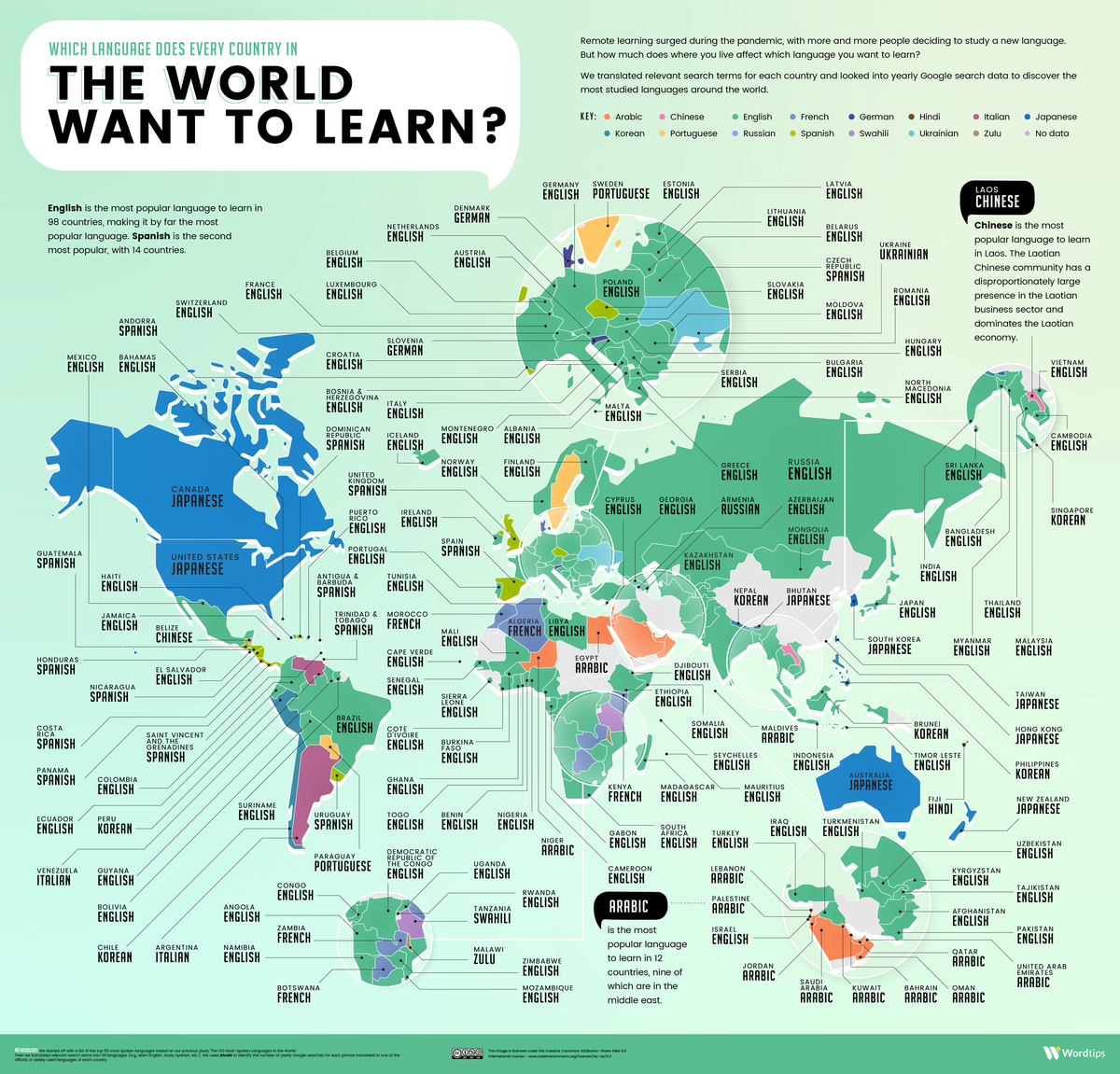
But which languages were the most popular to learn in each country? This graphic by Wordtips maps the most popular language learning choices around the globe.

To find out which countries wanted to learn which languages, Wordtips used Google’s Keyword Planner, and tallied the number of searches for ‘learn x language’ (translated into different languages) in every country from May 2020 to May 2021.

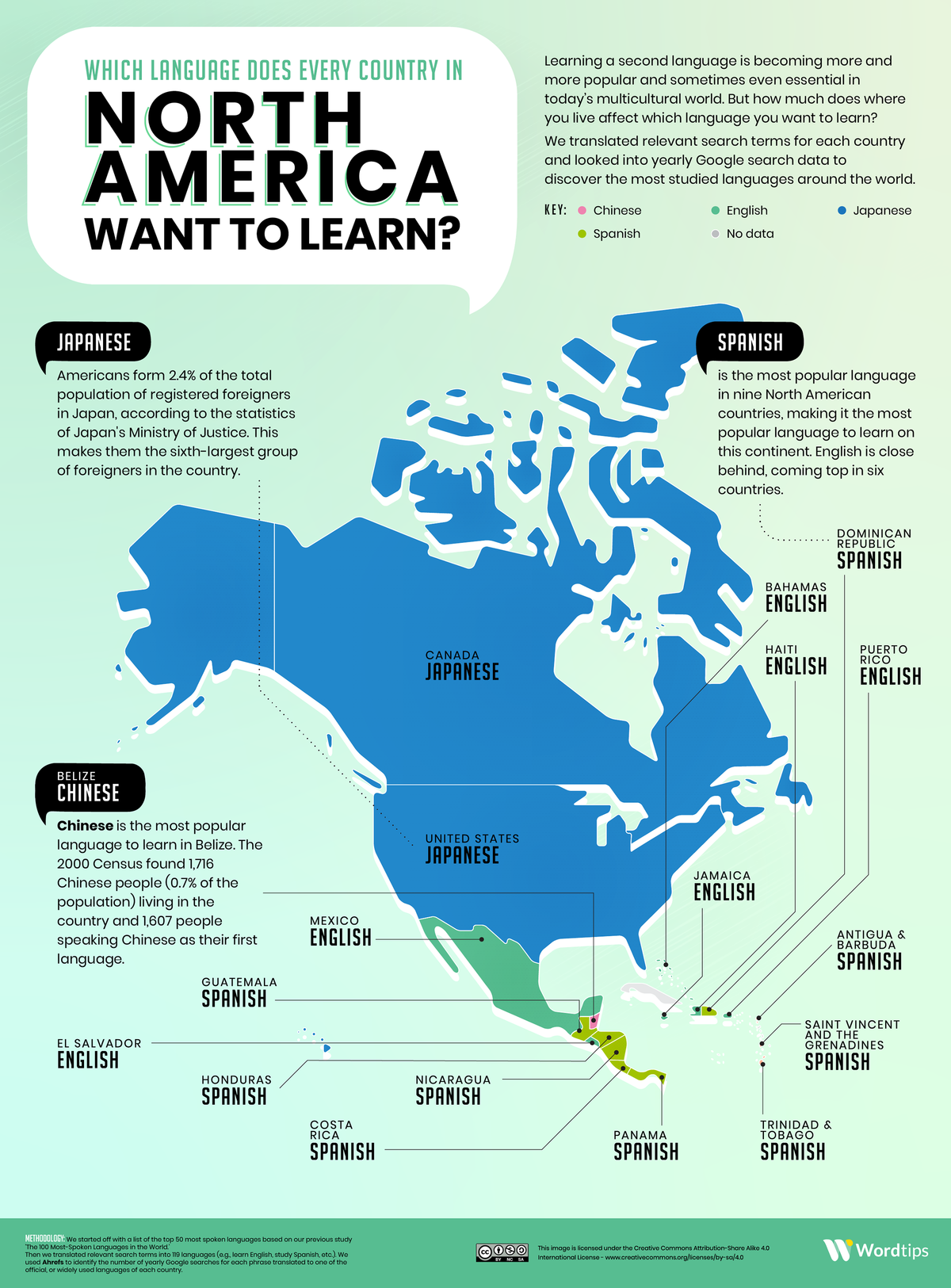
Most Desired Languages to Learn in North America

Interestingly, Japanese is the most popular language that Americans and Canadians want to learn.

While this may sound surprising, North Americans have consumed and adored Japanese pop culture since the early 1990s. And recently, Westerners’ interest in anime has grown even more prominent, with the demand for anime programs in the U.S., for Q1 of 2021, up 33% compared to a year prior.

Languages North Americans Want to Learn the Most

Another country’s top pick that may come as a surprise is Belize, where the most popular language to learn is Chinese.

According to the 2000 Census, almost 1% of the country’s population identifies as Chinese. Chinese immigration to Belize began in the mid-1800s, when Chinese immigrants were brought into the country (then known as British Honduras) as laborers.

More recently, a wave of Taiwanese migrants have immigrated and set up businesses in Belize, as part of Taiwan’s international development efforts.

Meanwhile in South America, both Peru and Chile showed a strong desire to learn Korean. The popularity of K-Pop in South America demonstrates how media and art can help spread languages far beyond their original borders, and sometimes in unexpected places.

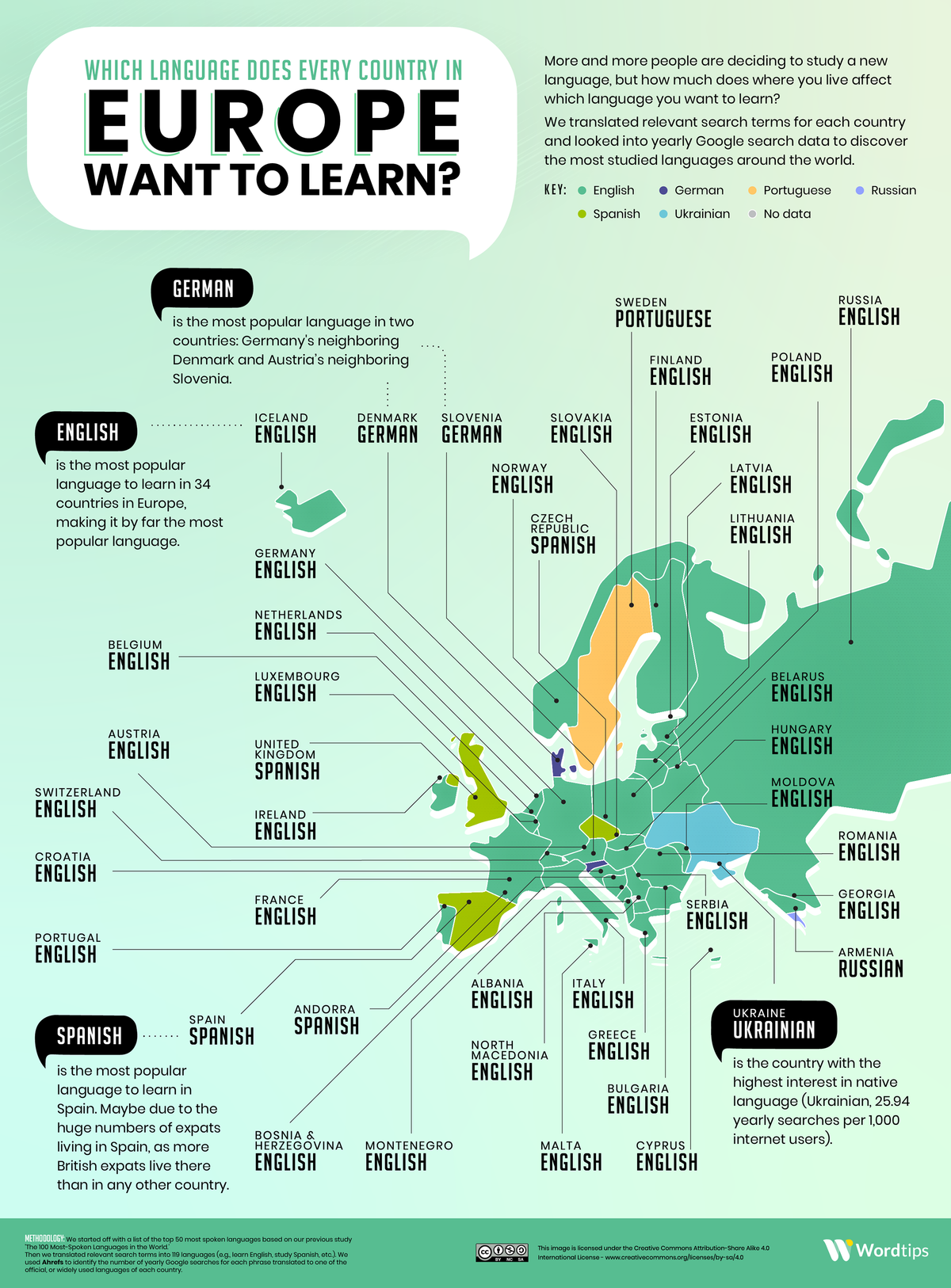
Most Desired Languages to Learn in Europe

English is the most popular language across Europe, as it’s the top searched language in 34 European countries.

Languages Europeans Want to Learn the Most

But a few countries differ from the norm—for instance, German is the most popular language to learn in Denmark. In a small Southern region of Denmark, German is the official minority language. And according to World Atlas, up to 20,000 ethnic Germans live in the area, with about 8,000 speaking standard German as their native tongue.

In the UK, Spanish takes the top spot. But more interestingly, Spanish is also Spain’s most popular language to learn, which seems counterintuitive. However, it could be because of Spain’s high concentration of British expats. According to BBC News, there are more than 300,000 British expats currently living in Spain.

Top Languages Spoken Worldwide

While English is the most popular language to learn in various countries, it’s also the most spoken language worldwide, with approximately 1.1 billion total speakers—that’s roughly 15% of the global population.

RankLanguageTotal Speakers
1English1,132 million
2Mandarin Chinese1,117 million
3Hindi615 million
4Spanish534 million
5French280 million
6Standard Arabic274 million
7Bengali265 million
8Russian258 million
9Portuguese234 million
10Indonesian199 million

And with more people interested in learning English, it looks like it could remain the world’s lingua franca (a common language among people who don’t speak the same native language) for years to come.

https://neurosciencenews.com/visual-neuron-change-19204/

Neurons in Visual Cortex of the Brain ‘Drift’ Over Time

FeaturedNeuroscienceOpen Neuroscience ArticlesVisual Neuroscience·August 27, 2021

Summary: Neurons in the visual cortex change their response to the same stimuli over time.

Source: WUSTL

New research from Washington University in St. Louis reveals that neurons in the visual cortex — the part of the brain that processes visual stimuli — change their responses to the same stimulus over time.

Although other studies have documented “representational drift” in neurons in the parts of the brain associated with odor and spatial memory, this result is surprising because neural activity in the primary visual cortex is thought to be relatively stable.

The study published Aug. 27 in Nature Communications was led by Ji Xia, a recent PhD graduate of the laboratory of Ralf Wessel, professor of physics in Arts & Sciences. Xia is now a postdoctoral fellow at Columbia University.

“We know that the brain is a flexible structure because we expect the neural activity in the brain to change over days when we learn, or when we gain experience — even as adults,” Xia said. “What is somewhat unexpected is that even when there is no learning, or no experience changes, neural activity still changes across days in different brain areas.”

Researchers in Wessel’s group explore sensory information processing in the brain. Working with collaborators, they use novel data analysis to address questions of dynamics and computation in neural circuits of the visual cortex of the brain.

Study co-senior author Michael J. Goard, from the Neuroscience Research Institute at the University of California, Santa Barbara, showed mice a single, short movie clip on a loop. (They used a section of the opening from a classic Orson Welles black-and-white film, de rigueur for today’s mouse vision studies.) While a mouse watched the movie, researchers simultaneously recorded activity in several hundred neurons in the primary visual cortex, using two-photon calcium imaging.https://055c33ee834f797fdfb31051eddd2060.safeframe.googlesyndication.com/safeframe/1-0-38/html/container.html

The scientists repeated the viewing sessions weekly for up to seven weeks, recording the activity of the same neurons in the same mice as they watched the loop of the same 30-second movie clip.

Then the physicists at Washington University parsed the data from the movie-watching mice, using new computational approaches to analyze the changes in neuronal population activity over time.

The researchers discovered that single-neuron responses to natural movies are unstable across weeks. In other words, individual neurons did not respond the same way to the visual stimuli — what was happening on the screen at the exact same moment in the film — when the mouse watched the film one week as compared with another week. This research finding was consistent with a study published by their collaborators in the same journal issue, Xia said.

This shows a brain
The researchers discovered that single-neuron responses to natural movies are unstable across weeks. Image is in the public domain

https://055c33ee834f797fdfb31051eddd2060.safeframe.googlesyndication.com/safeframe/1-0-38/html/container.html

However, in this particular study, the Washington University physicists were able to develop a way to decode the response to the visual stimuli across weeks if they factored in the population activity all of the neurons tracked for a given mouse — they just couldn’t do it using individual neurons alone.

Although Xia mapped out a consistent representation of the movie clip using the population activity, the scientists still don’t know whether this representation from the primary visual cortex is what the downstream brain areas are actually reading out.

Over the past 10 years, neuroscientists have increasingly documented similar examples of this “representational drift” in neural activity within different areas of the brain — with the first studies reporting drift in the activity of neurons in the hippocampus and the posterior parietal cortex.https://055c33ee834f797fdfb31051eddd2060.safeframe.googlesyndication.com/safeframe/1-0-38/html/container.htmlSee also

This shows the outline of a head

FeaturedNeurologyNeuroscienceApril 12, 2021

Imbalance in Gum Bacteria Linked to Alzheimer’s Disease Biomarker

But even with those studies already in print, many scientists are not prepared to deal with the possibility of drift in other areas of the brain, Xia said.

“People still don’t expect this kind of drift to be coming from the primary visual cortex,” she said. “The general belief is that those primary sensory cortices should be very reliable, because they are expected to faithfully encode the information from the sensory stimuli.”

About this visual neuroscience research news

Author: Talia Ogliore
Source: WUSTL
Contact: Talia Ogliore – WUSTL
Image: The image is in the public domain

Original Research: Open access.
Stable representation of a naturalistic movie emerges from episodic activity with gain variability” by Ji Xia, Tyler D. Marks, Michael J. Goard & Ralf Wessel. Nature Communications

https://www.popularmechanics.com/science/a37416251/elon-musk-tesla-robot/


What Can We Really Expect From Elon Musk’s Tesla Robot?

With the help of robotics specialists, we can separate the truth from the hype.

BY CAROLINE DELBERTAUG 27, 2021https://www.youtube.com/embed/j0z4FweCy4M?start=0&autoplay=1&enablejsapi=1&mute=1

  • Announced at Tesla AI Day, Elon Musk wants to build a pie-in-the-sky all-purpose robot, with prototypes next year.
  • His description involves work that today’s robots can’t do, like responding well to changes.
  • He’s right that robots have a place where humans would be in danger.

Elon Musk has announced his plans for a new Tesla humanoid robot that will excel at “mundane tasks,” but he’s making some common robotics mistakes with his grand plans.

What does the future of a Tesla robot look like? With the help of a couple of robotics specialists, we can separate the truth from the hype in Musk’s claims.

What can we expect from a true humanoid robot?

Making a robot look and even behave like human figure brings many programming challenges. Will the Tesla bot do bipedal locomotion, the complex two-legged walking that humans have perfected over millions of years? (Or dance like the very obvious human in a Tesla Robot suit did at Tesla AI Day when Musk made the announcement?) Northwestern University robotics professor Michael Peshkin said it’s tasks like this that are often underestimated by the public.

MORE FROM POPULAR MECHANICS

Pop Projects: DIY Birdhousehttps://imasdk.googleapis.com/js/core/bridge3.477.1_en.html#goog_179523779AdLEARN MOREWATCH: Pop Projects: DIY Birdhouse

“A baby spends several years learning how to move their body around,” Peshkin said. “We never appreciate how sophisticated people are to begin with. It’s the things that babies can do that are so hard for robots.”ADVERTISEMENT – CONTINUE READING BELOWhttps://377b6fda8dd8aaa1fb04d8646c2da4d9.safeframe.googlesyndication.com/safeframe/1-0-38/html/container.html

🤖You love robots. So do we. Let’s nerd out over them together.

Musk mentioned “mundane tasks” like screwing in bolts or doing grocery trips—both of which would require a lot of specialized, adaptive programming. The robot would have to respond and change “on the fly,” something very challenging. What if it doesn’t have the correct size bolts, or all the Honey Nut Cheerios are sold out at the store? That’s on top of Musk’s description of the robot as taking verbal instructions, adding a further requirement for natural language processing. (And we know Siri isn’t always fantastic at giving you the best answer when prompted.)HOW SMART ARE YOUR DEVICES?Amazon Echo or Google Nest: Which Is Better?

What do we think Tesla Bot will actually do?

Peshkin said the robot Musk is describing sounds like, maybe, the human workers at an Amazon warehouse. People can reach for and grab different items from a diverse stack of items. They could possibly throw out an apple that’s gone bad. While the term “unskilled labor” is often used for jobs like this, we actually use an incredible amount of multilayered judgment and caution when doing these tasks that seem simple.

“When you try to automate things people do, like picking things off the shelf in a warehouse, you often wind up changing the warehouse,” Peshkin said. “You typically change the environment, too. They have barcodes, the racks are at standard locations, the things are boxed in a different way, you make all kinds of adaptations—making the world safe for robots.” The task is made as uniform as possible so that it can be handled by programming.

Screwing in bolts, as a single job, is something robots can do well today. Manufacturing has had some of the world’s most advanced application robots for decades because of how relatively “doable” a lot of manufacturing tasks are with our current abilities with robots. A steady stream of goods might pass on a conveyor belt, where a robot must simply reach out, twist or glue a particular part or item into place, and then pull back its “arm.”

“Most robot hands found in manufacturing are metallic, rigid, of limited dexterity and only few of them have more than three fingers,” Arizona State University roboticist Heni Ben Amor said. Human hands are unfathomably complexand it would take many motors to create a similar robotic hand. “Human hands can delicately deal with everything from a tomato, to a violin, or even a jackhammer. Part of the reason for this is that the human hand combines different materials, including a.) hard bones, b.) muscles, and c.) a soft skin.”ADVERTISEMENT – CONTINUE READING BELOWhttps://377b6fda8dd8aaa1fb04d8646c2da4d9.safeframe.googlesyndication.com/safeframe/1-0-38/html/container.htmlRELATED STORYThis Robot Can Do Parkour…But Why?

What should Tesla Bot do?

One of the places Musk has gotten it right is that robots are able to go where the work is dangerous or boring for human workers. “Why not make robots do things where people don’t belong, where the task is dangerous, or things people don’t do well?” Peshkin said. “Let people continue to do the things people do well.”

But agai​​n, that’s not necessarily a robot that can listen to instructions and process language into a variety of tasks. “At the software and intelligence level, a major challenge with autonomous robots is the large variability in human environments,” Ben Amor said. “Robots in this case cannot rely on a human programmer and would have to constantly improvise and change their behavior.”

It’s easy to read between the lines to combine Musk’s ambitions to travel to and settle Mars with his comments here about robots. After all, a lot of the daily work of keeping a settlement going will be boring or dangerous—he could imagine robots working in manufacturing or even farming.

But he’s specific to say this robot will be a nonthreatening size and ability set, just 5’8” and a slight 125 pounds with a top speed of about five miles per hour. The “dangerous” work will be more like construction sites tha​​n, say, settlement security.

Peshkin helped to invent the idea of cobots, which are, he says, collaborative robots that work together with people. “Aren’t there things where people can team with robots in a physical way, each contributing their strengths?” he said. It’s easy to imagine that a carefully programmed helper or “booster” robot could be a big help to people on Mars or people who already work in dangerous places like underground mineral mines.

Ben Amor also said that Musk’s comments are an exciting rallying cry, even if what he’s describing is still very far out from our current abilities with robots. “Mr. Musk is mostly a visionary and is excellent at rallying young and old scientists and engineers behind a grand goal,” Ben Amor said. “Along the way he will likely hire and inspire a new generation of roboticists. Even achieving a small aspect of what he announced would be a major milestone in the field of robotics.”

https://carbuzz.com/news/this-is-how-volkswagen-designed-the-gti


This Is How Volkswagen Designed The GTI

13 HOURS AGOBY SEBASTIAN CENIZODESIGN10 COMMENTS

A lot of thought went into this.

Last month Volkswagen revealed pricing and trims of the new Golf GTI and its AWD R sibling. Then we got to see what the car could be with a little bit of tuning from the aftermarket, and the result was a stunningly retro BBS concept. But after seven successful iterations of the Golf GTI, how does a designer (or group thereof) decide how to make the eighth generation look as it does? How does one blend the iconic heritage of a globally loved car with contemporary design cues that point to the future? Volkswagen explains how the new GTI was styled, and the amount of detail and thought is astonishing.VolkswagenSaveVolkswagenSaveVolkswagenSaveVolkswagenSave

Klaus Zycoria is the head of Volkswagen Group Design and says, “The all-new GTI is a design statement; it merges a dynamic, sporty character with uncompromising functionality. We wanted to show that the GTI in its eighth generation has made a huge leap forward in performance.”

The new GTI gets that trademark red pinstripe at the front, modernized with the aid of an optional LED strip connecting the headlights and the VW logo. Wide lower side intakes increase visual width as does the shoulder line. This gives the car a low visual center of gravity, but it’s more than just styling. Extensive aero work was carried out on everything from the mirrors to the roof spoiler and even underbody paneling and arch liners, resulting in a drag coefficient of just 0.275.VolkswagenSaveVolkswagenSaveVolkswagenSaveVolkswagenSave

Subaru’s New Outback Color Took Half A Decade To Develop7 Coolest Features Of The Rimac Nevera

The forward-facing C-pillar and high rear shoulder give the impression of forward movement while an extended roof spoiler helps make the car look flatter. In keeping with a tradition initiated with the Mk. 6 generation, a wide rear diffuser houses one exhaust tip at each end, but there are modern changes too, like the central GTI badge where it would previously be offset to one side.

New wheels include a standard polished18-inch rim, an optional 18-inch gloss black wheel, and an optional 19-inch wheel blending both silver and black. There are five new colors, including Kings Red Metallic that pays homage to the original Mars Red of the Mk. 1 model, and a special new launch color called Pomelo Yellow Metallic available exclusively with the top Autobahn trim.VolkswagenSaveVolkswagenSaveVolkswagenSaveVolkswagenSave

Inside, the cockpit is “future-forward” and retains touches from the past. When you open the doors, both the digital driver display and the central infotainment screen light up, while new sport seats are said to echo the shapes of the original GTI’s seats. A tartan theme for the upholstery is common in GTIs, so this new model gets a fabric called Scalepaper with red seams and stitches complementing gray and black tartan. 30-color ambient lighting adds a touch more modernity.

The steering wheel is also rather modern, with touch-sensitive controls and a red GTI accent. The start/stop button is new and pulses red until you start the car. Finally, the standard manual gearbox comes with a golf ball-inspired knob, although it’s less like the original knob than expected.

It’s all been done rather well, but if you think that the new GTI doesn’t pay proper homage to past generations, take a look at the evolution from the first-ever GTI to now.VolkswagenSaveVolkswagenSaveVolkswagenSaveVolkswagenSaveVolkswagenSaveVolkswagenSave

https://www.lifesavvy.com/91789/remove-this-from-your-nightstand-to-improve-your-sleep/

Remove This From Your Nightstand to Improve Your Sleep

SHEA SIMMONS

@heysheashea
AUG 27, 2021, 12:00 PM EDT | 1 min read

A white nightstand with a clock, books, and lamp sits next to a bed with white bedding.
New Africa/Shutterstock.com

If you struggle with getting enough sleep, or even falling asleep in the first place, just going to bed might give you anxiety. Luckily, according to the experts, there are few things you can try that might reduce any sleep anxiety in the bedroom. One involves removing a popular nightstand item.

Evidently, your alarm clock could be intensifying your sleep anxiety, but not because you’re anticipating your morning alarm.RELATEDAre Wakeup Lights Worth Your Money?

Unfortunately, most of us need an alarm clock. While some might be fine with switching to a wake-up light, many people need that blaring sound from a phone or clock to get going. Oddly enough, though, that’s not what can intensify anxiety. The harm comes if you’re prone to waking up in the middle of the night to check the time.

“If you have an alarm clock in your room, turn it around,” said Annie Miller, a psychologist at DC Metro Sleep & Psychotherapy. “As long as you have an alarm set, you don’t need to know the time.”

YOUR NEW FAVORITE NEWSLETTER

Join over 50,000 subscribers and get a daily digest of featured articles, news, and shopping advice.Sign Me Up!

By submitting your email, you agree to the Terms of Use and Privacy Policy.The same is true for people who use their phones. If you’re tempted to flip it over and check the time, only to groan and realize you’ve only been asleep an hour, place it on the other side of the room so you have to get up to check the time.Miller also advised removing smartwatches at night, as they don’t adequately track your sleep, but rather, just your movements.If you want to try ditching your alarm clock, you might want to give a wake-up light or this clever programmable coffee pot hack a shot.

https://www.psypost.org/2021/08/study-finds-coronavirus-related-polarization-is-stronger-among-people-higher-in-cognitive-ability-61760


Study finds coronavirus-related polarization is stronger among people higher in cognitive ability

by Eric W. DolanAugust 26, 2021in COVID-19Political Psychology

(Image by Alexandra_Koch from Pixabay)

(Image by Alexandra_Koch from Pixabay)

New psychology research indicates that cognitive ability exacerbates political polarization in responses to the COVID-19 pandemic. The study, published in Intelligence, found that people with greater verbal ability tended to have more polarized responses, which may be related to their selective consumption of partisan media.

“We were initially interested in tracking risk perceptions over time to a novel health threat, and thought COVID-19 would be a good opportunity to do so — we started collecting data in February 2020 with no idea how much of an impact COVID would have. We also thought that perhaps reactions to COVID might be politically polarized, but had no idea how huge the effects of ideology would become,” said study author Brittany Shoots-Reinhard, a research assistant professor at Ohio State University.

For their research, Shoots-Reinhard and her colleagues collected five waves of data from 1,267 U.S. residents between February and July 2020. As part of the study, the participants completed two tests of cognitive ability — a measure numeric ability and a measure of vocabulary knowledge.

The researchers found that ideological polarization was stronger among those who scored higher on the test of verbal analogies. But this was not the case for numeric ability.

Liberal participants were more likely than conservatives to report that the COVID-19 pandemic had caused them distress. Liberals also perceived the virus as a greater threat to personal finances as well a greater threat to food, water, and medical resources. Conservatives, on the other hand, were less willing than liberals to purchase products from Wuhan, China. These differences were heightened among those with higher verbal ability.https://googleads.g.doubleclick.net/pagead/ads?client=ca-pub-9585941727679583&output=html&h=60&slotname=1119529262&adk=216074849&adf=92264163&pi=t.ma~as.1119529262&w=468&lmt=1630005638&rafmt=12&psa=1&format=468×60&url=https%3A%2F%2Fwww.psypost.org%2F2021%2F08%2Fstudy-finds-coronavirus-related-polarization-is-stronger-among-people-higher-in-cognitive-ability-61760&flash=0&wgl=1&uach=WyJtYWNPUyIsIjEwXzExXzYiLCJ4ODYiLCIiLCI5Mi4wLjQ1MTUuMTU5IixbXSxudWxsLG51bGwsbnVsbF0.&tt_state=W3siaXNzdWVyT3JpZ2luIjoiaHR0cHM6Ly9hdHRlc3RhdGlvbi5hbmRyb2lkLmNvbSIsInN0YXRlIjo3fV0.&dt=1630202397099&bpp=2&bdt=5554&idt=428&shv=r20210826&mjsv=m202108240101&ptt=9&saldr=aa&abxe=1&cookie=ID%3Dc228e13108d49cc4-229beb47bfc700c3%3AT%3D1622404274%3ART%3D1622404274%3AS%3DALNI_MbRhYkk8XcDQ0XVBYjdgR6u_cmNcA&prev_fmts=0x0%2C970x90&correlator=6534994713609&frm=20&pv=1&ga_vid=489211584.1622404280&ga_sid=1630202397&ga_hid=460424931&ga_fc=0&u_tz=-420&u_his=1&u_java=0&u_h=1050&u_w=1680&u_ah=980&u_aw=1680&u_cd=24&u_nplug=3&u_nmime=4&adx=456&ady=1547&biw=1679&bih=900&scr_x=0&scr_y=0&eid=44747621%2C182982000%2C182982200%2C21067496%2C31062297&oid=3&pvsid=2399184264518592&pem=924&ref=https%3A%2F%2Fnews.google.com%2F&eae=0&fc=896&brdim=0%2C23%2C0%2C23%2C1680%2C23%2C1679%2C980%2C1679%2C900&vis=1&rsz=%7C%7CeEbr%7C&abl=CS&pfx=0&fu=256&bc=31&ifi=3&uci=a!3&btvi=1&fsb=1&xpc=nhGXkoLvyg&p=https%3A//www.psypost.org&dtd=447

The tendency to consume partisan-aligned media was also greater among those with higher verbal ability. That is, as verbal ability increased, more liberal (or conservative) participants became more likely to consume more liberal (or conservative) media.

“It’s intuitive to think that intelligent people are less biased and that people who disagree with us are less intelligent,” Shoots-Reinhard told PsyPost. “But we (and others have) found that people with greater cognitive skills are more polarized. What is new about our study is that 1) we examined the ability-related polarization over time in a novel topic and 2) we compared different types of cognitive ability.”

“We consistently found that verbal ability, not numeric ability, predicted polarization in emotional reactions and risk perceptions to COVID,” Shoots-Reinhard explained. “We also found that people higher in verbal ability were more likely to selectively consume political media (e.g., liberals looked for COVID news in the New York Times; conservatives used Fox News) and interpret information consistently with their ideology (e.g., conservatives were more likely than liberals to think if current cases were rare they would continue to be small).

“This selective exposure and interpretation contributed to the polarized responses to COVID. This means that we have to look for ways to encourage people to listen to and incorporate other viewpoints—we can’t just give people information and expect that it will reduce polarization. We have to encourage actively open-minded thinking.”

To solidify the findings, the researchers also examined data from 4,494 individuals in the longitudinal Understanding America Study. They found a similar pattern: verbal ability predicted greater political polarization of COVID-19 risk perceptions. Verbal ability was also related to polarization surrounding “Medicare for All” and banning certain semi-automatic rifles.

The results are also in line with previous research, which has found that more intelligent people tend to be more ideologically intolerant than the less intelligent.

But as with all research, the new study includes some caveats.

“We need to do more research on what processes contribute to polarization in addition to exposure and interpretation, when those higher in ability will be more vs. less polarized, and whether verbal ability is the best predictor of polarization in other topics,” Shoots-Reinhard said. “We only examined COVID reactions and two other political topics and there are lots of other types of intelligence besides numeric and verbal that we haven’t investigated yet.”

The study, “Ability-related political polarization in the COVID-19 pandemic“, was authored by Brittany Shoots-Reinhard, Raleigh Goodwin, Pär Bjälkebring, David M. Markowitz, Michael C. Silverstein, and EllenPeters.