https://phys.org/news/2021-09-world-materials-x-ray-microscopy-tomograms.html


New world record in materials research: X-ray microscopy at a speed of 1000 tomograms per second

by Helmholtz Association of German Research Centres

Most people are familiar with computed tomography from medicine: A part of the body is X-rayed from all sides and a three-dimensional image is then calculated, from which any sectional images can be created for diagnosis.

This method is also very useful for material analysis, non-destructive quality testing or in the development of new functional materials. However, to examine such materials with high spatial resolution and in the shortest possible time, the particularly intense X-ray light of a synchrotron radiation source is required. In the synchrotron beam, even rapid changes and processes in material samples can be imaged if it is possible to acquire 3-dimensional images in a very short time sequence.

From 200 to 1000 tomograms per second

An HZB team led by Dr. Francisco Garcia Moreno is working on this together with colleagues from the Swiss Light Source SLS at the Paul Scherrer Institute (PSI), Switzerland. Two years ago, they managed a record 200 tomograms per second, calling the method of fast imaging tomoscopy. Now the team has achieved a new world record: With a speed of 1000 tomograms per second, they can now record even faster processes in materials or during the manufacturing process. This is achieved without any major compromises in the other parameters: The spatial resolution is still very good at several micrometers, the field of view is several square millimeters and continuous recording periods of up to several minutes are possible.

Rotary table and high speed camera

For the X-ray images, the sample is placed on a high-speed rotary table developed in-house, whose angular speed can be perfectly synchronized with the camera’s acquisition speed. “We used particularly lightweight components for this rotary table so that it can reach 500 Hertz rotation speed stably,” García Moreno explains.

At the TOMCAT beamline at the SLS, which is specialized in time-resolved X-ray imaging, PSI physicist Christian Schlepütz used a new high-speed camera and special optics. “This increases the sensitivity very significantly, so that we can take 40 2D projections in one millisecond, from which we create a tomogram,” Schlepütz explains. With the planned SLS2.0 upgrade, even faster measurements with higher spatial resolution should be possible from 2025.

Processing the data stream

The acquisition of 1000 three-dimensional data sets per second—and this over a period of minutes—generated a huge data stream, which was initially stored at the PSI. Finally, Dr. Paul Kamm at HZB was responsible for the further processing and quantitative evaluation of the data. The reconstruction of the raw data into 3D images was carried out remotely from HZB on the high-performance computers at PSI, and the results were then transferred to HZB for further analysis.

Sparklers, dendrites and bubbles

The team demonstrated the power of tomoscopy with various examples from materials research: The images show the extremely rapid changes during the burning of a sparkler, the formation of dendrites during the solidification of casting alloys or the growth and coalescence of bubbles in a liquid metal foam. Such metal foams based on aluminum alloys are being investigated as lightweight materials, for example for the construction of electric cars. The morphology, size and cross-linking of the bubbles are important to achieve the desired mechanical properties such as strength and stiffness in large components.

“This method opens a door for the non-destructive study of fast processes in materials, which is what many research groups and also industry have been waiting for,” says García Moreno.


Explore furtherThanks to a world record in tomography, synchrotron radiation can be used to watch how metal foam forms


More information: Tomoscopy: Time-resolved tomography for dynamic processes in materials, Advanced Materials (2021). DOI: 10.1002/adma.202104659Journal information:Advanced MaterialsProvided by Helmholtz Association of German Research Centres

https://www.castanet.net/news/Think-Local/346917/Connect-Hearing-will-be-there-on-your-journey-to-better-hearing

Connect Hearing will be there on your journey to better hearing

Connect for better hearing

Contributed – Sep 27, 2021 / 12:01 pm | Story: 346917Photo: Contributed

A woman recently came into a Connect Hearing in Kelowna to let the employees there know how grateful she was for the work they had done with her father.

The man was going to lose his driver’s licence due to hearing loss, but Connect Hearing was able to get him the proper hearing aids that ultimately allowed him to keep his licence. Connect was with him every step of the way, and his daughter just had to say thanks.

“That was life changing, because his quality of life would have gone in a completely different direction had he not come to us,” says Nancy Nolt, the regional clinic manager for Connect Hearing who oversees the company’s Interior, Kootenay and Lower Mainland locations.

The above story is just one of many emotional moments Connect Hearing employees experience on a regular basis. When someone gets their hearing back or improved, the emotions pour out of them.

“Our difference is that client experience,” Nolt says. “We want people to come in and have an experience with us. It’s so moving and heartfelt and impactful on their quality of life that they just can’t stop talking about us. They just want to share their story on how we’ve made a difference for them.”

Connect Hearing, which has two locations in Kelowna and another in West Kelowna, is a national company and therefore boasts a large network of resources.

More importantly, Connect Hearing gives people the chance to try hearing aids for two weeks without committing to a purchase. According to research, people struggle with their hearing for an average of seven years before they commit even to a hearing test, which highlights just how apprehensive people can be. Nolt hopes people will choose to come into Connect Hearing sooner. This will help people who are having trouble hearing conversations or are becoming withdrawn due to hearing impairment.

“Once you try them in certain environments where you are struggling … once we introduce an improvement, it’s amazing how the dollar value can kind of step out of the conversation,” Nolt says, “because the emotional impact rises for them and they’re like, ‘I need to do this. I need to do this for myself.’”

The financial investment of hearing aids cannot be ignored, but the investment into your hearing health your can be life changing. Connect Hearing is a partner of BCAA, it often has in-house offers and specials, and it also offers payment plan options. Some extended benefits could help out as well with the purchase of hearing aids.

The first step, however, is finding out where your hearing is by booking a free hearing test at Connect Hearing, which can be done here.

“If you’re curious about your hearing, I invite you to come into a Connect Hearing,” Nolt says, “because we’re here to help you start the journey and we’re here to support you on your journey to better hearing.”

https://neurosciencenews.com/brain-prediction-music-19364/

The Brain Is a Prediction Machine, and Music Reveals How It Works

FeaturedNeuroscience·September 27, 2021

Summary: Study provides empirical evidence to show the brain’s predictive ability forms the basis for musical phrasing.

Source: Aarhus University

There is not much evidence for how our brains perceive and decide when ‘something’ – be it a sentence, conversation or piece of music – begins and ends, but a research project from Aarhus University now sheds new light on the role of the brain as a prediction machine.

This comes from a scientific study in which Assistant Professor and AIAS fellow Niels Chr. Hansen documents that research participants experience so-called musical phrases – which correspond to a sentence or ‘unit of meaning’ – as complete and concluded, just as a phrase ends with a tone that creates uncertainty about what is going to happen next. In this way, the brain can effectively save completed phrases in its memory so that it is ready again before a new phrase begins.

The brain is one step ahead and matches expectations

This is to say that the brain is constantly one step ahead and matches expectations to what is about to happen, and according to Niels Chr. Hansen, this challenges previous assumptions that musical phrases first feel finished once the next phrase has already begun. The theory has previously been that the musical ‘units of meaning’ are perceived looking backwards rather than forwards, as the new study shows.

“We only know a little about how the brain finds out where the boundaries are over time – i.e. when things start and end – and here music provides a perfectly delimited domain to measure something that is otherwise difficult to measure, namely uncertainty,” says Niels Chr. Hansen. He is a fellow at the Aarhus Institute of Advanced Studies who is also affiliated with the Center for Music in the Brain. The latter is under the auspices of the Department of Clinical Medicine.https://e896175536382a5a7918765dbdc8308f.safeframe.googlesyndication.com/safeframe/1-0-38/html/container.html

The entropy in Johann Sebastian Bach

He expands further by saying that the international research team behind the study have used computer models to calculate the entropy, which is an expression of the overall disorder or unpredictability in a system, to estimate the uncertainty in the chorale melodies of the German composer Johann Sebastian Bach.

This shows a brain made of music notes
This is the first time that empirical evidence has been presented to show that the brain’s predictions form the basis for musical phrasing. Image is in the public domain

“We clearly see that people have a tendency to experience high-entropy tones as musical phrase endings – and this is basic research that makes us more aware of how the human brain acquires new knowledge – not just from music, but also when it comes to language, movements, or other things that take place over time,” says Niels Chr. Hansen.

On the long term, he hopes that the results can be used to optimise communication and interaction between people – or alternatively, as a tool to understand how artists are able to tease or trick audiences in e.g. film, theatre, music, dance, or literature.

The research findings are consistent with leading cognitive theories, which increasingly view the human brain as a prediction machine. However, according to the research group, this is the first time that empirical evidence has been presented to show that the brain’s predictions form the basis for musical phrasing.

The research results – more information

  • In the first experiment, 38 research participants were asked to listen to the chorale melodies by J. S. Bach note by note at their own pace which they determined by pressing the spacebar. Because they were told that they would be tested afterwards on how well they remembered the melodies, the researchers could use the dwell time for each tone as an indirect measure of the participants’ understanding of musical phrasing. In the second experiment, 31 different participants listened to the same melodies and then assessed how complete they sounded. Melodies that ended on high-entropy tones were assessed as more complete, and the participants also lingered for longer on these.
  • Important collaborators on the study are Dr. Haley Kragness (University of Toronto Scarborough), Prof. Laurel Trainor (McMaster University), Professor Peter Vuust (Aarhus University), and Dr. Marcus Pearce (Queen Mary, University of London).

Funding: The study is funded by the EU Horizon 2020 programme and Aarhus University Research Foundation.

About this music and neuroscience research news

Author: Niels Chr. Hansen
Source: Aarhus University
Contact: Niels Chr. Hansen – Aarhus University
Image: The image is in the public domain

Original Research: Closed access.
Predictive Uncertainty Underlies Auditory Boundary Perception” by Niels Chr. Hansen et al. Psychological Science


AbstractSee also

This shows a person looking at a computer tablet with fake news written on it

FeaturedPsychologyJune 3, 2021

Who’s More Susceptible to Believing Falsehoods?

Predictive Uncertainty Underlies Auditory Boundary Perception

Anticipating the future is essential for efficient perception and action planning. Yet the role of anticipation in event segmentation is understudied because empirical research has focused on retrospective cues such as surprise. We address this concern in the context of perception of musical-phrase boundaries.

A computational model of cognitive sequence processing was used to control the information-dynamic properties of tone sequences. In an implicit, self-paced listening task (N = 38), undergraduates dwelled longer on tones generating high entropy (i.e., high uncertainty) than on those generating low entropy (i.e., low uncertainty). Similarly, sequences that ended on tones generating high entropy were rated as sounding more complete (N = 31 undergraduates).

These entropy effects were independent of both the surprise (i.e., information content) and phrase position of target tones in the original musical stimuli.

Our results indicate that events generating high entropy prospectively contribute to segmentation processes in auditory sequence perception, independently of the properties of the subsequent event.

https://www.entrepreneur.com/article/382033

https://29fefb3d0f102b011068abe281e59556.safeframe.googlesyndication.com/safeframe/1-0-38/html/container.htmlhttps://29fefb3d0f102b011068abe281e59556.safeframe.googlesyndication.com/safeframe/1-0-38/html/container.html

Low-Code and No-Code Design Is the Future of Website Building

Low-code and no-code platforms are building sites that are just as impressive as ones built by skilled developers, and do it in less than half the time of their counterparts.By Itai Sadan September 26, 2021Opinions expressed by Entrepreneur contributors are their own.

The low-code and no-code web design movements are going through a renaissance. Every day, low-code and no-code website building platforms are releasing new features, innovations and solutions to continuously bridge the gap between what someone with nearly zero coding skills can accomplish and a full-fledged developer.

After all, why would any web professional waste time and resources on new code when a low-code or no-code platform can do the same thing in half the time? Web professionals and agencies everywhere are starting to reap the benefits granted by using these website-building platforms, which range from faster scaling to automated structuring for high-ranking SEO.

It’s important to identify the key factors behind the upward trend of low-code and no-code and fully grasp the benefits it passes on to businesses.

What exactly is low code and no code?

Low code and no code are widely defined as visual approaches to web development. With low code and no code, website building platforms can automate nearly every step of the development process and streamline builds, drastically increasing development speed for web professionals.

There are two main areas of low-code and no-code development. One type is design-first platforms, which allow web professionals to build visually engaging web applications. These usually have a strong focus on the design of a website, automating scaling and positioning to look flawless across all devices. These platforms are great when developers want to quickly produce external-facing web applications for their customers. These design-first platforms, such as Webflow, Duda and Bubble, are seeing the largest growth in popularity, due to their visual aspects and their wide range of clientele. The gap between what professional developers and people without any coding experience can do is becoming narrower with the rise of innovations in low-code website building platforms. 

The other type is functionality-first platforms. These were built around providing functionality and are best used as internal tools to automate IT processes swiftly. Examples of these platforms include Airtable, Google App Maker and Creatio. Large-scale organizations make heavy use of functionality-first platforms because they have a strong need for internal systems that help align data, processes and teams. This enables these businesses to better connect with digital native customers and rapidly adapt when new tools are integrated into their data systems.

Web professionals should choose the right platform according to their business needs — whether that be internal or customer-facing. If you’re a web development agency looking to pump out stellar-looking sites for a variety of clients, then it’s best to focus on design-first platforms. If you’re an IT company just seeking a way to simplify internal processes through automation, then functionality is what you’ll need.

Related: Why Your Next Hire Should Be a Coding School Graduate

Rapid training

It’s fairly obvious that it is much quicker to train someone to use a low-code or no-code platform than to turn them into a skilled web developer. Currently, it’s common for people to go to college or spend years getting certified as web developers. However, the number of people doing this is likely to drop significantly as low-code and no-code platforms expand services and continue to find clever ways to match the product quality of advanced coding.https://29fefb3d0f102b011068abe281e59556.safeframe.googlesyndication.com/safeframe/1-0-38/html/container.html

Becoming a competent web developer is a lengthy and tedious process compared to what low-code and no-code website building platforms are offering. Many website builders come complete with free “universities” and online training sessions that churn out certified website design professionals in just a few hours. The impact this rapid training has on the web design field and what tools newbie developers strive to learn should not be understated. Web professionals and employers are discovering that those many months learning to code can be much better spent working. Because after all – the best education is on-the-job training.

The power of white-labeling

Much can be achieved with low code and no code, however, it’s not always necessary to create a website from scratch. When combining a low-code or no-code platform with white-label integrations, designers build what they need to quickly, with no code, while complex software that has already been built by others integrates seamlessly into a single solution. This combination allows design agencies, SaaS platforms and freelance web designers to produce at a higher frequency, which leads to increased productivity, sales, and client satisfaction. Although there are a lot of things that can be developed with low code and no code, sometimes it makes even more sense to integrate and use white-label solutions offered by others.

A great example of white-labeling can be found at Costco. If you’ve ever had Costco’s coffee, then you’ve experienced white-labeling. This is because Costco’s branded coffee is actually from Starbucks. This is white-labeling in its essence — a company takes a product or feature that they don’t make themselves and rebrands it as their own. The same thing can be done at tech companies.

Just like how Costco doesn’t want to spend excess time and resources developing its own coffee in-house, design agencies and SaaS platforms that want to offer websites to clients can utilize pre-made software, elements, widgets and APIs so users don’t have to reinvent the wheel every time they create a new design. Granting users the ability to embed existing software into their designs cuts down website-building time because they don’t waste time building things that already exist.https://29fefb3d0f102b011068abe281e59556.safeframe.googlesyndication.com/safeframe/1-0-38/html/container.html

Businesses that thoroughly integrate white-labeling into their operations can realize benefits beyond the function the product was even designed to perform. The benefits of white-labeling range depending on the company. For example, companies that don’t want to develop certain software in-house may find it far more effective to white-label existing software as their own so their engineering teams can instead focus their attention on core services. The same benefit largely applies to web-development agencies, especially ones that want to demonstrate to their clients that all the technology and services they provide were developed under their roof.

Enhanced designs at scale

One of the major benefits of low-code and no-code website building platforms is that they allow web professionals to be a lot bolder in the scope of design projects. Low-code and no-code platforms save hundreds of development hours, with most on average cutting development time by 50-90% when compared to professionals developing sites from scratch. This is typically done through the use of intuitive building toolkits and efficient content management systems that design websites at scale.

These platforms also allow users to manage a library of templates, site sections and widgets to speed up future projects. Instead of starting from square one every time, web professionals can use low-code and no-code tools to build up a collection of existing sites and components when building new sites. This way, the build process is more like fitting together pieces of a puzzle rather than an uphill battle to meet a deadline with hardly any existing assets.

What’s even better about low-code and no-code platforms is the fact that they still largely allow users to code if they have the basic capabilities to do so. Users can get the projects done with low or even no coding, or they can decide to dive deep into custom coding in JavaScript, CSS, HTML and APIs to suit their needs. This option gives web professionals the best of both worlds and is a good indicator of what to expect of website building platforms in the future.

Related: How to Be a Design-Thinking Executive

Our codeless future

Website building will only continue to be simplified as platforms learn how to further automate the process. This will open doors for many people to enter the profession of web design without requiring them to spend months learning how to code. Ignoring this trend would be denying reality. There’s no way to truly know what the future holds, but I’m willing to put my money on low code and no code replacing standard web design for the majority of projects. This will allow more technical developers to use their hard-earned expertise towards specialized projects that require more customization.

https://news.harvard.edu/gazette/story/2021/09/an-excerpt-from-steven-pinkers-latest-book-rationality/


Why doesn’t rationality seem to matter anymore?

Steven Pinker.
Rationality is “not a power that an agent either has or doesn’t have, like Superman’s X- ray vision. It is a kit of cognitive tools that can attain particular goals in particular worlds,” writes Steven Pinker in his new book.Stephanie Mitchell/Harvard file photo

It can be fixed, Steven Pinker argues, and if we don’t our democracy and environment may be at stake

BY Steven Pinker

DATESeptember 23, 2021SHARE 

TRENDING

  1. Melting of polar ice shifting Earth itself, not just sea levels
  2. Answer to U.S. labor shortage? ‘Hidden’ workforce
  3. Why doesn’t rationality seem to matter anymore?
  4. FDA panel member cheered by Pfizer news on COVID vaccine in kids
  5. How a hormone affects society

Excerpted from “Rationality: Why It Seems Scarce and Why It Matters” by Steven Pinker, Johnstone Family Professor of Psychology.

Rationality ought to be the lodestar for everything we think and do. (If you disagree, are your objections rational?) Yet in an era blessed with unprecedented resources for reasoning, the public sphere is infested with fake news, quack cures, conspiracy theories, and “post-truth” rhetoric. We face deadly threats to our health, our democracy, and the livability of our planet. Though the problems are daunting, solutions exist, and our species has the intellectual wherewithal to find them. Yet among our fiercest problems today is convincing people to accept the solutions when we do find them.

How should we think of human rationality? The cognitive wherewithal to understand the world and bend it to our advantage is not a trophy of Western civilization; it’s the patrimony of our species. The San of the Kalahari Desert in southern Africa are one of the world’s oldest peoples, and their foraging lifestyle, maintained until recently, offers a glimpse of the ways in which humans spent most of their existence. Hunter-gatherers don’t just chuck spears at passing animals or help themselves to fruit and nuts growing around them. The tracking scientist Louis Liebenberg, who has worked with the San for decades, has described how they owe their survival to a scientific mindset. They reason their way from fragmentary data to remote conclusions with an intuitive grasp of logic, critical thinking, statistical reasoning, correlation and causation, and game theory.

The San track fleeing animals from their hoofprints, effluvia, and other spoor. They distinguish dozens of species by the shapes and spacing of their tracks, aided by their grasp of cause and effect. They may infer that a pointed track comes from an agile springbok, which needs a good grip, whereas a flat-footed track comes from a heavy kudu, which has to support its weight. They then make syllogistic deductions: Steenbok and duiker can be run down in the rainy season because the wet sand forces open their hooves and stiffens their joints; kudu and eland can be run down in the dry season because they tire easily in loose sand.

The San also engage in critical thinking. They know not to trust first impressions and appreciate the dangers of seeing what they want to see. Nor will they accept arguments from authority: Anyone, including a young upstart, may shoot down a conjecture or come up with his own until a consensus emerges from the disputation.

Another critical faculty exercised by the San is distinguishing causation from correlation. Liebenberg recalls: “One tracker, Boroh// xao, told me that when the [lark] sings, it dries out the soil, making the roots good to eat. Afterwards, !Nate and /Uase told me that Boroh// xao was wrong — it is not the bird that dries out the soil, it is the sun that dries out the soil. The bird is only telling them that the soil will dry out in the coming months and that it is the time of the year when the roots are good to eat.”

Yet for all the deadly effectiveness of the San’s technology, they have survived in an unforgiving desert for more than a hundred thousand years without exterminating the animals they depend on. During a drought, they think ahead to what would happen if they killed the last plant or animal of its kind, and they spare members of the threatened species. They tailor conservation plans to the vulnerabilities of plants, which cannot migrate but recover quickly when the rains return, and animals, which can survive a drought but build back numbers slowly.

The sapience of the San makes the puzzle of human rationality acute. Despite our ancient capacity for reason, today we are flooded with reminders of the fallacies and follies of our fellows. Three quarters of Americans believe in at least one phenomenon that defies the laws of science, including psychic healing (55 percent), extrasensory perception (41 percent), haunted houses (37 percent), and ghosts (32 percent) — which also means that people believe in houses haunted by ghosts without believing in ghosts. In social media, fake news (such as Joe Biden Calls Trump Supporters “Dregs of Society” and Florida Man Arrested for Tranquilizing and Raping Alligators in the Everglades) is diffused farther and faster than the truth, and humans are more likely to spread it than bots.

How, then, can we understand this thing called rationality, which would appear to be our birthright yet is so frequently and flagrantly flouted? The starting point is to appreciate that rationality is not a power that an agent either has or doesn’t have, like Superman’s X- ray vision. It is a kit of cognitive tools that can attain particular goals in particular worlds.

To understand what rationality is, why it seems scarce, and why it matters, we must begin with the ground truths of rationality itself: the ways an intelligent agent ought to reason, given its goals and the world in which it lives. These “normative” models come from logic, philosophy, mathematics, and artificial intelligence, and they are our best understanding of the “correct” solution to a problem and how to find it. They serve as an aspiration for those who want to be rational, which should mean everyone. A major goal of this book is to explain the most widely applicable normative tools of reason.

Normative models also serve as benchmarks against which we can assess how human schlemiels do reason, the subject matter of psychology and the other behavioral sciences. The many ways in which ordinary people fall short have become famous through the Nobel Prize-winning research of Daniel Kahneman, Amos Tversky, and other psychologists and behavioral economists. When people’s judgments deviate from a normative model, as they so often do, we have a puzzle to solve. Sometimes the disparity reveals a genuine irrationality: The human brain cannot cope with the complexity of a problem, or it is saddled with a bug that cussedly drives it to the wrong answer time and again.

But in many cases a problem may have been presented to them in a deceptive format, and when it is translated into a mind-friendlier guise, they ace it. Or the normative model may itself be correct only in a particular environment, and people accurately sense that they are not in that one, so the model doesn’t apply. Or the model may be designed to bring about a certain goal, and, for better or worse, people are after a different one.

Though explanations of irrationality may absolve people of the charge of outright stupidity, to understand is not to forgive. Sometimes we can hold people to a higher standard. They can be taught to spot a deep problem across its superficial guises. They can be goaded into applying their best habits of thinking outside their comfort zones. And they can be inspired to set their sights higher than self-defeating or collectively destructive goals.

Copyright © 2021 by Steven Pinker. “Rationality” is published by Viking, an imprint of Penguin Publishing Group, a division of Penguin Random House, LLC.

https://www.ecowatch.com/solar-self-reliance-for-renters-2655040319.html


Solar Self-Reliance: How to Generate Your Own Solar Power When Renting

 EcoWatchSep. 23, 2021 04:00PM ESTREVIEWS

plugging in solar panel

Elmar Gubisch / EyeEm / Getty Images

Installing solar panels is a great option for homeowners who want to reduce their power bills, and the payback period can be just a handful of years with favorable conditions. However, renters and apartment owners cannot use a typical solar power system due to the lack of space, and renters in particular must also negotiate with their landlords. A miniature solar system that is portable and easy to install can be a better option in these cases.

Rooftop solar systems can greatly reduce your electric bills, and you can add solar batteries to store solar energy for use at night. However, because most systems are tied to the power local grid, you must meet many technical requirements and get a permit to put solar on your property. The initial investment and paperwork are not a problem when installing solar panels in a home you own, but they’re a limiting factor for renters.

If you don’t own your home or apartment, you may have little incentive to invest in improving someone else’s property. Even if your landlord gives you permission to install solar panels, the decision only makes sense financially if you plan to rent for a very long time — longer than the solar payback period. Also, consider the following factors:

  • When your lease ends, your landlord may not be willing to purchase the solar panels you installed.
  • Moving rooftop solar panels to another home is difficult, and you will need a professional installation and another permit for the new property.

There are many types of miniature solar systems that can be installed without the complex requirements and permitting procedures of more permanent structures. These systems are an excellent option for renters, since taking them to another property is as simple as relocating your TV.

Solar Benefits for Non-Homeowners

Solar panel systems offer a common benefit, regardless of their size: they generate electricity from sunlight, reducing the amount of electricity you must pay your utility company for each month. Solar power also lowers the environmental footprint of your home, especially if you live in a region where most of the grid electricity comes from fossil fuels.

Homeowners get a few extra benefits when they install a traditional solar system, including:

  • Their property becomes more valuable, and many states don’t charge increased property taxes for the portion of home value that corresponds to solar panels.
  • Homeowners also qualify for the 26% federal solar tax credit as well as any additional incentives from state governments or utility companies.
  • There are permitting and grid connection requirements to meet, but once the solar PV system starts operating, it provides electricity for decades with minimal maintenance.

While mini solar panel systems may not be eligible for these perks, they have their benefits compared with rooftop systems. For example, they are much easier to install, with no permitting involved, and any maintenance is much simpler. Small-scale solar systems also have a lower price, and they are easily relocated.

The power bill savings achieved by a rooftop solar system are much higher, but that’s because they’re much larger. Many homeowners use solar PV systems that have capacities at or above 6 kW (6,000 W), while miniature systems often only generate up to 100 W. As you might expect, the corresponding cost of solar panels is very different: A 6 kW solar system can cost around $18,000 (before incentives) to install, while a miniature 100 W system might cost less than $300. However, each dollar invested is earned back multiple times over in both cases.

How to Utilize Solar Energy When You Rent

There are several options for renters who want to use solar power. These include:

  • Plug-in mini solar systems
  • Off-grid solar and battery systems
  • Portable solar panels
  • DIY solar setups
  • Appliance-specific solar panels

Plug-in mini solar systems work exactly like rooftop PV systems — they connect to your residence’s wiring and synchronize with the voltage and frequency of your grid power — just at a smaller scale. The power generated by a plug-in mini system is usually enough to power several electronic devices and LED bulbs, but not high-power devices like air conditioners and washing machines.

Here are some things to consider when deciding whether a solar plug-in mini system is right for your rental property:

  • Plug-and-play solar panels are not subject to the permitting requirements and interconnection procedures of a traditional rooftop installation, and they can be simply connected to a suitable power outlet.
  • NOTE: When using plug-in solar panels, you must make sure that the power outlet used has a circuit with enough capacity to carry the current, as well as an adequate breaker. Otherwise, you can cause an electrical fault.
  • Because this type of panel connects to the electrical system of the property, you should ask your landlord for permission before investing in one. You should also ask an electrician to check the power outlet you plan on plugging the panels into to make sure it has adequate capacity.

Off-grid solar panels and solar battery systems are completely disconnected from the grid, which makes them a popular option for remote or rural sites with no electric service. In these types of systems, one or more solar panels are used to charge a battery or solar generator with USB charging sockets and power outlets for small appliances. These off-grid systems are also a viable option for renters, because they are entirely self-contained and don’t connect to the utility grid.

Portable solar panels are popular for camping, but they can also be used by renters to power small devices. These are some of the smallest solar panels available, and they only have a few watts of capacity. Their main purpose is charging smartphones, tablets and other tiny USB devices, and many of them have built-in LED flashlights.

DIY solar panel setups are also an option. You can shop online for compatible solar panels, inverters, batteries and solar charge controllers, and then build a custom system according to your needs. However, keep in mind that you must have at least basic knowledge about electricity to safely and successfully install a homemade solar system.

Appliance-specific solar panels are also a viable option for renters. You can find many devices with built-in solar panels, which don’t depend on a power outlet to operate. For example, you can install solar-powered outdoor lights for your backyard or balcony, or use a solar air conditioning unit or fan to provide extra ventilation during the hottest hours of the day.

Pros and Cons of Small Solar Units

Miniature solar systems have advantages and limitations like any device. They have a lower cost than traditional rooftop systems, plus they are easier to install and relocate. Just keep in mind that they can’t power larger appliances, which means their power bill savings are small.

The following table summarizes the pros and cons of the most common types of miniature solar systems:

Renter-Friendly Solar SystemProsConsTypical Price
Plug-in solar system– Easy to install
– Can be plugged into a normal power outlet
– Can only operate when connected to the grid
– You need a dedicated circuit and breaker of adequate capacity
$1,500 for a 600 W solar system
Off-grid solar system– Can charge batteries or generators to be used after sunset
– Fully independent from the grid
– Batteries increase the system cost significantly if you want a high energy storage capacity$400 for a 100 W solar panel with a 24,000 mAh battery
Portable– Easy to carry
– Can be used for camping and other trips
– Limited use: Charging smartphones and other small devices$100 or less for a foldable 30 W panel
DIY Solar– You can create a custom system that meets your needs– Basic electrical knowledge is needed to set up a safe systemVariable, depending on the components used.
Appliance-specific– Easy to install
– The solar panel is often included with the price of the device
– You can only use the solar panel to power one appliance or deviceVariable, depending on the appliance

Miniature solar power systems are designed for small, low-power devices such as LED bulbs and electronic gadgets. If you’re a renter and would like to increase your savings beyond what is possible with small solar kits, you can consider joining a community solar project near you.

  • These projects normally have two membership options: purchasing a share or paying a monthly subscription.
  • In both cases, you will be entitled to a portion of the kilowatt-hours produced by the system, and this portion will be subtracted from your bill.

Another advantage of community solar is that you can move freely to another apartment or home. Since the solar panels are not physically located where you live, you can usually re-assign the electricity savings to your new address.

Products to Help Renters Maximize Solar

There are many brands of miniature solar kits, but you should look for a reliable provider like Sunboxlabs. Since you’re dealing with electricity, purchasing high-quality products is strongly advised to avoid accidents. Before purchasing any solar panel or a related component, make sure it has an electrical certification mark such as:

  • UL (Underwriters Laboratories)
  • ETL (Intertek)
  • CSA (Canadian Standards Association)
  • CE (Conformité Européenne)

You can look for a solar kit that includes all components, such as this WindyNation 100 Watt Solar Panel Kit. Alternatively, you can buy compatible parts separately, and build your own system. The following are some recommendations:

Solar System ComponentRecommended Product
Solar PanelRenogy 100 Watt 12 Volt Monocrystalline Solar Panel
BatteryMighty Max 12V Battery
Solar charge controllerALLPOWERS 20A Solar Charger Controller
InverterBESTEK 500W Power Inverter

Keep in mind that you will also need wiring to connect all components together, and make sure you read all instructions carefully to ensure safety.

https://ca.news.yahoo.com/gal-gadot-rocks-baby-daughter-151829878.html


Gal Gadot Rocks Baby Daughter Daniella with ‘Please Go to Sleep’ Dance

Greta BjornsonMon., September 27, 2021, 8:18 a.m.·3 min read

Gal Gadot Instagram
Gal Gadot Instagram

Gal Gadot Instagram

Gal Gadot is sharing some of her parenting secrets.

The Wonder Woman star, 36, posted a video of herself rocking her three-month-old daughter Daniella to sleep on Instagram Sunday, captioning the clip, “My signature ‘please go to sleep’ dance 🕺🏽.”

Gadot stood in a white t-shirt, beige shorts and sunglasses, gently swaying her infant while out to eat at a restaurant. The actress’ friends and followers celebrated the relatable parenting moment, and sent the family their love.

“I know that dance,” Aaron Paul wrote.

Stylist Elizabeth Stewart commented, “Awwwww!!!❤️”

Gal Gadot Instagram
Gal Gadot Instagram

Gal Gadot Instagram

RELATED: Gal Gadot Celebrates Rosh Hashanah with Introspective Message: ‘Ready for a New Year’

Robin Wright added, “Congratulations on number 3 sweet Gal!!! 🙋‍♀️🥰”

Gadot and husband Jaron Varsano welcomed Daniella, their third daughter, in June. The actress announced the birth of their baby on Instagram, sharing a sweet snap of the family of five in bed: herself, Jaron and proud big sisters Alma, 9, and Maya, 4.

“My sweet family 🖐🏼 I couldn’t be more grateful and happy (and tired 🤪) we are all so excited to welcome Daniella into our family. I’m sending all of you love and health. GG ♥️🖐🏼🖐🏼🖐🏼🖐🏼🖐🏼,” she wrote of the photo.

Gal Gadot/Instagram
Gal Gadot/Instagram

Gal Gadot/Instagram

After announcing she was expecting her third child earlier this year, the Wonder Woman star joked about only having daughters during an appearance on Live with Kelly and Ryan.

“It’s baby girl No. 3. Yes, we’re sticking to what we know,” she teasingly told Kelly Ripa and Ryan Seacrest in April.

RELATED: See Gal Gadot Try on Ben Affleck’s Batman Mask for Batman Day: ‘My Head Is Not That Big!’

The star also told the hosts about the sleep schedule she hoped to implement for her third child, explaining “With Alma, our first, we completely messed up the whole sleep routine. And when Maya was born, we were like ‘No more.’ So Maya can sleep through the night since she was five months. Alma, still at 9, sneaks into our bed.”

Gadot continued, “I think that’s what we’re going to stick to doing, we’re going to sleep train her, we’re going to make sure she loves and enjoys sleep. I feel like this is the hardest part of parenthood: the lack of sleep and the being tired all the time. That was the hardest thing for me.”

The actress, whose Wonder Woman franchise will wrap with third and final film, has previously spoken about how much it meant for Jaron, Alma and Maya to make cameos in Wonder Woman: 1984, the sequel to the 2017 original film.

“It meant a lot and especially in that very special scene,” Gadot told GoodDay DC’s Kevin McCarthy of having her family briefly appear in a special Christmas scene near the end of the movie.

“I have two daughters, both of them appeared. My oldest one appeared with Asa, Patty’s son, and then my youngest one, whom I was pregnant with during the reshoots for Wonder Woman, the first one, was there with my husband,” she said.

https://www.taiwannews.com.tw/en/news/4298023


Leaked DARPA docs reveal plans for risky research with Wuhan lab

Plan included work on humanized and ‘batified’ mice, adding furin cleavage sites, and ‘vaccinating’ wild bats

  4110 https://platform.twitter.com/widgets/tweet_button.f88235f49a156f8b4cab34c7bc1a0acc.en.html#dnt=false&id=twitter-widget-3&lang=en&original_referer=https%3A%2F%2Fwww.taiwannews.com.tw%2Fen%2Fnews%2F4298023&size=m&text=Leaked%20DARPA%20docs%20reveal%20plans%20for%20risky%20research%20with%20Wuhan%20lab%20%7C%20Taiwan%20News%20%7C%202021-09-27%2013%3A26%3A00&time=1632775571635&type=share&url=https%3A%2F%2Fwww.taiwannews.com.tw%2Fen%2Fnews%2F4298023 https://social-plugins.line.me/widget/share?url=http%3A%2F%2Fwww.taiwannews.com.tw%2Fen%2Fnews%2F4298023&buttonType=share-a&lang=zh_Hant&type=share&ver=2&id=0&origin=https%3A%2F%2Fwww.taiwannews.com.tw%2Fen%2Fnews%2F4298023&title=Leaked%20DARPA%20docs%20reveal%20plans%20for%20risky%20research%20with%20Wuhan%20lab%20%7C%20Taiwan%20News%20%7C%202021-09-27%2013%3A26%3A00 https://www.facebook.com/plugins/share_button.php?href=https%3A%2F%2Fwww.taiwannews.com.tw%2Fen%2Fnews%2F4298023&layout=button&size=small&width=60&height=20&appId https://www.facebook.com/plugins/like.php?href=https%3A%2F%2Fwww.taiwannews.com.tw%2Fen%2Fnews%2F4298023&width=90&layout=button_count&action=like&size=small&share=false&height=21&appIdBy Keoni Everington, Taiwan News, Staff Writer2021/09/27 13:26

Top of cover page of grant proposal EHA submitted to DARPA. (EcoHealth Alliance DEFUSE screenshot)

Top of cover page of grant proposal EHA submitted to DARPA. (EcoHealth Alliance DEFUSE screenshot)

TAIPEI (Taiwan News) — Leaked documents from a scuttled research grant proposal calling for collaboration between labs in Wuhan and the U.S. military are raising concerns about the dangerous nature of the experiments on coronaviruses possibly conducted prior to the start of the pandemic

On Sept. 21, Drastic Research, an international network of scientists investigating the origins of the pandemic, exposed a grant proposal presented to the Defense Advanced Research Projects Agency (DARPA) by U.S.-based research organization EcoHealth Alliance (EHA) and headed by British zoologist Peter Daszak. The documents, which were leaked by an anonymous whistleblower, detail a US$14 million proposal dubbed “Project DEFUSE” that sought to identify the spillover risk of coronaviruses to “US warfighters” but was ultimately rejected due to potential gain of function (GoF) and DURC (dual use research of concern) research elements.

The proposal for the US$14 million grant, titled DEFUS (Defusing the Threat of Bat-Borne Coronaviruses), was submitted in 2018 and would have run from that year until 2022. EHA was requesting US$14,209,245 in funding and would have allocated US$1,182,877 to the Wuhan Institute of Virology (WIV), with much of the rest subcontracted to the University of North Carolina, National University Singapore, United States Geological Survey Wildlife Health Center, and Palo Alto Research Center.

Among the more controversial proposed experiments presented in the application were the creation of bat coronavirus chimeras that would contain human-specific furin cleavage sites (FCS), the introduction of these viruses into humanized and “batified” mice, and a grandiose plan to “vaccinate” wild bats in caves against coronaviruses.

The mention of inserting FCS is significant because scientists consider the presence of these on the spike protein of SARS-CoV-2 to be one of the reasons why the virus is able to easily infect humans. Within the betacoronaviruses of sarbecovirus lineage B, the polybasic furin cleavage site is unique to SARS-CoV-2, according to News Medical Life Sciences.

Scientists who favor the lab-leak hypothesis point to the unusual presence of the FCS as an indication of manipulation in a laboratory. Advocates of the natural origin hypothesis argue that although the FCS is not documented in other sarbecoviruses, it does appear in other distant relatives such as MERS.

“Humanized mice” describes mice that have been genetically modified to express the human ACE2 protein, and in this proposal, WIV lead researcher Shi Zhengli (石正麗) — also known as “Bat Woman,” would oversee work on these rodents. “Batified mice” refers to mice that have been irradiated and injected with the bone marrow of bats to simulate the response of bats to viruses and treatments.

The most ambitious phase of the project was to vaccinate wild bats using aerosolized viruses. This was to include both broadscale immune boosting with “immune modulators” and targeted immune boosting with “novel chimeric polyvalent recombinant spike proteins.”

In one of the most controversial segments, the authors of the project proposed synthesizing spike glycoproteins, which bind to human cell receptors, and inserting them into SARSr-CoV backbones to assess whether they could cause SARS-like disease while declaring that it would not constitute GoF or DURC.” However, in his summary sheet of the grant proposal, James Gimlett, program manager of DARPA’s Biotechnical Technolgies Office, wrote that the team had failed to “mention or assess the potential risks” of GoF or DURC.

Gimlett then stated that the team’s approach of synthesizing spike proteins and inserting them into the backbones of SARS-related coronaviruses “does potentially involve GoF/DURC research” and that if the project was approved, an “appropriate DURC risk mitigation plan should be incorporated” into the documentation. His conclusion was to deny funding for the proposal due to lack of “data, statistical analyses, model development,” doubts about the efficacy of the bat inoculation program, and concerns over GoF/DURC.

As for similar projects that successfully secured funding, The Intercept on Sept. 6 released 900 pages of documents detailing work that EHA engaged with the WIV with funding from the U.S. National Institute of Health (NIH). One of the grants was a 5-year project slated to run from 2014 to 2019 titled “Understanding the Risk of Bat Coronavirus Emergence,” which provided EHA with a total of US$3.1 million, including US$599,000 allocated to the WIV.

In the grant notice, EHA stated that it had generated a chimeric virus with a spike protein with a 10% divergence from SARS-CoV. The notice added that the chimera had “replicated in primary human airway epithelium, using the human ACE2 receptor to enter into cells” in the transgenic mice.

In 2019, just before the known start of the pandemic, WIV assistant researcher Hu Ben (胡犇) began his work on a project titled “Pathogenicity of 2 new bat SARS-related covs to transgenic mice expressing human ACE2.” No information about this research has been released to the public since the start of the pandemic, including data on the eight chimeric viruses the WIV had been infecting the mice with.

Stuart Neil, a professor of virology at King’s College London, conceded on Twitter that the DARPA documents reveal “GoF however you want to cut it.” Neil said that he was “troubled” that the information is only being released at this late date and that there are “aspects of this proposal that are concerning from a DURC and GoF point of view.”

Jamie Metzl, a WHO committee member, said on Twitter that given the revelation of Daszak’s “undisclosed conflicts of interest & material nondisclosure” of the DARPA grant application, the time has come for the WHO to begin an official investigation into his participation in the study of COVID’s origins and to “retract its deeply flawed report.” Rutgers University microbiologist Richard Ebright wrote that the EHA application “outlines several risky research projects” that included the introduction of human-specific cleavage sties into SARS-like viruses.

Alina Chan, a molecular biologist at the Broad Institute of MIT and Harvard, reacted on Twitter to the leaked DARPA documents by remarking that such information would have been invaluable at the start of the pandemic: “Imagine if the public had this info in Jan 2020.”

Chan noted that while scientists such as Neil have pointed out that the proposal was not successful, it does not mean such work was not already underway at the time of the proposal. “When you see this level of detail, there’s a good chance some preliminary work has been done.”https://platform.twitter.com/embed/Tweet.html?dnt=false&embedId=twitter-widget-0&features=eyJ0ZndfZXhwZXJpbWVudHNfY29va2llX2V4cGlyYXRpb24iOnsiYnVja2V0IjoxMjA5NjAwLCJ2ZXJzaW9uIjpudWxsfSwidGZ3X2hvcml6b25fdHdlZXRfZW1iZWRfOTU1NSI6eyJidWNrZXQiOiJodGUiLCJ2ZXJzaW9uIjpudWxsfSwidGZ3X3NwYWNlX2NhcmQiOnsiYnVja2V0Ijoib2ZmIiwidmVyc2lvbiI6bnVsbH19&frame=false&hideCard=false&hideThread=false&id=1441914494922346499&lang=en&origin=https%3A%2F%2Fwww.taiwannews.com.tw%2Fen%2Fnews%2F4298023&sessionId=b96f568134d2901f134f05ff3f21b79989ee29dd&theme=light&widgetsVersion=1890d59c%3A1627936082797&width=550pxhttps://platform.twitter.com/embed/Tweet.html?dnt=false&embedId=twitter-widget-1&features=eyJ0ZndfZXhwZXJpbWVudHNfY29va2llX2V4cGlyYXRpb24iOnsiYnVja2V0IjoxMjA5NjAwLCJ2ZXJzaW9uIjpudWxsfSwidGZ3X2hvcml6b25fdHdlZXRfZW1iZWRfOTU1NSI6eyJidWNrZXQiOiJodGUiLCJ2ZXJzaW9uIjpudWxsfSwidGZ3X3NwYWNlX2NhcmQiOnsiYnVja2V0Ijoib2ZmIiwidmVyc2lvbiI6bnVsbH19&frame=false&hideCard=false&hideThread=false&id=1442030639461515267&lang=en&origin=https%3A%2F%2Fwww.taiwannews.com.tw%2Fen%2Fnews%2F4298023&sessionId=b96f568134d2901f134f05ff3f21b79989ee29dd&theme=light&widgetsVersion=1890d59c%3A1627936082797&width=550px

https://u.today/cardano-to-power-humanoid-robot-nurse-named-grace

Cardano to Power Humanoid Robot Nurse Named Grace

FacebookTwitterTelegramCopy URLNewsMon, 09/27/2021 – 05:22Adshttps://googleads.g.doubleclick.net/pagead/ads?gdpr=0&us_privacy=1—&client=ca-pub-4834169448759613&output=html&h=280&slotname=1950341887&adk=3852424935&adf=2578469993&pi=t.ma~as.1950341887&w=740&lmt=1632771152&psa=0&format=740×280&url=https%3A%2F%2Fu.today%2Fcardano-to-power-humanoid-robot-nurse-named-grace&flash=0&wgl=1&uach=WyJtYWNPUyIsIjEwLjExLjYiLCJ4ODYiLCIiLCI5NC4wLjQ2MDYuNjEiLFtdLG51bGwsbnVsbCwiNjQiXQ..&tt_state=W3siaXNzdWVyT3JpZ2luIjoiaHR0cHM6Ly9hdHRlc3RhdGlvbi5hbmRyb2lkLmNvbSIsInN0YXRlIjo3fV0.&dt=1632775022846&bpp=276&bdt=5024&idt=931&shv=r20210922&mjsv=m202109220101&ptt=9&saldr=aa&abxe=1&correlator=3222075802516&frm=20&pv=2&ga_vid=46188666.1632775022&ga_sid=1632775024&ga_hid=1432985277&ga_fc=0&u_tz=-420&u_his=1&u_h=1050&u_w=1680&u_ah=980&u_aw=1680&u_cd=24&adx=292&ady=353&biw=1679&bih=900&scr_x=0&scr_y=0&eid=21067496&oid=3&pvsid=1893418985198022&pem=546&ref=https%3A%2F%2Fnews.google.com%2F&eae=0&fc=896&brdim=0%2C23%2C0%2C23%2C1680%2C23%2C1679%2C980%2C1679%2C900&vis=1&rsz=%7C%7CoeE%7C&abl=CS&pfx=0&fu=0&bc=31&ifi=1&uci=a!1&fsb=1&xpc=xPgHIRt9ND&p=https%3A//u.today&dtd=1129Alex DovbnyaGrace, a robotic nurse assistant for senior care, will be scaled with the help of Cardano

Cardano to Power Humanoid Robot Nurse Named Grace

Cover image via stock.adobe.comRead U.TODAY onGoogle News

The Cardano blockchain has been chosen for powering the artificial intelligence (AI) modules of a humanoid robot called Grace.

Grace, who is fluent in English and Korean, was designed by Awakening Health and SingularityNET. It can be commercially applied both in eldercare and general healthcare. Given that the eldercare robotics industry has seen a huge boost due to the pandemic, demand is not an issue.

Equipped with powerful AI, Grace is capable of simulating 48 facial muscles, which allows it to have meaningful social interactions with patients.

The Cardano integration will drastically enhance the robot’s performance, meaning that it will take less time to process biodata.

On top of that, Cardano will make it more secure and private in order to protect medical records, according to SingularityNET CEO Ben Goertzel:Adshttps://googleads.g.doubleclick.net/pagead/ads?gdpr=0&us_privacy=1—&client=ca-pub-4834169448759613&output=html&h=228&slotname=9868862020&adk=1623828492&adf=2715987441&pi=t.ma~as.9868862020&w=740&lmt=1632771152&psa=0&format=740×228&url=https%3A%2F%2Fu.today%2Fcardano-to-power-humanoid-robot-nurse-named-grace&flash=0&wgl=1&uach=WyJtYWNPUyIsIjEwLjExLjYiLCJ4ODYiLCIiLCI5NC4wLjQ2MDYuNjEiLFtdLG51bGwsbnVsbCwiNjQiXQ..&tt_state=W3siaXNzdWVyT3JpZ2luIjoiaHR0cHM6Ly9hdHRlc3RhdGlvbi5hbmRyb2lkLmNvbSIsInN0YXRlIjo3fV0.&dt=1632775023129&bpp=1&bdt=5308&idt=1174&shv=r20210922&mjsv=m202109220101&ptt=9&saldr=aa&abxe=1&prev_fmts=740×280%2C336x280&correlator=3222075802516&frm=20&pv=1&ga_vid=46188666.1632775022&ga_sid=1632775024&ga_hid=1432985277&ga_fc=0&u_tz=-420&u_his=1&u_h=1050&u_w=1680&u_ah=980&u_aw=1680&u_cd=24&adx=292&ady=1861&biw=1679&bih=900&scr_x=0&scr_y=0&eid=21067496&oid=3&pvsid=1893418985198022&pem=546&ref=https%3A%2F%2Fnews.google.com%2F&eae=0&fc=896&brdim=0%2C23%2C0%2C23%2C1680%2C23%2C1679%2C980%2C1679%2C900&vis=1&rsz=%7C%7CoeEbr%7C&abl=CS&pfx=0&fu=0&bc=31&ifi=3&uci=a!3&btvi=1&fsb=1&xpc=rLmOexlhLs&p=https%3A//u.today&dtd=1187

In applications like that, the robot needs to deal with medical records on the back end, and it needs to deal with potentially confidential information that elderly folks and medical patients can give her on the back end…This really makes use of the security of the Cardano platform.

RelatedCardano Partners with Chainlink to Integrate Oracles for Advanced Smart ContractsAt the Cardano Summit 2021, Goertzel explained that the affordances permitted by the Plutus smart contract platform would let his company do “many interesting things” that weren’t possible due to the limitations of Solidity.

As reported by U.Today, the AI pioneer recently describes Cardano as “quite superior.”

Last September, SingularityNET announced that it would be the first major Ethereum-based project to at least partially migrate to the leading proof-of-stake blockchain.

Goertzel said that they were “not too far” from launching the AGIX token on the Cardano mainnet during his appearance at the summit.#Cardano NewsAbout the authorAlex Dovbnya

Alex Dovbnya (aka AlexMorris) is a cryptocurrency expert, trader and journalist with extensive experience of covering everything related to the burgeoning industry — from price analysis to Blockchain disruption. Alex authored more than 1,000 stories for U.Today, CryptoComes and other fintech media outlets. He’s particularly interested in regulatory trends around the globe that are shaping the future of digital assets, can be contacted at alex.dovbnya@u.today.

https://neurosciencenews.com/math-mood-preference-19363/

Math Equation of Mood Can Predict Your Preferences Better Than You Can

FeaturedNeuroscience·September 26, 2021

Summary: A new mathematical equation predicts which individuals will have more happiness and increased brain activity for intrinsic rather than extrinsic rewards. The approach can be used to predict personal preferences based on mood and without asking the individual.

Source: UCL

A new study led by researchers at the Wellcome Centre for Human Neuroimaging shows that using mathematical equations with continuous mood sampling may be better at assessing what people prefer over asking them directly.

People can struggle to accurately assess how they feel about something, especially something they feel social pressure to enjoy, like waking up early for a yoga class.

How people really feel about something can be gleaned from their mood and their brain activity in reward regions, according to new research published in the Journal of Neuroscience.

The researchers measured participants’ brain activity with fMRI and their mood with repeated questions about how they felt as the participants earned two types of rewards.

First, participants chose a box to earn points tied to how much money they would earn at the end of the task, which is an example of an extrinsic reward. They then played a game where they navigated a cursor through on-screen barriers. This time they did not earn anything for playing the game beyond their own satisfaction in doing well – an example of an intrinsic reward.

The participants answered the same question about how they felt repeatedly throughout the study. Most people felt happier after earning more points or successfully navigating through the barriers but the contribution of either reward to happiness varied from person to person.https://d7d87acbd8dbfd6fbc5632ced298bcbe.safeframe.googlesyndication.com/safeframe/1-0-38/html/container.html

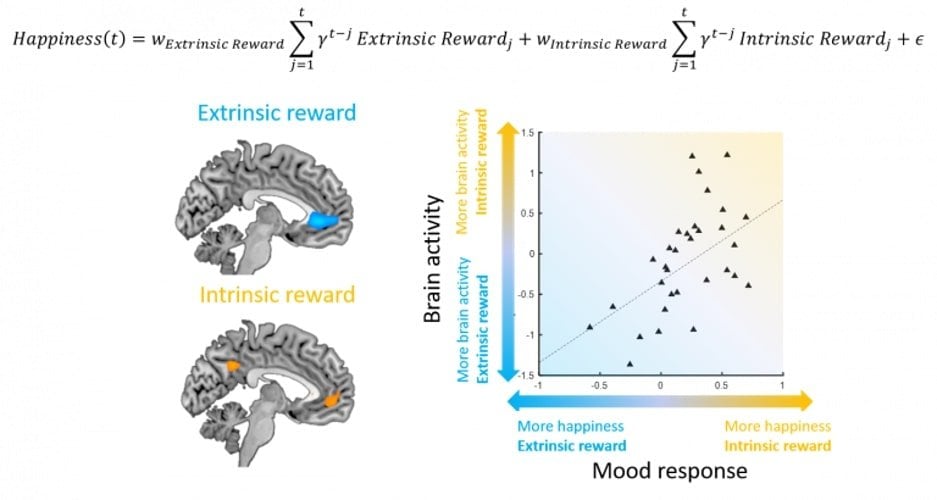
The research team developed a mathematical equation to determine how much intrinsic and extrinsic rewards contributed to the participants’ mood in a particular moment.

They found that people whose happiness was more swayed by intrinsic rewards had more activity in their ventromedial prefrontal cortex, a reward area, during intrinsic rewards compared to extrinsic rewards, and vice versa. These results provide a potential avenue to assess preferences without asking people outright.

This is a diagram from the study
The research team developed a mathematical equation to determine how much intrinsic and extrinsic rewards contributed to the participants’ mood in a particular moment. Credit: The Researchers

https://d7d87acbd8dbfd6fbc5632ced298bcbe.safeframe.googlesyndication.com/safeframe/1-0-38/html/container.html

Dr Bastien Blain, a Research Associate within the Centre’s Decision and Emotion team, who co-authored the study, said:

“Using mathematical equations, we can measure the value of any repeatable experience based on its impact on happiness. We use our mathematical equation to measure the intrinsic reward of skillfully navigating a simple maze and the extrinsic reward of earning money in a different task.

“Our mathematical equation lets us predict which individuals will have both more happiness and more brain activity for intrinsic compared to extrinsic rewards. The same approach can be used in principle to measure what people actually prefer without asking them explicitly, but simply by measuring their mood.”

Professor Robb Rutledge, Assistant Professor at Yale University and former Principal Investigator at the Centre, said:

“Over a century ago, Francis Edgeworth described an idealised instrument, which he called a hedonometer, for continually registering the height of pleasure experienced by an individual. Edgeworth’s idea is not actually as useful as it could be because you never know what it was that caused changes in happiness. Our ‘computational hedonometer’ can be used to tell how much people emotionally value experiences.”

About this math and neuroscience research news

Author: Press Office
Source: UCL
Contact: Press Office – UCL
Image: The image is credited to the researchershttps://d7d87acbd8dbfd6fbc5632ced298bcbe.safeframe.googlesyndication.com/safeframe/1-0-38/html/container.html

Original Research: Closed access.
A neurocomputational model for intrinsic reward” by Benjamin Chew, Bastien Blain, Raymond J Dolan and Robb B Rutledge. Journal of Neuroscience


Abstract

A neurocomputational model for intrinsic reward

Standard economic indicators provide an incomplete picture of what we value both as individuals and as a society. Furthermore, canonical macroeconomic measures, such as GDP, do not account for non-market activities (e.g., cooking, childcare) that nevertheless impact well-being.See also

This shows a marmoset

FeaturedNeurosciencePsychologyJune 27, 2021

Marmoset Study Identifies Brain Region Linking Actions to Their Outcomes

https://d7d87acbd8dbfd6fbc5632ced298bcbe.safeframe.googlesyndication.com/safeframe/1-0-38/html/container.html

Here, we introduce a computational tool that measures the affective value of experiences (e.g., playing a musical instrument without errors).

We go on to validate this tool with neural data, using fMRI to measure neural activity in male and female human subjects performing a reinforcement learning task that incorporated periodic ratings of subjective affective state.

Learning performance determined level of payment (i.e., extrinsic reward). Crucially, the task also incorporated a skilled performance component (i.e., intrinsic reward) which did not influence payment.

Both extrinsic and intrinsic rewards influenced affective dynamics, and their relative influence could be captured in our computational model. Individuals for whom intrinsic rewards had a greater influence on affective state than extrinsic rewards had greater ventromedial prefrontal cortex (vmPFC) activity for intrinsic than extrinsic rewards.

Thus, we show that computational modelling of affective dynamics can index the subjective value of intrinsic relative to extrinsic rewards, a ‘computational hedonometer’ that reflects both behavior and neural activity that quantifies the affective value of experience.

SIGNIFICANCE STATEMENT

Traditional economic indicators are increasingly recognized to provide an incomplete picture of what we value as a society. Standard economic approaches struggle to accurately assign values to non-market activities that nevertheless may be intrinsically rewarding, prompting a need for new tools to measure what really matters to individuals.

Using a combination of neuroimaging and computational modeling, we show that despite their lack of instrumental value, intrinsic rewards influence subjective affective state and ventromedial prefrontal cortex activity.

The relative degree to which extrinsic and intrinsic rewards influence affective state is predictive of their relative impacts on neural activity, confirming the utility of our approach for measuring the affective value of experiences and other non-market activities in individuals.