Summary: Study reveals how rhythmic brain activity shapes our perception.
Source: DPZ
Contrary to our intuition, the precision with which we perceive the real world is not stable in time, rather it rhythmically fluctuates between high precision and low precision states several times per second. These fluctuations follow rhythmic electrical activities in the brain. Electrical rhythms of the brain range across different frequencies, from 1 to 250 hertz.
Using these different frequencies the brain regulates how relevant information is transmitted between different brain regions. A group of neuroscientists from the German Primate Centre, Goettingen, Germany and the University of Melbourne, Australia has critically reviewed the evidence on this subject and shows how these frequencies may determine fundamental perceptual processes in the brain.
One basic phenomenon observed throughout brain areas is that slower rhythms (approx. 4 to 8 hertz) modulate the strength of a faster rhythm (approx. 40 to 80 hertz). This is known as cross-frequency coupling. The pair of frequencies coupled to each other varies, based upon the cortical area and its function for behavior.
In some instances, attention may cause nerve cells to become de-synchronized, allowing them to carry different informations, like when one string instrument plays a different melody from the rest of the orchestra. In others, attention may lead to the activation of large numbers of neurons to maximize their impact.
“These two different functions may be organized in the brain through cross frequency coupling,” says Moein Esghaei, one of the authors.
Distinguishing between different types of information
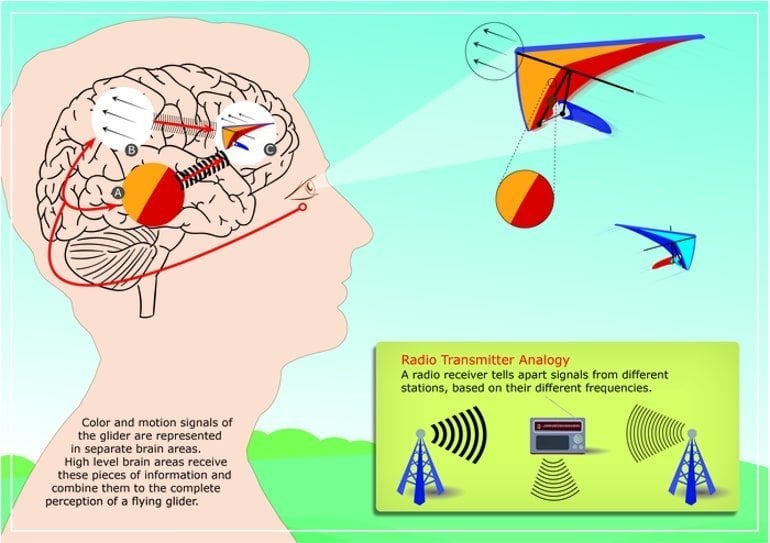
The simultaneous existence of different frequency bands in the brain also helps tagging different modalities of information arriving at the same brain region. For example colour and direction of a hang glider flying in the sky.
Similar to how a radio receiver identifies the radio transmitter from which a signal originates (inset at the right bottom), high level areas of our brain distinguish the source of a neural input activity based on its characteristic frequency. In the drawing of a human brain A and B mark brain areas devoted to analyzing color and motion direction information, respectively and C denotes high level brain areas that combine the information about individual visual features into a unified percept of visual objects. In this example, the color and motion direction of the tracked glider are separately analyzed in areas A and B, and then combined in area C to create our single perception of all the features of the glider. Credit: German Primate Center
“Our brain routes information about color and motion through different frequencies to higher order brain areas, just like telecommunication systems transmitting different types of information to the same receiver,” says Moein Esghaei.
“The rhythmic activity of neuronal networks plays a critical role for visual perception in humans and other primates,” summarizes Stefan Treue, head of the Cognitive Neuroscience Laboratory at the German Primate Center as a co-author.
“Understanding how exactly these activity patterns interact and are controlled, not only helps us to better understand the neural basis of perception, but also may help to elucidate some of the perceptual deficits in neurological conditions, such as dyslexia, ADHD, and schizophrenia.”
About this neuroscience research news
Author: Susanne Diederich Source: DPZ Contact: Susanne Diederich – DPZ Image: The image is credited to German Primate Center
Dynamic coupling of oscillatory neural activity and its roles in visual attention
Rhythmic neuronal activity has long been proposed to have a central role in information processing in the mammalian brain. Recent studies have documented a multitude of simultaneously active frequency bands.
These frequency components are often coupled, with the phase of a lower frequency modulating the power of a higher frequency rhythm [phase–amplitude coupling (PAC)]. We suggest that such coupling allows different scales of neural populations to interact and enables high-level cognitive functions, including selective attention.
We propose a scheme that outlines how changes in PAC during attention helps in sensory signal discrimination in early visual areas and in signal transmission in higher areas.
We suggest that dynamic coupling of distinct frequency bands provides a mechanism to functionally label and flexibly route signals from different sensory submodalities.
In most circumstances, disordered working conditions prevent us from performing accurate work. But in a reversal of this common wisdom, a team of researchers from the University of Adelaide and the University of St Andrews, Scotland has achieved recent breakthroughs in precision measurement by “scrambling” laser light.
The team was led by Professor Kishan Dholakia, who is jointly at the School of Biological Sciences, University of Adelaide and the School of Physics and Astronomy, University of St Andrews.
“We have used the wave properties of light to create grainy patterns due to interference, termed ‘speckle,” which offers a sensitive probe of both the light and the environment,” he said.
“The approach will advance optical and quantum sensing technology, enhance the performance of next-generation sensors, and lead to new measuring devices, which may have a variety of uses including in healthcare.”
Professor Kishan Dholakia worked with Morgan Facchin and Dr. Graham Bruce from the University of St Andrews.
“We have scrambled light into a grainy pattern known as ‘speckle’ by using either a piece of glass fiber the width of a human hair or a hollow sphere where the light bounces around many times before emerging,” said Professor Dholakia.
The principle of speckle can be easily demonstrated visually.
“If you shine a laser pointer on a rough surface like a painted wall, or a piece of frosted sticky tape, the light from the laser gets scrambled into the grainy speckle pattern,” said Professor Dholakia.
“Normally, we think that scrambling a signal means that we must lose information, but that’s not the case here. If you move the laser the exact pattern you see will change dramatically. It is this sensitivity to change that makes speckle a good choice for precision measurement.”
Work already carried out by the team used these speckle patterns to measure the wavelength—or color—of light at a precision of an attometer, which is equivalent to measuring the length of a soccer pitch with an accuracy equivalent to the size of one atom.
In the latest advance, the team have used speckle to measure the refractive index of gases. The refractive index of a material tells us how fast light travels in that material, and changes in this refractive index can be used to look for subtle changes in a material’s properties.
Writing in the journal ACS Photonics, the team reported measurements of the refractive index of air to one part in a billion—orders of magnitude improvement over previous speckle-based approaches.
Small changes in refractive index can have major implications for sensing. For example, infection can cause the refractive index of your red blood cells at a level that would easily be picked up by this sensor. The team hopes to advance this work not only for healthcare but also for field portable sensors that will have various applications, including detection of trace gases or small concentrations of chemicals in liquids.
More information: Morgan Facchin et al, Measurement of Variations in Gas Refractive Index with 10–9 Resolution Using Laser Speckle, ACS Photonics (2022). DOI: 10.1021/acsphotonics.1c01355
For college students whose childhoods included one or more major traumas—living with food insecurity or witnessing violence near home, which in the latest Student Voice survey impacted 20 percent and 15 percent of students, respectively—it’s easy to see higher education as a privileged space that doesn’t care about what they’ve endured in life. But when an invitation to share is built into campus life, students are more likely to feel honored and understood.
Take the University of Maryland, Baltimore County, as an example. Students coming to the campus from urban Baltimore, right next door, “wrestle with these issues all the time,” says Delana Gregg, director of academic learning resources, assessment and analysis with UMBC’s Academic Success Center. “It’s part of our curriculum to care about our community and find ways for students’ stories to come into the classroom. We’re actively trying to get these stories.”
A challenge for higher ed during COVID has been maintaining focus amid a continuously evolving public health threat. “At some point with a crisis on campus, you deal with it and then it goes away and then there’s some level of normalcy,” says Fran’Cee Brown-McClure, vice president for student affairs and dean of students at Union College, in New York. “That hasn’t happened since March 2020. It’s been constant crisis with no break.”
Officials at many institutions believe they’re doing pretty well supporting students, especially considering the extra resources invested in various support areas since the pandemic initially shuttered campuses. “Institutions very often think that they are forward-facing, inclusive and supportive, that students really know they understand and care about them,” says Sarah Whitley of NASPA: Student Affairs Administrators in Higher Education. Whitley, assistant vice president for its Center for First Generation Student Success, isn’t so sure students get that impression.
In the Student Voice survey of 2,003 college undergrads from Inside Higher Ed and College Pulse, with support from Kaplan, one in four respondents disagree at least somewhat that their college understands the connections they have to their families and home communities. In addition:
One-third of students disagree at least somewhat that their colleges are responsive to the needs of all students.
Nearly one in four disagree at least somewhat that their college makes an effort to understand their current experiences and challenges.
Following are 10 ideas for building stronger connections with students and turning those “disagree” findings around.
1. Educate campus leaders and teams about the range of student traumas.
Significant numbers of Student Voice respondents disclosed having gone through an adverse childhood event, either personally or as a member of their household. Forty-five percent identified depression or other mental health issues, 28 percent experienced emotional abuse and 27 percent dealt with the effects of long-term unemployment, for example.
“It’s a depiction of what our students are navigating,” says Whitley. “They have had hard times.”
Campus mental health services are generally adept at helping students who have dealt with common life events like divorce and death of a grandparent, but they tend to fall short in helping “those from certain neighborhoods likely to get a call that so-and-so got shot,” says Anthony Abraham Jack, an assistant professor at Harvard University’s Graduate School of Education and author of The Privileged Poor: How Elite Colleges Are Failing Disadvantaged Students (Harvard University Press). “The range of traumas in students’ lives go beyond the standard XYZ.” This is especially important, Jack will tell presidents, “as we diversify our campuses with students who come from disadvantaged communities.” Campus teams must understand that someone who has been evicted once has a higher chance of it happening again, and a family that has experienced food insecurity and is one paycheck away from being broke will probably be hungry again, he adds.https://e.infogram.com/9077dd50-22c3-453a-a8ba-a464cad1b646?parent_url=https%3A%2F%2Fwww.insidehighered.com%2Fnews%2F2022%2F02%2F02%2F10-ways-strengthen-connections-students-so-they-feel-seen&src=embed#async_embed
2. Ask faculty members to examine syllabi and gradebooks through a racial/equity lens.
Work at the Center for Urban Education at the University of Southern California’s Rossier School of Education has focused on developing open-access tools to engage faculty, student support staff and administrators in understanding how their practices are creating racialized patterns in their educational outcomes, explains Estela Mara Bensimon, founder of the center and a university professor emerita. One tool helps professors gain awareness of how white-centric their syllabus language and course content are. And a gradebook-mapping tool allows professors to notice if, for example, Black and Latinx students tend to wind up with C’s rather than B’s or A’s—and, with the realization that the course isn’t working for students in these groups, to make changes.
“Often faculty may want to do the right thing—they want to perform equally for all their students—but they don’t have the tools to understand why they don’t,” says Bensimon. As the description of the project notes, the issue isn’t to “not be racist,” but rather “whether policies and practices produce racist or antiracist outcomes.”
3. Seek the input of professors, staff and students.
Poku will eat lunch with students and attend club events and activities to build relationships with them. “When you’re in their space, it’s different. You have a chance to hear things differently,” she says.
She also tries to engage students in major projects, such as a guide to creating a gender-affirming campus developed with the help of two students. “It was a summer project. They brought new resources, did their own research on articles and added topics they thought we should include,” says Poku.
Student Voice explores higher education from the perspective of students, providing unique insights on their attitudes and opinions. Kaplan provides funding and insights to support Inside Higher Ed’s coverage of student polling data from College Pulse. Inside Higher Ed maintains editorial independence and full discretion over its coverage.
Presented by
4. Gather institutional data on how much students feel understood.
Having national trend data is a start, but campus leaders can best act on insights about students feeling understood, or not, by conducting their own surveys, says Kristine Goodwin, who recently began a role at Western New England University as vice president of student affairs. She might ask, “Can you name a faculty member, administrator or mentor who sees you, knows you, gets you and encourages you?” And then the idea would be to have students actually name the person. “I’d love to show custodians or dining people that their relationships and their communication with students matters,” she says.
5. Spend time with frustrated students, not just high-performing student leaders.
Just 17 percent of Student Voice respondents agree strongly that their university’s leaders “see” them, while 11 percent disagree strongly. A big reason for the masses not connecting with administrators may be presidents and other top-level officials not seeking out a mix of students to interact with regularly, either in one-on-one conversation or small groups. “We have long-standing relationships with student leaders. For everyone else, it’s come and go,” says Goodwin.
That gives officials limited perspective. “College presidents cherry-pick, and once they have their one or two spokespeople, they ride them until they graduate,” says Jack. “It drowns out the rest of the student body.”
Poku is impressed by one administrative colleague at Wheaton who posts open office hours for any student to drop in. “That’s symbolic, and there’s also substance,” she says, adding that administrators also need to seek out students “who are falling through the cracks, who are most frustrated with the institution, to hear their thoughts and concerns.”https://e.infogram.com/d2e9e3f2-5579-424e-9608-27ea4293f630?parent_url=https%3A%2F%2Fwww.insidehighered.com%2Fnews%2F2022%2F02%2F02%2F10-ways-strengthen-connections-students-so-they-feel-seen&src=embed#async_embed
6. Assign students an advocate.
UMBC’s Academic Advocacy model helps connect individual students with one caring person—their assigned academic advocate—who can really get to know that student’s “needs and experiences, and help make the connections with the right resources at the right time,” says Gregg. Even then, the student is not on their own because the advocate can step in as roadblocks appear. Faculty members refer students to the program and an advocate will be assigned to, as they’ll tell students, “help with anything that might get in the way of your academic goals.”
The institution also has first-year academic advocates, dedicated to helping first-time, full-time, degree-seeking undergrads work through academic and institutional challenges.
7. Ensure facilities and dining staff know they’re part of the student support team.
First-generation Student Voice respondents attending private institutions are the most likely group to identify janitorial or other facilities staff, or dining hall workers, as employees who “see” them. But even about one in 10 of the full sample identified these types of employees as part of their “village.”https://e.infogram.com/47b69388-ea69-419b-842c-41c85bdce096?parent_url=https%3A%2F%2Fwww.insidehighered.com%2Fnews%2F2022%2F02%2F02%2F10-ways-strengthen-connections-students-so-they-feel-seen&src=embed#async_embed
Brown-McClure from Union will lead an “all-hands-on-deck” meeting with housekeeping and dining teams at the beginning of the year. “I’ll say, ‘You’re a part of this community. If anything ever comes up with a concern for a student, we want you to know where you can go to share that’ … I don’t ask regularly, ‘What do you know or have you heard?’ They’re generally coming to me,” she says.
A report might come in about a particular corridor or even a specific bathroom stall, and during a case management meeting, a counselor could begin sharing information of concern about a student. Suddenly the team realizes that student lives in the exact spot the housekeeping report involved. “We start to put these puzzle pieces together,” says Brown-McClure, noting that she has seen this model with clusters from particular programs work at larger institutions as well.
Conduct-tracking software can even help staff identify something like a student having a pattern of behavior, such as intoxication each year around the same time. “It may come out that this is the anniversary of some traumatic event,” Brown-McClure explains. “It’s about having access to the data and asking questions and saying, ‘There’s something happening here.’”
8. Include disabilities in conversations about diversity.
College students are somewhat evenly split on how much they agree that their colleges are responsive to the needs of all students. Those with learning disabilities are more likely to disagree that student needs are being met.
Elisa Laird, associate executive director for professional development at AHEAD, the Association on Higher Education and Disability, would like to see institutions strengthen relationships with students with disabilities—and “normalize disability as just another aspect of diversity,” she says. Including disability in diversity, equity and inclusion efforts is currently part of the structure at some colleges but not others, Laird adds. But regardless, “everybody could be working together and reaching across campus to create safety nets for all students.”https://e.infogram.com/6bd9e5e4-8d51-4645-85d3-d4bfc7277977?parent_url=https%3A%2F%2Fwww.insidehighered.com%2Fnews%2F2022%2F02%2F02%2F10-ways-strengthen-connections-students-so-they-feel-seen&src=embed#async_embed
9. Encourage creative reflection about barriers to success.
UMBC offers a journaling class that helps students process challenges and barriers they’ve encountered. When Gregg has taught the class to those on academic probation (another section is for new students), she introduces it as a safe space to help get them back on track with their goals. Besides the instructor, students get support from an adviser and a financial aid counselor. “I tell students, ‘We are circling the wagons around you this semester, and we can get you completely set up for success,’” she explains.
Journal prompts cover topics such as emotional intelligence, time management and taking personal responsibility. “You can take an active role in taking control, or you can passively let things happen,” she says. “Giving students that ownership over their goals really helps. They feel like they have hope.”
10. Offer tough love where accountability is needed.
Encouraging students to seek help often results in relationship forming and trust building. Poku’s office at Wheaton worked with the film and media studies department on a film featuring students talking to other students about fears related to asking for help, plus the importance of actually doing so, she says. The idea is to create a culture where reaching out for assistance comes naturally.
However, sometimes students need a reminder that requesting help isn’t just about being allowed flexibility and leeway, such as with professors on deadlines. Academic advisers or coaches at Union find themselves having conversations with students who need to shift their approach. “If no one is following up, you think your behavior can continue,” says Brown-McClure. Rather than asking for help and sitting back to let someone else handle the situation—a safety net that won’t be there in postcollege life—students may be told it’s time for self-advocacy and action.
“We acknowledge where they are, that life happens,” she explains, “but also give them the tools to equip themselves with what they need to move forward.”
Read more about results from this Student Voice survey and how precollege experiences and student identities shape the challenges they face and connections they make. Access to the data is also available upon request.
3 Teaching Exercises for Mindfulness in the Classroom
Mindfulness can be an off-putting concept for some instructors, but it offers an opportunity to truly connect with students as they access knowledge and express their ideas, argues Irina Popescu.
My students are in crisis—actual crisis. They are severely anxious, depressed and distressed. They have told me as much over countless office hours, lunches and phone conversations.
I sound like a broken record, but I am not a mental health counselor. I often wish I could go back in time and become one, but that’s not in the cards for me. Yet, especially in my small liberal arts campus, students turn to faculty for emotional support quite often. In this pandemic world, we all want to feel heard and cared for, and that desire has made me reassess what is important for my teaching practice.
I honestly believe that we all need to start doing higher education differently at the current moment and create lasting changes—not just temporary ones. For me, those changes have been tied to one main component that I’ve added to my teaching practice: mindfulness inside the classroom.
Mindfulness can often be an off-putting concept and practice for some educators. Many faculty members across various campuses have told me that mindfulness is not something they can use in their classes because it feels hokey and inauthentic—and like it has nothing to do with their course materials. The fear that students will express resistance to mindfulness is something I have often heard, as well.
What I want to say in response to all that resistance is something that Beth Berila articulated in her wonderful book Integrating Mindfulness Into Anti-Oppression Pedagogy: “Students need to have space to process their emotions, and they need to be taught to do so in productive and compassionate ways.” Mindfulness practices allow students to feel heard, welcomed, included and cared for within the classroom space. This feeling of inclusivity is not always as readily available and accessible to all students, especially now. Mindfulness also offers you, as an educator, the opportunity to take a step back from your role and truly connect with your students as they access knowledge and express their distinct ideas and interpretations.
For the past two years, I’ve worked with many current and former students who are struggling to define their own journey within higher education, both as learners and knowledge producers. Based on those conversations, I’ve decided to make mindfulness a weekly focus for all my courses at least once a week, for five to 10 minutes, usually at the beginning of the class. I have incorporated many tactics of mindfulness into my teaching, and here I outline a few that I hope will be useful to anyone who wants to give students a moment to take a pause and take a breath.
Meditative Body Scan
One way to facilitate an awareness of mind and body within the classroom right away is simply to engage students in a three-minute breathing meditation and body scan at the beginning of a class session. In short, I invite students to close their eyes and focus on their breathing, trying to slow it down a bit. I then ask them to scan their bodies, from the top of their heads all the way to their toes, while breathing deeply in and out. I tell them to name any sensations they’re feeling but not to judge those sensations as they continue to breathe and scan downward. Finally, I have them open their eyes and write down what they’ve been feeling.
This kind of naming body scan helps students come into the classroom space, to feel their minds and bodies move from outside to inside the classroom. Often, I will have students talk to someone else in the class for one minute—not specifically about their mediation but about anything that comes to mind. Still, more often than not, they discuss the meditation. This functions as a kind of icebreaker and allows students to engage with one another within the classroom in a less academically structured way.
This whole exercise takes no more than five minutes and, in my experience, has greatly increased student participation for the remainder of the class. In several exit tickets and midsemester reviews, students, almost unanimously, reflected on how important these mindful activities have been for their mental well-being, “ability to feel present and heard,” and “desire to participate and engage with classmates and course materials.”
An effective way to transition between the meditative body scan to the course materials is to have students engage in conceptual puzzles that I design based on the readings for that particular day. I present students with a quote, image or video near the beginning of class—usually after our meditative moment—and set a two- to three-minute timer while students journal about it. They can draw, write a list of words, create a poem or simply respond in sentences. I will often incorporate another meditative pause after I stop the timer when students close their eyes and let their ideas settle around them.
Sometimes the brain teaser questions also deal with emotional responses to a text or image, which allows students to connect their own affective registers to course materials. When we come back together as class, I have students engage in a five-minute, student-led discussion in which they share their responses to their brain teasers.
Those discussions are some of the best we have in the class. I am silent, a mere listener, as students engage with one another. The focus on what each of their peers has to say really impacts and enhances active listening practices in the classroom. Although I teach humanities courses, such an activity would certainly transfer to any discipline—especially math, for instance, within a problem-set brain teaser.
An example of a brain teaser for my feminist theory course this semester was as follows:
“For the master’s tools will never dismantle the master’s house.”
Directions: Spend a moment or so picking the quote that most stands out to you here. Ponder why it stands out to you. How does the quote make you feel? Really try to memorize this quote before closing your eyes. Close your eyes. Visualize the quote you selected. What is it saying? What images appear in your mind? How can you apply it to your own life experiences? Gently open your eyes as the music starts. Spend two minutes discussing your visualizations with a partner.
Often these brain teasers deal with issues and constructions of race, ethnicity and gender in the Americas, as those are the types of courses I teach. That means that I often create brain teasers to allow students to engage with difficult and often discomforting topics—first on their own terms and then within the larger group.
Scavenger Hunt
This particular activity works well at the beginning of a semester as a kind of icebreaker, yet it can also work during a class in which you feel that students need to take some time to come together and get to know one another. It allows students to tell stories about themselves using objects you have preselected, and you can do it not only inside but outside the classroom if you are meeting that way. I have done this activity in my smaller discussion-based courses, which tend to have about 16 students. It encourages storytelling, sharing and active listening. Here is the script that I give students:
Directions: There are several objects around the trees near our table. Walk around and set your eyes on one object that speaks to you, one object that you naturally gravitate toward for whatever reason. Do not question it—just let your body and mind decide. Touch the object, smell it, look at it, explore it with your senses. Go for a walk with your object and reflect on the following questions in your walking meditation: Why this object? What does this object reveal about who you are?
When we come back together after a few moments of self-reflection, I invite students to share the object they chose and, if comfortable, the reasoning for their choice. They then talk for one minute before passing the microphone to the next speaker.
A Collective Deep Breath
Again, mental health issues are off the charts on our campuses and drastically impact the way our students learn, communicate and feel heard. As educators, we all need to take a major collective deep breath and pause for a minute to consider what is really important and how to best create an environment that helps rather than hinders. I’ve found that the incorporation of mindful activities, even for just five minutes once a week, greatly impacts students’ well-being inside and outside the classroom.
Bio
Irina Popescu is a visiting professor of Latin American studies at Bowdoin College. She teaches courses on human rights in the Americas. She has written pieces on anti-oppression pedagogy in Inside Higher Ed and other publications.
Monitoring of industrial assets often relies on high-frequency (HF) signal measurements. One difficulty of dealing with such measurements in the industrial context is the conciliation between the high-frequency sampling and low-dimensional decision states (e.g., healthy/unhealthy), in a context where, very often, labels are not available. Here, we propose a fully unsupervised deep-learning framework for high-frequency time series that is able to extract meaningful and sparse representation of raw signals and is able to handle different lengths of time series flexibly, overcoming thereby several of the limitations of existing deep-learning approaches. The decomposition framework will be very useful for handling in an automatic manner high-frequency signals and is an important basis for future applications with HF data.
Abstract
High-frequency (HF) signals are ubiquitous in the industrial world and are of great use for monitoring of industrial assets. Most deep-learning tools are designed for inputs of fixed and/or very limited size and many successful applications of deep learning to the industrial context use as inputs extracted features, which are a manually and often arduously obtained compact representation of the original signal. In this paper, we propose a fully unsupervised deep-learning framework that is able to extract a meaningful and sparse representation of raw HF signals. We embed in our architecture important properties of the fast discrete wavelet transform (FDWT) such as 1) the cascade algorithm; 2) the conjugate quadrature filter property that links together the wavelet, the scaling, and transposed filter functions; and 3) the coefficient denoising. Using deep learning, we make this architecture fully learnable: Both the wavelet bases and the wavelet coefficient denoising become learnable. To achieve this objective, we propose an activation function that performs a learnable hard thresholding of the wavelet coefficients. With our framework, the denoising FDWT becomes a fully learnable unsupervised tool that does not require any type of pre- or postprocessing or any prior knowledge on wavelet transform. We demonstrate the benefits of embedding all these properties on three machine-learning tasks performed on open-source sound datasets. We perform an ablation study of the impact of each property on the performance of the architecture, achieve results well above baseline, and outperform other state-of-the-art methods.
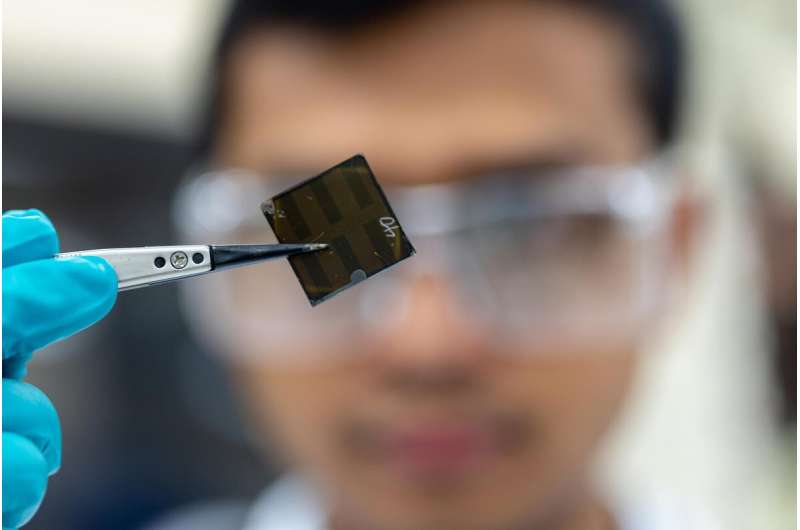
First author Randi Azmi holds the perovskite film on the glass substrate. Credit: King Abdullah University of Science and Technology
As global sustainability and clean energy megatrends impact how we approach energy strategies toward a greener future for the planet, renewable technologies such as wind and solar are leading areas of focus for research. In the solar technology space, the emerging field of perovskite solar cells (PSCs) has gained popularity within the last decade and a half for offering high power conversation efficiencies (PCEs).
However, in a field dominated by silicon solar cells, the relatively new technology must also meet two other crucial requirements to be successfully commercialized: stability and scalability.
In a recently published Science paper, “Damp heat–stable perovskite solar cells with tailored-dimensionality 2D/3D heterojunctions,” KAUST researchers reported a significant milestone through the first-ever successful photovoltaic (PV) damp-heat test of PSCs.
The damp-heat test is an accelerated and rigorous environmental aging test aimed at determining the ability of solar panels to withstand prolonged exposure to high humidity penetration and elevated temperatures. The test is run for 1,000 hours under a controlled environment of 85% humidity and 85 degrees Celsius. It is meant to replicate multiple years of outdoor exposure and evaluate factors such as corrosion and delamination.
Passing the test
The harshness of the test is in line with commercialization requirements that states PV technology must cover 25 to 30 years of warranty for conventional crystalline-silicon modules. In order to pass the test, the solar cell has to maintain 95% of its initial performance.
Led by first author Randi Azmi, a postdoctoral fellow in professor Stefaan De Wolf’s KAUST Photovoltaics Laboratory, their research had to overcome an enduring weakness in encapsulated PSCs to prevent packaging leakage.
Applied through a thin-film coating process, perovskites are sensitive and highly affected by the presence of humidity. This vulnerability of the 3D perovskite films allows an unwanted infiltration of atmospheric agents, such as moisture, with limited resilience against heat. Stability is essential to their functioning.
KAUST researchers found that engineering and introducing 2D-perovskite passivation layers blocked the moisture and simultaneously enhanced the power conversion efficiencies and lifetime PSCs.
The specificity of perovskites is that it’s a thin-film technology. As is the case with conventional solar cells, two contacts made of specific types of materials are still required. One collects electrons, and the other collects positively charged ‘holes,’ which represent the absence of electrons. Unlike silicon wafers, perovskite ink can be coated directly on a glass substrate, coupled with antisolvent extraction, followed by thermal annealing to fully crystallize the perovskite film. The perovskite ink is essentially formulated from a mixture of salts in a polar aprotic solvent at a low-temperature (typically lower than 100 Celcius).
One of the significant advantages is that precursor materials can be made without the need for expensive facilities and energy-intensive environments exceeding 1,000 degrees, which is typical for more traditional semiconductors such as silicon.
“It’s a very simple way to make solar cells,” said De Wolf. “While the optoelectronic properties are not unique, they are excellent. They’re on-par with very high-quality traditional semiconductors. That’s quite remarkable.”
By altering the composition, he said it’s also possible to tune the spectral sensitivity across the solar light spectrum from UV up to infrared. “This is quite attractive for certain applications.”
The remaining challenge, after performance and stability, is scaling. Most solar cell applications are focused on utility-scale sectors and rooftop panels. While the latter is not prominent in Saudi Arabia, utility projects being pursued in the Kingdom include large PV fields in the desert.
“The market is silicon-based, and it will be silicon-based for the next 20 years at least,” said De Wolf. The KAUST Photovoltaics Lab is mainly focused on improving the performance of perovskites solar cells in order to advance more efficient “tandem” solutions, pairing both traditional silicon and perovskites.
To this end, he said the current findings will aid much in increasing the reliability of perovskite-silicon tandem solar cells.
Episodic memory is “remembrance of things past,” such as when, where, and with whom a specific personal experience occurred.
As we age, episodic memories tend to fade. Age-related episodic memory decline usually happens gradually across the adult lifespan.
A meta-analysis of 36 studies found that aerobic exercise improves episodic memory in late adulthood if people start doing cardio by age 55.
Source: Igogosha/Shutterstock
Shakespeare’s “fair youth” Sonnet 30 captures the essence of what it’s like to recall episodic memories. The opening stanza says, “When to the sessions of sweet silent thought, I summon up remembrance of things past.” After reminiscence of loss and regret, the poem ends on an optimistic note, “But if the while I think on thee, dear friend, All losses are restor’d, and sorrows end.”
Unfortunately, summoning happy and restorative memories of the people and places of our past gets harder as “fair youth” turns to old age. Episodic memories tend to fade over time. Crystal clear recollections of precisely when, where, and with whom something happened get fuzzier as we get older.
Age-related memory decay occurs gradually across the adult lifespan. Notably, one of the first cognitive domains to decline in late adulthood is episodic memory.
Staying Active Keeps You Strong—Especially If You Start Sooner Than Later
A recent systematic review and meta-analysis of 36 studies involving 2,750 participants found that aerobic exercise improves episodic memory in late adulthood. These findings (Aghjayan et al., 2022) were published on February 17 in the peer-reviewed journal Communications Medicine.
“Aerobic exercise positively influences episodic memory among adults ≥55 years without dementia,” the University of Pittsburgh authors explain.
Cardio workouts were most effective at improving episodic memory if people were in their mid-50s and exercised regularly three times a week for at least 18 weeks.
Don’t Wait Till You’re 69 to Start Doing Cardio
“We found that there were greater improvements in memory among those who are age 55 to 68 years compared to those who are 69 to 85 years old—so intervening earlier is better,” first author Sarah Aghjayan said in a news release.
“Everyone always asks, ‘How much should I be exercising? What’s the bare minimum to see improvement?'” she added. “From our study, it seems like exercising about three times a week for at least four months is how much you need to reap the benefits in episodic memory.”
More research is needed to pinpoint exactly how long (duration) and how vigorously (intensity) people should be doing cardio to improve episodic memory. Some research studies suggest that high-intensity interval training (HIIT) has the most memory-boosting power.
In contrast, other studies indicate that as little as 15 minutes of moderate-to-vigorous physical activity (MVPA) a few times a week can offset cognitive decline.
article continues after advertisement
Due to a lack of high-quality human research data on the dose-response of different exercise intensities, this meta-analysis was unable to glean insights about the optimal duration and intensity of cardio workouts to improve episodic memory in late adulthood.
Take-Home Message
Doing cardio at any intensity for 15-90 minutes three times per week for at least four months appears to improve episodic memory for people ages 55 to 68.
Because there aren’t pharmaceutical treatments that can prevent or reverse episodic memory deterioration, Aghjayan et al. posit that aerobic exercise is a valuable non-pharmaceutical way to sustain episodic memory as we age. Their meta-analysis of three dozen studies also suggests that starting by age 55 seems to be key.
Disclaimer: This blog post is not intended as medical advice. Before starting any new workout regimen, consult with your healthcare provider—especially if you’re in late adulthood and haven’t been doing cardio regularly.
LinkedIn image: Monkey Business Images/Shutterstock
References
Sarah L. Aghjayan, Themistokles Bournias, Chaeryon Kang, Xueping Zhou, Chelsea M. Stillman, Shannon D. Donofry, Thomas W. Kamarck, Anna L. Marsland, Michelle W. Voss, Scott H. Fraundorf, Kirk I. Erickson. “Aerobic Exercise Improves Episodic Memory in Late Adulthood: A Systematic Review and Meta-Analysis.” Communications Medicine (First published: February 17, 2022) DOI: 10.1038/s43856-022-00079-7
It’s time to start letting go of the shame of daydreaming and be proud of being scatterbrained.
Many parents and teachers are concerned when they see children or teens daydreaming or spacing out. They wrongfully assume that daydreaming is not “productive” and is, therefore, a waste of time.
This wandering attention is how you can come up with new ideas, find inspiration, and problem-solve creatively, which is not only useful but also quite productive.
Focused Attention and ‘The Thinking Brain’
On busy days, your brain spends most of the time purposefully assembling, managing, and applying information while engaging in actions, behaviors, and self-expression.
Focus your attention on a variety of situations, people, problems, and solutions. This focus results from interactions between three parts of the brain: lower, middle, and frontal.
The lower brain works mostly out of our consciousness, monitoring sensory information and events in your environment and running the physiological systems that keep you alive.
The mid-brain monitors and processes emotions, manages memory, and acts as a relay station for the brain.
The frontal lobes, also called the prefrontal cortex, are often called “the thinking brain.”
It houses executive functioning skills like planning, organizing, sequencing, self-reflection, and impulse control that push away distractions and point the mind to a single task or thought.
The prefrontal cortex is the last part of the brain to develop at age 25 or so and is specifically affected by having ADHD.
Of course, cultural norms, technology, and trauma all affect our attention, as people learn to navigate through their lives, society, and the world at large.
Wandering Attention and ADHD
You’re bombarded by information every moment of every day, which creates what Goleman refers to as the “neural buzz” in the brain.
This “buzz” can easily interrupt you and overwhelm your capacity to manage your focus through your “thinking brains.”
Children, teens, and adults with ADHD have brain systems that are associated with creative mind-wandering. There’s some thinking that “zoning out” might actually be a time when innovative connections between new ideas are occurring.
When you make space for wandering attention, you not only give yourself more opportunity for creativity and connection, you also help minimize that persistent and overwhelming “neural buzz.”
Moreover, open awareness and mind drift are powerful tools for boredom relief and metacognitive thinking.
So, what does this mean for you and/or your child? Simply put, allow for some downtime — time when the brain can free-associate and take a break from the demands of technology, relationships, academics, and performance.
Here are 4 ways to let your wandering mind work its creative magic.
1. Create technology-free time.
Use technology-free time for whatever else you or they want to do, including, and especially, nothing. Set limits for this time if your child is struggling with “doing nothing.”
Consider making a list of “nothing” activities that foster brain breaks. Examples of low dopamine activities are reading, listening to music, playing in the yard, and taking a walk.
Get breaking news & relationship advice delivered to your inbox daily!
2. Explore the great outdoors.
Spending time in nature is one of the best ways to let your mind rest and your body recharge. The key is to pick an activity that you enjoy or your family enjoys doing together.
Hiking, biking, swimming, and canoeing are all wonderful activities. If your child prefers something less active, bring a picnic lunch to the park, fly a kite, build a snowman or gather shells at the beach.
3. Play with a pet.
Playing with pets is a fun way to unplug and unwind. Most kids have a natural affinity with animals, and walking a dog or taking care of a pet for a weekend can be an uplifting experience for people of all ages.
Meditation is a particularly helpful tool for parents. It often helps with regaining perspective in times of stress, increasing self-awareness, and practicing patience. Fortunately, there’s now a myriad of guided meditation apps and videos you can try to help you practice on occasion or in a new routine.
The time for letting go of the shame of daydreaming is now.
You benefit, in many ways, from zooming out and letting your mind wander. In the same way you feel recharged after a good vacation or a relaxing day at home, you need to give your mind a break from the constant buzzing.
Find an activity or two which will help you take a break and kickback. A little bit of doing nothing is sometimes better than constantly doing something.
Sharon Saline, Psy.D., is an international lecturer and workshop facilitator and has focused her work on ADHD, anxiety, learning differences, and mental health challenges and their impact on school and family dynamics for over 30 years. For more information, visit her website.
This article was originally published at drsharonsaline.com. Reprinted with permission from the author.
New technique amplifies weak optical signals while reducing noise
21 Feb 2022
A technique that can amplify weak optical signals, while simultaneously reducing noise has been developed by researchers in Canada. By exploiting the Talbot effect, the team showed how arbitrarily-shaped signals can be reliably detected, even when buried in background noise. The research was led by José Azaña and Benjamin Crockett at Quebec’s National Institute of Scientific Research.
The ability to detect weak, noisy optical signals is important in many aspects of science and technology. These include long-range telecommunications, where signals are weakened as they propagate through optical fibres; and biomedical imaging, where weak light beams are necessary to avoid damage to delicate living tissues.
Weak signals can be enhanced using active amplification, but this worsens the signal to noise ratio. Passive methods such as filtering-out noise tend to also attenuate the signal of interest, and do not work for signal bandwidths narrower than a few gigahertz.
Self-imaging effect
To address these problems, Azaña’s team turned to a passive amplification technique derived from the Talbot self-imaging effect, which occurs when light passes through an optical grating. It is a diffraction effect that can be used to combine successive light pulses by “stacking” them on top of each other – creating more powerful pulses. So far, however, this technique has been incompatible with the non-periodic, arbitrary waveforms found in most practical optical signals.
Building on previous work, Azaña and colleagues used a more advanced form of the Talbot setup to passively redistribute the energy of a weak signal into a high-intensity pulse. Crucially, this could be done without distorting the waveforms of the signals. The technique also reduced the overall signal-to-noise ratio. This enabled the researchers to amplify non-periodic signals by a factor of more than 100, while reducing relative noise in the measured signal.READ MOREQuantum carpets, carpets of light
Such a powerful approach could allow light sensors to pick up optical signals well below their current detection thresholds – signals that are buried deep within a noisy background. Furthermore, the technique is compatible with bandwidths spanning several orders of magnitude, from kilohertz to gigahertz. This enabled the team to amplify a diverse range of technologically relevant optical signals from ultra-narrowband waveforms to broadband signals.
Azaña’s team envisage a wide array of potential applications for their approach. They hope that it could be adapted to convey 2D and 3D images – with promising potential uses in fields including astronomy, photography, and holography. With further improvements, their Talbot effect concept could also be adapted to amplify noisy signals carried by other wave types. These may include additional electromagnetic wavelengths, sound, and potentially even quantum matter waves.
WHY YOUR BRAIN IS A “TIME MACHINE” LIVING 15 SECONDS IN THE PAST
Seeing is not believing.
Shutterstock
DAVID WHITNEY AND MAURO MANASSI
2.21.2022 3:00 PM
OUR EYES are continuously bombarded by an enormous amount of visual information — millions of shapes, colors, and ever-changing motion all around us. For the brain, this is no easy feat. On the one hand, the visual world alters continuously because of changes in light, viewpoint, and other factors. On the other, our visual input constantly changes due to blinking and the fact that our eyes, head, and body are frequently in motion.
To get an idea of the “noisiness” of this visual input, place a phone in front of your eyes and record a live video while you are walking around and looking at different things. The jittery, messy result is exactly what your brain deals with in every moment of your visual experience. This can be seen also in the video below. The white circle on the right shows potential eye movements, and the blurry blob on the left reveals the jumpy visual input in every moment.
Yet, seeing never feels like work for us. Rather than perceiving the fluctuations and visual noise that a video might record, we perceive a consistently stable environment. So how does our brain create this illusion of stability? This process has fascinated scientists for centuries and it is one of the fundamental questions in vision science.
THE TIME MACHINE BRAIN
In our latest research, we discovered a new mechanism that, among others, can explain this illusory stability. The brain automatically smoothes our visual input over time. Instead of analyzing every single visual snapshot, we perceive in a given moment an average of what we saw in the past 15 seconds. So, by pulling together objects to appear more similar to each other, our brain tricks us into perceiving a stable environment. Living “in the past” can explain why we do not notice subtle changes that occur over time.
In other words, the brain is like a time machine that keeps sending us back in time. It’s like an app that consolidates our visual input every 15 seconds into one impression so that we can handle everyday life. If our brains were always updating in real-time, the world would feel like a chaotic place with constant fluctuations in light, shadow, and movement. We would feel like we were hallucinating all the time.
We created an illusion to illustrate how this stabilization mechanism works. Looking at the video below, the face on the left side slowly ages for 30 seconds, and yet, it is very difficult to notice the full extent of the change in age. In fact, observers perceive the face as aging more slowly than it actually is.
To test this illusion we recruited hundreds of participants and asked them to view close-ups of faces morphing chronologically in an age in 30-second timelapse videos. When asked to tell the age of the face at the very end of the video, the participants almost consistently reported the age of the face that was presented 15 seconds before.
As we watch the video, we are continuously biased towards the past and so the brain constantly sends us back to the previous ten to 15 seconds (where the face was younger). Instead of seeing the latest image in real-time, humans actually see earlier versions because our brain’s refresh time is about 15 seconds. So this illusion demonstrates that visual smoothing over time can help stabilize perception.
What the brain is essentially doing is procrastinating. It’s too much work to constantly deal with every single snapshot it receives, so the brain sticks to the past because the past is a good predictor of the present. Basically, we recycle information from the past because it’s more efficient, faster, and less work.
This idea — which is also supported by other results — of mechanisms within the brain that continuously bias our visual perception towards our past visual experience is known as continuity fields. Our visual system sometimes sacrifices accuracy for the sake of a smooth visual experience of the world around us. This can explain why, for example, when watching a film we don’t notice subtle changes that occur over time, such as the difference between actors and their stunt doubles.
REPERCUSSIONS
There are positive and negative implications to our brain operating with this slight lag when processing our visual world. The delay is great for preventing us from feeling bombarded by visual input every day, but it can also risk life-or-death consequences when absolute precision is needed.
For example, radiologists examine hundreds of images in batches, seeing several related images one after the other. When looking at an X-ray, clinicians are typically asked to identify any abnormalities and then classify them. During this visual search and recognition task, researchers have found that radiologists’ decisions were based not only on the present image but also on images they had previously seen, which could have grave consequences for patients.
Our visual system’s sluggishness to update can make us blind to immediate changes because it grabs on to our first impression and pulls us toward the past. Ultimately, though, continuity fields promote our experience of a stable world. At the same time, it’s important to remember that the judgments we make every day are not totally based on the present, but strongly depend on what we have seen in the past.





 Bruce's Blog