https://gulfnews.com/uae/health/struggling-to-breathe-while-sleeping-how-one-indian-expat-in-dubai-beat-sleep-apnea-1.85800945

Struggling to breathe while sleeping? How one Indian expat in Dubai beat sleep apnea

Heavy snoring, waking up tired are signs of the condition that can be fatal if untreated


Published:  February 21, 2022 16:21Suchitra Bajpai Chaudhary, Chief Reporter
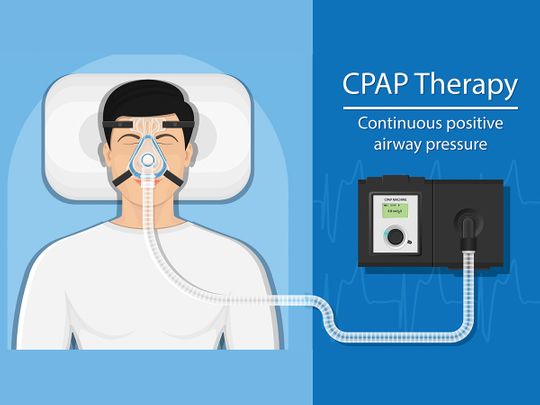


20220221 cpap machine
A CPAP machine must be used only when all other efforts fail.Image Credit: Shutterstock

Dubai: It’s been 10 years since Dubai-based Indian expat Irwinder Singh Bajaj, head of finance at a leading international luxury brand, was diagnosed with sleep apnea.

Recalling his ordeal, Bajaj told Gulf News: “Prior to my diagnosis, I had no idea why I would get up so tired and drowsy. I had begun napping through meetings and was dozing off at traffic signals. My snoring was loud at night and my wife asked to get this checked.” 

Play

Loaded: 25.89%Unmute

Remaining Time -2:00

partner logo

X

20220221 Irwinder Singh Bajaj
Irwinder Singh Bajaj used to wake up feeling tired; he had no idea he was suffering from sleep apnea.Image Credit: Supplied

Bajaj underwent a compete sleep evaluation test and was surprised with his diagnosis. “My doctor diagnosed my case as that of severe sleep apnea, so much so that my sleep pattern tests revealed I was breathless every 15 seconds in a minute during my sleep. That added up to having a disrupted sleep for nearly three to four hours of my total sleep time. No wonder I felt the way I did.”

Bajaj was advised to use a Continuous Positive Airway Pressure (CPAP) machine during sleep. The machine maintains a continuous flow of oxygenated air in the airways keeping them open and thereby allowing the user to have a restful, uninterrupted sleep.

‘I wake up fresh now’

His problem was completely resolved ever since he started using the machine. “I do not feel drowsy first thing in the morning that I usually felt earlier. Now, I am completely fresh and awake when I get up. My efficiency has improved, my energy levels are great and resolving my sleep apnea issues has done wonders for my life,” Bajaj said.

Bajaj is not a solitary case as it is estimated that nearly a 100 million people worldwide are diagnosed with this seeimingly simple disease with dangerous consequences. Recently, leading Bollywood music director Bappi Lahiri’s death was attributed to complications arising out of obstructive sleep apnoea.

However, the worrying factor about sleep apnoea is that it remains undiagnosed for long.

shutterstock_695736313-1645446114920
Sleep apnoea mostly affects menImage Credit: Shutterstock

What is sleep apnea and how is it diagnosed?

If you snore heavily in your sleep or wake up feeling tired, it is likely that you are suffering from ‘sleep apnea’. Apnoea refers to a temporary pause in breathing and in many cases this happens during sleep.

Dr Vijay Nair

Pulmonologist Dr Vijay Nair from Aster Clinics in Dubai explained: “Sleep apnea refers to the sudden stopping or disruption of breathing because the muscles in the upper respiratory tract, which begin from the nostrils to the pharynx, relax completely. This results in the constriction of the airway passage, cutting off oxygen supply to the brain.”

Dr Nair said people with sleep apnea are advised to get a complete Ear Nose Throat evaluation. This helps to see if there are any physical obstructions triggering the condition, such as tonsils, adenoids, polyps, etc. Then the patient undergoes a sleep pattern test where the sleeping pattern is scrutinised; the heartbeat, blood pressure, blood oxygen saturation, etc., are measured while the patient sleeps.

“The scores provide a very clear feedback on whether a patient suffers oxygen deprivation. This is calculated on the Epworth scoring table. Even normal people without apnoea suffer from breath obstruction for up to five seconds. The result is evaluated on a measuring scale called Epworth or Stop-Bang. The scores on this indicate the extent of the deterioration of sleep apnoea. A score of up to 10 is considered within normal range and anything above that is diagnosed as sleep apnoea,” Dr Nair said.

“I have many cases of sleep apnoea referred to me and these range from cessation of breathing for anything from 10 seconds, which is mild, to the most severe kind up to 45 seconds.”

Who is at risk?

Morbid obesity is most prominently linked to sleep apnea and it mostly occurs in older males. Dr Dhirender Singh, consultant interventional cardiologist at NMC Hospital, Al Nahda, Dubai, explained why the brain goes into overdrive, triggering anything from high blood pressure to heart failure.

Dr Dhirender Singh

“When there are disruptions in breathing, the brain is deprived of oxygen and that triggers a response from the symptomatic nervous system to cope with the emergency. The catecholamine hormones are released into the blood. The blood pressure rises, there is an increase in the level of stress hormones such as adrenalin and cortisol, the heart starts beating faster and it is likely to suffer from atrial fibrillation, irregular rhythms or arrhythmias. This can trigger a stroke or sudden heart failure. Therefore, it is essential that apnoea is diagnosed and there is appropriate medical intervention,” Dr Singh said.

Three types of sleep apnea

Dr Nair said: “Apnea is of three types – obstructive sleep apnea, centralised sleep apnea or a combination of both. In a majority of cases, it is obstructive apnoea which means the patient has some kind of physical obstruction it the upper airways. When little kids get apnoea, it is due to a growth in their adenoids or tonsils.

“In case of older people, smoking could be one of the main reasons constricting the airway passage or causing nasal and chest congestion, leading to physical obstructions.

“In case of obese people, presence of fatty deposits could constrict the upper airway muscles and constrict the passage. These muscles completely relax and stick to each other in that position depriving the individual from carrying out the normal function of respiration – inspiration and expiration. This results in the patients trying to put an effort their breathing and the entire upper respiratory airway vibrates due to the effort which we hear as snoring.”

Causing complications

Both Dr Singh and Dr Nair agreed that unchecked apnoea could lead to serious health consequences. Low oxygen in the blood also triggers inflammatory response in the body which can lead to insulin resistance and affect the insulin absorption in the blood resulting in Type II diabetes. People with sleep apnoea are at high risk of developing hypertension, heart disease, stroke and many other complications and need to consult their doctor for a proper treatment that might involve a complete health and lifestyle change. 


ALSO READ

Is sleep apnea reversible?

While Bajaj’s sleep apnoea problem was resolved with a CPAP machine that he uses every night to sleep well, not all patients might need this. Dr Nair said a CPAP machine must be used only when all other efforts fail. “A majority of patients who come to my clinic for sleep apnoea treatment are able to manage or reverse it with lifestyle changes,” he added.

Dr Nair mentioned a patient whose weight dropped from 190kg to 96kg in a year. “A severe sleep apnoea patient, his condition was completely reversed when we conducted his test a year later.”

People who diet and exercise and are able to reduce the fat percentage in their body experience relief and reversal. Reduction of fat allows their respiratory tract to function normally and helps reverse apnoea, explained Dr Nair.

Orthodontists have created special jaw devices to push the jaw in an angle, wherein the upper respiratory tract is not restricted, thereby allowing free flow of air. There is plenty of research underway to understand the reasons for apnoea and look for new cures.

https://insideevs.com/news/569208/2022-vw-id4-epa-ratings/

2022 VW ID.4 EPA Numbers Are Out, Base Model Gets 280-Mile Range

All 2022 ID.4 trims see range increases and improved MPGe ratings.

2021 Volkswagen ID.4 AWD exterior dynamic

Feb 22, 2022 at 10:28am ET

57

By: Dan Mihalascu

Volkswagen has announced EPA-estimated range figures for the 2022 ID.4 electric SUV, and all trims offer more miles per charge than before. 

Leading the pack is the rear-wheel-drive ID.4 Pro, which has an EPA-estimated range of 280 miles, an increase of 20 miles from the corresponding 2021 model. The 2022 VW ID.4 Pro S rear-wheel-drive model’s EPA-estimated range is 268 miles, up 18 miles over the 2021 ID.4 Pro S.

All-wheel-drive VW ID.4 models also see range improvements for the 2022 model year, with the AWD Pro now rated at an EPA-estimated 251 miles of range—an improvement of 2 miles over 2021MY—and the AWD Pro S at 245 miles (+5 miles).

Looking at the efficiency figures, it’s pretty clear that’s where the range increases come from, as all 2021 ID.4 trims are more efficient than before.

49 Photos

2021 Volkswagen ID.4 AWD exterior

For the ID.4 Pro RWD, the EPA-estimated fuel economy is now 121 MPGe city, 102 MPGe highway, and 112 MPGe combined; the 2021 model was rated at 107/91/99 MPGe (city/highway/combined). The ID.4 Pro S RWD is now rated at 115 MPGe city, 97 MPGe highway, and 106 MPGe combined, exceeding the 2021 model’s 104/89/97 MPGe (city/highway/combined) ratings.

The same goes with the AWD models, with the EPA-estimated fuel economy for the 2022 ID.4 Pro AWD being 106 MPGe city, 96 MPGe highway, and 101 MPGe combined, compared to 102/90/97 MPGe (city/highway/combined) for the 2021 ID.4 Pro AWD. Finally, the 2022 ID.4 Pro S AWD is rated at 100 MPGe city, 90 MPGe highway, and 95 MPGe combined, while the 2021 model returns 98/88/93 MPGe (city/highway/combined).

We’ve asked VW of America whether increased efficiency is the cause for the range increases or a switch to the EPA 5-cycle test (or both). We’ll update this story when we get a reply.VW ID.4 for fast charging without charging curve

Another improvement for 2022 regards the DC fast-charging speed, which increases from 125 kW to 135 kW. This will shorten charging times accordingly, although VW did not provide numbers. The automaker also mentions the addition of the Plug and Charge feature (later availability) to help simplify the charging experience at Electrify America.

Speaking of Electrify America, the 2022 ID.4 comes with three years of unlimited 30-minute charging sessions at the network’s DC fast chargers at no additional cost. VW customers will be able to manage their charging plan through the Electrify America app.

As before, all VW ID.4 models come with a 82 kWh (gross) battery along with a permanent-magnet synchronous motor in the rear, offering 201 horsepower and 229 pound-feet of torque. The ID.4 AWD adds an asynchronous electric motor on the front axle rated at 107 horsepower and 119 pound-feet of torque. The combined maximum output is 295 horsepower and 339 lb-ft of torque.

Read more VW ID.4 stories

 US: 2022 Volkswagen ID.4 Is Coming With A Few Changes

 VW ID.4 Getting Plug & Charge, Bidirectional Charging This Summer

Source: Volkswagen of America

https://www.discovermagazine.com/technology/ai-machines-have-beaten-moores-law-over-the-last-decade-say-computer

AI Machines Have Beaten Moore’s Law Over The Last Decade, Say Computer Scientists

Computational performance has followed Moore’s Law since the dawn of the computer age. Not any more.

The Physics arXiv Blog iconThe Physics arXiv BlogBy The Physics arXiv BlogFeb 21, 2022 2:00 PM

ai

Credit:(whitehoune/shutterstock)

Newsletter

Sign up for our email newsletter for the latest science newsSIGN UP

Since the 1990s, computer scientists have measured the performance of the world’s most powerful supercomputers using benchmarking tasks. Each month, they publish a ranking of the top 500 machines with fierce competition among nations to come out on top. The history of this ranking shows that over time, supercomputing performance has increased in line with Moore’s Law, doubling roughly every 14 months.

But no equivalent ranking exists for AI systems despite deep learning techniques having led to a step change in computational performance. These machines have become capable of matching or beating humans at tasks such as object recognition, the ancient Chinese game of Go, many video games and a wide variety of pattern recognition tasks.

For computer scientists, that raises the question of how to measure the performance of these AI systems, how to study the rate of improvement and whether these improvements have followed Moore’s Law or outperformed it.

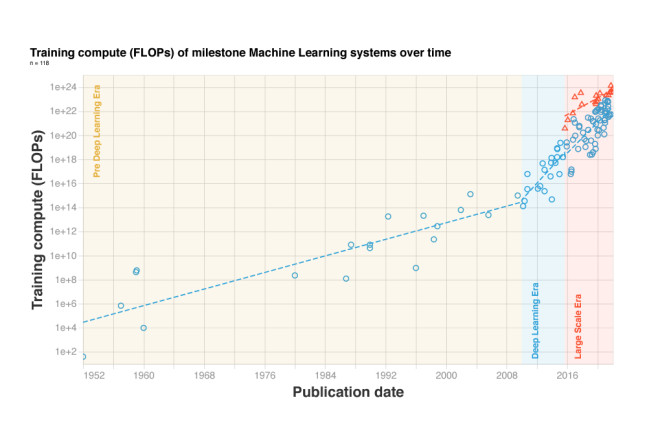
Now we get an answer thanks to the work of Jaime Sevilla at the University of Aberdeen in the UK and colleagues who have measured the way computational power in AI systems has increased since 1959. This team say the performance of AI systems during the last ten years has doubled every six months or so, significantly outperforming Moore’s Law.

How AI performance has changed since 1959 (source: arxiv.org/abs/2202.05924)

This improvement has come about because of the convergence of three factors. The first is the development of new algorithmic techniques, largely based on deep learning and neural networks. The second is the availability of large datasets for training these machines. The final factor is increased computational power.

While the influences of new datasets and the performance of improved algorithms are hard to measure and rank, computational power is relatively easy to determine. And that has pointed Sevilla and others towards a way to measure the performance of AI systems.

Their approach is to measure the amount of computational power required to train an AI system. Sevilla and colleagues have done this for 123 milestone achievements by AI systems throughout the history of computing.

They say that between 1959 and 2010, the amount of computational power used to train AI systems doubled every 17 to 29 months. They call this time the pre-Deep Learning Era. “The trend in the pre-Deep Learning Era roughly matches Moore’s law,” conclude Sevilla and co.

The team say that the modern era of deep learning is often thought to have started in 2012 with the creation of an object recognition system called AlexNet. However, Sevilla and co say that their data suggests that the sharp improvement in AI performance probably began a little earlier in 2010.

This, they say, marked the beginning of the Deep Learning Era and progress since then has been rapid. Between 2010 and 2022, the rate of improvement has been much higher. “Subsequently, the overall trend speeds up and doubles every 4 to 9 months,” they say.

That significantly outperforms Moore’s Law. But how this has been achieved, given that the improvement in chips themselves has followed Moore’s Law?

Parallel Processing

The answer comes partly from a trend for AI systems to use graphical processing units (GPUs) rather than central processing units. This allows them to calculate more effectively in parallel.

These processors can also be wired together on a large scale. So another factor that has allowed AI systems to outperform Moore’s Law is the creation of ever larger machines relying on greater numbers of GPUs.

This trend has led to the development of machines, such as the AlphaGo and AlphaFold machines that have cracked Go and protein folding respectively. “These large-scale models were trained by large corporations, whose larger training budgets presumably enabled them to break the previous trend,” say Sevilla and co.

The team say the development of large-scale machines since 2015 has become a trend by itself — the Large-Scale Era — running in parallel to the Deep Learning Era.

That’s interesting work that reveals the huge investment in AI and its success in the last decade or so. Sevilla and co are not the only group to be studying AI performance in this way and indeed various groups differ in some of their measured rates of improvement.

However, the common approach suggests that it ought to be possible to measure AI performance on an ongoing basis, perhaps in a way that produces a ranking of the world’s most powerful machines, much like the TOP500 ranking of supercomputers.

The race to build the most powerful AI machines has already begun. Last month, Facebook owner, Meta, announced that it had built the world’s most powerful supercomputer devoted to AI. Just where it sits according to Sevilla and co’s measure isn’t clear but it surely won’t be long before a competitor challenges that position. Perhaps it’s time computer scientists put their heads together to collaborate on a ranking system that will help keep the record straight.

https://newatlas.com/medical/sound-waves-stem-cells-bone/


Sound waves convert stem cells into bone in regenerative breakthrough

By Michael Irving

February 21, 2022

https://newatlas.gystaudio.com/embedded/newatlas.com/medical/sound-waves-stem-cells-bone/

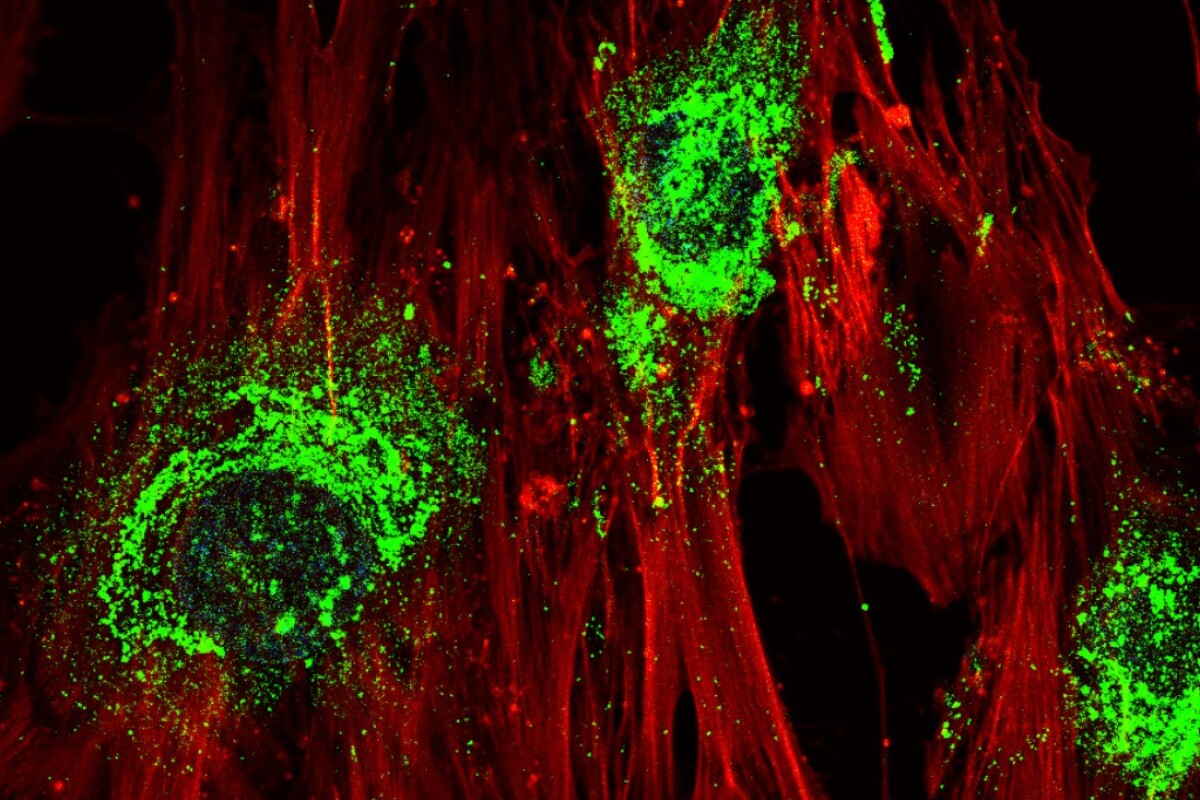
A microscope image of stem cells turning into bone cells – green indicates collagen, which the cells produce as a by-product of the process

A microscope image of stem cells turning into bone cells – green indicates collagen, which the cells produce as a by-product of the process

RMIT

VIEW 3 IMAGES

Regrowing or replacing bone lost to disease is tricky and often painful. In a new study Australian researchers have found a relatively simple way to induce stem cells to turn into bone cells quickly and efficiently, using high-frequency sound waves.

Stem cells have enormous medical potential in helping to regenerate various tissues in the body, but bone has proven particularly hard to work with. Bone originates from what are known as mesenchymal stem cells (MSCs), which mostly reside in the bone marrow. Collecting these is a painful procedure, then converting them into bone cells is difficult to scale up to useful levels.


MORE STORIES

A test subject wears both the device and traditional sensors while sleeping at the Kempenhaeghe Epilepsy and Sleep Center

MEDICAL

Wrist-worn device used to more easily assess sleep apnea

Shown here on an eyeglass lens, the thin film could also be applied to camera lenses

MATERIALS

High-tech lens treatment could render glasses permanently fog-free


But researchers from RMIT have now found a faster and simpler way to induce MSCs to turn into bone cells. Previous studies have suggested that the vibrations from sound waves can induce cell differentiation, but it typically took over a week with mixed results. These experiments have been limited to low frequencies, and it was thought that higher frequencies would have little benefit. So for the new study, the RMIT team investigated these higher frequencies.

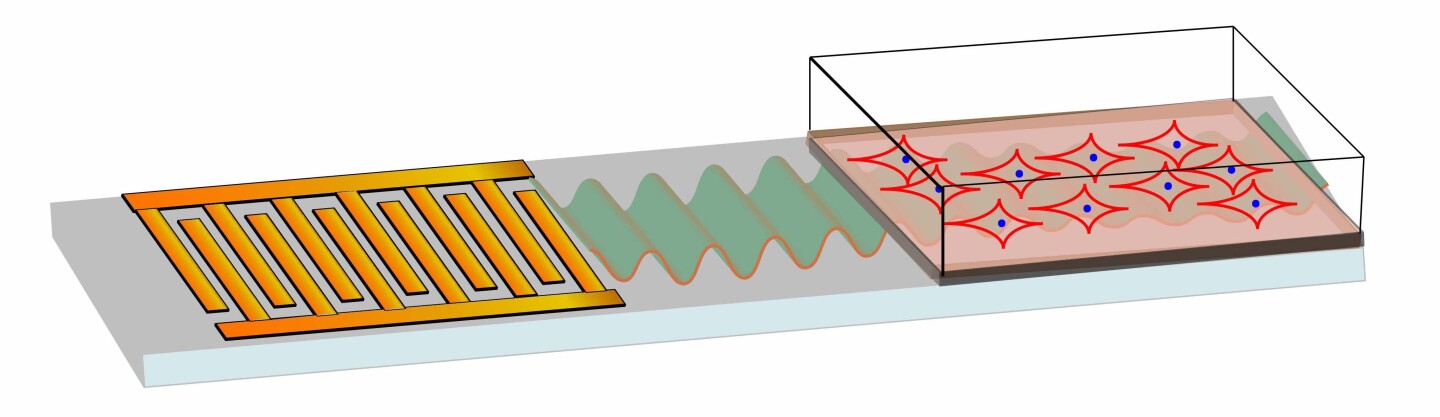
The team used a microchip that produced sound waves in the MHz range, and directed it at MSCs in silicon oil on a culture plate. They found the optimal setup was to expose these cells to 10-MHz signals for 10 minutes a day for five days, which boosted the levels of certain markers that indicated they were converting into bone cells.

A diagram illustrating how the microchip (left) produces sound waves to induce the stem cells in culture (right) to begin differentiating into bone

“We can use the sound waves to apply just the right amount of pressure in the right places to the stem cells, to trigger the change process,” said Leslie Yeo, co-lead researcher on the study. “Our device is cheap and simple to use, so could easily be upscaled for treating large numbers of cells simultaneously – vital for effective tissue engineering.”

Once the stem cells have begun to differentiate into bone, they can be injected into the body at the site of an injury or disease, or coated onto an implant, ready to grow new bone. The team says this process removes the need for drugs that coax stem cells down this path, and makes the whole thing much faster and more efficient. Importantly, the MSCs can be obtained from other parts of the patient’s body, such as fat tissue, which is less invasive than from bone marrow.

The team plans to continue investigating how to scale up the platform for practical use.

The research was published in the journal Small.

Source: RMIT

We recommend

  1. CircRNA_014511 affects the radiosensitivity of bone marrow mesenchymal stem cells by binding to miR-29b-2-5pYanjie Wang et al., BJBMS, 2019
  2. Honeycomb-Like Hydrogel Microspheres for 3D Bulk Construction of Tumor ModelsJiachen He et al., Research, 2022
  3. Conformally Mapped Multifunctional Acoustic Metamaterial Lens for Spectral Sound Guiding and Talbot EffectHe Gao et al., Research, 2019
  1. Application of stem cells in peripheral nerve regenerationSheng Yi et al., Burns & Trauma, 2020
  2. Therapeutic effect of autologous compact bone-derived mesenchymal stem cell transplantation on prion diseaseZhifu Shan et al., J Gen Virol, 2017
  3. Mesenchymal stem cells from bone marrow regulate invasion and drug resistance of multiple myeloma cells by secreting chemokine CXCL13Guihua Zhang et al., BJBMS, 2019

https://fortune.com/2022/02/22/elon-musk-neuralink-brain-implant-claims/


Elon Musk claims Neuralink’s brain implants will ‘save’ memories like photos and help paraplegics walk again. Here’s a reality check

BY 

JEREMY KAHN

JONATHAN VANIAN

, AND 

MAHNOOR KHAN

February 22, 2022 9:37 AM PST

https://fortune.com/videos/embed/6c9972dc-efb2-49a2-8000-1e3a8b34a91f?autoplay=true&adTagUrl=pubads.g.doubleclick.net%2Fgampad%2Fads%3Fiu%3D%2F21809533738%2Ffortune%2Ftech%26description_url%3Dhttps%253A%252F%252Ffortune.com%252F2022%252F02%252F22%252Felon-musk-neuralink-brain-implant-claims%252F%26env%3Dvp%26impl%3Ds%26correlator%3D%26tfcd%3D0%26npa%3D0%26gdfp_req%3D1%26output%3Dvast%26sz%3D640x360%26ciu_szs%3D300x250%2C728x90%26unviewed_position_start%3D1%26cust_params%3Dcid%3D3223462%2526topics%3D%2526tags%3DElon%2520Musk%252CNeuralink%2526ctype%3Darticle%2526premiumCategory%3DF-BreakingNews%2526host%3Dfortune.com

Never miss a story: Follow your favorite topics and authors to get a personalized email with the journalism that matters most to you.

Elon Musk has a knack for accomplishing feats that others consider improbable. From blasting rockets into space to becoming the king of the EV industry, Elon is determined to make history.

PAID CONTENT

5 ways to build trust at your company—and why it matters

FROM PWC

His latest passion project is Neuralink—a company that is developing a brain implant that will link the human brain directly to computers. He claims the brain-computer interface will enable humans to carry out actions through thought alone. One of Musk’s first goals: helping paraplegics regain their independence.

But it doesn’t stop there. The company’s technology, Musk hopes, will one day not only treat but cure brain disorders and even save memories so people can revisit them like photo albums.

Helping paraplegics walk and curing brain disorders are certainly noble goals. And, hey, ordering a pizza just by thinking about it sounds cool. But many experts are concerned that Musk is seriously overhyping what Neuralink’s implants will be able to accomplish.

https://cca838d0b0b9a7ff9e8fe849963607fb.safeframe.googlesyndication.com/safeframe/1-0-38/html/container.html

“Unlike Tesla or SpaceX, we are not talking about technological problems or infrastructure problems. These are fundamental science problems,” Christof Koch, a researcher at the Allen Institute for Brain Science, told Fortune in a recent magazine feature.

Here, Fortune tackles Musk’s biggest claims about what Neuralink’s brain implant can do:

“Even in a benign AI scenario, we will be left behind. But with a brain-machine interface, we can actually go along for the ride,” says Musk.

First off, the kind of superintelligence Musk is afraid of remains science fiction, with computer scientists divided on when, and even whether, it will ever arrive. Many think it is at least a few decades off. Secondly, Musk envisions his brain-computer interface as a two-way communication mechanism, so even if Neuralink succeeds in delivering on Musk’s grand vision, its brain implants could just as easily be used by superintelligent machines to control humans as they could be a means for humans to ensure their dominance over superintelligent machines. And either way, the technological advances necessary to enable that kind of high-bandwidth brain-computer mind-meld are also years, if not decades, away.

2. The BCI will restore mobility for people with spinal-cord mobility

In April 2020, a team of researchers reported that they successfully restored sensation to the hand of a research participant with a severe spinal cord injury using a BCI system. We think that Musk’s claim of restoring mobility with BCI is well within reach. But questions remain about how much functionality such systems will be able to produce and how easy it will be for patients to learn to use them. Questions also remain about the longer-term safety of having implants in the human brain.

3. BCI will treat neurological conditions like Parkinson’s

There is current technology like deep brain stimulation that can already do some of this. Neuralink could potentially further advance on these treatments. But the current configuration of the Neuralink device, which has electrodes implanted close to the surface of the outer layer of the brain, known as the cortex, is not set up to conduct deep brain stimulation.

4. The bran chip will give superhuman abilities to able-bodied people

While it might be able to allow able-bodied people to type or play a video game through thought alone, scientists still don’t know how to interpret brain activity associated with more complex, conceptual thoughts. What’s more, it’s not clear medical regulators will allow able-bodied individuals to have brain implants installed, as the risks of the implants and the surgery to implant them might be hard to justify.

5. They will be able to insert the brain chip in less than an hour without general anesthesia

Each of the 64 threads that carry electrodes for monitoring brain activity is much thinner than even the finest human hair. These electrodes feed into the Link device itself, which is about the diameter of a quarter and about five times as thick and sits in a hole drilled in the skull. The brain itself has no pain receptors and brain surgery is already often carried out under local anesthetic. So, it is possible Neuralink will be able to deliver on this promise. However, the surgical robot it plans to use to implant its BCIs has not yet been proven in clinical testing and there could certainly be risks associated with drilling into the skull and bleeding during the electrode implantation.

https://phys.org/news/2022-02-technique-wearable-sensors-faster-costly.html


FEBRUARY 15, 2022

New technique for making wearable sensors allows faster and less costly prototyping of designs

by Alan S. Brown, University of California – Berkeley

Slicing the way to wearable medical sensors
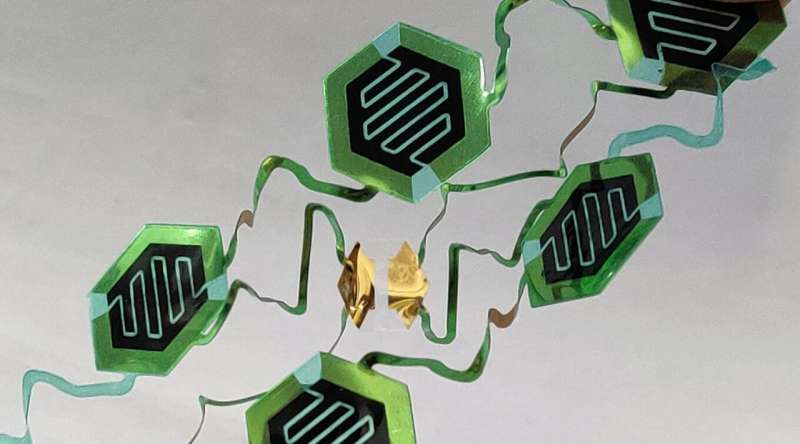
A supercapacitor array made using a new fabrication technique that is faster and less expensive than photolithography. Credit: Peisheng He/UC Berkeley

Engineers at UC Berkeley have developed a new technique for making wearable sensors that enables medical researchers to prototype test new designs much faster and at a far lower cost than existing methods.

The new technique replaces photolithography—a multistep process used to make computer chips in clean rooms—with a $200 vinyl cutter. The novel approach slashes the time to make small batches of sensors by nearly 90% while cutting costs by almost 75%, said Renxiao Xu (Ph.D.’20 ME), who developed the technique while pursuing his Ph.D. in mechanical engineering at Berkeley.

“Most researchers working on medical devices have no background in photolithography,” Xu said. “Our method makes it easy and inexpensive for them to change their sensor design on a computer and then send the file to the vinyl cutter to make.”

A description of the technique was published Jan. 25 in ACS Nano. Xu, who now works at Apple, and Liwei Lin, professor of mechanical engineering and co-director of the Berkeley Sensor and Actuator Center, were the lead researchers.

Wearable sensors are often used by researchers to gather medical data from patients over extended periods of time. They range from adhesive bandages on skin to stretchable implants on organs, and harness sophisticated sensors to monitor health or diagnose illnesses.

These devices consist of flat wires, called interconnects, as well as sensors, power sources and antennas to communicate data to smartphone apps or other receivers. To maintain full functionality, they must stretch, flex and twist with the skin and organs they are mounted on—without generating strains that would compromise their circuitry.

To achieve low-strain flexibility, engineers use an “island-bridge” structure, Xu said. The islands house rigid electronics and sensor components, such as commercial resistors, capacitors and lab-synthesized components like carbon nanotubes. The bridges link the islands to one another. Their spiral and zigzag shapes stretch like springs to accommodate large deformations.

In the past, researchers have built these island-bridge systems using photolithography, a multistep process that uses light to create patterns on semiconductor wafers. Making wearable sensors this way requires a clean room and sophisticated equipment.

https://googleads.g.doubleclick.net/pagead/ads?client=ca-pub-0536483524803400&output=html&h=280&slotname=5350699939&adk=2265749427&adf=780081655&pi=t.ma~as.5350699939&w=750&fwrn=4&fwrnh=100&lmt=1645487202&rafmt=1&psa=1&format=750×280&url=https%3A%2F%2Fphys.org%2Fnews%2F2022-02-technique-wearable-sensors-faster-costly.html&flash=0&fwr=0&rpe=1&resp_fmts=3&wgl=1&uach=WyJtYWNPUyIsIjEwLjExLjYiLCJ4ODYiLCIiLCI5OC4wLjQ3NTguMTAyIixbXSxudWxsLG51bGwsIjY0IixbWyIgTm90IEE7QnJhbmQiLCI5OS4wLjAuMCJdLFsiQ2hyb21pdW0iLCI5OC4wLjQ3NTguMTAyIl0sWyJHb29nbGUgQ2hyb21lIiwiOTguMC40NzU4LjEwMiJdXV0.&dt=1645487201808&bpp=10&bdt=2183&idt=670&shv=r20220216&mjsv=m202202090102&ptt=9&saldr=aa&abxe=1&cookie=ID%3D6d20cec83a9677a1-22c493fe55c20058%3AT%3D1623616277%3AR%3AS%3DALNI_MYGjh5ycHtkxpZragWDgq9gSWG1KA&correlator=5697963650301&frm=20&pv=2&ga_vid=981691580.1517602527&ga_sid=1645487202&ga_hid=1792440504&ga_fc=1&u_tz=-480&u_his=1&u_h=1050&u_w=1680&u_ah=980&u_aw=1680&u_cd=24&u_sd=1&dmc=2&adx=334&ady=2312&biw=1677&bih=900&scr_x=0&scr_y=0&eid=42531397%2C44750773%2C31064857%2C21067496&oid=2&pvsid=4448730848992506&pem=46&tmod=1442310107&uas=0&nvt=1&ref=https%3A%2F%2Fnews.google.com%2F&eae=0&fc=896&brdim=1%2C23%2C1%2C23%2C1680%2C23%2C1677%2C980%2C1677%2C900&vis=1&rsz=%7C%7CpeEbr%7C&abl=CS&pfx=0&fu=128&bc=31&ifi=1&uci=a!1&btvi=1&fsb=1&xpc=gOK0I5dpmC&p=https%3A//phys.org&dtd=701

The new technique is simpler, faster and more economical, especially when making the one or two dozen samples that medical researchers typically need for testing.

Making sensors starts by attaching an adhesive sheet of polyethylene terephthalate (PET) to a Mylar (biaxially oriented PET) substrate. Other plastics would also work, Xu said.

Slicing the way to wearable medical sensors
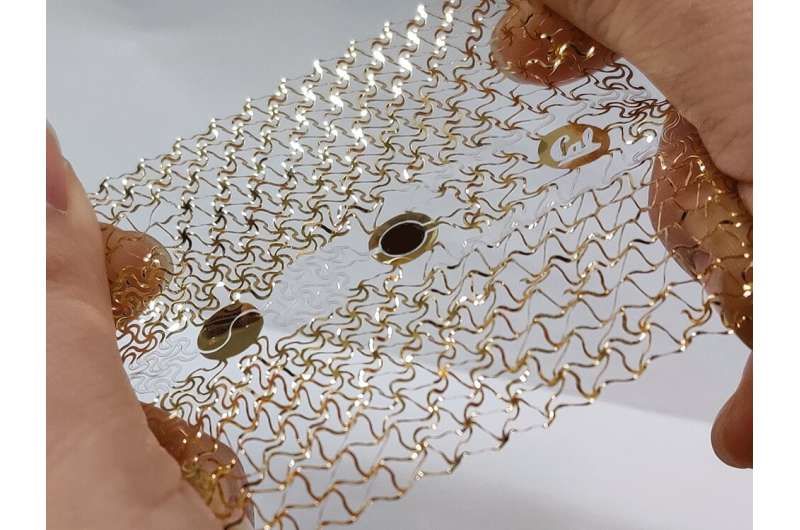
A stretchable “smart mesh” made from the two-mode cutting fabrication process. This device could be applied in skin-mounted sweat extraction and sensing. Credit: Peisheng He/UC Berkeley

A vinyl cutter then shapes them using two types of cuts. The first, the tunnel cut, slices through only the top PET layer but leaves the Mylar substrate untouched. The second type, the through cut, carves through both layers.

This is enough to produce island-bridge sensors. First, tunnel cuts are used in the upper adhesive PET layer to trace the path of the interconnects; then the cut PET segments are peeled off, leaving behind the pattern of interconnects on the exposed Mylar surface.

Next, the entire plastic sheet is coated with gold (another conductive metal could be used as well). The remaining top PET layer is peeled away, leaving a Mylar surface with well-defined interconnects, as well as exposed metal openings and contact pads on the islands.

Sensor elements are then attached to the contact pads. For electronic devices, such as resistors, a conductive paste and a common heat plate are used to secure the bond. Some lab-synthesized components, such as carbon nanotubes, can be applied directly to the pads without any heating.

Once this step is done, the vinyl cutter uses through cuts to carve the sensor’s contours, including spirals, zigzags and other features.

To demonstrate the technique, Xu and Lin developed a variety of stretchable elements and sensors. One mounts under the nose and measures human breath based on the tiny changes in temperatures it creates between the front and back of the sensor.

“For a breath sensor, you don’t want to something bulky,” Lin said. “You want something thin and flexible, almost like a tape beneath your nose, so you can fall asleep while it records a signal over a long period of time.”

Another prototype consists of an array of water-resistant supercapacitors, which store electrical power like a battery but release it more rapidly. Supercapacitors could provide power for some types of sensors.

“We could also make more complex sensors by adding capacitors or electrodes to make electrocardiogram measurements, or chip-sized accelerometers and gyroscopes to measure motion,” Xu said.

Size is sensor cutting’s one key limitation. Its smallest features are 200 to 300 micrometers wide, while photolithography can produce features that are tens of micrometers wide. But most wearable sensors do not require such fine features, Xu noted.

The researchers believe this technique could one day become a standard feature in every lab studying wearable sensors or new diseases. Prototypes could be designed using high-powered computer-aided design (CAD) software or simpler apps made especially for vinyl printers.


Explore further

Soft pressure sensor breakthrough solves field’s most challenging bottleneck


More information: Renxiao Xu et al, Facile Fabrication of Multilayer Stretchable Electronics via a Two-mode Mechanical Cutting Process, ACS Nano (2021). DOI: 10.1021/acsnano.1c10011

Journal information: ACS Nano 

Provided by University of California – Berkeley

https://venturebeat.com/2022/02/21/no-code-automation-platform-skael-raises-38m-to-streamline-enterprise-processes/

No-code automation platform Skael raises $38M to streamline enterprise processes

Kyle Wiggers@Kyle_L_Wiggers

February 21, 2022 5:00 AM

image of various software developers consulting a tablet

Image Credit: Maskot // Getty Images

Join today’s leading executives online at the Data Summit on March 9th. Register here.


No-code platforms, which let users create apps leveraging tools that don’t require programming knowledge, are gaining popularity in the enterprise as their value becomes apparent. According to a 2021 TechRepublic survey, 47% of employees said that they currently use low-code — a version of no-code that involves minimal programming — and no-code solutions in their organizations, with 20% saying that they intend to adopt technology in the next 12 months. Markets and Markets predicts that by 2030, the global low-code and no-code development platform market will hit $187 billion in revenue. And by 2024, it’ll account for more than 65% of application development activity, Gartner anticipates.

One of the promises of no-code is improved automation. Specifically, proponents point to its potential to support “hyperautomation,” a term coined by Gartner to describe the concept that companies use to identify, vet, and automate business processes. Automation Anywhere, a software automation vendor, estimates that 70% to 80% of a typical rules-based process could automate by a no-code or low-code platform.Unmute

Duration 0:45

/

Current Time 0:04Advanced SettingsFullscreenPauseUp Next

A relatively new company, Skael, offers a no-code platform focused on this type of automation. After launching in 2016, San Francisco, California-based Skael’s customer base expanded to teams at brands including Google, Asurion, and the San Diego Housing commission. Reflecting the growth — and investors’ general enthusiasm — Skael today announced that it raised $38 million in a series A financing round led by RTP Global with participation from Bonfire Ventures and Dell Technologies Capital, bringing the company’s total to $42 million.

Automating processes

Skael is the brainchild of Baba Nadimpalli, who previously founded financial software developer MAK Software Solutions and network tech consultancy CommCube. The goal was to create a platform that uses technologies spanning natural language processing, natural language understanding, and machine learning to automate tasks, dynamically interpreting data without deep human involvement.

ADVERTISEMENT

“Automation is the fastest-growing enterprise technology segment, and its demand is only increasing due to a combination of macroeconomic factors,” Nadimpalli told VentureBeat via email. “It’s typical to measure return on investment in years, requiring very specific technical resources — both software and people — to design, develop, deploy, manage, and train end-to-end automation strategies … [But] implemented well, automation serves the enterprise purpose of business continuance [and unlocking growth.]”

In practice, Skael offers automation tools designed to tackle particular tasks, like refreshing and moving deals through customer relationship management software. One of Skael’s tools, for example, automates HR onboarding, offboarding, and employee assessments by updating popular HR applications. Another learns from existing IT service tickets and knowledge bases to help users order equipment and access new software.

The Skael process automation platform.

ADVERTISEMENT

Beyond this, Skael claims its platform can process PDFs and text-based documents such as contracts, training materials, and HR policies to search for answers to, “open domain” questions through “cognitive search.” Cognitive search — a technology that’s gained increased attention recently, prompting tech giants including Microsoft, Amazon, and Google to invest in its development — uses AI to ingest, understand, organize, and query digital content from multiple data sources at once.

“Modern-day work for the vast majority of the world is a copy-and-paste of the industrial revolution, burning employees out in jobs that have very little need for human intelligence, ingenuity, or creativity,” Nadimpalli told VentureBeat via email. “Instead of wrapping people around process and then around technology, it should be the other way around, with technology wrapped around people — [and] with process as the middle layer … Skael’s platform [pushes] out the design, development and deployment of digital employees to non-technical users, [resulting] in more engaged human employees and customers [whose] time is now spent on more purposeful and engaging work.”

Challenges in automation

The future of hyperautomation platforms like 75-employee Skael’s looks bright when considering the growing appetite for automation solutions. According to a 2022 survey commissioned by UiPath, an automation vendor and Automation Anywhere rival, 78% of companies say that they’re likely to invest or increase their investments in automation. A 2020 Zappier poll shows that about 40% of employees believe automation saves their business money.

ADVERTISEMENT

But companies looking to embrace no-code automation face challenges on the road to deployment. A 2019 Appian survey found less than half of organizations have deployed intelligent automation — despite seeing the value in it. The top reasons they cited were struggling to adapt with the technology, failing to understand how AI would change anything, difficulty integrating automation with existing IT deployments, and the need to change IT culture and app development practices.

“Organizations in every region and industry are automating at least some business processes, yet only a slight majority have succeeded at meeting their targets,” McKinsey analysts wrote in a 2018 report. “[Specific] practices best support a successful automation effort: making automation a strategic priority, deploying technologies systematically, decentralizing governance, ensuring the IT functions’ involvement, internalizing automation’s costs and benefits, and prioritizing workforce management.”

ADVERTISEMENT

Still, Nadimpalli asserts that Skael’s platform can affect change even in legacy organizations that haven’t undertaken any digital transformation efforts. That’s despite competition from startups like workflow automation platform Conexiom, enterprise process automation company Redwood Software, and IT service desk automation startup Swish.ai, which collectively have raised hundreds of millions in venture capital to date.

“[We had] $7 million in annual recurring revenue in fiscal year 2021 and plan to grow over 240% in 2022,” Nadimpalli said. “The pandemic has driven unprecedented levels of introspection in human history, causing the so-called ‘great resignation’ on a global level. Suddenly, investments that raise employee satisfaction and engagement have a directly measurable return on investment, especially if they can be deployed in weeks versus months — [like Skael.]”

https://phys.org/news/2022-02-black-widow-millisecond-pulsar.html

FEBRUARY 17, 2022 REPORT

New ‘black widow’ millisecond pulsar discovered

by Tomasz Nowakowski , Phys.org

New ‘black widow’ millisecond pulsar discovered
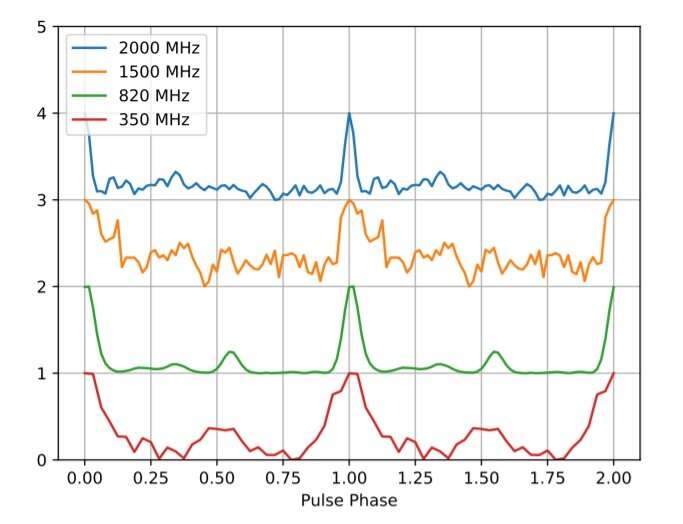
Multi-band radio pulse profiles of PSR J1555−2908. Credit: Ray et al., 2022.

An international team of astronomers reports the detection of a new millisecond pulsar (MSP) using the Green Bank Telescope (GBT). The newfound pulsar, designated PSR J1555−2908, turns out to be one of the so-called “black widow” MSPs. The finding is detailed in a paper published February 10 on arXiv.org.

The most rapidly rotating pulsars, those with rotation periods below 30 milliseconds, are known as MSPs. Researchers assume that they are formed in binary systems when the initially more massive component turns into a neutron star that is then spun up due to accretion of matter from the secondary star.

A class of extreme binary pulsars with semi-degenerate companion stars is dubbed “spider pulsars.” These objects are further categorized as “black widows” if the companion has extremely low mass (less than 0.1 solar masses), while they are called “redbacks” if the secondary star is heavier.

PSR J1555−2908 was initially identified as a gamma-ray point source by NASA’s Fermi spacecraft. Given that a large number of point sources in the GeV gamma-ray sky are known to be powered by pulsars, PSR J1555−2908 was perceived as a promising target to search for pulsations. Therefore, a team of astronomers led by Paul S. Ray of the U.S. Naval Research Laboratory in Washington, DC, has investigated this source with GBT, which resulted in the detection of radio pulsations.

“This fast and energetic millisecond pulsar was first detected as a gamma-ray point source in Fermi Large Area Telescope (LAT) sky survey observations. Guided by a steep spectrum radio point source in the Fermi error region, we performed a search at 820 MHz with the Green Bank Telescope that first discovered the pulsations,” the researchers explained.

GBT observations identified radio pulsations of PSR J1555−2908 with a 1.79 ms period. Afterward a 5-minute GBT observation at S-band confirmed the discovery and determined the pulse width at 559.4 Hz to be very narrow—about 3%. By analyzing the Fermi data, gamma-ray pulsations have been also detected from this source.

According to the study, PSR J1555−2908 is an interacting binary system with an orbital period of approximately 0.23 days. The neutron star’s mass is estimated to be some 1.4 solar masses, while the minimum mass of the companion star was calculated to be about 0.052 solar masses. These results indicate the “black widow” class of this MSP.

PSR J1555−2908 has a relatively high spin-down power—at a level of 310 decillion erg/s. Such a high value makes it a good candidate to search for X-ray pulsations, as other MSPs with comparable spin-down power are known to exhibit bright non-thermal pulsations. However, the team analyzed the available data from the Neutron Star Interior Composition ExploreR (NICER) but, so far, has not found any significant X-ray pulsations from this pulsar. This may change as the researchers continue their monitoring of PSR J1555−2908 using ground-based facilities.


Explore further

Radio pulsations detected from the gamma-ray millisecond pulsar PSR J2039−5617


More information: Discovery, Timing, and Multiwavelength Observations of the Black Widow Millisecond Pulsar PSR J1555−2908, arXiv:2202.04783 [astro-ph.HE] arxiv.org/abs/2202.04783

https://phys.org/news/2022-02-vortex-microscope.html


FEBRUARY 17, 2022

Vortex microscope sees more than ever before

by Brandie Jefferson, Washington University in St. Louis

Vortex microscope sees more than ever before
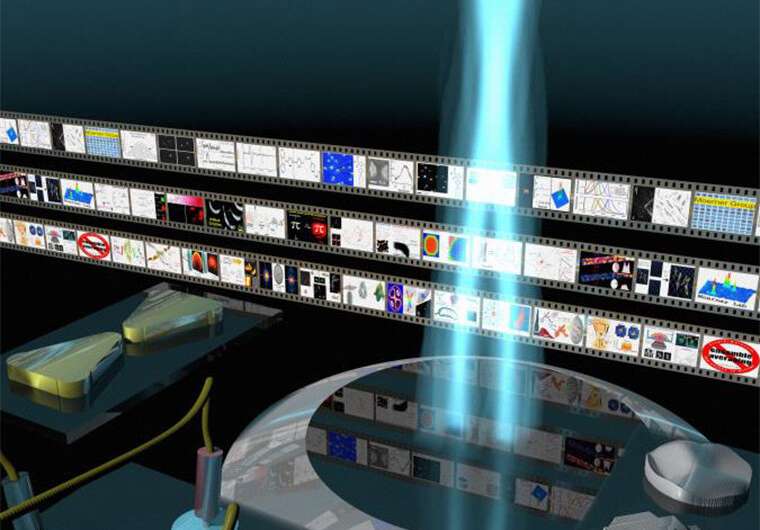
The vortex microscope offers a detailed look into how the surfaces of amyloid beta fibers interact with each other—how they bounce off each other or attach—and how their surfaces affect whether or not they begin to aggregate. Credit: Matthew Lew

Understanding the nitty gritty of how molecules interact with each other in the real, messy, dynamic environment of a living body is a challenge that must be overcome in order to understand a host of diseases, such as Alzheimer’s.

https://e85153067ba569bab95e6bebdd437c0b.safeframe.googlesyndication.com/safeframe/1-0-38/html/container.html

Until now, researchers could capture the motion of a single molecule, and they could capture its rotation—how it tumbles as it bumps into surrounding molecules—but only by compromising 3D resolution.

Now, the lab of Matthew Lew, assistant professor of electrical and systems engineering at the McKelvey School of Engineering at Washington University in St. Louis, has developed an imaging method that provides an unprecedented look at a molecule as it spins and rolls through liquid, providing the most comprehensive picture yet of molecular dynamics collected using optical microscopes.

The research was published in a special issue of the Journal of Physical Chemistry B. The Feb. 17, 2022, Festschrift is dedicated to Nobel laureate William E. (W.E.) Moerner, an imaging pioneer, Washington University alumnus and mentor to more than 100 students over the years, including Lew.

Moerner was the first person to observe optical signatures of a single molecule; previously, researchers weren’t sure it was even possible to measure such signals.

Now Lew’s lab is the first to be able to visualize the orientation and direction of a molecule’s rotational movement—how it spins and wobbles—while it’s in a liquid system.

The new imaging technology, called a vortex microscope, relies on a particular type of light: a polarized optical vortex.

“You can bend the light in a certain way so that the photons are spinning along their path,” Lew said. Instead of a straight “beam of light,” this optical vortex is shaped more like a corkscrew. It’s created by shining light through a helical-shaped lens, the top of which is uneven, sloping downward into a spiral.

The microscope also splits the light into two different directions of polarization, providing insight into the direction of the wobble of nano-sized light sources, the molecules in the sample.

For their experiments, Lew and first author Tianben Ding, then a postdoctoral researcher in Lew’s lab, looked at amyloid beta fibers. Clumps of these proteins, found in the brain, are associated with Alzheimer’s disease. The team added fluorescent tracer molecules to the fibers.

The tracers’ job was to probe the surfaces of the amyloid beta fibers. Each time a tracer bumped into a fiber, it emitted a light.

The light carried information about its interaction with the fiber. After it passed through the lens, that information was translated by an algorithm developed by Lew’s team.

An optical vortex is not a “point” of light, but it’s spread out in more of a donut shape. Based on the donut’s properties—is it stretched out along a certain axis, or darker in some places?—the algorithm can infer seven distinct properties of the tracer molecule, including its position and direction.

Light surprise

Lew said he and Ding were surprised when a computer simulation suggested an optical vortex might open up an opportunity to see motion and details at once.

“In our field, we’re always trying to think about concentrating the light because our light sources are so weak,” Lew said.

“It was surprising that spreading the light out into a donut shape would be useful at all.”

Because the team used a polarized optical vortex, they also can determine the direction of the wobble, a novel ability of the vortex microscope.

The ways in which the molecule interacts with the fiber can, in turn, help paint a picture of the fiber’s motion and topology.

Putting it all together, the vortex microscope offers a detailed look into how the surfaces of these amyloid beta fibers interact with each other—how they bounce off each other or attach—and how their surfaces affect whether or not they begin to aggregate.

“This is the first time we can measure these very detailed dynamics of how molecules move and rotate inside liquid systems,” Lew said.


Explore further

New study sheds light on molecular motion


More information: Tianben Ding et al, Single-Molecule Localization Microscopy of 3D Orientation and Anisotropic Wobble Using a Polarized Vortex Point Spread Function, The Journal of Physical Chemistry B (2021). DOI: 10.1021/acs.jpcb.1c08073

Journal information: Journal of Physical Chemistry B 

Provided by Washington University in St. Louis